
Malu Lambert: Are SA’s best red blends hiding in plain sight?
By Malu Lambert, 27 May 2026
-
Share:





3
Two tastings recently underscored the vast potential of South Africa’s more creative red blends. Those that fall outside the familiar Bordeaux model and its trusty trio, sometimes quintet, of grapes. In this unresolved category, syrah rubs shoulders with cabernet sauvignon, pinotage and cinsault, while so-called curiosities such as petite sirah, mourvèdre, tannat and carignan are used to colour in the lines.
The first of these was the annual Investec Trophy Wine Show’s Old Wines Tasting, the traditional precursor to the week of judging ahead. To qualify, whites must be at least 15 years old, reds 25 years, but plenty are much older. What emerged was not only the complexity and longevity of the unconventional red blends, but also a reminder that South Africa has historically produced wines that sit outside of blending conventions.
Wines such as Alto Rouge, Chateau Libertas and Rustenberg Dry Red have long embraced eclectic blending models, while Rust en Vrede built a reputation on combining cabernet sauvignon, merlot, and syrah. More recently, producers such as Hogan (Divergent) and Sijnn (Red) have emerged as compelling modern examples of cabernet used as the backbone to Rhône-forward blends.
We know that cabernet sauvignon and cinsault are committed bedfellows. In many mid-century varietal bottlings, the more lowly cinsault was never disclosed on the label, yet played an integral role in fleshing out the wines and, ironically, often contributing to their ageing potential. The Le Riche Vogelzang and Leeu Passant Dry Red being excellent examples of this enduring synergy.
Then there are South Africa’s uniquely idiosyncratic Cape Blends, built around the doctrine of a minimum 30% pinotage, while the remainder is left wide open to interpretation.
So this begs the question: with such a proven track record, why has the non-Bordeaux red category not emerged more clearly as a South African flag-bearer? Rather than looking primarily to Bordeaux blends – a style that perhaps no longer holds the same universal appeal it once did – why not lean further into wines that allow for less oak, greater drinkability and a wider scope for imagination, all without sacrificing complexity or longevity?
There appears to have been a slump sometime after those early bottlings. These non-classic blends became more hodgepodge than purposeful, often with the accusation that they were little more than leftovers tapped off from the bottom of tanks and barrels.
New life for unusual red blends arrived with South Africa’s fine wine revolution, spearheaded by producers such as Eben Sadie and the iconic Columella. The first vintage of Columella (2000) was entirely syrah, but Sadie soon began incorporating mourvèdre and grenache, later expanding the blend to include varieties such as carignan, cinsault, tinta barocca and even pinotage.
From afterthought to thoughtful
Then, the second tasting. Tulbagh feels apart from the rest of the winelands. Geographically, it’s an hour from the heart of the Boland. To get there, you navigate a mountain pass. It’s a trek.
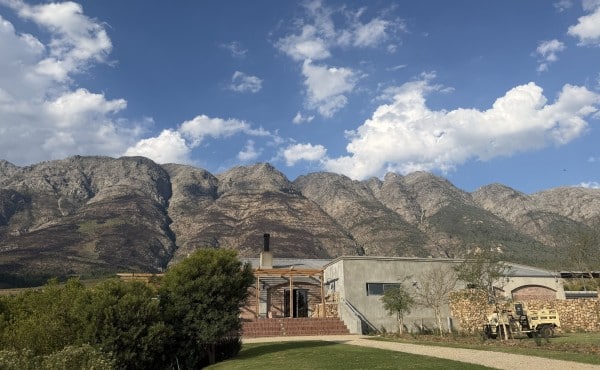
But once you arrive, prepare to be dazzled by some of the Cape’s most breathtaking scenery. The Obiekwaberge, Saronsberg and Witzenberg ranges hem the valley in on all sides. It feels cut off and, because of that, there is a growing sense of adventure among the producers working here.
One fine day, I made my way to the 180-hectare Drie Fonteine, now home to the once-roving label De Kleine Wijn Koöp. The austerity of the cold-blue Witzenberg seemed to pull endlessly away as we drove up the long dirt track. Sprawled across the slopes, between 400 and 500 metres above sea level, the vineyards grow in schist, shale and saprolite soils.
Drie Fonteine has lived several lives. Established in the early 2000s, the property has passed through numerous owners, including both American and British investors.
Under its earlier identities as Tulbagh Mountain Vineyards and later Fable Mountain Vineyards, the estate built a reputation for Rhône varieties. Its potential reflected in the calibre of winemakers drawn there over the years, including Andrea and Chris Mullineux, Callie Louw, Tremayne Smith and Francois Haasbroek.
It has always been an ambitious operation, even laying claim to South Africa’s first gravity-fed cellar. In its latest incarnation, De Kleine Wijn Koöp’s Wynand and Anya Grobler, together with their partners, have transformed the property, complete with five cottages, a tasting room and an ongoing chef residency by Michelin-starred Peter Gast.
The irrepressible whimsy of De Kleine Wijn Koöp is felt throughout, and, as Anya puts it, is “unapologetically Afrikaans”. Celebrated for its striking design, the label built a cult following through small-batch wines, inventive blends and standout old vine semillons such as Debutant and Road to Santiago.
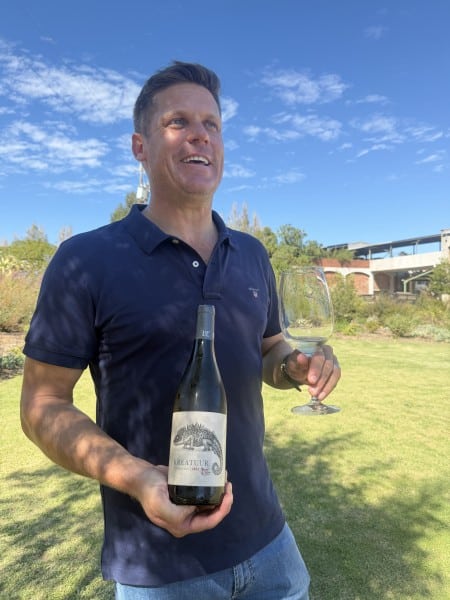
Wynand Groblert of De Kleine Wijn Koöp.
The stalwart of the portfolio has always been Kreatuur, first released as a red in 2013, a Swartland blend of syrah and grenache, followed by a white in 2014. Its label changes every vintage, featuring fantastical hybrid creatures stitched together from disparate parts.
“The design is meant to symbolise evolving variety compositions across changing sites and vintages, which gives us the freedom to be creative with it,” explains Wynand. “There must be red fruit, there must be spice, there must be something attractive about it,” he says. “But at the same time, the person who wants to cellar the wine must benefit too.” The aim he says, ultimately, is balance between accessibility and intrigue.
The flexibility, he believes, leads to more interesting wines. “There’s no expectation that it has to be some prescribed blend. That freedom opens the door for the wine to be better, rather than trying to force it into a specific category or style.”
Much of this same thinking informs their first estate release, the DKW Drie Fonteine Red 2023, built around the farm’s established plantings of syrah (77%), grenache (13%) and mourvèdre (10%)
“It’s about embracing that individuality,” says Wynand. “Why try to copy someone else when we have the potential to make something distinctly South African, with its own character and sense of place?
“Bordeaux-style wines are also often driven more by élevage. Obviously the site still matters enormously, but the winemaking plays a bigger role in the final wine. With Rhône varieties, the approach tends to be more transparent, in the sense that the terroir comes through.”
What he’s seeing, particularly in the market, is that consumers, especially merlot drinkers, often discover they enjoy Rhône wines more than they expected. “People respond to the complexity, the spice and the softer texture. It opens up a whole new world for them. They’re becoming less attached to classic formulas and more interested in wines with personality.”
With substantial vineyard potential still to be developed across Drie Fonteine, the future scope for red blends is considerable. “We have a lot of room for growth, and these wines are definitely top of mind for us.”
He believes the valley has consistently shown extraordinary promise for these styles. “They probably express Tulbagh better than anything else. You can already see people moving in that direction. Both our neighbours are planting carignan, so there’s clearly a shared sense of where the region could go.”
If Stellenbosch is the spiritual home of these wines, and the Swartland their renaissance, is it such a leap to suggest that Tulbagh could become the new vanguard? Only time will tell.
What already seems evident, however, is that South Africa excels at producing interesting, creative and distinctive red blends, and that each region is capable of its own interpretation. Rather than competing in well-trodden arenas, perhaps it is time to embrace a category that feels unmistakably South African: everything but Bordeaux.
Editor’s note: Signature Red Blends is our term for distinctive South African red blends that sit outside traditional Bordeaux-style conventions. Entries for this year’s category report sponsored by Prescient Fund Services are now open – for the rules and entry form, click here.
- Malu Lambert is a freelance wine journalist and wine judge who has written for numerous local and international titles. She is a WSET Diploma alum and won the title of Louis Roederer Emerging Wine Writer of the Year 2019, among many other accolades. She sits on various tasting panels and has judged in competitions abroad. Follow her on X: @MaluLambert
-
Share:

Related articles
Opinion & Analysis
Malu Lambert: Farmer Angus, chickens, carbon and how it all relates to wine
4 March 2026
“PASTURE REARED” reads Angus McIntosh’s T-shirt, a white Leghorn chicken tucked under his arm. He’s better known as Farmer Angus, the name under which he sells his food range and,...
Opinion & Analysis
Malu Lambert: Cap Classique surges at home but can it win abroad?
11 December 2025
Turning 21 is a coming-of-age. It feels fitting, then, that Silverthorn is marking 21 years since its maiden vintage: The Green Man Blanc de Blanc 2004. The boutique Cap Classique...
2
Opinion & Analysis
Malu Lambert: New map links Swartland geology to wine styles
1 October 2025
“We didn’t want another pretty poster by a cartographer,” says well-known viticulturist Jaco Engelbrecht in his characteristically direct manner. “This map links geology to viticulture and actual pockets of wine...
Tim James | 27 May 2026
A minor correction, Malu. Sadie Columella 2000 wasn’t pure syrah, but contained about 18% mourvèdre.
Greg Sherwood MW | 27 May 2026
While “South Africa excels at producing interesting, creative and distinctive red blends” is undoubtedly true, producers should always proceed with commercial caution. The whole reason Cape Red Blends (with min 30% Pinotage etc) never captured the consumers imagination was because drinkers never really understood the wines and the category… or perhaps producers never explained the wines stylistically clearly enough? Rhone blends are hardly novel or esoteric, but despite the unquestionable greatness of a fine Cabernet / Cinsault blend, it’s certainly never caught on in any meaningful way in export markets. Hence, there is a reason Bordeaux blends from Stellenbosch and surrounds carry such gravitas and international respect and recognition! Selling wine commercially, at the end of the day, trumps all else.
Greg Sherwood MW | 27 May 2026
Also, it’s only fair when talking about Hogan’s Divergence Red blend of Cabernet, Carignan and Cinsault to acknowledge the influence of Chateau Musar from Lebanon of course… something Jocelyn has humbly always been happy to do herself.