
Melvyn Minnaar: SA wine’s missing archive
By Melvyn Minnaar, 2 June 2026
-
Share:





1
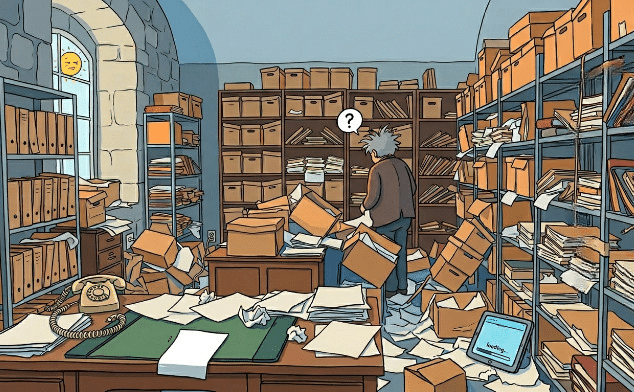
Research can be fun. History makes for good drama, fine romance and, yes, thrilling plots. Isn’t story telling nothing but a nifty narrative of the past? (Even SciFi follows plots of times past.) Why would wine’s South African tale then be so elusive, so tricky?
Researching local wine and its past is confusing fun. But finding facts and historical data is not easy – I’ve been working on it, so I know.
One would think that for all the punting of wine’s cultural draw and depth there will be plenty of books of detail and records kept. The opposite is true. And, as for official documentation, well, just about nothing. (Important contributions to this field do exist – including Joanne Gibson’s “SA Wine History” series on this site – but they underline rather than resolve the underlying problem: a dispersed record rather than a consolidated archive.) If some caring person didn’t put Jan van Riebeeck’s diary in dusty storage, we may never have known when the first colonial wine was made in southern Africa…
Local wine culture is seriously lacking in an official and well-kept archive.
It is on this note that I fear (and mourn) the possible finale of more than forty annual Platter’s Wine Guides (or whatever name it carried on its last bolshy coloured covers). That rainbow of booklets, from the skinny 1980s to the hefty, hectic last years, denote a remarkable record of South African winemaking. Not without irony.
The yearly Platter’s, whatever its intensions then and more recently (when grape politics and winery snobbery battled its enduring heroic efforts of documentation) are a record of note by default.
Oh yes, the five stars and the red print and the ever goings-on about blind/sighted judging were providing the dramatic and superficial optics. But it is in the small type, the short notes, the data details and sometimes the interesting introduction to entries, that valuable archival stuff is housed.
The driving force of the guide when John and Erica Platter launched it in 1980 was factual information, getting specifics right. In other words, the USP was that it contained so much and spelled it out. For it had to sell – every year. Updating it annually was important, and now also, in hindsight, for South African wine history.
If you wanted to know when the first sauvignon blanc came onto the market, you could find it in the Platter’s of that year. If you wanted to know how many chardonnays were produced in 1990, count them at the entry on the last pages. Oh, and if you wanted to know who owned what winery and which route to take there, it was reliably fact-checked. Reading the editor/guest introductions and between the lines you could get a grip on what was going on in the vineyards, cellars and trade and maybe the raison d’être of SA wine.
One could say that the last half century of South African wine history was inadvertently, fortuitously, captured in Platter’s. All hail.
Along with the Platter era, there appeared, of course, some other booklets of opinion. (They came and went, with their own wine judgments). From time to time a coffee table publication would shine the PR spotlight on an estate, label or winery. KWV’s Wynland monthly and Ramsay, Son & Parker’s Wine magazine (prequel to this website) were useful chroniclers of developments as they unfolded in the industry.
Coinciding with the Platter beginning was the surprisingly jolly The Complete Book of SA Wine by John Kench, Phyllis Hands and Dave Hughes, published in 1983. Now, from 43 years hence, its ambition was admirable: it tried and accomplished collecting a great deal of data and opinion. There’s something quite enchanting about the approach and text. (Despite the awful illustrations.)
But such standouts are rare. A local wine book library won’t be without writs by Leipoldt, De Bosari, De Klerk, Brink, Fridjhon, James. Not much more. And some of the more academic ones by the likes of Orffer, Saayman and Archer. (The latter’s 2018 technical Vine Roots is surprisingly fun to read. I had, for a profile piece.)
The reality is that such a library hardly exists – certainly not one offering serious historical researchers close, hands-on access to data. The search, in this sense, is both wide and deep. (I once traced, with some luck and persistence, a “legendary” soil scientist’s doctoral thesis back to a German archive.) A central facility – an archive of and for South African wine – has long been overdue. In the meantime, we have (had) Platter’s.
- Melvyn Minnaar has written about art and wine for various local and international publications over the years. The creativity that underpins these subjects is an enduring personal passion. He has served on a few “cultural committees”.
-
Share:

Related articles
Opinion & Analysis
Melvyn Minnaar: Wine’s enduring role in opera
8 April 2026
An elegant, silver-plated hip-flask is one of my most treasured memories of a glorious time in the company of stage artists. On the front of the classic slug-fit shape (easily...
Opinion & Analysis
Melvyn Minnaar: Remembering D.J. Opperman, his poetry and enduring love of wine
2 February 2026
My poetry professor drank himself to death. So the gossip went. Red wine. Other students and colleagues suggested he polished off six bottles a day. The liver couldn’t deal with...
Opinion & Analysis
Melvyn Minnaar: Art, wine and their shared history of deceit
3 November 2025
Whenever a wise guy pooh-poohs my fierce argument about the parallels between art and wine, I point out how these two human productive endeavours share a history of mischief. “Creative...
Joanne Gibson | 2 June 2026
“Local wine culture is seriously lacking in an official and well-kept archive.”
I hear you, Melvyn.
I would love to make this happen, and have already made an “unofficial” start. Wish I could devote much more time to it. Need a bit of funding…