
Greg Sherwood MW: From Etna to the Cape – granite reconsidered
By Greg Sherwood, 25 June 2026
-
Share:





2
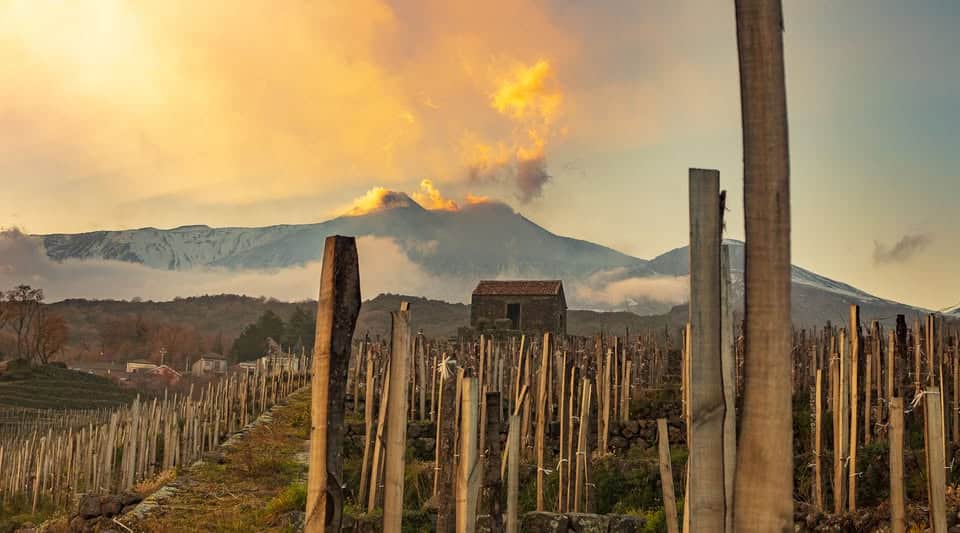
For the past several years, I have been gently agitating for a press visit to the vineyards of Mount Etna in Sicily. My requests were directed at Benanti, the benchmark estate in the Etna DOC. Unfortunately, unbeknownst to me, the winery was in the process of changing importers, temporarily scuppering my plans.
As an attentive buyer of fine wine and a committed lover of Italy’s greatest bottles, I like to think I was an early adopter of what has since become one of the world’s most fashionable wine regions. At one stage my retail portfolio featured six or more leading Etna producers, including Benanti, Tenuta di Fessina, Passopisciaro (Andrea Franchetti), Pietradolce, Terre Nere and Paola Caciorgna – all now among the appellation’s most respected names.
The opportunity resurfaced when the InsidEtna generic tasting came to London on 24 March. Unsurprisingly, my first stop was the Benanti table, still my favourite producer and, in my view, the benchmark for Etna DOC.
Fortuitously, Benanti’s UK agency had recently been taken on by WoodWinters, one of Britain’s leading Italian wine specialists and also an importer of South African producers including Sakkie Mouton, Pounding Grapes, Silvervis, Carinus Wines and Bosman. It proved the perfect introduction to revive my proposal. Thankfully, co-owner Salvino Benanti was receptive and, before long, my long-planned visit to the fabled volcanic slopes of Etna was becoming a reality.
Travelling from London to Sicily takes over three hours, longer than the quick hops to France or Spain. During the flight I found myself contemplating not only the volcanic terroir awaiting me but also its unexpected similarities to the deep granitic soils of the Western Cape.
As the fine wine market grows weary of generic, heavily extracted, high-alcohol wines, discerning consumers are increasingly seeking precision, freshness, restraint and a genuine sense of place. Those qualities define Etna’s volcanic vineyards just as surely as they do the granitic slopes of the Paardeberg and Polkadraai Hills.
This shift has fuelled Etna’s meteoric rise, with producers successfully packaging their high-altitude volcanic vineyards into a compelling narrative of heroic island viticulture.
The Cape finds itself at a similar crossroads. It possesses some of the oldest decomposed granitic soils on earth, particularly across Stellenbosch, Swartland and the Paarl foothills. That prompted a question: what percentage of the world’s vineyards are actually planted on deep decomposed granite? We often hear that only around 1% of vineyards worldwide lie on volcanic soils.
Granite’s untold story
While there is no definitive global database, geological surveys and wine specialists estimate that less than 5% of the world’s vineyards are planted on deep decomposed granitic soils. That came as a revelation, despite having encountered remarkable granite terroirs from the Cape to the Greek island of Tinos.
Further reading revealed that although granite is abundant within the earth’s continental crust, deeply weathered decomposed granite – known as gore or arène in France – is relatively rare in premium wine regions. Formed over millions of years, it creates sandy, nutrient-poor, exceptionally free-draining soils that are highly prized for viticulture.
In France, thoughts of granite inevitably lead to Beaujolais and its northern crus, including Fleurie, Morgon and Chiroubles, where vines grow almost exclusively on pink decomposed granite that naturally curbs vigour and enhances finesse.
Further north, the steep terraces of Condrieu and Cornas also rest on weathered granite, giving Viognier and Syrah their distinctive mineral tension – characteristics not unlike those found in Chenin Blanc grown on the ancient granitic sands of the Paardeberg.
Granite is exceptionally hard and, in many parts of the world, has never weathered deeply enough to form root-penetrable soils. Where it has broken down into deep decomposed sands, it provides one of the world’s rarest and most sought-after foundations for fine wine.
Etna has earned its reputation as the “Burgundy of the Mediterranean” not only because of Nerello Mascalese and Carricante but through a remarkably coherent marketing strategy. Producers have made the volcano itself the protagonist, celebrating individual contrade, altitude, freshness and the smoky, saline imprint of basalt and volcanic ash. Once again, the parallels with South Africa’s granitic vineyards are striking.
South Africa possesses an equally compelling, if entirely different, geological story. The Cape Granite Suite dates back roughly 510-550 million years, predating both Europe’s wine regions and the geological formation of Mount Etna itself.
Unlike Etna’s youthful volcanic energy, the Cape’s granite speaks of ancient stability, deep rooting and structural elegance – qualities that undeniably find expression in the wines. Emphasising this geological origin gives consumers a tangible anchor, shifting the conversation beyond fruit flavours towards place and provenance.
Just as the volcanic wines of Santorini, Tenerife and Etna have captured the imagination of fine wine drinkers, so too can the Cape’s granitic vineyards. The relationship between granite, vine physiology and the fresher, more transparent wine styles emerging from these sites offers South Africa a powerful point of difference.
By borrowing Etna’s storytelling model – replacing volcanic drama with the quiet authority of half-a-billion-year-old granite – South African producers can continue reshaping the country’s fine wine identity, demonstrating that the Cape’s greatest wines are defined not simply by sunshine, but by one of the world’s oldest and rarest viticultural foundations.
- Greg Sherwood was born in Pretoria, South Africa, and as the son of a career diplomat, spent his first 21 years traveling the globe with his parents. With a Business Management and Marketing degree from Webster University, St. Louis, Missouri, USA, Sherwood began his working career as a commodity trader. In 2000, he decided to make more of a long-held interest in wine taking a position at Handford Wines in South Kensington, London, working his way up to the position of Senior Wine Buyer over 22 years. Sherwood currently consults to a number of top fine wine merchants in London while always keeping one eye firmly on the South African wine industry. He qualified as the 303rd Master of Wine in 2007.
-
Share:

Sandy Harper | 28 June 2026
Nice article Greg. The world should pay more attention to the ancient soils of South Africa.
Greg Sherwood | 29 June 2026
The only people who have shouted loudly about soils is Mike Ratcliffe with his ancient Vilafonte soils in Paarl and a few Swartlanders emphasizing Decomposed Granite. Bruwer Raats is also very vocal about the Decomposed Granite of the Polkadraai Hills. But plenty more to be done.