
Clash of the titans: Bordeaux 2016 vs South Africa 2017
By Christian Eedes, 16 October 2026
-
Share:





1
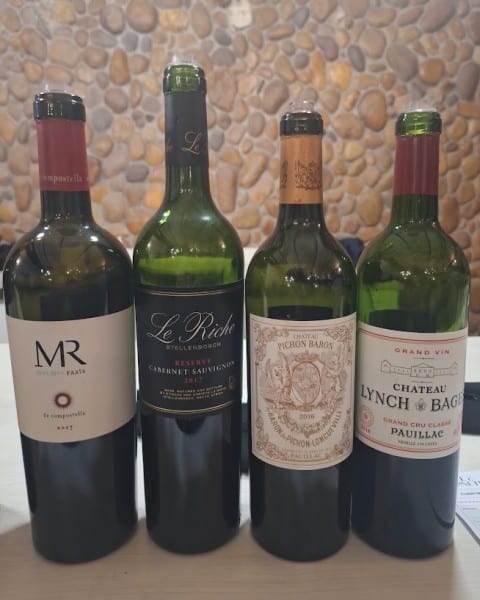 A wine can look very good in isolation. Put it alongside its counterparts from the rest of the world, and the context changes. In a tasting billed as “Clash of the Titans”, merchant Brice & Burnett pitted Bordeaux 2016 against South Africa 2017, two much celebrated vintages. The results were instructive, if not entirely comfortable for local patriots.
The wines were tasted blind, one flight of three and three flights of four (B&B current prices in brackets).
Flight One
Du Terte Margaux 2016 – R1,250
Meerlust Rubicon 2017 – R750
Cantemerle Haut-Medoc 2016 – R975
Flight Two
Delaire Graff Botmaskop 2017 – R625
Keet First Verse 2017 – R1,025
Lafon-Rochet Saint-Estèphe 2016 – R1,450
Ernie Els Signature 2017 – R1,000
Flight Three
Kanonkop Paul Sauer 2017 – R1,425
Canon Saint-Emilion 2016 – R3,500
Domaine de Chevalier Pessac-Léognan Rouge 2016 – R2,300
Glenelly Lady May 2017 – N/A
Flight Four
Mvemve Raats De Compostella 2017 – N/A
Le Riche Cabernet Sauvignon Reserve 2017 – R1,295
Pichon-Longueville Baron Pauillac 2016 – R5,350
Lynch-Bages Pauillac 2016 – R4,950
Here’s how I rated the wines:
97
Lynch-Bages 2016
96
Canon 2016
Le Riche Cabenet Sauvignon Reserve 2017
95
Domaine de Chevalier Rouge 2016
Lafon-Rochet 2016
Mvemve Raats De Compostella
94
Delaire Graff Botmaskop 2017
Ernie Els Signature 2017
93
Glenelly Lady May 2017
Pichon-Longueville Baron 2016
92
Meerlust Rubicon 2017
91
Cantemerle 2016
Keet First Verse 2017
90
Du Tertre 2016
89
Kanonkop Paul Sauer 2017
Price, quality and the question of origin
The first point to make is that price and quality did not correlate particularly well. Lynch-Bages 2016, at R4,950, was my top wine at 97, but the R3,500 Canon 2016 managed 96, as did Le Riche Cabernet Sauvignon Reserve 2017 at R1,295. Mvemve Raats De Compostella 2017, current price unavailable although originally released at R1,500, also scored 95. These results suggest that serious quality is not the exclusive preserve of Bordeaux’s most expensive labels. Indeed, Le Riche offered a particularly compelling case for South African value. That said, a single tasting cannot establish a general relationship between price and quality, and the absence of retail prices for two local wines limits the comparison.
How did South Africa fare overall? Respectably, but with qualifications. Of the 15 wines, six South African examples scored 94 or above, against four Bordeaux wines. Yet Bordeaux claimed the top two scores, with Lynch-Bages at 97 and Canon at 96, while Kanonkop Paul Sauer 2017 brought up the rear at 89 (more on this below). The comparison is not quite as simple as the numbers suggest: the flights were small, and individual bottles, tasting order and stylistic preference inevitably influence results. Still, the strongest South African wines demonstrated that the country can compete at this level, even if the very top end of Bordeaux retained an edge.
I could identify the country of origin in 10 of the 15 instances. The Stellenbosch wines generally showed greater ripeness and higher alcohol, while retaining a degree of pyrazine character. This combination is revealing: Cabernet-based wines can be simultaneously generous and green, and ripeness alone does not guarantee completeness.
One further consideration is how much the wines had evolved. At roughly nine to ten years old, these were not merely exercises in youthful fruit and tannin. Scores were heavily influenced by the degree to which each wine had developed, and whether that development was positive. A wine that has shed its primary fruit without gaining complexity (Pichon Baron) is not necessarily better for the experience. Conversely, a wine retaining freshness, structure and interest (Lynch-Bages) after a decade deserves considerable credit.
Endurance is praiseworthy. The point of fine wine is not simply to impress when young, but to reward patience. On that measure, the most successful wines were those that are travelling well, not merely those that had started with the greatest reputation.
South Africa’s showing, wine by wine
A few brief remarks on each of the South African wines. Meerlust Rubicon 2017 was in good nick, if a relatively modest rendition of this famous wine. Delaire Graff Botmaskop and Ernie Els Signature both showed the precision and polish one would expect from these properties. Keet First Verse, at 15% alcohol, was relatively sweet and lacked structure, shortcomings I flagged on release (review here). Glenelly Lady May 2017 seems to be going through an awkward phase, its richness and firmness not yet reconciled and my sense is it’s nowhere near its peak. Mvemve Raats De Compostella was its usual elegant self, while Le Riche Cabernet Sauvignon Reserve displayed impressive structure and balance.
As for the Paul Sauer, perhaps we secretly like it for its oddness. It’s never been the most polished or immediately charming of wines, and its old-school, dikvoet character is part of its identity. But in this instance, those qualities seemed exaggerated, the wine showing as oxidised and raisined, with a kirsch-like quality to the fruit. Broad, flat and soft, it seemed to have little life left in it. This was not simply my own reaction; other tasters expressed similar reservations. One bottle is not a verdict on a wine, still less on a vintage. The 2017 could yet emerge gloriously with further bottle age, but this was a perplexing showing.
-
Share:

Jan Carlsson | 16 October 2026
Hi Christian!
Sounds like a bad bottle of PS!?
Should hardly be oxidised and raisined at this stage. Just had 2015 which just entered it’s optimal drinking window. 2017 not be there yet?