Reviews and ratings - only R55 per month.Subscribe
Black Elephant Vintners The Dark Side of the Vine Semillon 2017
While the 2015 vintage of The Dark Side of the Vine Semillon from Black Elephant Vintners was staggeringly good, I recall being somewhat nonplussed as to how very oxidative the 2016 was. Happily, the 2017 is a return to form.
Grapes from a Franschhoek vineyard planted in 1905, winemaking involved 24 hours of skin contact before spontaneous fermentation and maturation lasting 12 months in two old 500-litre French oak barrels.
The nose is wonderfully complex with notes of pear, peach, yellow apple, naartjie, thatch, vanilla, cinnamon, and white pepper, and other spice plus some flinty reduction while the palate is lean yet flavourful with bright acidity and a long, salty finish. It’s a wine that’s initially quite reticent but provides increasing pleasure as you engage with it. Price: R385 a bottle.
Help us out. If you’d like to show a little love for independent media, we’d greatly appreciate it. To make a financial contribution, click here. Invoice available upon request – contact info@winemag.co.za
Let’s take the quality of the wines discussed below as unassailable. Is the aesthetic judgement – and in one case, the political one – merely a matter of taste (or conviction)? Well, they’re at least questionable.
I don’t think I’ve ever seen a public reference to Sadie Columella’s comprehensive use of Latin on its elegantly designed display label (“Liberatus in Castro Bonae Spei”, etc), apart from Christian Eedes referring to it, apparently approving of its originality, in his introduction to the second Wine Label Design awards. Otherwise, I suppose it’s either an elephant-in-the-room thing which embarrasses commentators, or else no-one apart from me finds it odd enough to be worth mentioning. De Toren uses a Roman numeral for the “five” part of the name of Fusion V, and there is the occasional label using them for the date – such as Steenberg Magna Carta, where the practice is perhaps saved from silliness, if not pretension, by relating to the Latin name, I suppose. Sadie, however, inverts this latter process, so that it is in fact ONLY the number which is not Latinate; it’s in standard Arabic numerals. The Latin link to the name is, of course, that Columella was an ancient Roman agronomist (so too was Palladius, but that label is in English, like the “back”, official, label of Columella….)
Eben Sadie told me many years back that he was so in love with his maiden wine that he thought neither English nor Afrikaans good enough for its label – hence the Latin. Some time later I asked him (and I suspect he sensed my own doubts) if he regretted having done something so unusual, and he emphatically denied that. Myself, I think the later choice of Afrikaans for the Ou Wingerdreeks/Old Vineyard Series entirely more appropriate than Latin. Incidentally, I wonder if Sadie is the only producer in the world to use three different languages (unmixed) on his labels, as well as the only producer with one of those languages being Latin?
*
The foreign language on Klein Constantia’s Vin de Constance label is, of course, French – though limited to the name. I don’t find that pretentious, but I fear the whole effect of the packaging is rather kitsch, which is perhaps even worse. Using a bottle manufactured by modern techniques to imitate a wonky 18th century hand-blown one (and repeated as a magnum) – well, it’s rather like those electric heaters that have a moulded plastic cover electrically illuminated from behind and painted to supposedly resemble glowing coals. I believe they found the bottle in Italy and subsequently patented the design; the rather ugly label is designed to match. Groot Constantia’s Grand Constance, another wine inspired by the old Constantias, also alludes directly to an antique-style bottle but doesn’t pretend that the allusion is more than that, so it ends up that much less vulgar. A pity that Vin de Constance, one of the Cape’s few indisputably iconic wines, and one of its most expensive, should be packaged like this, so self-consciously coy.
*
The problem with the public presentation of Kanonkop Paul Sauer is rather more serious and more fundamental: the problem is the name itself. I guess if the wine were named after Hendrik Verwoerd, more people might notice the problem and, I hope, join me in objecting. But I suppose few international admirers, and maybe not all that many local ones, realise that Paul Sauer was more than just another run-of-the-mill National Party minister in the apartheid era – even if the overwhelmingly white (mostly right-wing?) local constituency for fine wine perhaps realises it and doesn’t much care. The Kanonkop website says that Paul Sauer was a politician most famous for serving “in the South African parliament for forty-one consecutive years”. It doesn’t mention that, very importantly, he chaired the Sauer Commission, established in 1947, to formulate an alternative new policy for traditional racial segregation, and whose work has been seen as the theoretical basis for the apartheid system that Sauer’s party was to soon start enforcing.
The only other Cape wine producer I can think of that honours a famous racist is the KWV, with what was Abraham Perold Tributum and now appears to be The Mentors Perold. A.I. Perold was, of course, an important local viticulturist and no doubt his achievement (particularly his creation of pinotage) is what the KWV wants to honour. But he was also, inescapably (it’s not often mentioned by the Pinotage Association or others), a Nazi supporter and member of the Ossewa Brandwag before his premature death in 1941. (Incidentally, Sadie Columella also mentions ‘tributum” on its label – but the tribute is to someone who died two millennia back, distant enough for use to ignore that he was, apparently, a supporter of slavery.)
History is history. It happened. But it doesn’t need to be insisted upon when that history is offensive to so many people. No one admires Kanonkop as a wine producer more than I do. But is it really acceptable that one of South Africa’s finest, best-known wines are still named after a person so deeply implicated in establishing the policies of grand apartheid? The names of streets, airports, cities etc deemed offensive to most South Africans have been changed in the last few decades, statues have toppled…. Shouldn’t the name of the Kanonkop flagship have also discreetly changed – to PS, perhaps (the suggestion made to me by Jancis Robinson, when I asked her opinion of this)? Its persistence seems to me one more measure of how little the wine industry has shifted since 1994 to reflect – let alone to help build – a successful post-apartheid society.
Dragging Perold with it, Paul Sauer Should Fall! Not the wine, of course (let’s not be radical here), just the name.
Tim James is one of South Africa’s leading wine commentators, contributing to various local and international wine publications. He is a taster (and associate editor) for Platter’s. His book Wines of South Africa – Tradition and Revolution appeared in 2013
Help us out. If you’d like to show a little love for independent media, we’d greatly appreciate it. To make a financial contribution, click here. Invoice available upon request – contact info@winemag.co.za
In these troubled times, wine provides solace and what solace to be had from the new releases from Donovan Rall. Tasting notes and ratings as follows (prices to be confirmed):
Rall Cinsault Blanc 2020
Matured in a clay amphora for 10 months. The nose is shy but subtle notes of citrus, peach and hay can be detected. The palate is better balanced than previous vintages – good fruit definition and freshness. Relatively broad with nice texture and plenty of flavour. No longer an oddity, this vintage possesses proper vinosity.
CE’s rating: 91/100.
Rall Grenache Blanc 2020
Grapes from Piekenierskloof. Matured in a combination of concrete egg and amphora. Some struck match reduction before citrus, peach and herbs on the nose while the palate is wonderfully vivid – great fruit concentration and punchy acidity before a pithy finish. Impressive presence and intensity of flavour.
CE’s rating: 95/100.
Rall White 2020
64% Chenin Blanc, 32% Verdelho and 4% Viognier. The nose of this vintage is rather exotic with notes of pineapple and other tropical fruit to go with pear, peach, citrus, herbs and spice. The palate possesses great fruit density but also freshness – the acidity is high without being hard or angular. Lots going on in terms of flavour, the finish long and dry.
CE’s rating: 95/100.
Rall Ava Chenin Blanc 2020
From vineyards planted on schist. The nose is distinctive in showing pronounced notes of hay and herbs as well as citrus and white peach while the palate has lovely purity of fruit to go with invigorating acidity – it’s a super-elegant and precise wine, possessing wonderful tension.
CE’s rating: 97/100.
Rall Cinsault 2020
60% of the grapes from Darling and 40% from Swartland, 100% whole-bunch fermented. Aromatics of red cherry, pomegranate, fresh herbs and a hint of earth. The palate is light and pretty with well delineated fruit, snappy acidity and crunchy tannins. Neatly done with a nice energy about it.
CE’s rating: 91/100.
Rall Red 2019
65% Syrah, 13% Grenache, 13% Cinsault and 9% Carignan. The nose is particularly expressive with notes of red and black berries, cured meat, lavender, herbs and pepper while the palate is rich and flavourful but equally not short of freshness – a bit less foursquare than preceding vintages have tended to be. Complex and satisfying.
CE’s rating: 94/100.
Rall Ava Syrah 2020
From two Swartland vineyards on schist. Sensational aromatics of red and black berries, all sorts of flowers (rose, lavender and lilies), herbs, pepper and spice while the palate shows exquisite refinement – great fruit definition, lemon-like acidity and powdery tannins. Wonderful structure with all the various elements in just about perfect harmony. Plenty of flavour intensity without being at all heavy, this is a very sophisticated offering.
Help us out. If you’d like to show a little love for independent media, we’d greatly appreciate it. To make a financial contribution, click here. Invoice available upon request – contact info@winemag.co.za
Grapes from a block planted in 1981, the Ou Steen from Longridge is made in the style of a Loire Demi Sec, that is to say semi-sweet and the 2017 has a residual sugar of 14,4 g/l to go with a total acidity of 6.1 g/l.
The nose shows lemon, peach, dried herbs, and some leesy complexity while the palate is full with a lovely sweet ‘n sour quality – concentrated fruit matched by vibrant acidity. There’s no denying the sweetness now but this wine should only become more interesting over the years. Price: R395 a bottle.
Help us out. If you’d like to show a little love for independent media, we’d greatly appreciate it. To make a financial contribution, click here. Invoice available upon request – contact info@winemag.co.za
Introduction
This year’s Minority Report convened by winemag.co.za and sponsored by multinational financial services company Prescient is to be released sequentially – part two featuring niche red varieties now out. There were 55 wines entered and these were tasted blind (labels out of sight) by a three-person panel, scoring done according to the 100-point quality scale.
Niche Red Varieties Top 10
The 10 best wines are as follows:
94
Zorgvliet Petit Verdot 2018 Price: R160 Wine of Origin: Banghoek Abv: 14.25%
92
B Vintners Lone Wolf Cinsault 2020 Price: R250 Wine of Origin: Stellenbosch Abv: 13%
Zorgvliet Cabernet Franc 2018 Price: R160 Wine of Origin: Banghoek Abv: 14.51%
Piekenierskloof old vines.
About the category
The focus of the Minority Report is on wines from varieties whose respective total plantings do not exceed 5 000ha. South Africa’s eight most widely planted varieties (Chenin Blanc, Colombar, Cabernet Sauvignon, Sauvignon Blanc, Shiraz, Pinotage, Chardonnay, and Merlot in that order) all have plantings of over 5 000ha and together makeup 82% of the national vineyard – this is a chance for the more subordinate varieties to shine!
In-depth analysis
To read the report in full, including key findings, tasting notes for the top wines and scores on the 100-point quality scale for all wines entered, download the following: Prescient Minority Report 2021
Shop online
Johannesburg boutique wine retailer Dry Dock Liquor is offering some of the wines in the Top 10 for sale and can deliver nationwide – buy now.
Online retailer Wine-of-the-Month Club is offering a six-bottle mixed case selected from the Top 10 – buy now.
Video
Chris Hani Baragwanath Academic Hospital, Soweto.
The 19th century British Prime Minister Benjamin Disraeli has been credited with first saying that “There are three kinds of lies: lies, damned lies, and statistics.” It ought to be added that there are three kinds of statisticians: competent statisticians, incompetent statisticians, and lying statisticians. The laws of libel preclude me – at least for the moment – from using this taxonomy to categorize the experts whose latest article on the subject of the usefulness of liquor lockdowns in reducing trauma admissions has recently been published. But I will unpack some of the arguments they have used and the conclusions they have arrived at so that you can decide for yourselves.
The subject requires a little background: a coterie of researchers, many of them funded by the Medical Research Council (MRC), has been publishing articles over the past two decades about alcohol use and abuse. The data they have assembled have been music to the ears of the prohibitionist lobby within the ANC. This may of course be a complete coincidence, but since the MRC is funded by the government, this stream of research has proved to be a lucrative route to further funding and academic advancement.
For most of this period the liquor industry has been strangely silent. Despite articles whose claims are so extraordinary that even a brain-dead zombie high on nyaope could pick out the flaws, none of the industry organisations challenged what was being published. For example, Richard Matzopoulos argued in 2014, using 2009 figures, that alcohol costs the SA economy over R200bn. To arrive at this number he aggregated a vast number of indirect costs including the expenses incurred nationally on security. Apparently, break-ins and thefts are only perpetrated by people tanked up on liquor. (To accept this logic, you also have to believe that if alcohol were not available there would be no need for security fencing, burglar alarms, and armed response units). Once you start adding tangential costs why draw the line there? Make alcohol foot the bill for unwanted pregnancies and then debit the industry for the crimes perpetrated by kids who were born out of wedlock.
Covid-19 presented a heaven-sent opportunity: the National Coronavirus Command Council, an entity dominated by prohibitionists, used the Disaster Management Act to drive its agenda. The MRC gang, ever keen to please their lords and masters, instantly set about using the liquor lockdowns to support the anti-alcohol proposals they had been trying to incorporate in legislation. Less than two months into the pandemic they published “South Africa’s COVID-19 Alcohol Sales Ban: The Potential for Better Policy-making” in the International Journal of Health Policy Management.
They argued that “the dramatic decrease in violence and injuries following an alcohol sales ban in South Africa has implications for its alcohol policy post-lockdown as well as the current emergency response in other countries….The decline in alcohol-related trauma, alongside alcohol’s perceived role in crime and undermining public safety, has won political and popular support for maintenance of these restrictions.” They concluded that “we have here an opportunity for stakeholders to work together to develop better alcohol policy and safeguard the post-COVID future of all South Africans.”
The liquor industry culture of ignoring whatever rubbish the anti-alcohol research lobby wrote changed with the Covid-19 lockdowns. Finally, the formal industry bodies grew a pair and began investing in expertise to challenge the very tenuous findings of the MRC gang. A peer-reviewed document appeared late last year showing that there was no hard evidence to support the theory that it had been the ban on liquor sales which had reduced the number of trauma admissions: in over twenty countries which had imposed very strict lockdowns to control the pandemic but which had permitted the continued sale of alcoholic beverages, the reduction in trauma admissions was pretty much the same as in South Africa. It wasn’t the ban on liquor sales that had produced the result, they argued, it was the restrictions on mobility.
The statisticians weren’t fazed. They proceeded to panel-beat their numbers to produce an article which “seemed” to support their prohibitionist agenda. This required several sleights of hand. Firstly they had to keep their raw data away from public scrutiny, Secondly, they made no provision for illicit alcohol supplies. In other words, they assumed that just because liquor couldn’t be obtained legally there was no alcohol about. This took an extraordinary amount of mental gymnastics – since they were obliged to disregard the arguments they use in other studies (and which they feed to the WHO). So this study makes no mention of the estimate that roughly 25% of alcohol consumed in South Africa is not recorded in the official stats. Thirdly they ignored data – like the decline in deaths when alcohol was legally available in late June/July 2020. Finally, they knowingly used the least valid mobility statistics (Google Mobility’s Residential Data) to airbrush away the impact of reduced mobility on trauma statistics.
There’s no prospect that even the widespread publication of evidence of what they have been doing will send them scurrying for cover. Like PPE tenderpreneurs who can’t imagine life without their daily fix of Moët, they’ve become addicted. More importantly, those they serve are not going to give up their agenda just because the facts can no longer be squeezed into their model. If anything, they will exert greater effort than before to force through the legislative changes which have depended on their research outcomes to gain traction.
The wine industry as a whole cannot assume that the formal organisations (which, while they have finally acted, left things dangerously late) will handle this with the urgency and force that is required. If you don’t want advertising banned, the drinking age raised to 21, further restrictions on hours of trade and the whole panoply of regulations that the Stalinists at the South African Alcohol Policy Alliance have in their sights, now is the time to get involved.
Michael Fridjhon has over thirty-five years’ experience in the liquor industry. He is the founder of Winewizard.co.za and holds various positions including Visiting Professor of Wine Business at the University of Cape Town; founder and director of WineX – the largest consumer wine show in the Southern Hemisphere and chairman of The Old Mutual Trophy Wine Show.
Help us out. If you’d like to show a little love for independent media, we’d greatly appreciate it. To make a financial contribution, click here. Invoice available upon request – contact info@winemag.co.za
Introduction
This year’s Minority Report convened by winemag.co.za and sponsored by multinational financial services company Prescient is to be released sequentially – part one featuring niche white varieties now out. There were 47 wines entered and these were tasted blind (labels out of sight) by a three-person panel, scoring done according to the 100-point quality scale.
The focus of the Minority Report is on wines from varieties whose respective total plantings do not exceed 5 000ha. South Africa’s eight most widely planted varieties (Chenin Blanc, Colombar, Cabernet Sauvignon, Sauvignon Blanc, Shiraz, Pinotage, Chardonnay, and Merlot in that order) all have plantings of over 5 000ha and together make up 82% of the national vineyard – this is a chance for the more subordinate varieties to shine!
In-depth analysis
To read the report in full, including key findings, tasting notes for the top wines and scores on the 100-point quality scale for all wines entered, download the following: Prescient Minority Report 2021
Shop online
Johannesburg boutique wine retailer Dry Dock Liquor is offering some of the wines in the Top 10 for sale and can deliver nationwide once the alcohol ban has been lifted – buy now.
Online retailer Wine-of-the-Month Club is offering a six-bottle mixed case selected from the Top 10 – buy now.
Video
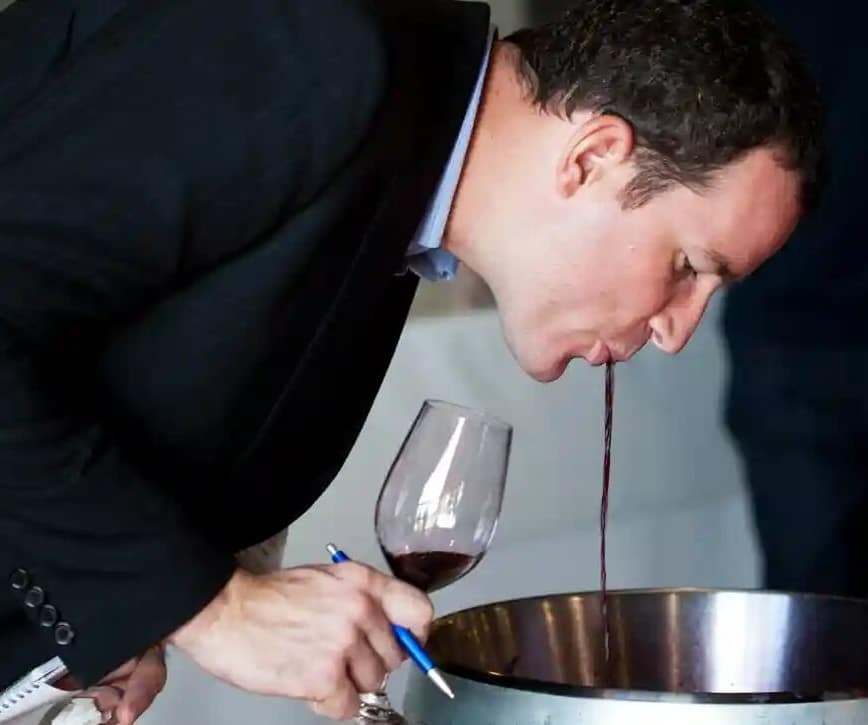
If you’re sensible as well as squeamish, you will not have peered too closely into a winetaster’s spittoon. But if you have (huh, Kwispedoor?), you should have realised, from all those unattractive, mucusy strings, that saliva has played a role in what’s going on in there. And, indeed, winelovers should recognise the role that saliva plays in drinking (and eating, of course). Including its significance, as a dwindling product of a taster’s mouth, in wine competitions: overworking saliva with too much tasting and spitting leads to build-up of acid and, especially, tannin in the mouth, fundamentally altering balance and even flavour and thus helping to account for some of the odder results in scoring big line-ups.
Tasters’ saliva flows are all individual too, like many of their flavour threshholds (look at the comparative lists of mentioned aromas and flavours in different tasters’ notes and you can often wonder if they were assessing the same wine – but that’s another story). Apparently, a person secretes from half a litre to three times that – daily.
I’ve been recently reminded about the soldierly but unsung efforts of saliva in promoting oral satisfaction because I’ve been suffering for a few weeks from a (fairly) dry mouth. Something is inhibiting my saliva flow. Perhaps I’m more vulnerable to this than many as I did have one of my salivary glands (we have three major and hundreds of minor ones) surgically removed a few decades back, after repeated blockages. I’m now wondering if a moderately reduced saliva flow has accounted over the years for what seems like an idiosyncratic extra sensitivity to bitterness – I’ve been aware of the sensitivity, so I never publicly describe a wine as bitter without first checking with other tasters. Interestingly, the flow or its effect seems inconstant, so a wine might taste bitter to me one day but less so the next – probably others will have noticed the pattern, which is yet another reason not to bet too much on a single blind tasting.
Anyway, now my saliva flow is definitely reduced and I’m hoping that my newly dry mouth – not an uncommon condition, I believe – will prove to be a temporary condition. It prompted me to do some research, and I’ve been surprised to find out just how much study there has been of saliva and the way it mediates how we experience wine.
According to one article on the World of Fine Wine website, the winelover’s real interest in saliva is that it contains certain proteins that bind with tannins. Mucins in saliva lubricate and protect the surface of the mouth. “Tannins remove this lubrication, causing a sense of dryness, puckering, and loss of lubrication in the mouth. This is what we describe as ‘astringent.’” The problem for tasters faced with a long line-up of wines to be tasted quickly is that this astringency builds up, as saliva can’t keep up the pace with replenishing the lubricating layer. The tannin content of white wine is obviously less than for red, but the acidity is usually higher, and “frequent exposure to a high acid stimulus is likely to overwhelm the buffering and dilution capacity of the saliva. This can leave the mouth feeling sensitive to subsequent samples and might lead to acidity being misjudged”.
The anonymous author of this article says that all this should not lead professional wine-tasters to despair (little chance of that, I would suggest!), although palate fatigue is “near fatal” for assessing elegance and harmony, which “depend in large part on mouthfeel”. But, the author adds, “it is an observation that should encourage us to approach tasting with a degree of humility” (um, perhaps a slighter great chance of that, now and then).
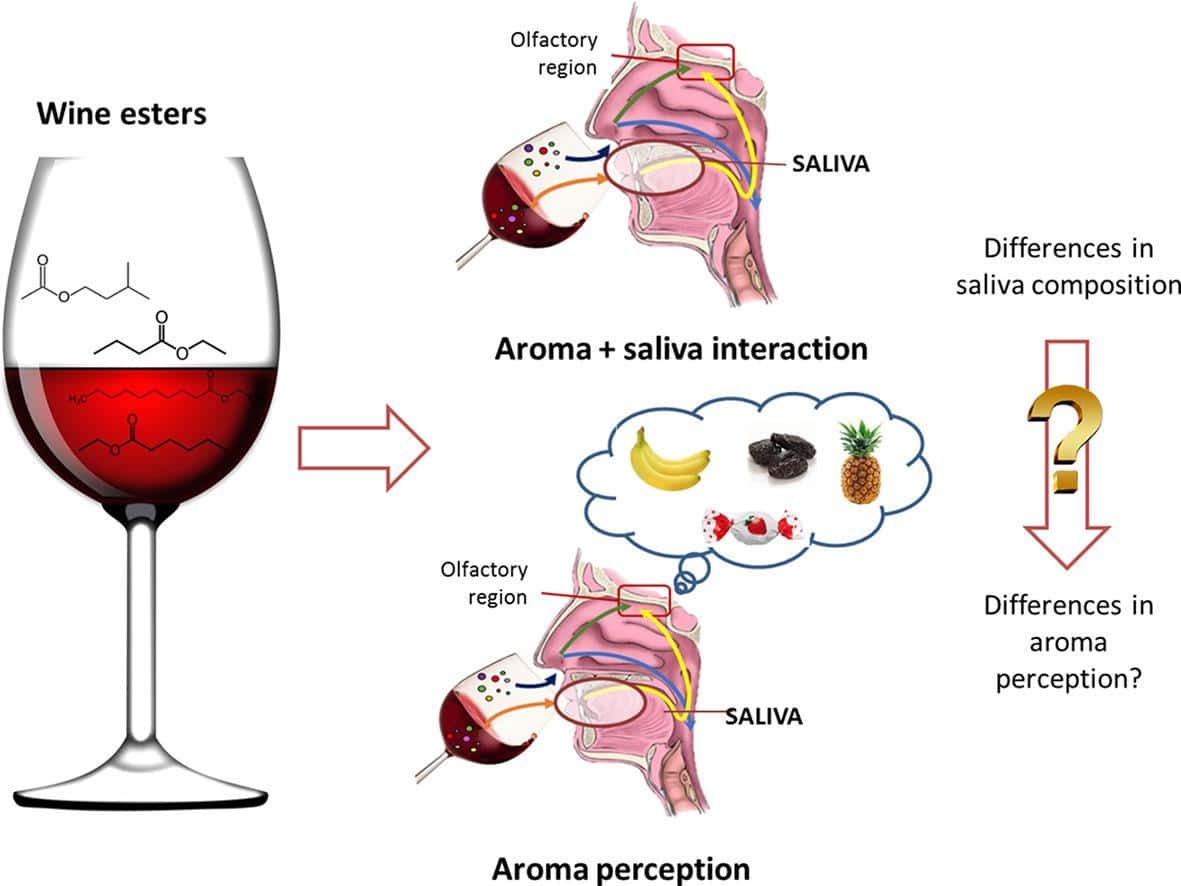
Aroma and saliva interaction. Source: Sciencedirect.com
There’s more to the role of saliva than all that, apparently. I did notice, for example, but confess I didn’t approach too closely, a scientific paper in Food Research International entitled: “Effect of saliva composition and flow on inter-individual differences in the temporal perception of retronasal aroma during wine tasting”. And how about, in Food Chemistry: “Simulation of retronasal aroma of white and red wine in a model mouth system. Investigating the influence of saliva on volatile compound concentrations.”
A rather less formidable-looking discussion of the importance of saliva in wine-tasting starts off by pointing out that “We are, in fact, working with personalized sets of molecules from the moment wine hits mouth … there are things going on in your mouth that change the way your wine tastes, and they’re not the same for everyone.” There are enzymes as well as proteins involved, it seems (and saliva can thus even affect aroma). Some of them are devoted to breaking bonds with sugar molecules. The author points out that “if you chew a bite of bread or potato long enough, it will begin to taste sweet as your saliva breaks the starch down into simple sugars”. And further: “On contact, your saliva begins liberating wine aromas into the air inside your mouth and the back of your throat (the pharynx) where they can travel up to your nose (the ‘retropharyngeal’ path) and be smelled.”
Other enzymes and proteins are active, and I found this paragraph interesting: “The quick shift from wine’s strongly acidic pH – usually pH 3-4, somewhere between cola and orange juice – to your saliva’s fairly neutral one also changes the chemical form of some molecules, sometimes changing them from aromatic to un-aromatic versions or vice-versa. All of this explains why a wine’s flavor seems different in the afterglow of swallowing compared with when you take that initial exploratory sniff. It isn’t just the addition of the basic information your tongue can contribute about sweet, salty, sour, bitter, and umami. You’re actually creating new aromas as you sip, swish, and swallow.”
One conclusion is clear about all this: saliva helps explain, as this author says, “why humans are so inconsistent about describing what they put into their mouths”.
As for my personal plight, I’m also suspecting that my current inhibited saliva flow can lead to some intensification of certain flavours as well as textures, especially if I am tasting repeatedly. Which I should be at this time of year, as the next edition of Platter gets assembled. However, unfortunately, the Platter process has been badly affected by the prohibition on moving wine. I must just hope that by the time the flow of Platter samples resumes, the flow of my saliva will also be back to normal.
Tim James is one of South Africa’s leading wine commentators, contributing to various local and international wine publications. He is a taster (and associate editor) for Platter’s. His book Wines of South Africa – Tradition and Revolution appeared in 2013
Help us out. If you’d like to show a little love for independent media, we’d greatly appreciate it. To make a financial contribution, click here. Invoice available upon request – contact info@winemag.co.za
Wildeberg is the Franschhoek farm owned by UK wine company Boutinot and Terroirs the name given to wines from special sites across the Western Cape.
The Terroirs Chenin Blanc features grapes from a 1977 Paarl vineyard, winemaking spontaneous fermentation and maturation lasting 12 months in new and older oak.
The nose shows hay, citrus, stone fruit, flinty reduction and some “wet wool” character while the palate is rich and thick textured – great depth of fruit, driving acidity and a savoury finish. If you like your Chenin to have some va-va-voom, then this is for you. Approximate retail price: R260 a bottle.
Help us out. If you’d like to show a little love for independent media, we’d greatly appreciate it. To make a financial contribution, click here. Invoice available upon request – contact info@winemag.co.za
The Stellenbosch-based cellar Spier has announced the appointment of Johan Jordaan as head winemaker. He succeeds Frans Smit, who has now taken on the role of Spier’s managing director.
Jordaan was raised on a grape farm in Rawsonville and has a Diploma in Oenology from Elsenburg Agricultural College in Stellenbosch. He joined Spier in 2007 and has long been in charge of red wine production.

 While the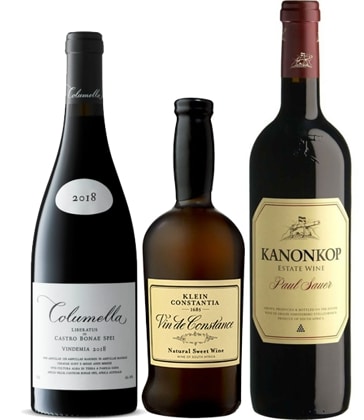

 Rall Ava Syrah 2020
 Grapes from a block planted in 1981, the Ou Steen from Longridge is made in the style of a Loire Demi Sec, that is to say semi-sweet and the 2017 has a residual sugar of 14,4 g/l to go with a total acidity of 6.1 g/l.





 Wildeberg is the Franschhoek farm owned by UK wine company Boutinot and Terroirs the name given to wines from special sites across the Western Cape.
 The Stellenbosch-based cellar Spier has announced the appointment of Johan Jordaan as head winemaker. He succeeds Frans Smit, who has now taken on the role of Spier’s managing director.