Reviews and ratings - only R55 per month.Subscribe
Harry Hartman maiden releases
Harry Hartman Wine Co. sees Cape Town businessman and wine enthusiast Marcel Hartman in collaboration with Sean Harrison of Graft Creative (the “Harry” in Harry Hartman), the two adopting a négociant model to bring wines to market. The new business currently offers two products but the intention is to add to the range in time. Tasting notes and ratings as follows:
Somesay Syrah 2019
Price: R295
Grapes from Cederberg and Stellenbosch. Partial whole-bunch fermentation. A heady nose of blackberries, violets, incense, earth and spice. The palate has good depth of fruit and smooth tannins with a gently savoury finish. It’s power-packed and quite polished despite a modest alcohol of 13.5%.
CE’s rating: 93/100.
Coracle 2019
Price: R495
37% Cabernet Sauvignon, 31% Petit Verdot, 17% Cabernet Franc and 15% Merlot – all grapes from Stellenbosch. Red and blackberries, violets, some leafiness and tilled earth plus discreet oak notes on the nose. The palate is dense with chewy tannins – again plenty of reined-in power for a wine of 13.5% alcohol.
Attention: Reviews like this take time and effort to create. We need your support to make our work possible. To make a financial contribution, click here. Invoice available upon request – contact info@winemag.co.za
I know it’s only September, but the way the year has been progressing so far, I suspect one would be hard-pressed to find anyone who wouldn’t agree to 2020 being surreptitiously terminated prematurely by way of a hard reboot. Just holding your finger down on the power button until the lights go out, count to five, and press restart with the year hopefully resuming with normal operations while simultaneously killing off the suspected virus that was making everything go haywire. Well, there is no harm in dreaming…
One thing that hasn’t been a dream is the fabulous weather we’ve enjoyed this year as we experienced one of the driest and sunniest summers on record here in the UK with temperatures still hitting the early to mid-20s centigrade even as we approach the middle of September, which is as anyone who has lived in the UK will know, one of the most uplifting factors as we all subconsciously start to assume the automatic seasonal brace position in preparation for another dark, cold, depressing winter.
Talking about the weather is, of course, a national pastime in the UK and so you will hopefully forgive my sentimentality as I look back on a lost year that could have been so incredibly magical and exhilarating, filled with memorable summer parties and fine wine-fuelled social gatherings were it not for the small matter of a global viral pandemic. But as a South African living in London, my home from home, I will still remember the lockdown months of 2020 with a certain strange fondness, sitting on my sunny deck in the back garden with a glass of delicious Rosé in hand wondering if 11.45am was too early for the first glass of wine of the day! But of course, just as discussing the weather has long been a favoured cultural pastime in the UK, in the wine trade, the same can be said for the annual autumnal crystal ball gazing and prediction generating competition amongst wine trade commentators, who all seemed to believe at one point in time that it was absolutely de rigeur to dedicate one of your final columns of the year to making ridiculous pronouncements and predictions about the year ahead.
Then, all of a sudden, and I can’t for the life of me remember the year, but I certainly remember the moment, leading blogger and wine journalist Dr Jamie Goode wrote a sensationally cutting article calling time on this ridiculously vacuous practice. Perhaps it was just the waste of wine column inches that were being dedicated to pointless and repetitive fantasizing or just the mere fact that no one ever seemed to get any of the predictions even vaguely correct, that led to his animated literary outburst. Who knows? The net result was that the practice somehow seemed to disappear almost overnight with commissioning editors taking flight and never again daring to propose that their columnists write up their “top ten predictions for next year.”
Coming soon.
Now I know what you are thinking… and no, you are wrong. I am not going to be tempted into resurrecting what I too believe is a completely mindless and pointless exercise of crystal ball gazing, trying to predict future wine trends. But rather, what actually reminded me of the hilarious prediction merry-go-round era was this past week’s frothing social media and rumour mongering surrounding not only the impending results of the highly respected Decanter World Wine Awards but also the pronouncements from one Tim Atkin MW in his 2020 South Africa Wine Report. Completed this year almost solely with samples couriered by South African producers to Tim in the UK, many have hypothesized how tasting all South Africa’s greatest wines away from the cellars of production and outside of the winelands would possibly impact on the resulting scores? Would there be any more hundred pointers? Would he dare? Or might he even consider more than one this time? Yes, entertaining banter for sure if you are a wine geek.
WhatsApp and twitter this past week have started to resemble the pre-Oscars nominations night with every fine wine collector committing their two cents worth to predict which wines would feature in the lauded 98 to 100 point arena. Needless to say, the nominations from the wine connoisseur chattering classes have included all the usual suspects. So with only a day to go until the announcement of Tim’s red and white Wines of the Year 2020 are live-streamed on Instagram, I thought it would be fun to regurgitate just some of the candidates and wines consumers themselves feel are worthy of greatness.
To be fair, while 2019 is an exceptional year for taut, mineral, tension driven white wines with great purity, it is perhaps slightly farfetched to anticipate many 99 or 100 pointers being awarded to any new 2019 release whites. Then again I may, of course, be wrong, with notable and very worthy candidates including wines from the likes of Eden Sadie and his Old Vine Series whites, Chris Alheit’s single-vineyard Chenin Blancs or even one or other single-vineyard Chenin Blanc white from David and Nadia Sadie. These for me are the long-odds runners where anything is possible. Where things really start getting interesting is with some of South Africa’s top reds and without doubt, top favourites with short odds include the Kanonkop Paul Sauer, the Mullineux Iron and Schist single terroir Syrahs, the Porseleinberg Syrah, Reenen Borman’s Boschkloof Epilogue Syrah as well as the Rall Ava Syrah. But then, of course, there are also the silent pedigree runners like the Delaire-Graff Reserve Cabernet Sauvignon or even the R4000-a-bottle Lawrence Graff Reserve Cabernet Sauvignon selection. Also, knowing that Tim likes but does not love sweet wines, potential 98 or 99 point candidates here include the Vin de Constance, last year’s Sweet Wine of the Year, the Mullineux Olerasay No.2 Straw Wine and perhaps even Chris Alheit’s new straw wine as rated 98/100 points by Winemag’s own editor. Who knows… but when I last spoke to Tim recently, he commented that I “may be surprised…” when the results are announced. That could mean one of many things… or indeed nothing!
But more important than any pronouncements Tim Atkin may make on Thursday, has been listening to all the enthusiastic discussions on social media networks as consumers make THEIR own judgements on which wines they have identified as being worthy of stardom. With all the writing and wine reviewing I personally do, I try to never forget for even a moment that the consumer is king! What they think is the most important indicator for a producer’s true path to success and stardom and all of us reviewers would be very wise never to forget this fact. You can’t fault a customer who puts their own hard-earned money where their mouth is!
Greg Sherwood was born in Pretoria, South Africa, and as the son of a career diplomat, spent his first 21 years travelling the globe with his parents. With a Business Management and Marketing degree from Webster University, St. Louis, Missouri, USA, Sherwood began his working career as a commodity trader. In 2000, he decided to make more of a long-held interest in wine taking a position at Handford Wines in South Kensington, London and is today Senior Wine Buyer. He became a Master of Wine in 2007.
Attention: Articles like this take time and effort to create. We need your support to make our work possible. To make a financial contribution, click here. Invoice available upon request – contact info@winemag.co.za
Is it a Capetownian thing? We all know that September is spring flowers month. Every year around this time we are seized by the desire to shoot up to the West Coast National Park and ooh and ah at floral carpets of yellow, orange and white. We know it’s a full day’s outing, and that queueing at the gate of the park is involved. Do we make bookings in advance for lunch – or even tea? Never.
It struck me this year that we should have several coffees and a massive, rich brunch beforehand. It worked brilliantly; moreover, I discovered a lovely new restaurant at the start of the West Coast: Die Damhuis.
Screams “national monument”.
Actually it’s very, very old. Built in 1785 in Melkbosstrand, Die Damhuis is coming up for 250.
Brunch at the beach in the Cape is nearly always glorious. Camps Bay on a Sunday morning is a mini-trip to Los Angeles. Late breakfast in Kalk Bay is a little bit of Cornwall, a little bit of Portugal. Muizenberg is a hazy Californian scene; Sea Point is … I don’t know, San Fran?
Melkbosstrand was new for me. The beach is huge and sandy. It goes on for miles – all the way to Koeberg power station. In the parking lot, we saw a surfer, his body glittering with droplets, chatting to a lifeguard. We saw palm trees on the beach road and cyclists in lycra. We saw women walking tiny dogs and small children on shoulders.
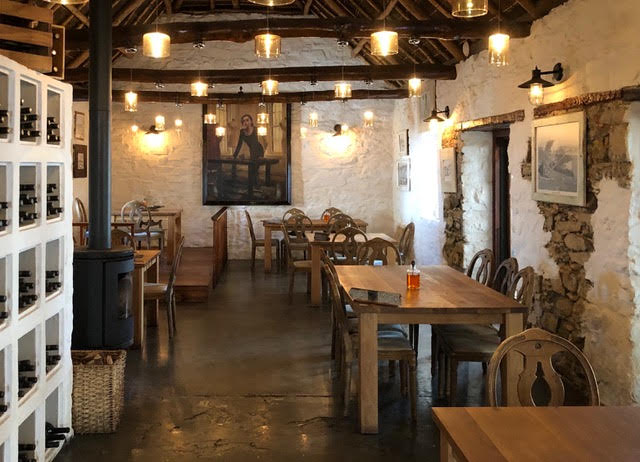
Die Damhuis is prominent on Beach Road. It sits close to the cars, its lime-wash-white walls and rough buttress visible from the sand. The thatch hangs low. Even if you can’t date it to the nearest half-century, it screams “national monument”.
The tables are full and a manager seems to never leave his spot at the front door, checking reservations, requesting the use of sanitizer, reminding people (the cyclists) to put on their masks, and declining chancers without bookings. Die Damhuis has been popular for over a decade. The views, coffee, food and service are all good – very good, actually. But what’s truly unique is the building.
Die Voorhuijs with its ancient walls.
The walls of Die Damhuis are famous for their composition. They are mostly built of local sand and stone, but cattle dung was used too. And hay. And whale bones. In the historic inside section of the restaurant (“Die Voorhuijs”), sections of plaster have been stripped back to reveal the very rough, chunky form of the walls. It’s a bit like dried-out, rocky road biscuit mix.
Our coffees are served hot – I do like coffee as a hot drink, not a room temperature one, what about you? Service at Die Damhuis is swift and efficient – and friendly. When I express an interest in the building’s history, waitress Louise Booysen hands me Damhuis Cookbook, the big, hardcover coffee-table-cum-history-cum-recipe-book that’s available for browsing and purchase at the restaurant. The book was written by Damhuis owners Dirk and Reinet Nagtegaal.
In the foreword, Dirk says Die Damhuis was built by Christiaan Brand and his family. According to him, Brand was the first resident of Melkbos. He may have been the first settler: Ancient Khoi-San middens and stone-age artefacts have been found nearby.
“Piping hot and generous”.
Brunch has arrived, and very quick it was too. The Banting Breakfast – with poached eggs, bacon, hollandaise sauce, a black mushroom base and roast tomato garnish – is piping hot and generous. The eggs are perfectly poached, the bacon is neither fatty and limp nor overcooked to a splintery crisp. The mushroom is meaty, the tomatoes are sweet and the hollandaise has a rich yellowiness to it that makes me think of big, brown-shelled farm eggs.
My husband’s hollandaise breakfast is wolfed before I have a chance to taste it – surely a good sign — and my fast-growing son’s toasted cheese and ham with chips is just what he wants: an extra-generous mound of chips and a sandwich heavily weighted with melty cheese.
If I had to be critical, it would be of the zig-zag balsamic glaze added to the hot breakfast plate for a gourmet flourish. I know that a strong feature of West Coast farm food is a delight in sweet and sour – think of bobotie with peach chutney; snoek with apricot jam, “korrelkonfyt” (raisin jam) or grape must with cheese, not to mention honeyed root veg – but to me the balsamic glaze zig-zag is simply an overused and now dated stab at Mediterranean style.
As the plates are cleared and we luxuriate in the sunshine and sea air outside, Die Voorhuijs is being prepared for lunch. Die Damhuis is famous for its oxtail, lamb shanks and tripe. Mussels and hake are popular too. Milk tart and lemon meringue pie feature on the dessert menu.
Interestingly, the restaurant’s interior didn’t start out as a home. It was originally a “visschuur” (fish shed), a place to clean, salt and dry fish. It became a home later. In front of Die Damhuis, under the tarmac of Beach Road, there is a fresh water spring. Once Brand had collected spring water into a dam, he and the family moved in, and the house became known as Die Damhuis.
There aren’t many restaurants in the Western Cape that have been occupied for two and a half centuries. Our oldest wine farms were established in the early 1700s. Like the Nagtegaals, the owners of places like Vergelegen, Spier, Groot Constantia, The Vineyard and the Cape Heritage hotel market a glimpse of heritage.
Through its book, its website, its menu and its interior décor, Die Damhuis very sensibly draws attention to its building’s history. Knowing that we’re dining in an SA National Monument, and being able to easily access information about the history of the area and the building, adds richness to our dining experience. This sense of place can be the difference between dining and destination dining: in other words, we might be prepared to drive out to eat in a place that makes us feel like we’ve been somewhere different – both in history and in real time.
Without grumbling, given the restrictions on movement in the past six months, “going somewhere different” is a longed-for treat.
Die Damhuis: 021 553 00932; Beach Road, Melkbosstrand; Diedamhuis.co.za
Daisy Jones has been writing reviews of Cape Town restaurants for ten years. She won The Sunday Times Cookbook of the Year for Starfish in 2014. She was shortlisted for the same prize in 2015 for Real Food, Healthy, Happy Children. Daisy has been a professional writer since 1995, when she started work at The Star newspaper as a court reporter. She is currently completing a novel.
Attention: Articles like this take time and effort to create. We need your support to make our work possible. To make a financial contribution, click here. Invoice available upon request – contact info@winemag.co.za
Introduction
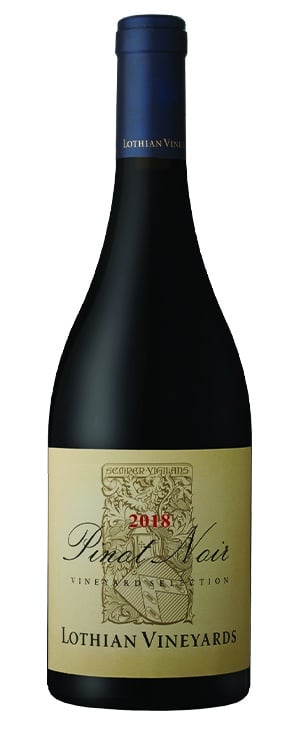
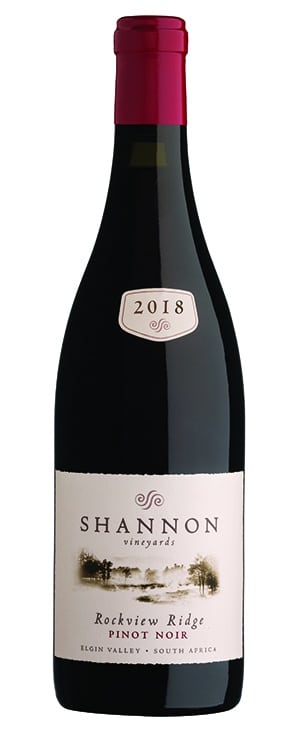
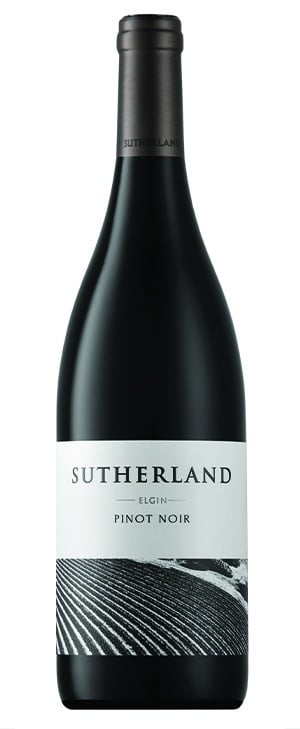
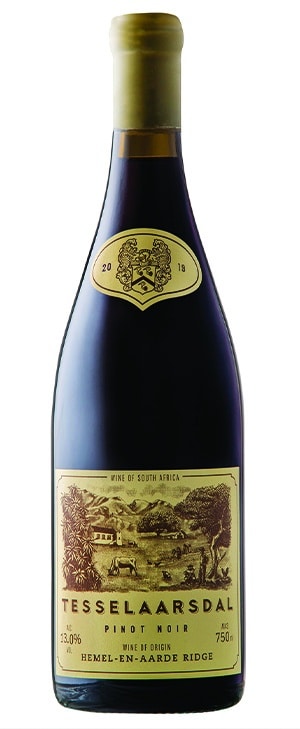
This year’s Pinot Noir Report convened by Winemag.co.za and sponsored by multinational financial services company Prescient is now out. There were 30 entries from 24 producers and these were tasted blind (labels out of sight) by a three-person panel, scoring done according to the 100-point quality scale.
Top 10
The 10 best wines overall are as follows:
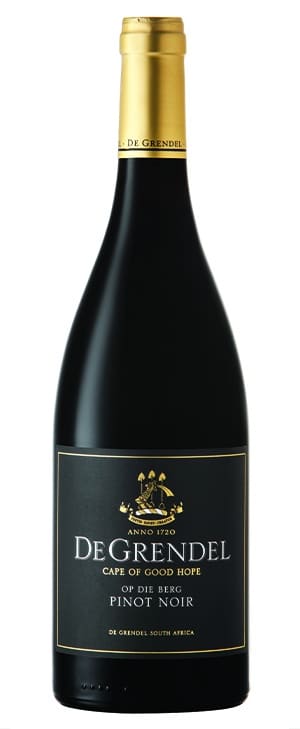
De Grendel Op Die Berg 2018 Price: R220 Wine of Origin: Ceres Plateau Abv: 13.7%
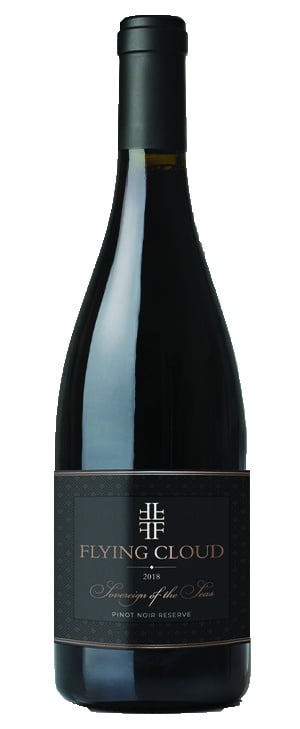
Flying Cloud Sovereign of the Seas 2018 Price: R295 Wine of Origin: Outeniqua Abv: 13.1%
Though a notoriously difficult grape to work with on account of how fragile it is, Pinot Noir is capable of making red wines of great refinement and elegance. It is at its most glorious in Burgundy, France but there are now impressive examples from Oregon in the USA, New Zealand’s South Island and increasingly South Africa. At the end of 2019, it was the 12th most-planted variety locally making up 1.3% of the total area under vineyard.
What characterises Pinot Noir in the most basic terms is a certain sweet fruitiness and lower levels of pigments and tannin relative to the likes of Cabernet Sauvignon and Syrah. It is difficult to judge on account of how ephemeral it is in the glass but this is precisely the charm for many.
What does a top Pinot Noir go for?
The average price of the Top 10 is R319 a bottle with Sutherland 2017 the most affordable at R190 a bottle.
In-depth analysis
To read the report in full, including key findings, tasting notes for the top wines, buyer’s guide and scores on the 100-point quality scale for all wines entered, download the following: Prescient Pinot Noir Report 2020
Shop online
Johannesburg boutique wine retailer Dry Dock Liquor is offering all wines in the Top 10 for sale – buy now.
Video
CheNinà 2019 is a collaboration between Bernhard Bredell of Scions of Sinai and Raphael Paterniti and Marta Gobbo of Openwine, the Cape Town wine bar/retailer operation. The wine is dedicated to the couple’s daughter and the wrap-around label, which draws inspiration from the story of Alice in Wonderland, was designed by Michael Beckurts, a student at the Creative Academy – it won silver plus the People’s Choice Award at the Label Design Awards sponsored by self-adhesive label supplier Rotolabel earlier this year.
The wine’s not half-bad, either. Deep in colour, the nose shows naartjie, peach, a funky leesy quality and spice while the palate has good fruit concentration, punchy acidity and a savoury finish. Layered and long, it’s geeky in a good way. Price: R340 a bottle.
Attention: Reviews like this take time and effort to create. We need your support to make our work possible. To make a financial contribution, click here. Invoice available upon request – contact info@winemag.co.za
Andrea and Chris Mullineux.
The attention to detail that Swartland-based Andrea and Chris Mullineux bring to viticulture and winemaking borders on obsessive-compulsive disorder, the happy consequence of this being wines of rare craftsmanship. Tasting notes and ratings for the new releases as follows:
Mullineux Old Vines White 2019
Price: R325 a bottle.
The Old Vines White grows ever more intricate in its assembly – the 2019 consists of 74% Chenin Blanc, 8% Clairette Blanche, 7% Viognier, 6% Grenache Blanc, 2% Semillon, 2% Macabeo and 1% Verdelho – and the result is an ever more complex drinking experience.
The nose has an attractive floral top note before citrus and peach plus spice and a little earthiness while the palate has good weight and texture (alcohol is 14%) while not being short of freshness. This possesses layers and layers of flavour, the finish long and gently savoury.
CE’s rating: 95/100.
Mullineux Granite Chenin Blanc 2019
Price: R600
A hint of flinty reduction before pear, white peach, green apple, herbs and spice on the nose. The palate is lean in the best sense with pure fruit, fresh acidity and a saline finish. Elegant and energetic.
CE’s rating: 95/100.
Mullineux Quartz Leliefontein Chenin Blanc 2019
Price: R600
The nose shows yellow fruit plus a funky leesy note – bee’s wax comes to mind. The palate meanwhile is creamy in texture with coated acidity and a gently savoury finish. Broader and a little more rustic than its counterpart above.
CE’s rating: 93/100.
Mullineux Granite Syrah 2018
Price: R1 050
A hint of reduction before red fruit, tea leaf and white pepper on the nose. The palate has lovely shape and texture – pure fruit along with powdery, densely packed tannins while the finish is exceptionally long. Beautifully refined and poised.
CE’s rating: 96/100.
Mullineux Schist Roundstone Syrah 2018
Price: R1 050
A wonderfully complex nose of red and black berries, olive, lavender, fynbos and spice. The palate is extraordinarily vivid with great fruit definition, bright acidity and fine tannins. It’s a very direct, complete wine that should age well over many years.
CE’s rating: 98/100.
Mullineux Iron Syrah 2018
Price: R1 050
Black berries, violets, earth, black pepper and other spice. The palate is dense and weighty with nicely grippy, mouthcoating tannins, the finish super-savoury. As ever, the most forceful of the trio.
Attention: Reviews like this take time and effort to create. We need your support to make our work possible. To make a financial contribution, click here. Invoice available upon request – contact info@winemag.co.za
There are only 28 wines on this year’s Cape Winemakers Guild (online-only) auction, compared with 45 last year. Given the (ok, arguably) absurdly high prices that wine has been getting at the Strauss auctions during the Covid-19 months, I suspect that those winemakers who chose not to enter a wine this year might regret holding back. But logistics etc are too complicated right now for some, it seems, so we have this reduced entry.
Happily for keen auction wine-buyers, however, there is also a Vinotheque Auction (I pedantically note that it’s the CWG, not me, that doesn’t like to include the usual accent on “vinothèque” any more than the apostrophe that should be there in its name; though if they don’t want to do the French properly, why not just be less pretentious and use “wine library”?). This sale should be interesting and worthwhile all round for wine lovers, with a number of six-bottles lots – including some vertical selections, such as one of Paul Sauer which will no doubt do astronomically well – from past auctions. You can find the whole list on the CWG website here. The proceedings of this section of the auction will go to help CWG members needing help to support their employees in this challenging year.
As for the 28 CWG Auction wines, the standard is up to that higher one (in my opinion) we’ve been seeing in recent years. I tasted them blind this past week, following respectable pandemic protocols, along with some other critics and judges. Christian Eedes (CE) and Angela Lloyd (AL) have already published their views, in their very different styles, and in my remarks, I’ll refer to some of their judgements, as they inevitably differ from mine in some significant instances, as well as agree in others. I don’t aim to mention all the wines, but will include those that I most enjoyed and some that I most didn’t. I did score them and will mention scores when useful. I won’t aim to give full wine names, as these can be cumbersome, but identities will be clear.
The whites
Both bubblies on offer were admirable, showing some rich development. I’m with AL in just preferring the Silverthorn 2015 – I liked the greater freshness and incisiveness, But I’d rate both of them a little higher than CE did (and he preferred the Graham Beck 2009).
Christian rated the Bartho Eksteen Vloekskoot 2019 highly (93), but I found the oak and bit of residual sugar intrusive and the latter element tussling unhappily with the greenness on the finish. On the other hand, I liked the Miles Mossop Saskia-Jo blend a little more than he did: an interesting blend (chenin, clairette, grenache), with plenty of flavour and freshness and a lovely balance. At 95 points, that just pipped the Raats Chenin for me.
Of the three chardonnays, my favourite was – just – Ataraxia. Clearly the other tasters I’m referring to here and I all agree on the excellence of this category this year (two of CE’s three top-scorers). Ataraxia, Paul Cluver and Leeu Passant are all eminently buyable wines for the long term – the Leeu Passant Radicales Libres 2015 deserving special mention as being a fairly rare example of the experimental/different winemaking that the CWG should be encouraging.
The reds
If the chardonnays were the strongest white category, I was much impressed this year by the red Bordeaux-style wines – blended or varietal. (More evidence for me of Stellenbosch coming right!) As a category, syrah was less appealing, to my taste at least, and although I always respect Saronsberg wines, I find its Shiraz just too sweet and rich and oaky to cope with (I must say that sweetness is a general problem I still find on too many Cape reds, including even some that I rather liked on this tasting). Same goes, as always, for the Cederberg Shiraz. But not for the perfumed, more elegant and fresh Boschkloof Epilogue, which I’d eagerly score 95, at least. The Neil Ellis Tempranillo is ok but did little to change my conviction that this great producer of cab-based wines shouldn’t venture towards the Mediterranean.
Back to the cabs etc. Interestingly, CE’s lowest score overall was for the Spier Frans K Smit, which was among my favourites. I’ve always admired Frans K’s winemaking, generally without caring for the style – but he’s nowdays making more elegant, lighter, understated wines. This blend, for example, is not only (and irrelevantly in this context!) the Auction’s first certified organic red and spontaneously fermented, but declares just 13.5% alcohol. I also highly rated the Kanonkop, Delaire and Strydom blends, and the Edgebaston and Hartenberg straight cabs. In fact, the only one in this category I didn’t care for, really, was the Groot Constantia blend – ripe, big and oaky, but undeniably impressive (towards the lowest end of my ratings, around the middle of CE’s, and unmentioned by AL).
Ernie Els is another producer which (via its winemaker, Louis Strydom) has grown fresher and easier in recent years, and the Ernie Els 2017 is a brilliantly drinkable wine. We three all at least quite liked it. And it’s rather innovative, too, in exploring the great blending tradition of the old Alto Rouge: cab, shiraz, cinsault – which I discussed not long ago, looking at the history of red blends in the Cape.
You will, of course, find on the CWG website all the details of the 3 October Auction, including full info about the wines. If you are in the market for older stuff, make sure you look at the list of Vinotheque wines. And if you’re also a pedant, try to be a realistic one and forget that lack of an accent grave. Wine is probably more important.
Tim James is one of South Africa’s leading wine commentators, contributing to various local and international wine publications. He is a taster (and associate editor) for Platter’s. His book Wines of South Africa – Tradition and Revolution appeared in 2013
Attention: Articles like this take time and effort to create. We need your support to make our work possible. To make a financial contribution, click here. Invoice available upon request – contact info@winemag.co.za
The 2020 Nedbank CWG Auction hosted by Bonhams will be held online on Saturday, 3 October 2020, from 12h00 (London time). Due to Coronavirus, there will be no public tastings prior to sale.
The line-up comprises 28 wines, total cases on offer amounting to 564 cases (6 x 750ml) compared to 45 wines and 1 932 cases last year.
In support of one of the Guild members, buyers will have the opportunity to bid on smaller lots – the funds raised by the first case of six bottles of every wine will be given as financial assistance to Samantha O’Keefe, whose Lismore property in Greyton was devastated by fire in December last year.
The CWG will also be hosting a 50-item Vinotheque Auction, made up of older wines donated by members, the objective being to raise funds to assist employees within their businesses whose livelihoods have been affected by the Coronavirus pandemic.
Media and trade were invited to a blind tasting of the line-up, my scores as follows:
95
Ataraxia Under The Gavel Chardonnay 2019
Fermented and matured for nine months in French oak. Aromatics of blossom, pear, citrus and white peach plus some flinty reduction. The palate is pure, fresh and pithy. Intense but not weighty, this possesses plenty of detail. Focussed and precise.
95
Kanonkop CWG Paul Sauer 2017
Matured for 24 months in French oak, 100% new. A complex nose with some reduction before red and blackberries, rose-like perfume, earth and pencil shavings. The palate is dense and smooth textured although not short of freshness and the finish is very dry. Succulent and seamless, this is dialled up to the max as now seems to be the way at this cellar.
95
Leeu Passant Radicales Libres 2015
Grapes from Barrydale, maturation lasted 60 months. Deep straw yellow in colour, the nose shows citrus, oatmeal and some attractive developed character while the palate shows good depth of fruit, coated acidity and a savoury finish. Properly complex with layers of flavour and a super-long finish. That much less weird than 2014!
94
Boschkloof Epilogue Syrah 2018
Newton Johnson Family Vineyards Windansea Pinot Noir 2017
Paul Cluver The Wagon Trail Chardonnay 2018
93
Bartho Eksteen Vloekskoot 2019
Boplaas Cape Vintage CWG Reserve 2015
Cederberg Teen Die Hoog Shiraz 2018
Ernie Els CWG 2017
Groot Constantia CWG Gouverneur’s Reserve 2018
Luddite The Lone Stranger Mark ll 2018
Miles Mossop Wines Saskia-Jo 2018
Rijk’s CWG Chenin Blanc 2018
Rust en Vrede CWG Auction Estate 2017
92
Delaire Graff Estate Banghoek Cabernet Franc Cabernet Sauvignon 2016
Edgebaston Cabernet Sauvignon Reserve 2017
Graham Beck Cuvée 129 Extra Brut 2009
Hartenberg CWG Auction Cabernet Sauvignon 2018
Raats Family Wines The Fountain Terroir Specific Chenin Blanc 2019
Saronsberg Die Erf Shiraz 2017
Simonsig Mediterraneo 2015
Villiera Drip Barrel Cabernet Franc 2018
91
De Grendel Wooded Sauvignon Blanc 2019
Neil Ellis Wines Amper Bo Tempranillo 2015
90
Silverthorn Big Dog VI Méthode Cap Classique 2015
Strydom Family Wines The Game Changer 2017
What constitutes optimal winegrowing country is very much in flux, something that is well demonstrated by Sijnn, the property established by David Trafford of De Trafford near Malgas, near the Breede River mouth and some 250 km east of Cape Town. The Red from Sijnn is a field blend of Syrah, Mourvèdre, Touriga Nacional and Trincadeira and the 2016 has just been released.
The nose is very expressive with notes of violets, dark berries, earth and spice while the palate shows extraordinary depth, presenting as smooth-textured in the best sense, the finish very dry. Price: R390 a bottle.
Attention: Reviews like this take time and effort to create. We need your support to make our work possible. To make a financial contribution, click here. Invoice available upon request – contact info@winemag.co.za
According to Google Analytics, we had 29 391 users in August, an increase of 5.5% year on year. We are proud of this given the generally tough trading conditions for media. In this regard, we were saddened to note the recent closure of Associated Magazines and the magazine division of Caxton. News24, meanwhile, have opted for digital subscriptions but we would prefer to keep this site open to all.
At the end of last year, we began a reader funding drive to cover some of our costs and continue to provide coverage of an industry we all care deeply about. We suggested an amount of R600 a year or R50 a month per individual with a view to achieving a total audience contribution of R300 000 per annum. To date, we’ve had nearly 160 people pledge their support. We are most appreciative, but we still have a long way to go to reach our above-mentioned target by the end of 2020.

 Somesay Syrah 2019





 CheNinà 2019 is a collaboration between Bernhard Bredell of Scions of Sinai and Raphael Paterniti and Marta Gobbo of Openwine, the Cape Town wine bar/retailer operation. The wine is dedicated to the couple’s daughter and the wrap-around label, which draws inspiration from the story of Alice in Wonderland, was designed by Michael Beckurts, a student at the Creative Academy – it won silver plus the People’s Choice Award at the
 There are only 28 wines on this year’s Cape Winemakers Guild (online-only) auction, compared with 45 last year. Given the (ok, arguably) absurdly high prices that wine has been getting at the Strauss auctions during the Covid-19 months, I suspect that those winemakers who chose not to enter a wine this year might regret holding back. But logistics etc are too complicated right now for some, it seems, so we have this reduced entry.
 The 2020 Nedbank CWG Auction hosted by
  What constitutes optimal winegrowing country is very much in flux, something that is well demonstrated by Sijnn, the property established by David Trafford of De Trafford near Malgas, near the Breede River mouth and some 250 km east of Cape Town. The Red from Sijnn is a field blend of Syrah, Mourvèdre, Touriga Nacional and Trincadeira and the 2016 has just been released.
 According to Google Analytics, we had 29 391 users in August, an increase of 5.5% year on year. We are proud of this given the generally tough trading conditions for media. In this regard, we were saddened to note the recent closure of Associated Magazines and the magazine division of Caxton. News24, meanwhile, have opted for digital subscriptions but we would prefer to keep this site open to all.