
Group effort.
Wine distributors David and Jeanette Clarke along with Intellego winemaker Jurgen Gouws have for a while made a very palatable Pinotage in a new wave style, which is to say light and fresh. Previously they used grapes grown by Andrew Wightman of Swartland property Môrelig but in 2019 they worked with Scholtz Rossouw who also farms in the Paardeberg, the vineyard in question planted in 1968.
Winemaking involving carbonic maceration, the nose shows cherry and raspberry plus herbs, spice and a little earthiness while the palate is pure and fresh with crunchy tannins. Perfect for summer al fresco dining, this is a useful reference when it comes to plotting the way forward for Pinotage – see further thoughts on the subject here. Approximate retail price: R140 a bottle.
Editor’s rating: 92/100.

Find our South African wine ratings database here.
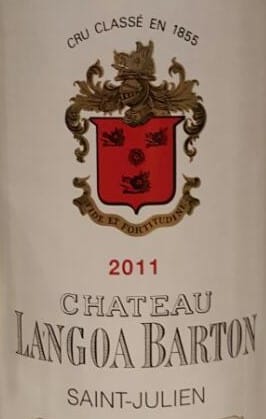 Yesterday the 2011 from Saint-Julien Third Growth Langoa Barton (picked up on sale from Ultra Liquors) next to the Cabernet Sauvignon Reserve of the same vintage from Stellenbosch property Delaire Graff. The former a blend of 63% Cabernet Sauvignon, 34% Merlot and 3% Cabernet Franc and the latter 95% Cabernet Sauvignon but including 3% Petit Verdot and 2% Malbec.
Both already drinking well but equally both possessing the inherent structure to last a good while yet, the Bordeaux all about elegance and refinement, the Stellenbosch wine showing much more fruit power.
It’s not difficult to make good wine: other than a reasonable winery and a degree of technical competence, all that you need are plentiful supplies of healthy grapes. Not tiny bunches with tiny berries harvested from ancient vines growing in obscure sites mid-way up steep slopes – just healthy wine grapes from any number of tried and tested varieties, competently farmed and fit for purpose. There are also plenty of places where suitable grapes can be farmed: all you need are ample supplies of water, reasonable sunlight, and a temperate climate. Torrential rain, high humidity, gale force winds are all weather conditions to be avoided.
La Mancha in Spain is perfect for this sort of production. It’s inland, the soils are homogeneous, there’s enough irrigation water to ameliorate the semi-desert conditions, and the ground is pretty flat so much of the farming can be mechanised. Unsurprisingly, it is the largest continuous vine-growing region in the world. At 190 000 hectares, it’s twice the size of the entire South African vineyard area and produces closer to three times our annual production. It has seven times the number of growers, but half the number of wineries.
When it comes to being in the wine business, La Mancha is one kind of “place.” But there are other kinds of wine “places” – tiny sites in the midst of well-known wine-producing regions where the fruit that is harvested delivers a palpably better result. The vines aren’t always significantly older – Leeuwenkuil’s Heritage block in the Swartland is probably only halfway to old vine status – nor do they have to be planted on vertiginous slopes.
Often there’s no satisfactory explanation for why one such site is better than a neighbouring block. I once stood with the owner of the Domaine de la Romanée-Conti overlooking his two most prized vineyards, Romanée-Conti and La Tache. They are divided from each other by a very narrow block (“La Grand Rue” – about 30 metres wide) owned by another proprietor. They are pretty much at the same altitude. They are farmed in exactly the same way, and vinified in the same cellar, by the same winemaker. When the wines are young it’s sometimes difficult to tell them apart. As they age, they evolve differently. No one has yet come up with a plausible and complete explanation for why the difference between the two wines relates to differences in the geology (or anything else) of two near-adjacent sites.
You can’t produce Romanée-Conti in La Mancha, nor could you produce in Vosne-Romanée the very acceptable La Mancha table wine which sells in tanker-loads. They are made for two entirely different markets, at price-points so far apart that for every bottle of current release Romanée-Conti you might buy, you could actually purchase over two containers of table wine from these relatively newly laid-out vineyards in the heart of Spain.
Some wine writers and the geekier consumers think that this commodity versus terroir wine dichotomy must lead to a fatal outcome for one of the combatants. If price alone is what drives the market, the La Mancha option must necessarily overwhelm fine Burgundy. But what is empirically clear that both have a place, and the market determines – to a greater extent – the risks and rewards of each option.
For South Africa, the problem at present is that our Burgundies are being overwhelmed by our La Manchas. The state of the economy, the loss of premium consumers (to recession down-buying, to emigration and to the Grim Reaper) has shifted the balance of power so that many of the fine wine sites are under-recovering on their operating costs. The fear is that they may soon succumb to urban creep. At the same time, our La Mancha grape growers along the Orange River are flourishing, their business booming as the economy forces existing consumers to buy down, and as many newcomers to wine respond to the attraction of brand before recognising the value of origin.
This is not a problem which can be solved by government intervention – through a more buoyant environment (something which is partly in the power of politicians) would certainly help – as would a clear statement from the authorities that rezoning of agricultural land for high-density residential purposes will never be permitted. The solution must come from consumers who refuse to pay a premium for non-premium wine. As long as wine drinkers allow brand owners to use (admittedly perfectly good) cheap juice there’s no incentive for them to buy fruit from the premium appellations. If the great estates of the Coastal Region are to survive, they have to ensure that the wines they make are distinctive enough to warrant the premium they need to charge. The fact so many aren’t anywhere near breakeven suggests a lack of competence and a lack of imagination.
The ever-increasing availability of reasonable quality cheap wine from irrigation areas is what is nowadays called “disruption” – no different from the impact of Uber on the taxi industry and AirBnB on the hotel trade. Those who do not adapt will perish, and VinPro, for all its appeals for higher grapes prices, will not be able to save them. The growers have driven their wine farms into the ground. They’ve had so little money for so long that they now cannot afford to replant their virused vineyards. The ever-decreasing yields of ever less attractive fruit will never be worth the kind of money which would make the farm a viable proposition.
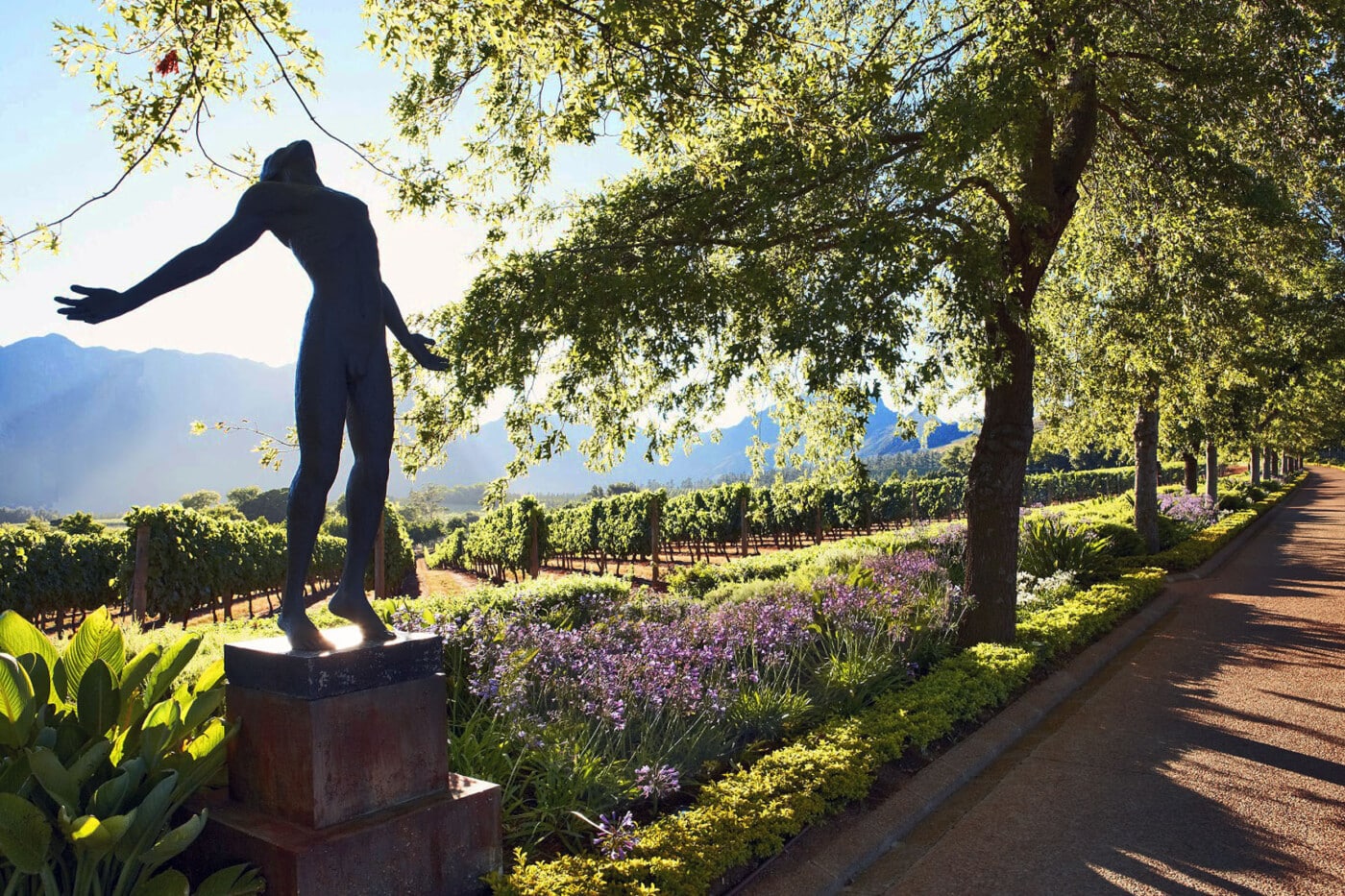
If South Africa were to become an investible proposition, international buyers would arrive to take them out of their misery. Laurence Graff bought the rundown Delaire farm and turned into an iconic property. This isn’t going to happen for the many other properties which today are like Delaire was 15 years ago – not as long as the land issue remains unresolved, and not as long as political uncertainty prevails.
Remarkably, Stellenbosch cellar Kleine Zalze has two wines among the winners of this year’s Standard Bank Chenin Blanc Top 10 Challenge, namely the top-end Family Reserve 2018 (approximate retail price: R220 a bottle) and the mid-range Vineyard Selection 2018 (R120 a bottle).

Bang for the buck.
Happily, the Vineyard Selection is both widely available and provides excellent quality relative to price. From vineyards that are 30 years old on average, winemaking involved maturation in old oak for six months. The nose shows citrus and peach with some hay and spice in the background while the palate is super-rich and super-fresh – concentrated fruit combined with punchy acidity.
Editor’s rating: 91/100.
Find our South African wine ratings database here.
Almost twenty years ago Garth van der Walt set a new foodie standard in the South Peninsula. Back in 1997, he was one of the founding members of The Olympia Café in Kalk Bay. His job was the food. Now he’s at it again.

It’s Friday night and there are white tablecloths over the wooden tables at the Empire Café in Muizenberg. There are flowers and candles. There’s a musician. Imposing, bearded Van der Walt is visible in the kitchen. The Empire isn’t usually open at night but Van der Walt is trying something new.
Our table is offered a free sangria – made the traditional way, with red wine, fresh fruit and sherry, – or a glass of cider. We’re handed a freshly-printed menu, listing just 15 dishes.
Our table is happy until the chisa nyama plate arrives. And then we become very happy.
Chisa nyama means ‘fired meat’ in IsiZulu. Van der Walt’s take on the tastes of township steakhouses is outstanding. The thin slices of beef short rib have an oily, smoky meatiness that is complemented by a loose, fresh-tasting polenta and Van der Walt’s made-from-scratch chakalaka. It’s an evocative dish. The chakalaka is chunky and good and hot. It takes you out of yourself like loud music. The meat tastes like being outside in the heat and the night. The yellow polenta is that warm-inside, restoring experience of a great night with friends.
The prego sauce for the albondigas – spicy Spanish meatballs – is also made from scratch. The venison meatballs – made mainly with kudu meat – are delicious. This time Van der Walt situates us somewhere between a gourmet prego roll and a boerie braai in the bushveld. Either way, we’re in South Africa, and we’re outside, near fire and beer.
Van der Walt does not pull punches with his flavours. At its best, his food is not just tasty but transporting.
And he’s at his best with meat. The way he pairs passion fruit with pork belly – that small plate staple – is bold, with both cooked and raw fruit on the plate.
My favourite vegetarian dish is the “meatiest” one. The roasted beetroot for the bruschetta with pesto and pecorino crisp is velvety-rich.
The other strongly-flavoured vegetarian dishes are good, too. The feta-filled chilli poppers are salty, spicy-hot and satisfying. The honey-caramelised Karoo green olives are deeply flavoursome.
The “quieter” dishes suffer by comparison. The prawn rissois, the guacamole with nachos, and the kingklip and ham phyllo parcels with tomato and basil cream are accomplished. They also demonstrate range. But sharing table space alongside the punchy meat dishes, they taste to me like date-night food when what I want is more parties-on-plates.
The biggest disappointment is the arancini: a crumbed mushroom risotto ball filled with mozzarella. The crumb is crisp and the risotto is tasty but the mozzarella is frozen. It’s a technical fault Van der Walt should not have made, but to be honest I don’t mind. Arancini are not hard to come by. I find Van der Walt’s takes on local flavours far more interesting than his Mediterranean-inspired dishes. (I’m going to have to go back another Friday for his waterblommetjie tempura.)
It’s the precedent set by the meat dishes that make the crème brûlée and the fruit crumble a little disappointing too. They don’t end the meal with a bang.
Given Van der Walt’s skill, there’s a modesty to this menu. As appropriate as tapas is to Empire Café, what with its view of grungey-salty Muizenberg Beach, I wonder if what Van der Walt is serving here isn’t essentially a five-course menu of small plates. One could easily build from dips and olives to veg to fish dishes to meat – and finally to dessert. The prices suggest tapas: the most expensive dish on the menu is R42. But the quality of the meat dishes is not far off the small plates at Pot Luck Club.
To be fair, Van der Walt has a challenge on his hands – and it’s not just to make a profit in famously unflashy Muizies. Van der Walt is conscious of the legacy of David Jones, founder and former owner of the Empire Café, who died suddenly last year.
Jones, Van der Walt and Kenneth McClarty opened Olympia Café together in 1997. Not only did The Olympia succeed, it inspired so many new cafes and coffee shops in the South Peninsula it’s no longer possible to swing a wetsuit without hitting a ciabatta or a flat white.
McClarty was the dog-loving foodie, and he’s still at The Olympia. Jones was the surfer-baker. His recipes are still in use in the Olympia bakery. Van der Walt was the meals guy. His cooking flair is behind many of the most-requested breakfast, lunch and dinner dishes on the Olympia’s chalkboard menu.
When Jones died twelve months ago, Van der Walt didn’t hesitate to step into his old friend’s shoes the Empire kitchen. Patrons of the café like the fact that Jones’s menu is still up, along with his portrait. This may explain why some items on the tapas menu are new and exciting, while others are soothingly familiar. I wouldn’t mind if Van der Walt phased out the hummus, the roast peppers and the smoked aubergine – but then I’m not a local.
Muizenberg is mellow and it’s anti-pretension. Van der Walt’s tapas evenings boast live music and we were entertained by South African music royalty: former Gereformeerde Blues Band guitarist Willem Moller. No-one was shouting Moller’s credentials from the rooftops, and Van der Walt doesn’t shout his. That’s admirable, of course, but I don’t think anyone would mind if Van der Walt cranked the flavour volume up. Come summer, we’ll be longing for as many SA-inspired small plates as he can produce.
Empire Café: 021 788 1250; 11 York Road, Muizenberg
It’s easy sitting in Cape Town and hearing reports of the city’s reservoirs filling nicely and imagining that the drought is over. In many parts, for many agriculturists, it’s not. I fully realised this on a visit last week to three Swartland producers – and in fact, I’d recently heard a similar story from Peter-Allan Finlayson near Bot River in the Overberg: Gabriëlskloof was still in great need of more rain.
On the Paardeberg it was a warm, humid spring day, and there was the faint hope of a shower to come later that day. Everything was looking fresh and green and lovely, and there was the occasional standing puddle of water – for, yes, the winter rains were better than in recent years, giving the prospect of some relief, but the annual rainfall is still significantly down on the historic averages.
My first visit was to Barry Schreiber’s farm – not far from Adi Badenhorst’s and David and Nadia Sadie’s. It supplies grapes to a number of important producers, and houses the new (that is, long unused but now restored) cellar where Jasper Wickens makes his splendid Swerwer wines – his shiraz also comes off the farm. Jasper is married to Franziska, Barry’s daughter, who is the viticulturist here (and expecting their first child very shortly). They told me that so far this year they’ve had some 370 mm of rain, as against the 500-600 that used to be the normal average.
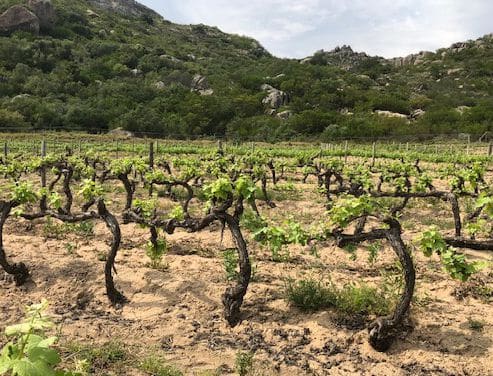
In fact, this lovely farm, at the end of the Siebritskloof valley running into the low, sprawling mountain, is usually a little wetter, as well as cooler, than most of the Paardeberg vineyards – it’s even called Waterval, after the water that can pour off the mountain ridge. Franziska is steadily planting more vineyards – this year two Portuguese varieties that should perform well in dry, hot conditions, tinta barocca and tinta amarela (trincadeira). But the main problem in the vineyards nearest the ridge is, I was surprised to learn, dassies – the rock rabbits. Apparently, it’s not so much a question of their eating roots, as I’d have imagined, but of their climbing into the vines and feasting on the green shoots!
I will later report further on this, my first visit to Waterval and the JC Wickens cellar.
Next stop was for a quick catch-up at Lammershoek, one of the largest estates committed to the ideals and precepts of the Swartland Independent Producers. A spin through the cellar with Jorrie du Plessis, winemaker alongside cellarmaster Schalk Opperman, continued the focus on vineyards. The Mysteries range is focusing on single-vineyard wines, including one from what seems to be the oldest chardonnay vineyard in the country – bushvines planted in 1981. Not the variety best suited to the Swartland, but a very decent wine and expressing a significant historical moment!

Eben Sadie in his Rotsvas vineyard.
On the matter of sustainability and vines suited to a Swartland in the grip of global warming, Lammershoek’s sales and marketing head, Jonathen Ralph, is a great fan of the Italian (mostly Sardinian) variety vermentino, so I dare say there’ll be some plantings of that soon. There already is vermentino planted just next door to Lammershoek, at Eben Sadie’s small farm Rotsvas. It’s one of a dozen or so varieties (I lose count) in the new vineyard destined to one day feed into Palladius. Last time I visited, the vines were not yet in: it’s exciting to see the changes in a project like this.
Just as notable are the changes in the black-grape vineyard on Rotsvas, which this year produced its first significant crop (Eben hasn’t yet decided what will happen to the wine). It looks remarkable, with a thick, now beaten-down cover crop – 15 types of plants in it – with square areas cleared around each vine. Interestingly, the vines looked much less advanced in terms of shoot and leaf development than others I’d noticed on the Paardeberg that day – because, Eben said, the roots are that much cooler under their substantial blanket.
The meticulous, painstaking work on these vineyards is expensive and laborious. The thoughtful detail of Eben’s never-ending work always impresses me. Every aspect of the farm and winery is carefully thought through and, not irrelevantly, done with an eye to beauty as well as usefulness: an elegant cantilevered steel framework for the new carport near the cellar, low and thick white walls everywhere – even curving up to the entrance of a tool shed with a flourish. But the vineyards, both here and those he manages together with other farmers, are his central focus and passion. I came to visit intending to discuss something quite other, but didn’t get the chance – or, rather, I chose to listen to fascinating disquisitions about vines and vineyards, soil preparation, and the problems resulting from the use of vine-grafting machines, etc.
An interesting conundrum comes out of Eben’s recent interplanting of vines in the gaps of all the vineyards supplying his Old Vineyard series (he’s just planted 7000 new vines in them). An old vineyard must be 35 years old to qualify for Heritage status in the Old Vines Project. As individual vines die or for other reasons must be replaced, at what point does the vineyard lose its status? Like the axe which remains “Washington’s axe”, despite both handle and head having both been replaced. Or like the Cape Fine and Rare Wine Auction, which claims to have been established in 1975 – even though the name and venue are new, and it sells a totally different kind of wine from that of the earlier days of the Nederburg Auction.

Boutique.
Attorney Alan Jeftha and sons Jaimie and Raphael planted just under 1ha of Syrah on their Constantia property next to Eagles’ Nest and then got the renowned Duncan Savage to consult on making some wine, 850 bottles of the maiden vintage 2018 now available and a promising debut it is, too.
The nose is particularly primary with a hint of reduction before violets, dark cherry, herbs and pepper while the palate is light-bodied with lemon-like acidity and crunchy tannins. Alcohol: 14%. Price: R210 a bottle.
Editor’s rating: 90/100.
Find our South African wine ratings database here.

Fail-safe.
Is there a top-end Chenin Blanc with a longer track record of excellence than Hope Marguerite from the Beaumont property in Bot River? First made in the late 1990s, the wine has grown in stature ever since and is now a leading example of what can be done with old vines, grapes from two such blocks, one planted in 1974 and the other in 1978.
The current-release 2018 involved spontaneous fermentation before 10 months of maturation in 400-litre French oak barrels, 15% new. The nose shows flowers, dried herbs, white peach, citrus and spice on the nose while some smoky reduction also lends interest. The palate shows great fruit definition, bright acidity and just a little phenolic grip on the finish. Layers of flavour, the overall impression savoury rather than sweet but nothing too severe about it – just beautifully envisioned by winemaker Sebastian Beaumont. Wine Cellar price: R315 a bottle.
Editor’s rating: 95/100.
Find our South African wine ratings database here.

Piece of work.
Lionel Smit is an artist, Bernhard Bredell a winemaker (his own label being Scions of Sinai) and this Grenache Blanc from Voor Paardeberg grapes is the product of their collaboration. Vinification involved three days of skin contact, fermentation occurring spontaneously, 25% in new oak before 10 months of maturation.
The nose shows dried herbs, pear, lime and white peach plus some leesy complexity. The palate is light bodied with driving acidity and a pithy finish (alcohol: 11.5%). It’s quite a stern wine but it certainly makes you sit up and take notice. Wine Cellar price: R335 a bottle.
Editor’s rating: 93/100.
Find our South African wine ratings database here.

Party on!
At the recent Cape Town lunch function to launch the 2016 vintage of Vin de Constance from Klein Constantia, managing director Hans Astrom said “We’re making like they do in Champagne and serving the same wine throughout the meal” – the maiden 1986 with duck terrine, the 2007 with crayfish, the 2012 with pork belly and the 2016 with cheese.
Astrom and winemaker Matthew Day make no secret that they are attempting to take the property’s famous late-harvest sweet wine Vin de Constance in a relatively lighter, fresher style. Why, you might ask? Well, the wine is something of an anomaly in that it is succeeding precisely at a time when the world’s other great sweet wines are faced by declining demand in the marketplace. Of course, Vin de Constance has got plenty of heritage, which accounts for some of its appeal, but what the astute KC team have realized is that it’s important to make the wine in such a way that it gives it more rather than fewer drinking opportunities. In a good vintage, total production can be as much as 35 000 bottles and you don’t want punters only drinking it on milestone birthdays…
My impression of the 2016, however, was that while the pursuit of elegance ostensibly makes sense, there might come a point where Vin de Constance is too pared down… Tasting notes and ratings for the 2015 and 2016, both previously unreviewed on this site, as follows:
Klein Constantia Vin de Constance 2015
Wine Cellar price: R1 095
An amazingly complex nose of orange, apricot and caramel plus notes of floral blossom, mint and other fresh herbs, ginger and other spice. The palate is rich and full yet energetic thanks to a cracking line of acidity, the finish long and savoury. Impressive but perhaps not as nuanced or complete as 2013 and 2014.
Editor’s rating: 95/100.
Klein Constantia Vin de Constance 2016
Price: TBC
A delicate and quite primary nose – lemon, a certain leafy quality, some floral perfume and a little ginger. The palate is clean and fresh – remarkable fruit purity, the finish long and pithy but definitely slighter, less opulent than other vintages of recent times.
Editor’s rating: 94/100.
Read Joanne Gibson’s article on how Constantia sweet wine was resurrected here.
Find our South African wine ratings database here.
Subscribers receive daily reviews and in-depth reports before release to the public. Cancel any time.
