Ballsy.
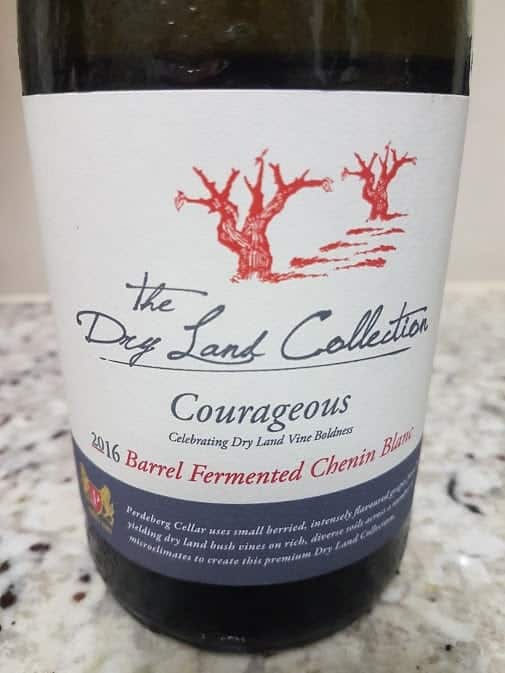
Remarkably, the The Dryland Collection Courageous Barrel Fermented Chenin Blanc from Perdeberg in Paarl has placed among the top 10 at the Standard Bank Chenin Blanc Top 10 Challenge for four consecutive years.
The current-release 2016 is old school but entirely delicious. Matured for 10 months in 500-litre barrels, 10% of which were new, the nose shows citrus and peach, bee’s wax and a hint of spice. The palate is rich and greasy with tangy acidity lending balance, the finish suitably savoury. Alcohol is 13.75% and RS is so 3.8g/l so not exactly aperitif style. Price: R127 a bottle.
Editor’s rating: 92/100.
Find our South African wine ratings database here.
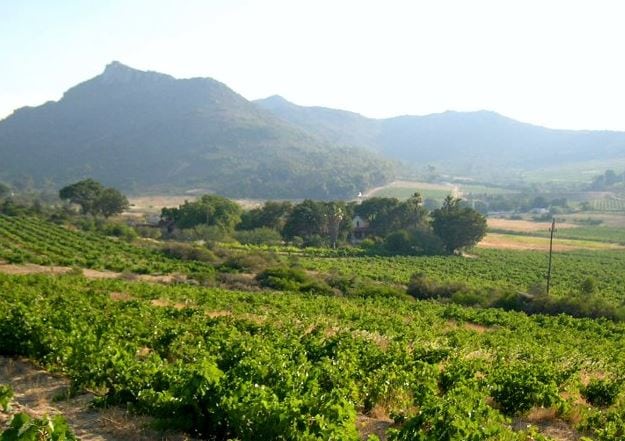
Fynbos Estate.
Johan and Diana Simons’s Fynbos Estate is in one of the sprawling Paardeberg’s many kloofs – across a few high ridges from more lushly vineyarded and better-known parts. Much of its 300-plus hectares is a nature reserve, and there are visitor cottages and facilities for functions, but all are modest, not imposing on what is undoubtedly one of the loveliest parts of the southern Swartland. There are also some olive groves, however, and 13 hectares of low-yielding bushvines from which Johan makes his wine in a small cellar dating back nearly 200 years.
These go under the Dragonridge brand – named for one of the peaks up which the nature reserve runs. I must have looked a bit doubtful when Johan pointed out the ridge to me, for he assured me that on a starlit Swartland evening, with a good few glasses of Swartland wine well absorbed and making for magic, one can clearly discern the shape of a sleeping dragon. Sounds reasonable to me.
Dragonridge Wines are not among the best known of the Swartland Independent Producers, for reasons including the breadth of the range and the small quantities, and a lack of energetic marketing – Diana and Johan are clearly despondent about the apparent need for social media involvement and the like; and as someone of approximately their age and background, it’s something I sympathise with. It’s hard when your heartfelt efforts are directed at being in harmony with nature, as theirs are, to be enthusiastic about selling yourself on Facebook.
Natural is what the wines emphatically are. “Natural” is a notoriously difficult category to define, and a contested one, but there are very few wine ranges in South Africa that meet the more rigorous standards, which would include hands-off, additive-free winemaking (not uncommon these days, especially in the Swartland) but also organic viticulture (that’s the really tricky bit). As to truly minimal sulphur content, that’s even rarer (and the most contested of the requirements). Dragonridge wines, however, meet all of those standards. They also, incidentally, take to an extreme the requirements for estate wines: Johan, who not only doesn’t enjoy marketing but thinks that truth should simply be allowed, is disappointed that the authorities won’t allow him to claim on his labels that on average for his wines there’s no more than 500 meters from vine to bottle.
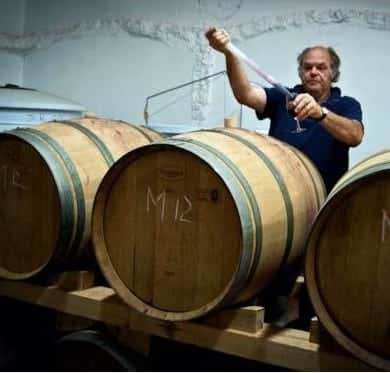
Johan Simons of Dragonridge.
So: a small, agricultural effort, from a producer determined to work with nature as much as possible and minimise the human footprint (Johan has recently returned to working only with cork and wax closures as he feels these to be more in accord with such principles), expressing the farm’s unique conditions. Unsurprisingly, the wines are unpretentious and honest, fresh and lively, often idiosyncratic. The range, as I said, is unwieldily large, occasionally unpredictable and adventurous – a good méthode ancestrale bubbly, for example, fits in well with the context, but who’d have expected a rather promising MCC from chardonnay to be on the way?
But Johan doesn’t seem offended or in disagreement when I suggested that he could be called a bit eccentric. Nor did Diana, who added: “He doesn’t care that much what other people think….” I’d guess that most other people would enjoy most of his wines, though – a forthcoming Pinotage 2017, for example, that’s lightly fruity and perfumed, easy-going and delicious, with modest alcohol (like most of these wines) and a hint of pinotage bitterness only adding interest. The best of the reds is probably the Aquila, a balanced, fresh and vivacious blend of sangiovese and cab. (The names of many wines, incidentally, derive from the heavens – stars and constellations, I believe.) But the one that I couldn’t resist buying a few bottles of was the Cygnus 2015, a gorgeously golden, delicious skin-contact, old-wood-matured chenin. A steal at R120.
Dragonridge wines are not easy to find, but if you’re within striking distance, you could do much worse than make a visit, which would be tonic for the soul as well as the tastebuds. Directions and plenty of information on the website.
 The 2018 Concours Mondial de Bruxelles was held over 10 to 13 May in Beijing, China and attracted over 9 180 wines from almost 50 producer countries. Results were announced recently and top performing South African wines were as follows:
Grand Gold
Waverley Hills Chardonnay 2016
Gold
Boschendal Lanoy 2016
Boschendal Sauvignon Blanc 2017
David Nieuwoudt Ghost Corner Wild Ferment Blanc 2016
Eerste Hoop Viognier 2016
Escapades Cabernet Sauvignon-Shiraz-Malbec 2016
Escapades Sauvignon Blanc 2017
Escapades Semillon Sauvignon Blanc 2017
Kaapse Pracht Chardonnay – Chenin blanc 2017
Kleine Zalze Family Reserve Cabernet Sauvignon 2013
Kleine Zalze Family Reserve Chenin Blanc 2016
Kleine Zalze Family Reserve Sauvignon Blanc 2016
Kleine Zalze Family Reserve Sauvignon Blanc 2017
Kleine Zalze Vineyard Selection Sauvignon Blanc 2017
Linton Park De Slange Rivier 2015
Lourensford Limited Release Chardonnay 2016
Ridgeback Journey 2015
KWV Roodeberg White 2017
Saronsberg Seismic 2015
Simonsig Chenin avec Chêne Blanc 2016
Spier 21 Gables Cabernet Sauvignon 2014
Spier 21 Gables Sauvignon Blanc 2017
Spier Creative Block 2 2017
Spier Creative Block 5 2015
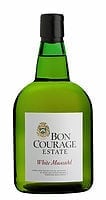 The 16th annual Muskadel SA Awards function, sponsored by Enartis SA have been announced. There were 31 entries, seven more than in 2017.
Platinum Awards
Conradie Family Vineyards Muskadel Limited Release 2009
Du Toitskloof Red Muscadel 2015
Bon Courage White Muscadel 2017
Bon Courage Red Muscadel 2017
Gold awards
Badsberg Perlé Moscato 2018
Boplaas Heritage Collection Terroir Selection Muscadel 2013.
Montagu Red Muscadel 2017
Montagu W & S Red Muscadel NV.
The five judges for this year were Dave Biggs (wine writer), Hans Lösch (previously Monis, now Columbit South Africa), Cerina van Niekerk (winemaker at Klawer Wine Cellar), Raymond Noppé (Cape Wine Master) and Nina Mari Bruwer (Cape Wine Master and Mont Blois winemaker).
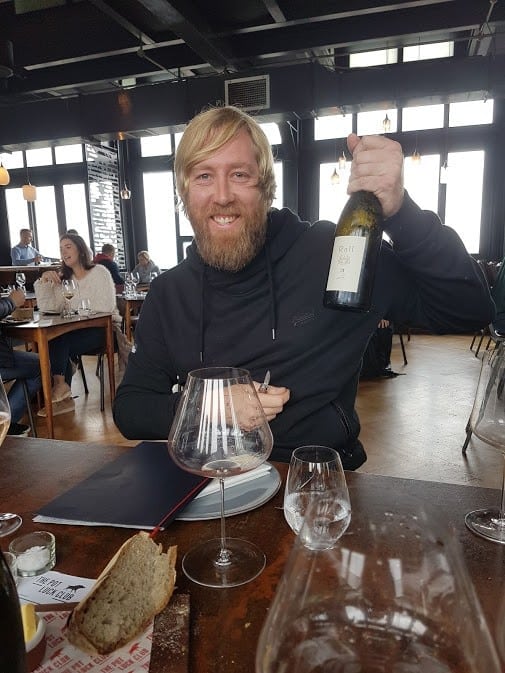
Donovan Rall of Rall Wines.
When Donovan Rall first started out back in 2008, there were just two wines, the White and the Red. The range has now expanded to seven (eight if you count the Pét-Nat made exclusively for the Japanese market) but the overall quality is as high as ever. Tasting notes and ratings for the new releases as follows:
Rall Cinsault Blanc 2017
Approximate retail price: R225
From a 0.2ha Wellington vineyard planted in 1989 and the only certified vineyard of this mutation in the country. Left on the skins for 72 hours and then matured in amphora for nine months. There’s a slight leesy quality to an otherwise shy nose while the palate is reminiscent of lemon cordial – light and fresh with a pithy finish. Alcohol: 11%.
Editor’s rating: 88/100.
Rall Grenache Blanc 2017
Approximate retail price: R225
Grapes from a Piekenierskloof vineyard. An elusive yet enticing nose showing pear, white peach, yellow apple and citrus overlain with floral and herbal notes. In the mouth, the flavours unfurl – great front, side and back palate. Light and graceful, lovely freshness and just a little grip on the finish.
Editor’s rating: 95/100.
Rall White 2017
Wine Cellar price: R300
71% Chenin Blanc, 24% Verdelho, 5% Viognier and the first vintage to exclude Chardonnay. Stone fruit and orange with top notes of potpourri and spice. Lovely presence in the mouth – muscular rather than weighty. Concentrated fruit and tangy acidity before a saline finish. Alcohol: 13.5%.
Editor’s rating: 94/100.
Rall Ava Chenin Blanc 2016
Sold out.
From a low-bearing 2.4ha vineyard Swartland vineyard plated on schist and just under 20 years old in age. The nose shows citrus and bee’s wax plus a definite but not unattractive reductive note. The palate, meanwhile, has a “fatness” about it despite a moderate alcohol of 13%. Layers and layers of flavour and nicely coated acidity, this is a most striking wine. Total production: 1000 bottles.
Editor’s rating: 94/100.
Rall Ava Chenin Blanc 2017
Approximate retail price: R450
Again a certain reductive flintiness to the nose and again a palate that is not without grunt. Aromas and flavours of herbs, pear, lemon, naartjie, peach and spice – so, so complex. Excellent fruit purity, fresh acidity and a pithy finish. Has a wonderful vitality and directness about it. Alcohol: 13%.
Editor’s rating: 95/100.
Rall Cinsault 2017
Approximate retail price: R225
Grapes sourced 50:50 from Darling and Swartland. 100% whole-bunch fermentation. A beautiful nose of red cherry, cranberry, earth and spice while the palate has great fruit integrity fresh acidity and tannins which are supple and fine. An elegant and sophisticated rendition of this variety which can tend to make quite rustic wines. Alcohol: 13%.
Editor’s rating: 94/100.
Rall Red 2016
Wine Cellar price: R305
70% Syrah, 15% Cinsault, 8% Grenache and 7% Carignan. 100% whole-bunch fermentation. Red and black fruit, fynbos, pepper and spice on the nose. The palate has a real succulence about it – pure and fresh with lovely ripe tannins, the finish long and savoury. Super-sexy stuff.
Editor’s rating: 93/100.
Rall Ava Syrah 2017
Approximate retail price: TBC.
From a vineyard adjacent to that which supplies the grapes for Ava Chenin. An utterly seductive nose displaying top notes of lilies and fynbos before black fruit, pepper and a little earthiness. Hugely intense and yet so vivid on the palate. Great fruit expression, lovely freshness and powdery tannins while the finish is extraordinarily long and dry. Manages to combine both gravitas and sexiness making for a riveting drinking experience – the essence of “Syrah”. Unfortunately only 900 bottles made but wines like this boost the reputation of the entire category.
Editor’s rating: 97/100.
Find our South African wine ratings database here.

Joakim Hansi Blackadder and Enrico Hoffman, BSH Home Appliances MD.
The competition to determine the first Gaggenau South Africa Sommelier Award winner was completed yesterday with Joakim Hansi Blackadder, managing partner in Somm Hospitality Enterprises in Stellenbosch, announced as the winner.
Blackadder will be heading off to Beijing, China during October to compete in the International Gaggenau Sommelier Awards against other winners from Switzerland, China, Hong Kong, Taiwan, Sweden, France and the UK.
Johannesburg-based Wikus Human of Marble restaurant in Rosebank, Johannesburg, was runner-up.
When golfer Ernie Els teamed up with Jean Engelbrecht of Rust en Vrede for the first wine to be produced under his eponymous label, what emerged was the most expensive modern South African wine yet. Engelbrecht ominously warned in advance that the price would be “commensurate with Ernie’s international standing”. The fact that it was to be directed heavily at the American market (presumably its legions of rich golf-fans in particular) played a part in this. The Ernie Els cab-based blend sold for $60 there, and R450 here. The current release, 2013, sells for R780 from the farm – still very expensive, but not at the local peak, nor anywhere near as lonely as it once was at that rarefied level.
If the price was guided by the American market, so was Louis Strydom’s styling: this was the time when Robert Parker’s aesthetic dominated the world of red wine, especially in America, so the wine had to be ripe, fruit-driven and richly textured, with smooth tannins and notes of expensive new oak. Wine Spectator responded gratifyingly,rewarding it with 93/100 points (as it did in the same report for De Trafford Shiraz 2000, at a mere $40) – the highest score it had ever given South African wine.
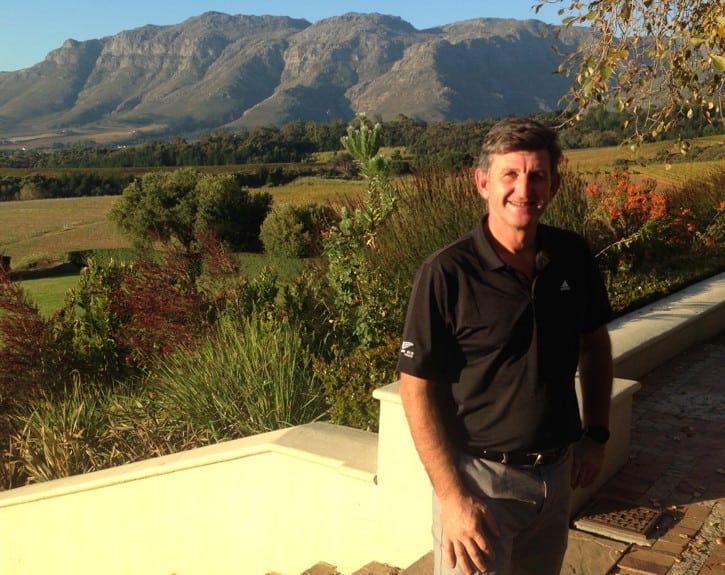
Louis Strydom of Ernie Els Wines.
This was to remain the style of Ernie Els Signature, and of the other wines that gradually emerged from the cellar – after 2004 in its own quarters, with its own vineyards on the Helderberg, and Louis Strydom the brand’s dedicated winemaker. He’s now MD too; for something about recent developments, including the near-complete bowing out of Ernie Els, and the new German proprietor’s more recent acquisition of Stellenzicht, see here.
At a recent vertical tasting of the wine, held at the cellar – which is now closing for a year to allow substantial renovations and developments – that maiden 2000 performed very creditably. On its way down, no doubt, but still with an obvious fruitiness. We’d already tasted two vintages of the Proprietor’s Blend, 2006 and 2009, which included 20% shiraz as well as the Bordeaux varieties, and the Signature was immediately obvious as being not quite as massively, sweetly opulent, frankly alcoholic, as those wines (though no shrinking violet, indeed). But one of those wines that has aged rather than developed interesting savoury qualities over time – here the primary fruitiness remained dominant, monolithic even.
The 2001 was a better wine of a similar type, showing some complexity. My own tastes meant that I rather preferred the 2002 – perhaps because, from that poor vintage, it simply wasn’t as ripe, seemed a bit tighter and fresher, with a herbal touch. The ageability of all the older wines was not unimpressive – the 2004, big, bold and powerful, still has plenty of room for development, I would say.
Unfortunately the cellar has no remaining stocks of 2005–2007, so the vertical tasting was interrupted. It resumed with 2008, a brilliant balancing act whereby, somehow, the 15.3% alcohol allowed a touch of something like smoky elegance to come through, and a characteristic tealeaf note, and inevitably, a finishing touch of sweetness of effect (all these not bone-dry, well over 2 grams per litre of residual sugar and occasionally over 3; with the high alcohol level, generally something over 14.5% playing its part).
I’m reminded with these, in fact, of another big, bold and notably well-made Cape wine – Saronsberg Shiraz. That wine, too, in its best years also achieves an element of gracefulness that one wouldn’t normally associate with this style. All these Ernie Els Signatures were consistent in basic character and flavour profile, leaving room for some vintage differences – though these have not been strongly marked (the 2009 especially good, perhaps, and the 2012, which concluded the lineup, also impressive). Noteworthy and admirable, I think, is the quality of tannic presence that Louis has conjured, particularly after about 2008. The goal of a firm, structuring presence but also a soft, velvety approachability has been well met.
Whether or not one particularly enjoys this style, then, it would be hard to deny the achievement of Louis Strydom in his way of expressing Helderberg grapes in the Ernie Els wines. It will be interesting to see if more recent vintages, and those to come, will show any meaningful response to the comparative decline in the fashionability of big, ultra-ripe, voluptuous wines, even to a small extent in the USA.
Above board.
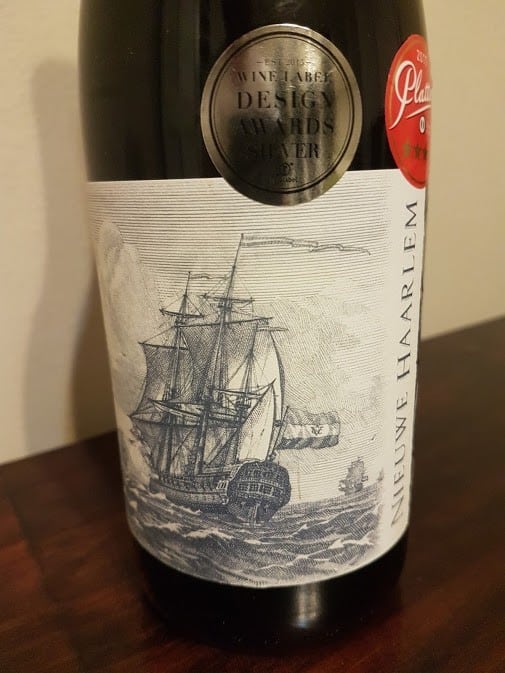
You’ve got it good when something like the Nieuwe Haarlem Cinsault 2016, grapes from 40-year-old Piekenierskloof bush vines, is available for just R75 a bottle.
The nose shows a slight reductive note before red cherry, plums, earth and spice. The palate is broad but equally not short of freshness and grip, the finish suitably savoury (alcohol is 13.37%). Nicely put together and the label isn’t half bad either – it won silver at the Rotolabel Wine Label Design Awards earlier this year (see here).
Editor’s rating: 88/100.
Find our South African wine ratings database here.
However distasteful the practice of wine listing fees that restaurants attempt to extract from producers, we must conclude that the fact that it still exists, is because most consumers don’t care that the result is reduced choice when dining out – only those producers with sufficient marketing budget to pay the listing fees get listed and those who can’t or won’t are excluded.
At stake, is the issue of total addressable market – South Africa has a population of some 56 million but clearly not all citizens are consumers of fine wine. The vast majority will be excluded simply by lack of disposable income. The (very) small potential market left is then constrained by 1) a low level of involvement – choice of wine is a fairly low priority for most people; 2) risk aversion – a tendency to opt for something tried and tested rather than an alternative that is new and potentially unpalatable; 3) lack of convenience – exploring an overtraded market and stocking the household cellar is too time-consuming; and 4) price sensitivity – a failure to recognise a material improvement in quality the higher the cost of the wine.
Let’s just be clear about how small appetite for fine wine is in South Africa. Natural wine had a 16% share of the total alcoholic beverage market in 2015. SAWIS defines “super premium” as wine selling at prices above R32.00 per 750ml, all other wine (so called “premium” and “standard priced”) falling below that threshold. In 2015, super premium made up 16% of the total of 383 million litres of natural wine consumed, the equivalent of 2.6% of the total market. What’s 16% of 383 million litres in bottles? It’s 81.7 million bottles. That’s right: fewer than 1.5 bottles costing more than R32 are consumed per head annually.
Meanwhile, pure alcohol consumption in South Africa was at 11.5 litre per capita per year in 2015, pushing us up to the third biggest drinking nation in Africa, and the 19th biggest drinking nation in the world, tied with Poland – clearly, we like a toot. It would appear, however, that the wine industry at all levels is not doing enough to penetrate into other sectors of the overall alcoholic beverage industry. Ask what radically new experiences are being created to attract new consumers and enable new use cases and the answer unfortunately has to be: Not very many.
 My contention is that the Internet is going to change this. When it comes to shopping, e-commerce has to be the way forward. To date, poor connectivity, on the one hand, and a lack of robust and well-developed shopping portals on the other, have constrained this. But broadband access continues to improve and the fact that online wine retail is so competitive (Cybercellar, Getwine, Norman Goodfellows, Port2Port, Wine Cellar, Wine of the Month Club not to mention the likes of Makro all fighting for a slice of the pie) means that service offerings must also get better – removing inconvenience from the wine shopping experience.
Online media meanwhile facilitates involvement – the winemag.co.za audience has grown by 210% from when we first started working on relaunching it as a purely digital entity at the beginning of 2014 until now (total users month to date: 22 159). Online media is also less elitist, content generators and users afforded a far more intimate interaction than was the case with print media, conversations and idea exchanges able to happen in real time thanks to apps like Twitter and the comment sections on websites. This, in turn, builds trust between commentator and consumer thus leading to the latter becoming less risk adverse and more confident about trading up. And to return to where this article started out, consumers will also become less tolerant of crappy restaurant winelists.
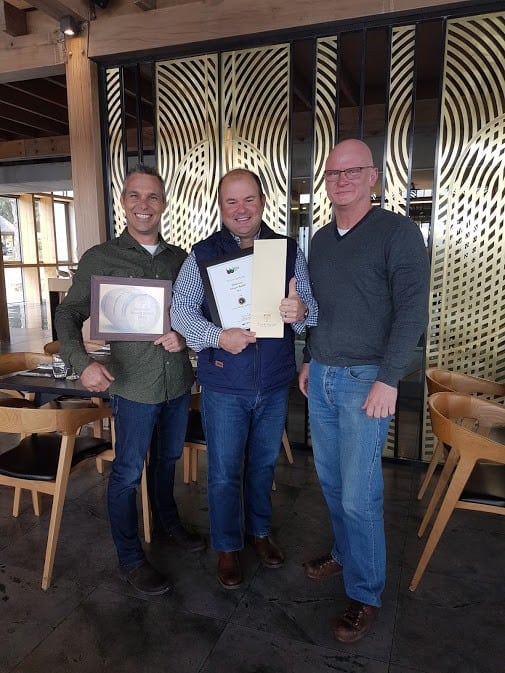 Best wine overall in the second annual Merlot Report was the Shannon Mount Bullet 2015 and the prize for producing this a new 225-litre Taransaud barrel worth R14 720.
Here Clinton Le Seur of Taransaud’s local agency Chene South Africa can be seen with Shannon Vineyards co-owner James Downes and winemag.co.za editor Christian Eedes.
To read the report in full, click here.
Subscribers receive daily reviews and in-depth reports before release to the public. Cancel any time.
