
Malu Lambert: Farmer Angus, chickens, carbon and how it all relates to wine
By Malu Lambert, 4 March 2026
-
Share:




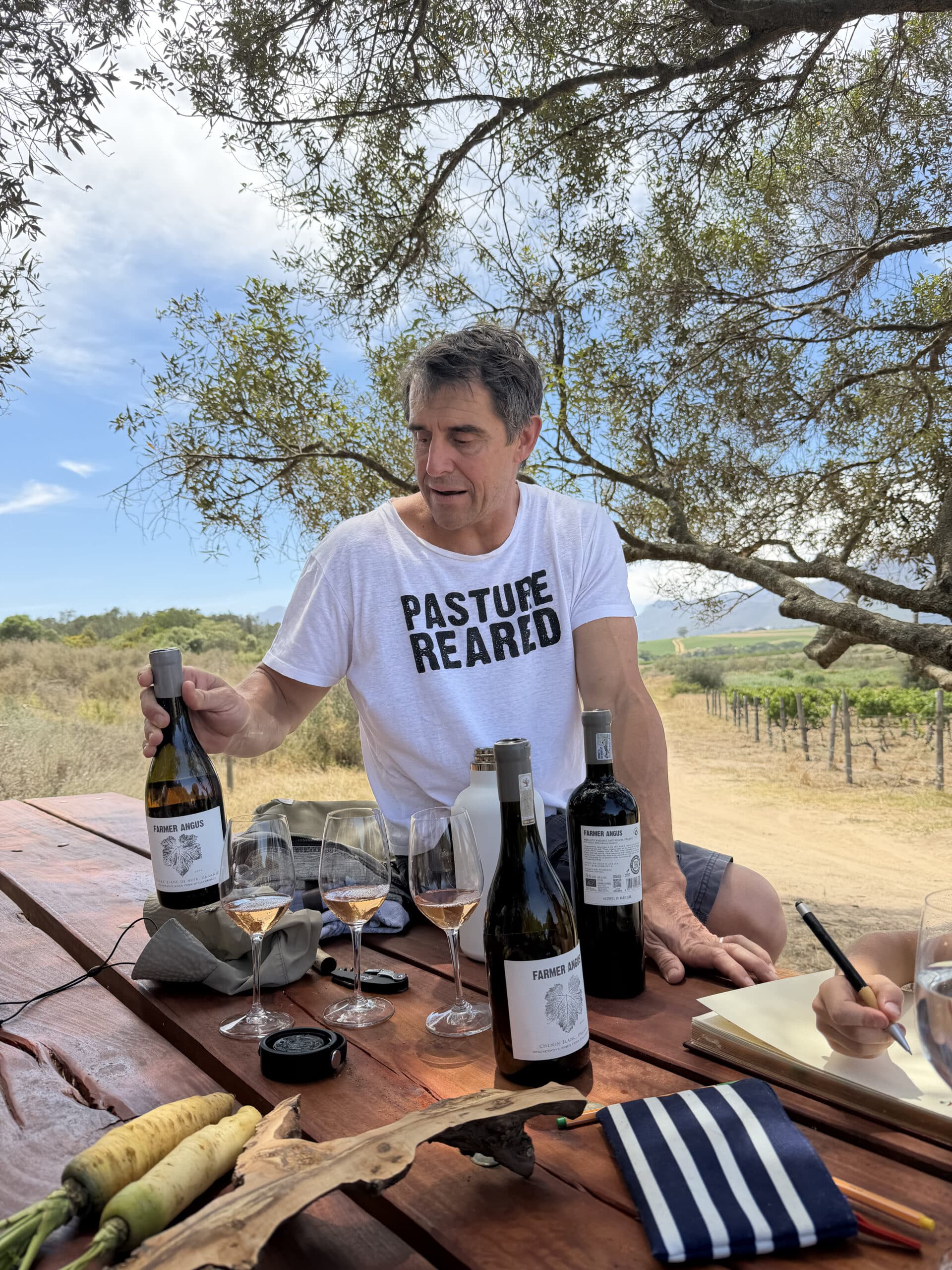 “PASTURE REARED” reads Angus McIntosh’s T-shirt, a white Leghorn chicken tucked under his arm. He’s better known as Farmer Angus, the name under which he sells his food range and, now, own-label wine. We find him at Spier in Stellenbosch, 650-hectares he farms regeneratively.
“These girls,” he says, nodding to the white-feathered hens ranging in and out of, and beneath, his custom-built Eggmobile, “are the biggest component of our business,” the majority of which, he shares, is employee-owned.
The mobile chicken coops move across the pasture behind the cattle herds. After the cows have grazed, the hens are brought in to scratch through the manure, eating fly larvae, spreading dung evenly and accelerating its breakdown, which naturally reduces parasites and boosts soil fertility. The system mimics natural grazing patterns, stacking livestock in a way that builds soil organic matter with the added advantage of producing pasture-raised eggs and beef.
The Leghorn back pecking on the ground, we continue our tour à la bakkie. Among the vineyards are pasture, vegetable plots, fruit orchards, rooibos and indigenous fynbos. “We have planted hundreds of thousands of bulbs, trees, shrubs and succulents,” he says.
Punctuating the vines are cylindrical cypress trees. “I brought the seeds back from Italy,” he says. “Over time, they’ve become epigenetically adapted to the farm.” When asked why plant them in the vineyard, the answer is esoteric. “The vine is the plant of Dionysus, the god of wine and pleasure, a downward force. Apollo, represented by the cypress, points upwards and serves as a kind of energetic counterbalance.”
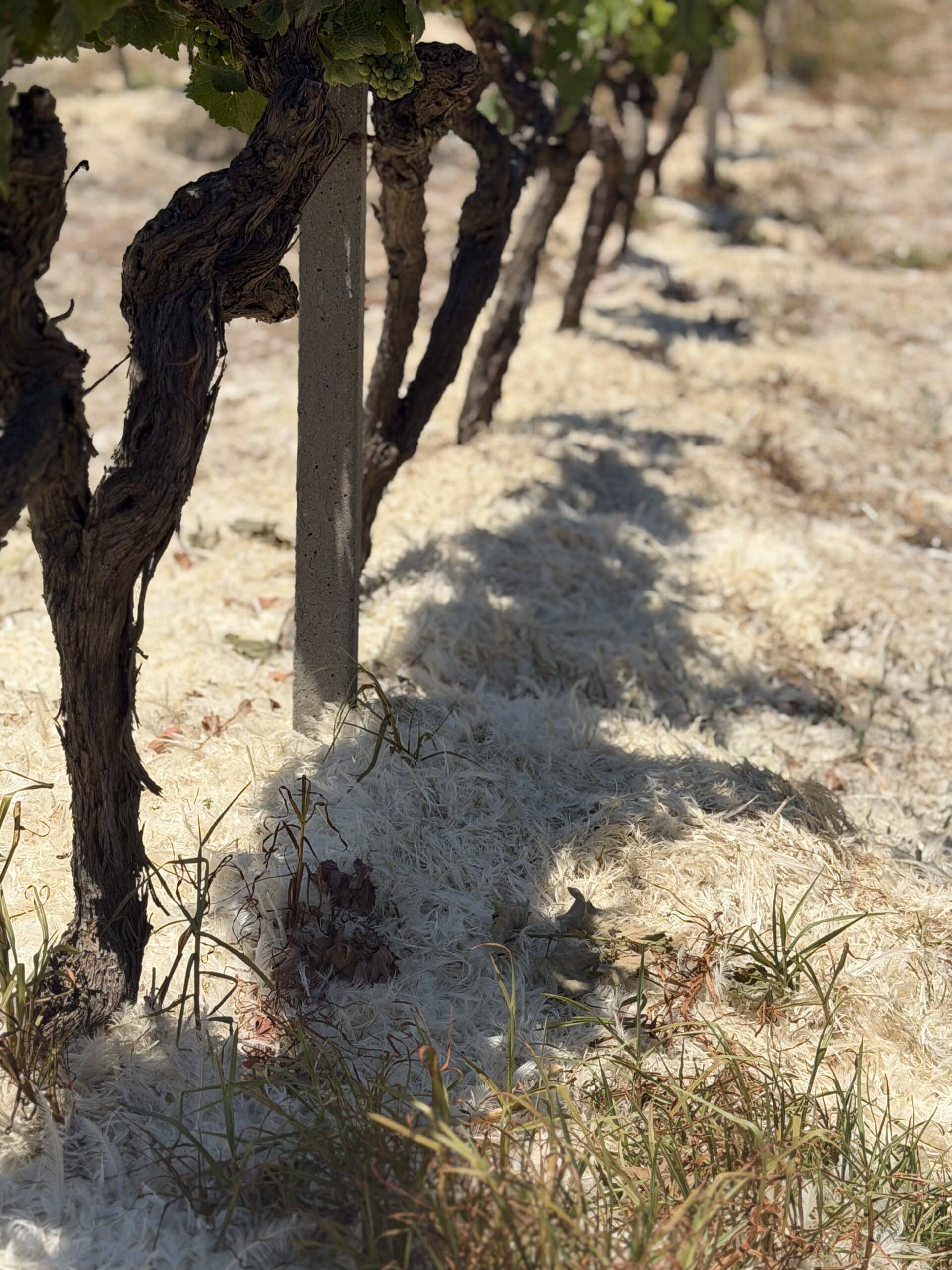 We come to a stop at a table beneath a tree. McIntosh has prepared an outdoor tasting of his range, complete with farm-grown charcuterie, each cut matched to one of the three wines. Beyond us, a block of chenin blanc appears dusted in snow, improbable in 35-degree heat. It is, in fact, chicken feathers spread between the rows as nitrogen-rich mulch (see right).
“We were the first in the country to do this,” he says. “It’s an extraordinary fertiliser, and it keeps the soils cool.”
Carbon credits
Delicious produce aside, what McIntosh is really farming is carbon. “If you’re a farmer, you’re either taking carbon out of the soil and dumping it into the atmosphere, or you’re putting it back. That’s the measure of whether you farm regeneratively or destructively. There is no middle ground.”
Though the project began in 2009, independent audits introduced in 2012 show the farm has removed more than 25 385 tonnes of CO₂ from the atmosphere. In 2014, it became the first farm in the world to be paid carbon credits for increasing soil carbon in grazing land. To date, audited credits exceed 23 000 tCO₂e.
He says the operation has sequestered four times more CO₂ than its wine production emits, meaning each bottle removes more greenhouse gas than it creates. Carbon credits are issued when verified soil carbon gains are recorded and sold on voluntary markets, and at Spier, half of the net income from those sales goes directly to farm workers.
“When producers describe themselves as carbon neutral, it means they’ve calculated their emissions and then offset them through carbon credits,” explains McIntosh. “We’ve taken a different approach and aimed to become carbon negative. In other words, we remove more carbon than we produce.”
McIntosh took over management of the farm in 2009, when 54 hectares of vineyards were still conventionally farmed. Unwilling to have these blocks in the middle of a regenerative system, he began converting the vineyards, and removing sites he felt would never produce quality fruit.
“There’s plenty of organic wine on the market,” he says. “We weren’t prepared to make bad organic wine.” The estate vineyards have been certified since 2015, and practices include biodynamics.
Early chenin experiments in 2006 were, he admits, “questionable.” By 2016, longtime Spier cellarmaster Frans Smit was satisfied with the fruit quality and started making small batches, joined by the farm’s ‘organic winemaker’ Tania Kleintjes. By 2024, they felt ready to release the wines commercially.
All certified organic and bearing the ‘Farmer Angus’ label, today we taste the sold-out 2024 chenin, piercing and Anjou-like; the 2024 blanc de noir from shiraz, limpid and textural; and a merlot-driven 2020 red blend (30% cabernet), all soft cherries and meltwater tannins. The labels are vine leaf rubbings corresponding to each cultivar, a technique McIntosh says he learned from his mother.
His in-laws own Spier, so the relationship between the brands is supportive, operating on a profit-share model.
The reason for creating a separate label is simple, he says. “After caring for these vineyards for so long, wine has become just another farm product, like the eggs. It’s my own expression. In time, I’d like to build a small cellar.”
While Kleintjes officially makes the wines, McIntosh says he is involved in every aspect. “About 80% of the result comes from farming decisions. With merlot especially, ripeness must be achieved in the vineyard; you can’t fix it later. Much of what we do focuses on reducing vine stress.”
On this point, he places a vine spliced in half on the table to illustrate the Italian Simonit & Sirch pruning method. “It preserves the vine’s vascular system,” he says, tracing a furrow, “and maintains sap flow. Traditional pruning creates repeated wounds that block sap movement over time. We believe we’ve extended vine lifespan by five to ten years and improved phenolic development during ripening.”
It is labour-intensive as each vine must be individually assessed, but it also increases engagement. “If the people working in the vineyard are engaged and proud, that energy carries through. It’s the difference between industrial and regenerative farming. There’s an emotional and biological response.
“Everything around us is alive and interconnected. The more we recognise that, the better our farming becomes.”
- Malu Lambert is a freelance wine journalist and wine judge who has written for numerous local and international titles. She is a WSET Diploma alum and won the title of Louis Roederer Emerging Wine Writer of the Year 2019, among many other accolades. She sits on various tasting panels and has judged in competitions abroad. Follow her on X: @MaluLambert
-
Share:

Related articles
Opinion & Analysis
Malu Lambert: Cap Classique surges at home but can it win abroad?
11 December 2025
Turning 21 is a coming-of-age. It feels fitting, then, that Silverthorn is marking 21 years since its maiden vintage: The Green Man Blanc de Blanc 2004. The boutique Cap Classique...

2
Opinion & Analysis
Malu Lambert: New map links Swartland geology to wine styles
1 October 2025
“We didn’t want another pretty poster by a cartographer,” says well-known viticulturist Jaco Engelbrecht in his characteristically direct manner. “This map links geology to viticulture and actual pockets of wine...
9
Opinion & Analysis
Malu Lambert: Uprooted – why SA vineyards are disappearing
6 August 2025
“Not known, because not looked for / But heard, half-heard, in the stillness / Between two waves of the sea.” Quoting T.S. Eliot, Jonathan Steyn, convener of UCT GSB's Business...
Comments
0 comment(s)
Please read our Comments Policy here.