
Jamie Goode: Wine tasting – are we making it up?
By Jamie Goode, 3 June 2026
-
Share:




3
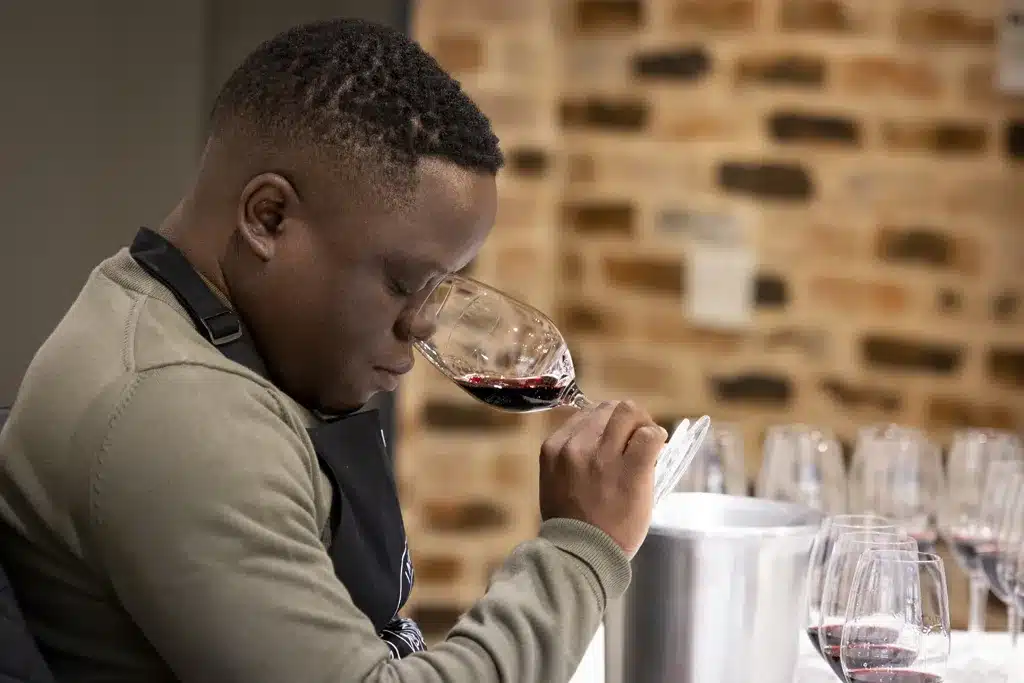
How much of wine tasting is real – and how much is just your brain filling in the gaps? Are we detecting stable, objective properties in the glass or constructing meaning in real time from a mix of chemistry, memory and suggestion?
Is wine tasting really objective?
We behave as if wine tasting were objective. When it comes to tasting wine, we try as hard as we can to get the conditions of the tasting right. We prepare the wine so it’s at the ideal temperature, we use good, clean glassware, we eliminate background odours and distractions like noise, and we limit the number of samples we try at once so that our palates aren’t too fatigued.
The way the wine industry works assumes that each wine has a particular taste or flavour, and that we all experience the same flavour when we taste together, and while we might have stylistic preferences, we nobly set the aside so we can discuss wines. Competitions and panel tastings assume that skilled judges will more-or-less agree about the wines they are tasting, and that their verdicts will largely be normative. Wine exams put students through blind tasting tests where the more skilled students will get close to the judgement offered on the wine by the experienced examiners.
Yet we all know that tasting blind is difficult, and even when we taste with skilled and experienced colleagues there will be some significant differences in verdicts and opinions. This was evidenced at a recent Ten Years On tasting looking at the top new wave South African wines from 2016 held in London. You couldn’t get a better bunch of top South African wine experts in the room – buyers, journalists, retailers. Yet the verdicts on some of the wines differed wildly.
Delve into the science of flavour perception, and suddenly it becomes clear why trying to evaluate wines in an objective fashion is so difficult, and the best we can hope for is intersubjectivity. And it also shows that when we taste wines as professionals and try to rate and describe them, we are making a lot of our perception up, and the result has as much to do with us as it does what is in the glass.
Let’s begin with smell
Let’s begin with smell, which is where a lot of the information about wine comes from. Remember, that when something is in our mouth, we think we are ‘tasting’ it. But much of the information is coming from retronasal olfaction, with odours escaping the oral cavity and entering the nose through the back door route. We localise these aromas to where the food or drink is present in the mouth (as sensed by touch) because if it is unpleasant (as decided by the nose) it’s then easier to eject it from the mouth. Effectively, we project a sensation detected in our nose from odorant molecules to the food or drink in our mouth, and see these properties as possessed by the stuff in our mouth. It’s a sort of illusion.
So we have between 300 and 400 different olfactory receptors. These are contained in olfactory neurons which are mounted on a postage-stamp-sized piece of tissue called the olfactory epithelium. This is where the brain meets the outside world! Each olfactory neuron contains one type of olfactory receptor. The fact that we can smell many thousands of different volatile chemicals (odorants) tells us that the signal coming from this olfactory epithelium isn’t a direct identification of each odorant. There must be some sort of coding going on. Each receptor will respond to a range of different chemicals, binding with varying degrees of tightness. The strength of this bonding is important information, as is the timing of it: how fast does it bind, and for how long? This information is sent to the olfactory bulb, where structures called glomeruli each receive thousands of inputs from the same olfactory receptor neuron type.
This is the primary information that we detect about smell at the sensory level. But a lot of processing is then needed to make sense of it. And flavour itself is a multimodal sensation, with contributions from sight, smell, taste, touch and sometimes even hearing, all bundled together at a preconscious stage to form a seamless perception where we largely don’t even recognize the contributions from the individual senses.
So back to smell. The idea that we are measuring devices is soon seen to be absurd when we understand what is going on. Think about the smell of coffee. It is formed by the joining up of many hundreds of different odorants, and yet we recognize coffee as coffee whether it is an espresso, or a flat white, whether it is speciality coffee or instant from a packet. This is because we learn to recognize patterns of receptor activation coming from the olfactory epithelium as odour ‘objects’. And often, vision is involved as well, as we see the coffee cues (it could be beans, it could be in the context of a coffee stall, or it could be the cup used) while we are exposed to the odour.
This is very similar to what occurs in vision. We are able to recognize a cartoon of a face with just a few lines as a face because we have learned that there are certain visual features that create a face, and in our environment, faces are very important objects. And more than just recognizing the face, we can see emotions displayed in a cartoon face because recognizing the emotions of others is a vital survival skill. The same applies for all manner of visual objects. Think of trees or cars. You might see a tree or car type that you’ve never seen before, but immediately you recognize it to be a tree or car with no effort at all.
And then, with olfaction, we have the problem that only the olfactory object theory will solve. Think of walking through a market where there are many different chemicals in the air. Immediately we spot the objects against a hugely complex background. We might smell pizza, cheese or sausages being fried. And coffee of course. And diesel fumes as a van starts up. One of the features of olfaction that helps us here is that we can rapidly adapt to base smells, and remove them from the picture. There’s a lot of interesting computation going on here. The stereo nature of olfaction may also be helping: we have two nostrils for a reason.
So when it comes to tasting wines, it’s really hard for us to behave like measuring devices and break down our perceptions in a reductive fashion, as we are encouraged to do with wine education programs. Studies have shown that it’s very hard (almost impossible) for people to identify the individual odorants in mixes when there are more than four odorants present. You can have an aroma wheel in front of you, but all that is doing is providing a lexicon (a set of descriptive words) where you are trying to match other odour objects with a novel odour object that’s in front of you: a wine.
This makes the path from perception to description (in words) a perilous one. It’s hard for everyone: not just you. [Hopefully you find this reassuring.] Even as an experienced taster, I find describing wines in words quite tricky, and it requires concentration, imagination, a bit of educated guesswork, and lots of stored experiences to compare the current one with. And in terms of language, some descriptors, some figurative language, and comparing the wine with others tasted.
And, I think it’s fair to say, we do make stuff up. Studies have shown that experts taste differently to novices. Novices focus on what is in the glass (bottom up) and then try to describe this, and they find it very hard because they lack the words for wine that professionals have. Experts taste what is there, but they also add to the perception from their bank of tasting experience (top down). They fill in gaps, and they often template. That is, they think about the wine, decide what it is, and then from the set of words they have for that wine type they make their note. For example, if I taste a wine blind and I think it’s Sauvignon Blanc, I go to my lexicon for Sauvignon Blanc and pull out the words that I think best match this wine.
This is why, I think, Peynaud was led to say that great wines tasted blind often disappoint. Once we know the identity of the wine, our experience can guide us to interrogate the wine in a smarter way to get the best out of it. I know that if I’m tasting a great wine blind, even if I recognize it to be a remarkable wine, I’d much rather be tasting it knowing what it is. The supplementary clues guide or fragile perceptions along the right paths; otherwise, it’s easy to get lost.
So what do we conclude? Yes, wine tasting involves lots of stuff that we make up, and many gaps are filled in with our own interpretations and projections. It’s very difficult, and we are not machines. But this isn’t a counsel of despair. Rather, knowing how our perception works, we are set free of the burden to always get it right, and we can begin really enjoying wine without performance pressure. And we can realistically work on improving how we taste, and how we describe wines as professionals, knowing our propensity to hallucinate as we taste. It’s a fascinating subject, and there’s lots more to say about it.
- Jamie Goode is a London-based wine writer, lecturer, wine judge and book author. With a PhD in plant biology, he worked as a science editor, before starting wineanorak.com, one of the world’s most popular wine websites.
-
Share:

Related articles
Opinion & Analysis
Jamie Goode: Viticulture is at a crossroads – but are new varieties really welcome?
5 March 2026
I’ve been following wine for a long time now, and since 2008 I’ve made my living entirely from communicating about it. I’ve learned a few things from my travels around...
3
Opinion & Analysis
Jamie Goode: Is wine really too complicated – or just too expensive?
2 February 2026
There’s quite a lot of discussion about the role of education in the wine world at the moment. Wine education is a thriving business. There seems to be a hunger...
7
Opinion & Analysis
Jamie Goode: Kiss the dirt – the truth about what makes great wine
9 December 2025
One of the biggest changes in viticulture over the last decade has been an increasing interest in what happens under the surface of the soil. We used to see vineyard...
Kwispedoor | 3 June 2026
Fascinating. Yes, of course our brains make stuff up. But I often see people making things up as a matter of habit, too. Where people review wine (professionally, or on social media), some things are quite obvious. Like the WSET reviewers (medium+ acidity, anyone?) or the excessively, often nonsensical, purple prosers (partly air-dried Turkish figs on the trembling al denté tummy of a Mongolian maiden). I prefer reviews of experienced tasters who have a real, authentic passion for wine and who write honestly and unpretentiously.
Your article also articulates nicely how very unlikely it is that any reviewers can really get 5-10 different flavours from every wine that they taste. Of course it happens that a particularly complex wine will catch you at a time when you, the wine, and the conditions alignin perfectly so that you can discern a plethora of descriptors. But every time? Classic gap-filling.
I’ve often wondered how often we’d find classic red wine descriptors in white wines, and vice versa, if we couldn’t see the wine. I’m not talking about common descriptors like blackcurrants, which you’ll find in white wines like Sauvignon Blanc, but things like red fruits in white wines. Or citrus in red wines. It happens, but extremely infrequently. Perhaps it’ll happen more if we never see what we taste?
Greg Sherwood | 3 June 2026
When Michael Fridjhon famously called my tasting notes “purple prose puffery” safely, he thought, behind a Business Day paywall, what he failed to grasp is that I often taste new wine releases over several hours, and indeed, often over several days, allowing the wine to evolve and open its shoulders, yielding forth a continious movable feast of aromas and flavours. When you try and convey that in a note to a consumer, it can perhaps come across as slightly spurious and manufactured. But whatever the case, this is still different to sip and spit critics who claim to assess accurately, 300 or even 400 wines in a day… with matching tasting notes. That to me is a more superficial style of tasting assessment.
Kwispedoor | 3 June 2026
Yes, giving a wine such a long time to evolve will certainly increase the chances of picking up more flavours and aromas (up to a point, of course – a reductively made Sauvignon will definitely also offer up new things after a couple of weeks open). And yes, NOBODY can accurately assess 300 wines in a day. I think the problem comes in when a certain style of writing/assessment is chased to such a degree that what’s actually in the glass is not ultimately properly captured . If basically every wine assessed yields a tasting note with 10 descriptors, or every wine moves one to poetry, it loses its authenticity.