
Tim James: A visit to Radford Dale’s developing organic estate in Elgin
By Tim James, 11 June 2026
-
Share:




One of the more profound pleasures in being intimately involved in (and reporting on) South African wine in the past quarter-decade or so of change has been seeing the growth of infant wine-projects into something substantial without overwhelming outside financial support. I’m thinking particularly of those that have led to the building of significantly vineyarded estates or at least wineries. There are not actually all that many – a sizeable proportion of the big names of the new world of Cape wines are not only buying in all (or the vast majority) of their grapes but are also making them in other people’s cellars.
Big names include, of course, Sadie (from making wine in a rented shed to owning a nice chunk of the Paardeberg and having a splendid array of buildings there); Badenhorst (with an even bigger chunk of the Paardeberg and a bigger business, and a cellar that is a serious advance on what he arrived to find – but which no-one would call splendid); Restless River (a brave and successfully-grown project far away in the Hemel-en-Aarde – where one would also have to include Ataraxia, amongst others); more recently, Testalonga and Mother Rock further north, and the infant new home to Callie Louw formerly of Porseleinberg.
There are more, of course. And a rather special and fairly rare case of substantial success is Radford Dale, which Platter’s welcomed as a Franco-Australian venture in its 2000 edition with a pair of 1998 wines made “after hours” by the Australian part (Ben Radford) in rented space. Alex Dale is in fact a Brit, though raised and with long wine experience in France. The name of the winery changed a few times (including, rather desperately, “The Winery” for a few years), though Radford Dale remained a range name. Later, from the 2019 vintage, the winery, long since established in premises on the lower Helderberg, changed back to Radford Dale, with The Winery of Good Hope now demoted, in turn, to being a range name.
Radford Dale became a significant landowner for the first time only in 2019, when it bought the small Elgin Ridge farm in Elgin. This had been farmed both orginally and biodynamically from the start; the latter nonsense (my opinion, not necessarily theirs!) was dropped, but the organic orientation, which fitted well into the RD ethos, was maintained, and it became Radford Dale Organic Estate. Founder of the company, Alex Dale, shows his commitment to organics by also being the motive force behind Organic Wines South Africa, which, although it doesn’t seem to have grown much since its founding 2024, should soon give more evidence of progress.
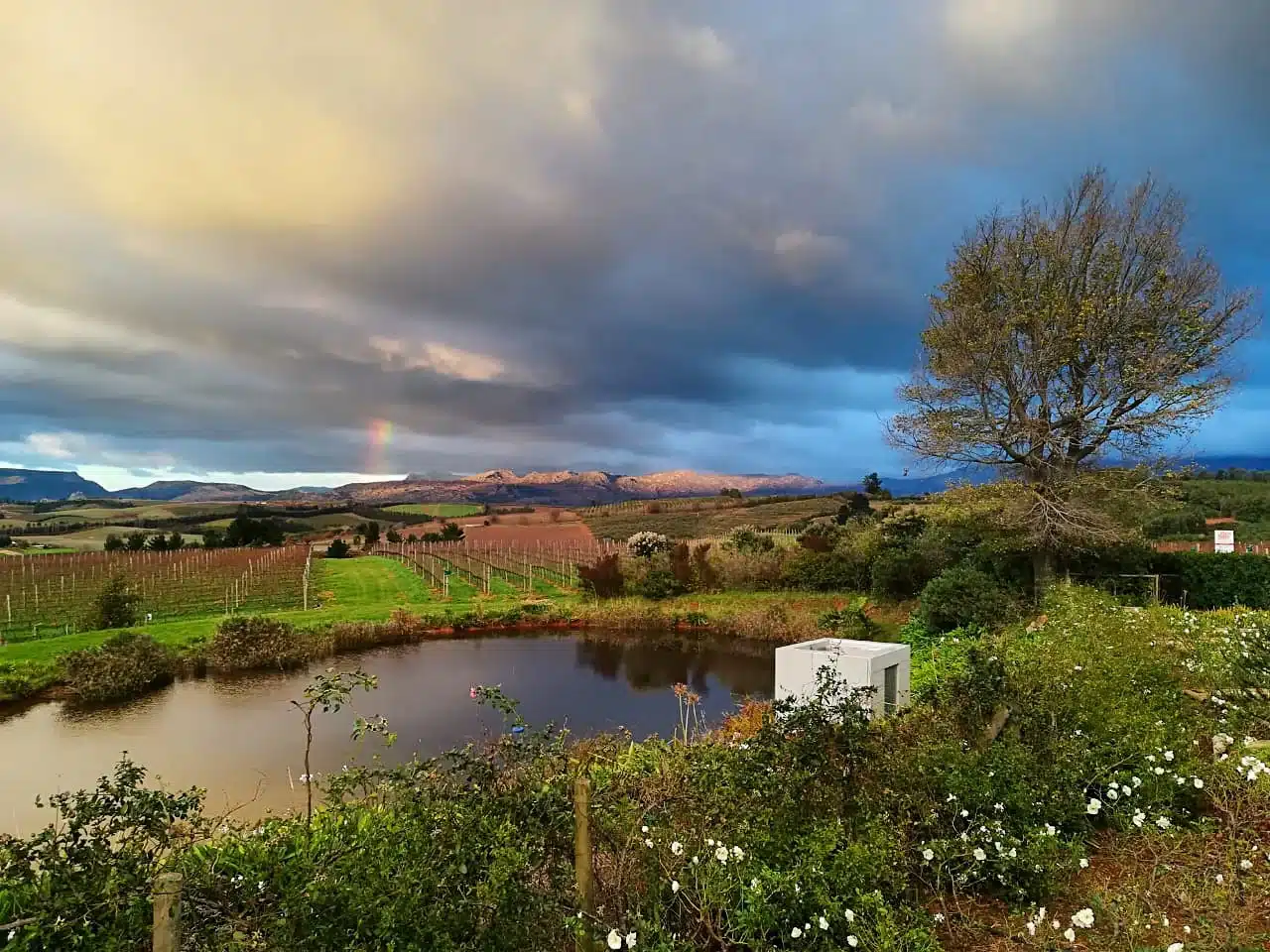
I visited the Elgin farm in early 2022 when it was getting into its stride under cellarmaster-viticulturitst Jacques de Klerk. He’s since moved on (to manage Krone in Tulbagh, which has a lot going for it but is not as pretty as, especially, this part of Elgin, with its rolling hills – vineyards dipping down the sometimes steep slopes in various directions – all looking particularly lovely and green, not to mention damp the day I arrived).
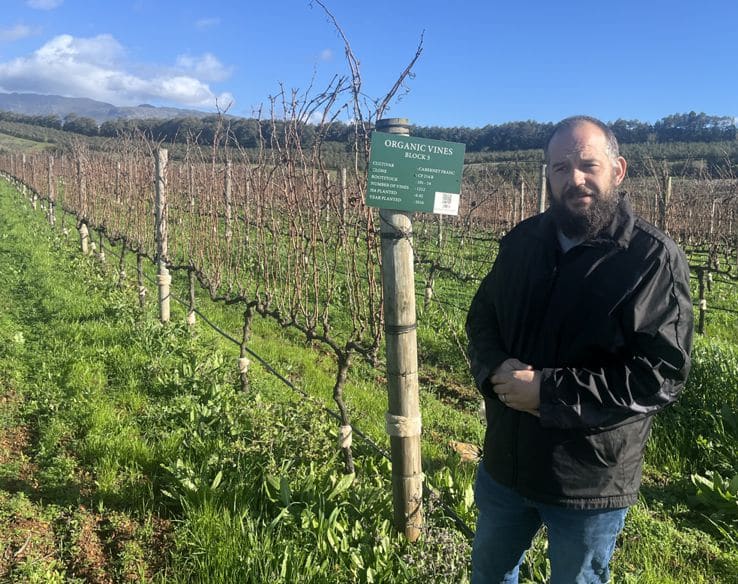
Gerhard Joubert of Radford Dale Organic Estate.
Change, especially in the vineyards, was already under way then, and it continues. Gerhard Joubert was Jacques’ assistant and is now farm manager. He walked me around the vineyards last week, together with RD winemaker Petroné Thomas and marketing man Tom Prior, who both divide their time between HQ in Stellenbosch and this increasingly significant Elgin outpost. The old sauvignon blanc vineyard had been doomed from the start of the new ownership, and the day of my visit the cut-short vines were being taken away. The semillon has also been removed. There are fields lying fallow, waiting to be planted, others have been regrafted (which is what will happen to the old sauvignon vines), some vineyards are mature and some getting there – including, importantly, new clonal plantings of pinot noir, as well as that RD specialty, gamay. A fine work in progress is happening.
With more grapes coming into the cellar, especially a volume shift towards red wines, there’s going to need to be some expansion there too – but new buildings can wait a year or two says Petroné. This is not one of those ventures where there is a lot of money to be thrown at projects: change is incremental. Witness, on a small scale, the clay pots. There are now three of them, this year holding the maiden, 2026, crop of gamay – which is something to look forward to. From the pots it tasted gorgeous: ripe but fresh, characterful, with some intensity and structure; probably the best Radford Dale gamay I’ve tasted. The 2026 pinot components in barrel also looked very promising, with the new clonal material making what will be a useful contribution to the blend.
We tasted the current range of releases off the farm, from the impressive 2025 vintage, alongside the 2024s, which Petroné bottled, but did not vinify. (All in the range should cost around R566.) The slightly older Touchstone Chardonnay 2024 shows a comparatively easy-going wine approaching readiness, nicely combining lightish, citrusy elegance at 12.5% alcohol (all of these wines are characteristically modest in this), with sufficient richness. 2025 delivered riper flavours, with a depth of peachy ripeness controlled by a serious but unaggressive acidity giving vibrancy and vitality; there’s a little more new oak on it which works well, adding to the complexity. A very good example of Elgin chard, I’d say, and a marked improvemement on the first wines following the RD takeover. All the work in these vineyards is clearly having an effect.
There was also a quality difference with the Freedom pinot pairing, at least partly reflecting the vintage character. The quietish 2024 is light and just a touch lean, I found, at 13% alcohol, a bit grainy. 2025 offers lovely pure fruit and some charm, with balanced acidity and decent length – also not for many years’ development, but it should improve and give satisfaction for a while. The 2026 vintage, as the barrel tasting suggested, looks set to raise the level here, as the new clonal material enters the blend.
Apart from that promising maiden gamay, the real red delight here is the Higher Purpose Cabernet Franc. The “recipe” now followed was, it seems, something of a happy accident originally. The grapes are fermented partly in concrete egg (and clay pot until 2026) for 10 days, 10% of them whole-bunch, so the temperature is not controlled, and there’s some carbonic maceration. There’s little oak influence. Both vintages show gorgeous, pure succulent fruit freshness, with an excellent balance of tannin and acidity – but the 2025 takes it all to a higher level of pure-fruited intensity.
If 2025 is a particularly impressive vintage at Radford Dale Organic, as well as more widely in the Cape, another change that’s less common is worth noting in the winery as a whole – a shift from heavy (900g) bottles to ones weighing less than half that. They take environmental concerns seriously here: all the packaging respects sustainability and they even went to some trouble to find a source of label backing paper (the stuff that’s discarded after peeling off the labels to apply to the bottle) that is recyclable.
The older Elgin vineyards of Radford Dale Organic are maturing under Gerhard Joubert’s careful regime; more are coming into production. Petroné Thomas is showing a delicate hand in the cellar, in line with the Radford Dale tradition. The future looks promising; this is a winery growth that must be especially welcomed for its respect for its sense of social and environmental responsibility – as well as ambitious and delicious wine.
- Tim James is one of South Africa’s leading wine commentators, contributing to various local and international wine publications. His book Wines of the New South Africa – Tradition and Revolution appeared in 2013.
-
Share:

Related articles
Wine
Book now for the PFS Winter Series 2026 public tasting – Cape Town
11 June 2026
Please join Winemag.co.za for a walk-around tasting of the top performing wines in PFS Winter Series 2026. Discover the best of our newly bundled seasonal reports. Featured categories are: Pinotage...
Reviews
Celestina Agulhas White 2024
11 June 2026
Want access to this content? Reviews and Reports are initially reserved for subscribers. Get immediate access to exclusive insights and data. SUBSCRIBE NOW Already subscribed? Login
Opinion & Analysis
Michael Fridjhon: The Tim Atkin Special Report and the question of independence
10 June 2026
The news, announced recently by Wines of South Africa (WOSA) to its members, that henceforth producers would have to pay to have their wines rated by Tim Atkin MW for...

Comments
0 comment(s)
Please read our Comments Policy here.