
Editorial: Not every good wine has to be rare
By Christian Eedes, 21 July 2026
-
Share:





6
South African wine has become remarkably successful at producing world-class bottles at the top end and inexpensive supermarket wines at the bottom. But what has happened to the space between commodity wine and ultra-premium offerings, where many consumers begin to trade up?
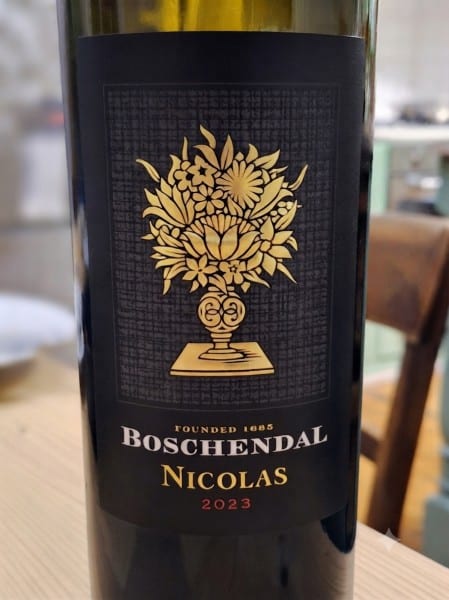 One fairly recent wine that attempts to address this gap is Boschendal Nicolas, a red blend launched by producer-wholesaler DGB. The maiden 2016 vintage was released in 2019 with a high-profile, luxury-focused campaign, the apparent aim being to create a brand offering superior quality and status to mass-market wines, but at a price point significantly below traditional luxury offerings.
Then selling for R200 a bottle, Nicolas challenged conventional terroir thinking by being classified as W.O. Coastal Region, and appeared aimed at emerging-market urban professionals while retaining sufficient quality and character to satisfy enthusiasts.
On quality, I wrote at the time: “Quite winning. Red and black fruit, a subtle herbal note, some floral perfume on the nose. The palate is medium bodied with fresh acidity and very fine tannins, the finish admirably dry. Not super-intense but balanced and supple.” I awarded it 90 points.
Critics questioned whether a relatively modestly priced wine could credibly occupy a luxury position, despite the brand ambition. Another issue was scale. Initial production was just 20,000 litres, or 26,666 bottles.
Commenting on this site, Mike Ratcliffe of Vilafonté and a seasoned industry player argued that South Africa needed globally recognised brands capable of selling millions of bottles annually. “The market is so big that Chocolate Block [from Boekenhoutskloof] and R&R Classique will never even notice the competition. The South Africa dream should be that we develop at least 10 single branded wines selling 2 million-plus bottles at the R200/$20/£12-15 price point or more – this would be a massive success. It can be done – quite quickly. This would start putting us on the map,” he wrote.
Fast forward to 2026 and the 2023 vintage of Nicolas (38% Cabernet Sauvignon, 29% Shiraz, 26% Merlot, 5% Cabernet Franc, 1% Malbec and 1% Petit Verdot and now designated W.O. Stellenbosch) has just been judged best overall in the Signature Red Blend Report sponsored by Prescient Fund Services, scoring 95 points. For those inclined to dismiss blind tastings as a bit of a lottery, it is worth noting that the same wine was awarded Best Other Red Blend at this year’s Trophy Wine Show, scoring 96 points.
Volumes are not yet at the 2-million-bottle mark, but they have grown to 210,000 bottles, just shy of 700% growth over eight vintages. Price, meanwhile, has risen to R240 a bottle, an increase of 20%.
A few observations:
- Volume growth is genuinely impressive.
Moving from 26,666 bottles to 210,000 bottles in eight vintages is exceptional. Many premium wine brands struggle to move beyond niche status. Nicolas has achieved meaningful consumer acceptance helped no doubt by canny distribution and brand activation. - The icon ambition remains a work in progress.
If the goal was to create a globally recognised South African super-brand selling one to two million bottles annually, there is still some way to go. At 210,000 bottles, Nicolas is a successful premium brand; at two million bottles, it becomes an industry case study. - The pricing strategy is intriguing.
A move from R200 to R240 over eight vintages is modest, particularly after inflation. In real terms, the wine has probably become cheaper. This could be read as DGB prioritising accessibility and volume over maximising price. Equally, the relatively modest increase may say more about difficult trading conditions than any conscious pricing strategy. - The numbers are not to be sneezed at.
The project moved from approximately R5.3 million in gross sales (26,666 bottles × R200) to R50.4 million (210,000 bottles × R240): just less than a tenfold increase. That is a significant commercial achievement.
My verdict? Nicolas has cleared the first hurdle. The interesting bit now begins.
Nicolas has become more than yet another red blend. It has developed into a genuine brand. The next challenge is whether it can cross the threshold from successful premium proposition to international-scale icon.
The danger would be celebrating too early. At 210,000 bottles, the brand has clearly gained traction. At two million bottles, it becomes transformative.
The kicker came this past weekend while visiting my parents-in-law in Montagu. Having woefully undercatered on wine to accompany our lamb shank lunch, I was quite happy to pick up a bottle of Nicolas from the local TOPS at SPAR. It is poised and unshowy, and at 13.5% alcohol, very much in tune with the idea that less can be more.
-
Share:

Mike Ratcliffe | 21 July 2026
well done DGB 🇿🇦
Hendrik Louw | 21 July 2026
Indeed something to celebrate. 🍷
Andrew Harris | 21 July 2026
Hi Christian,
Thanks for the insightful views on the brand success of the Boschendal Nicolas which has been, and still is, a long term project which has seen some early success.
Firstly, from the outset, quality was our number one priority immediately followed by the question “can we scale this quality?” which is what, among other factors, prompted our significant investment into vineyards in the Helderberg.
As these plantings have started coming online we have been able to move to WO Stellenbosch and are delighted with the quality and the subsequent recognition from several local and international critics and competitions.
The obvious thought would be that as a wine scales and blends get stretched quality would take somewhat of a downward trajectory, but we have actually seen the opposite due to the quality, and scale, of our Helderberg plantings.
As the vintages have progressed (and scaled) we have seen a marked improvement in the quality of the wine and the subsequent recognition, winning the Wine Mag Signature Red Blend Report as well as a Trophy at the Trophy Wine Show this year.
And you are absolutely correct, the first hurdle is now behind us, but this is just a start. We are seeing encouraging global interest in the wine and will continue to build the brand amongst ‘emerging-market urban professionals’ as you put it, as well as continuing to increase local distribution.
But as you say, this is still early days and by no means worthy of a celebration of final success, we remain optimistic yet realistic. Iconic global brands of 2 million bottles plus were not built overnight and while we may have made a good start recognise that we there is still more to be done.
Robert Bellon | 21 July 2026
Superb article
Thanks Christian
Robert Bellon
info@robertbellon.co.za
Louis | 22 July 2026
I agree. It’s relatively easy to make an exceptional single-vineyard wine when production is just a couple of thousand bottles. The real challenge is scaling up while maintaining consistent quality and character. South Africa has only a handful of producers who have managed that successfully. It’s often the established large brands, having built their reputation on inexpensive, everyday wines, that are now trying to move into the premium segment while still serving the mass market. Playing credibly on both fronts is no easy task.
Jason Messina | 27 July 2026
I called the Nicolas achieving these heights from the very first vintage, combined with DGB’s focus on only harvesting the best vineyards, this paid off handsomely! Congrats Team DGB!