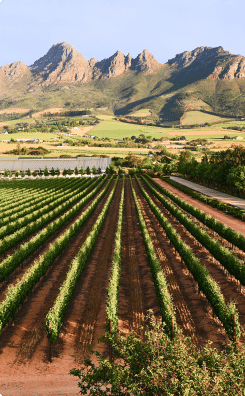
Stompie Meyer’s new property called Platteklip Vineyards is situated 30km from the Atlantic Ocean at between 600m and 800m above sea level in a small valley in the Piketberg, his fellow farmers more inclined to plant apples, pears, citrus, proteas and buchu than wine grapes. The sandstone soils are apparently most similar to those of Constantia, growing conditions to those of Elgin although there’s less humidity removing disease pressure.
Meyer acquired the property in 2016 which was then under natural vegetation and has to date planted seven hectares – the eventual wines could be designated either W.O. Swartland or W.O. West Coast but Meyer believes that his terroir is so unique that it deserves a brand new ward being declared and is lobbying for “Piket-Bo-Berg”. It will be a fascinating project to watch unfold but in the meantime, he continues with his Mother Rock label, tasting notes and ratings as follows:
Mother Rock Kweperfontein Chenin Blanc 2018
Price: R210
From a Paardeberg vineyard planted in 1984. A compelling nose of lemon, orange, herbs, spic and some leesy funk. The palate is super-concentrated with punchy acidity and a finish that is long and savoury. There’s no denying the rough edges on this wine but that’s what makes it.
CE’s rating: 93/100.
Mother Rock Liquid Skin Chenin Blanc 2019
Price: R225
From the same block as Kweperfontein but this kept on the skins for nine weeks. The nose has a pronounced reductive pong to go with citrus while the palate is lean with arresting acidity and a pithy finish. It’s super-geeky and comes across rather unresolved now but if the 2017 is anything to go by, should age well.
CE’s rating: 91/100.
Mother Rock Brutal! Chenin Blanc 2019
Price: R225
Grapes from a 1962 vineyard, the winemaking involves carbonic maceration plus two weeks’ skin contact. A pretty nose with top notes of hay, flowers and herbs before pear, peach and lemon. Light and fresh on the palate with a saline finish, this is most appealing.
CE’s rating: 92/100.


Earth child.
Mother Rock White 2019
Price: R150
From vineyards scattered throughout the Swartland, this consists of 57% Chenin Blanc, 22% Viognier, 18% Grenache Blanc and 3% skin-contact Semillon. A wonderfully complex nose of white peach, apple, lime, lemon, flowers and herbs. The palate is elegant and detailed – remarkably light and pure with bright acidity and a long, pithy finish. A delight to drink.
CE’s rating: 96/100.
Mother Rock Halocene 2018
Price: R210
From 50% Carignan, 35% Mourvedre and 15% Cinsault. Red fruit, some floral perfume, mint and other herbs, earth and spice on the nose while the palate is light, fresh and flavourful, the tannins fine.
CE’s rating: 91/100.
Find our South African wine ratings database here.
Attention: Reviews like this take time and effort to create. We need your support to make our work possible. To make a financial contribution, click here. Invoice available upon request – contact info@winemag.co.za
Why blend, rather than sticking to one variety? The more I ponder the question, the clearer to me it is that there’s always yet another reason to be found – but two of the commonest are probably “just because it’s there” and “tradition”. Though, of course, we can always hope that there’s an underlying aim of making a better wine from what’s available. You could always ask old Europe to bear witness to all these ideas, with hundreds of years sifting out the best potential of what’s available, either for blends or for single-variety wines. Although then you have to also consider modern “improvements”, which might also be considered as appealing to particular markets – such as the rise of the SuperTuscans rejecting the dominance of traditional varieties and techniques in favour of the international lust for the red Bordeaux varieties matured in new oak barriques.
Take the Cape’s white wines, for an instructive example about blending. Doubtless, the overwhelming number of “Dry Whites” (or their sweeter alternatives) simply reflect what’s available in those million-litre tanks, blended to make a wine that hopefully meets the market profile for a particular wine. At a more ambitious level of winemaking, things get more complicated, as the winemaker gets more demanding. In Swartland (or what could be called Swartland-style) whites, for example, where Chenin blanc is frequently the base, winemakers often seek to add some Clairette, generally a pretty neutral variety, not to add particular aromas or flavours, but to naturally bring up the blend’s freshness. On the other hand, viognier would be used (or sometimes avoided!) less for structural reasons than for aromatic ones, as it easily adds some peachy perfume. (There was, incidentally, a brief vogue which I suspect to have originated in Australia and “legitimised” by probably overstated practice in Côte-Rôtie in the Northern Rhône, to blend in some viognier to add a floral note to syrah; there are still some of these made, some very good, like La Motte’s Pierneef version, but fewer than a decade back, I think.)
To get back to the whites. I mentioned Chenin as the commonest base of Swartland-style whites – a now well established and critically successful category reaching far beyond the Swartland itself, but dating back less than two decades, to the maiden Sadie Family Palladius of 2002. Chenin was inevitably an (internationally unprecedented) significant part of Sadie’s blend because great quality old-vine Chenin was in such abundance in the Swartland. He also had easy access to good viognier and chardonnay. Since then, the growing complexity of the blend has seen the number of varietal components growing to something like a dozen. Some of them, particularly, are serving notably useful functions: early-picked grenache blanc and Clairette, for example, where fairly early additions, made to bring freshness and brightness. But some seem “merely” to be there because they are characteristic of the Swartland and therefore (somewhat theoretically as well as practically) contribute to the aim of making a wine that is reflective of that regional terroir. The Badenhorst Kalmoesfontein White similarly has around a dozen varieties, and I suspect it might be difficult to identify the contributing virtue of each and every one of them – though the whole is splendid indeed.
The “Swartland blend” was influenced by winemaking ideas of, especially, the south of France and the Rhône valley (and the latter influence has grown, notably with the increasing use of varieties like grenache blanc, Marsanne and Roussanne at least as much in blends as well as in varietal wines). But if the Swartland blend emerged from specifically Cape conditions (including Cape history as expressed by the ubiquity of old-vine Chenin), the Semillon-Sauvignon blend, made famous by André van Rensburg’s 2001 Vergelen, speaks eloquently of another reason for blending: authority and prestige. This is not at all to diminish van Rensburg’s wish to create something new (for South Africa) and commanding, from two varieties which complement each other beautifully. But that complementarity was long proved in the Graves region of Bordeaux and had acquired an international prestige which has undoubtedly furthered the proliferation of this blend in the cooler parts of the Cape.

It’s always interesting to suspect the greater prestige of European, especially Bordeaux, influence on South African winemaking than on some other, perhaps more self-confident New World producers, like California and Australia, where blended wines from the Bordeaux grapes are less advertised, and probably less practised, than here, and monovarietal cabernet sauvignon, for example, generally has more unambiguous prestige. Another suspicion I have long held is that there are more red wines in the Cape than in Bordeaux (let alone other countries) which proudly announce that they contain all five major red Bordeaux grapes – sometimes even naming the wine for that fact, in advance, as in De Toren Fusion V, Van Biljon Cinq, Raka Quinary, Constantia Glen Five, and Spier Creative Block Five if you know of others, please let me know; Gabriëlskloof used to have Five Arches).
If the traditional Bordeaux red blend (with cabernet sauvignon and merlot as overwhelmingly the major partners) has unparalleled prestige, it is not entirely because it “works” so much better than the individual varieties on their own (though it often does). Post-phylloxera replanting in Bordeaux eliminated a great many minor varieties (of course the plantings were not legislated then as they are now), leaving cab and merlot dominant. To an extent, this was a blend which reflected a happy partnership, with fleshier merlot plumping the elegant austerity of cab’s framework (as Rhône syrah also seems to have done in bad vintages in the old days). But it also worked as a kind of insurance policy, making it likelier that one or other variety would do better in difficult years. This must surely have also been behind the radically mixed vineyards of, for example, much of old Portugal.
But what was primarily exported to the emulating New World, surely, was the prestige of Bordeaux, with recipes trailing behind it. I had intended to speak in this article about what has happened to cab-based red blends here, especially with regard to cinsault, but that must wait, as I haven’t left myself enough space. Let me rather finish with a memory connected with that Bordeaux prestige here.
Billy Hofmeyr was self-taught when it came to winemaking, but a true lover of Bordeaux reds and that style was what he wanted to create when he established, in the 1970s, his small Paarl farm called Welgemeend. His 1979 Estate Wine was the Cape’s first commercial release of a red Bordeaux blend. He thought, incidentally, that it contained those five major varieties, but it later turned out that the petit Verdot was something else entirely. Anyway, as well as making the best wine he could each year from those varieties, he also amused and taught himself by making up each year a few bottles according to the blends of various famous Bordeaux châteaux, and he would put on the bottles photocopied labels from Margaux, Pétrus, Lafitte, etc, as appropriate. Billy retired from winemaking in the earlier 1990s, and earlier this century the Hofmeyr family sold the property, leaving a number of those Bordeaux facsimiles in the cellar. The excited new owners got in touch with an equally excited, and at that stage equally naïve retailer, who tried to sell them – but fortunately, the mistake was noticed before any irreparable harm was done to anyone’s reputation. Perhaps only I remember.
Attention: Articles like this take time and effort to create. We need your support to make our work possible. To make a financial contribution, click here. Invoice available upon request – contact info@winemag.co.za
Jasper Wickens has been a Swartland Independent producer since 2011 and now operates out of a renovated cellar on his wife Franziska’s family farm called Waterval on the Paardeberg. Tasting notes and ratings for the newly released 2019s as follows:
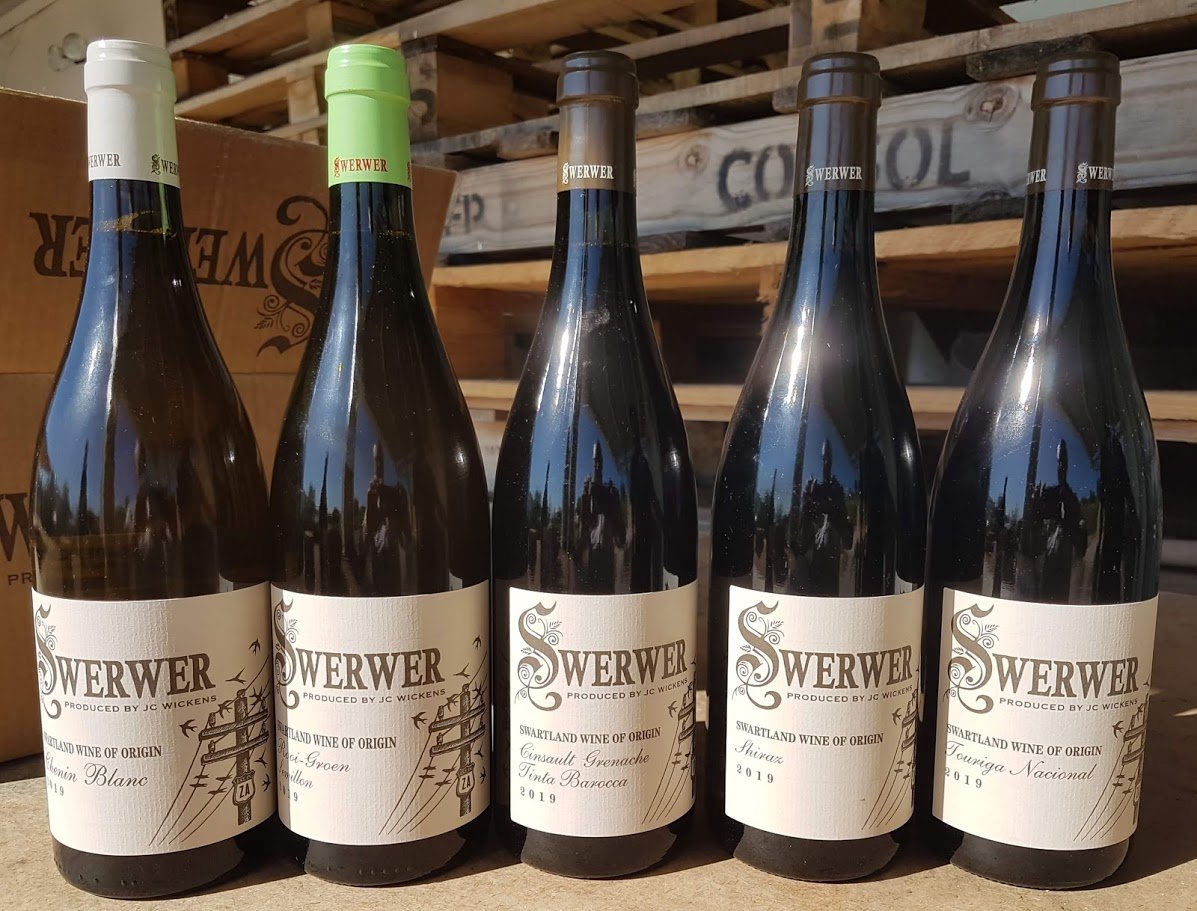
Swerwer Chenin Blanc 2019
Price: R220
A pronounced reductive note before peach, apple and hay. The palate has good fruit weight, moderate acidity and a gently savoury finish. Nice enough but this seems to have less detail and energy than previous vintages.
CE’s rating: 89/100.
Swerwer Rooi-Groen Semillon 2019
Price: R220
From Semillon Gris. A complex nose with notes of orange, peach, some waxy character, hay, earth and spice. Quite broad on the palate with soft acidity and a slight bitterness to the finish.
CE’s rating: 90/100.
Swerwer Cinsault Grenache Tinta Barocca 2019
Price: R240
Aromatics of cherries, plums, some musk, earth and spice. Medium-bodied with generous fruit, good freshness and quite soft tannins. As smashable as ever, it must be said.
CE’s rating: 92/100.
Swerwer Shiraz 2019
Price: R220
Attractive aromatics of red and blackberries, lilies, fynbos and white pepper while the palate is light and fresh with powdery tannins. Great fruit definition, balance and length.
CE’s rating: 95/100.
Swerwer Touriga Nacional 2019
Price: R220
Ripe plums, blueberry, lavender, fynbos, earth and spice on the nose. The palate has lots of sweet, concentrated fruit to go with grippy, slightly coarse tannins – some will like it for how characterful it is while others might find it a bit too rustic.
CE’s rating: 91/100.
Find our South African wine ratings database here.
Attention: Reviews like this take time and effort to create. We need your support to make our work possible. To make a financial contribution, click here. Invoice available upon request – contact info@winemag.co.za
I make no apologies for trying to uphold a resolutely positive demeanour in the face of on-going trouble and strife in both the UK and South African economies. Thankfully, the UK government, however incompetent and increasing woke they have become, enforcing ever more incoherent and disparate policies with those of Scotland and Wales, they have not yet turned into a government that thrives on schadenfreude.

But it seems in South Africa, the populace is firmly beset by politicians who are deriving a great amount of pleasure from the suffering and misery being inflicted on wide swathes of the economy, most notably in the wine industry in the Western Cape that also happens to be one of the region’s largest employers. For the first time, possibly ever, I am seeing influential, successful industry leaders starting to buckle and fall prey to the relentless waves of negativity and incompetence emanating from South Africa’s dogmatic national politicians. The final straw for many of our teetering wine farms? Let’s hope not.
Like a bad dose of déjà vu, a nationwide alcohol ban has descended across the nation once again and thrown thousands of livelihoods into peril. This blanket ban on the transportation, distribution and sale of all alcohol resembles, from the outside, a proverbial sledgehammer being used to crack a small nut. Interestingly, the popular narrative now emerging from the government encompasses the nations’ collective inability to handle and consume alcohol responsibly during lockdown, therefore directly impeding their broader anti-coronavirus strategies. Funny how this was never an issue pre-Coronavirus!? Across the UK, in complete contrast, it was interesting to note that once the closure of restaurants, bars and pubs was announced at the beginning of lockdown, wine shops were immediately classified as essential retail businesses and given a special dispensation to remain open alongside all the food retailers. Unlike the South African government, UK politicians realised that effectively banning the sale and distribution of alcohol would constitute a most serious and grave deprivation of national civil liberties and would almost certainly not have been tolerated by the broader population.
All across Europe and the United States of America, a much broader philosophical debate has started to rage as governments enact ever more draconian measures to fight the Coronavirus pandemic, many of which have been deemed by large sectors of the establishment as unacceptably authoritarian and unjust, and thus representing a clear encroachment on the civil liberties enshrined in law in most of these countries constitutions. If you are one of those that believe that all governments are merely benign entities happily existing to serve its people, well, then you probably aren’t going to be too worried by the current laws being enacted by many governments. If on the other hand, you are one of the growing numbers of sceptics who see the increasing disregard for political due process and the authoritarian decisions power hungry politicians are enacting, then you might be more worried about the parallel agendas many of these politicians harbour, specifically in a South African context. Parallel agendas you may ask?
Well, from where I stand, some of the alcohol and tobacco abolitionist murmurings surfacing from very senior government ministers reeks of blatant nanny state, backdoor national socialism where policies and laws are enacted unilaterally and in the name of ‘protecting the greater population’ as if it were some collective huddle of young adolescent kids who need a special kind of authoritarian paternalism to look after them… because they don’t know any better. If my memory serves me correctly, this was half the root evil that inspired and underpinned many of the policies in the early years of apartheid in the 1950s and 1960s. This kind of dogma is extremely dangerous and more often than not leads to negative outcomes for the majority of the population if left unchallenged.
As many governments and countries around the world now try and move out of hard lockdown in the hope of reviving their flagging economies, many politicians are now realising in an almost naive hindsight that perhaps shutting down their economies so totally was not the most inspired decision to follow. Only in the past weeks, Norway’s Prime Minister apologised on national TV for their draconian lockdown and admitted that following a more measured, cautious route of Coronavirus prevention in the model of Sweden, might actually have been a more appropriate and less economically damaging course of action to take. Already in the UK, we can see that as the economy slowly tries to returns to life, large swathes of the hotel, tourism, hospitality and restaurant sectors are flatlining on the hospital operating table. The hard shock treatment meant to protect the patient has instead had the opposite effect and actually killed them.
It may already be too late for South Africa to learn the lessons from other countries that preceded it in the pandemic as the damage to the economy may already be terminal. What is clear is that the hard lockdown policies South Africa is blindly reverting back to including the blanket alcohol ban, will cause untold long-term economic damage much of which will quite simply not be reversable. Now is the time for intelligent, considered, measured policies that keep the patient alive instead of killing him. Why not allow mail order wine sales, wine club and membership wine sales and deliveries? Why not allow home deliveries direct from wineries? Sledgehammer policies will neither stem the new spike in South African Coronavirus infections nor improve the capacity of a creaking healthcare system that has been historically mismanaged and faced chronic underinvestment for decades. It is never too late to turn course for the greater good of the economy and the whole country.
Attention: Articles like this take time and effort to create. We need your support to make our work possible. To make a financial contribution, click here. Invoice available upon request – contact info@winemag.co.za

Sugardaddy.
The 2019 vintage of the famed Hope Marguerite Chenin Blanc from Beaumont in Bot River carries more residual sugar than usual, 8.3g/l to be precise, but tasting it prior to gaining access to this information, I did not notice any extra palate weight or undue sweetness – TA is high at 6.8g/l and pH is low at 3.18 while alcohol is a moderate 12.54%, and I think the wine hangs together well.
The nose shows pear, peach, citrus and apple with some dried herbs and a little yeasty complexity in the background. The palate possesses a good core of fruit plus bright acidity while the finish is long and pithy. Currently, it comes across as rather tightly wound and it will be interesting to see how that extra RS manifests itself in years to come. Approximate retail price: R360 a bottle.
CE’s rating: 93/100.
Find our South African wine ratings database here.
Attention: Reviews like this take time and effort to create. We need your support to make our work possible. To make a financial contribution, click here. Invoice available upon request – contact info@winemag.co.za
This year’s Cape Bordeaux Red Blend Report convened by winemag.co.za and sponsored by multinational financial services company Prescient is now out. There were 61 entries from 51 producers and these were tasted blind (labels out of sight) by a three-person panel, scoring done according to the 100-point quality scale.
The 10 best wines overall are as follows:
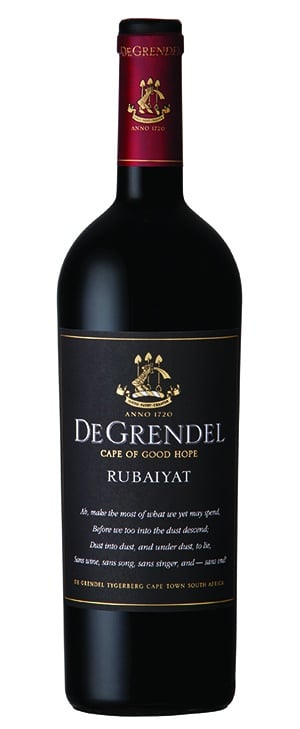
De Grendel Rubaiyat 2016
Price: R375
Wine of Origin: Coastal Region
Abv: 14.5%
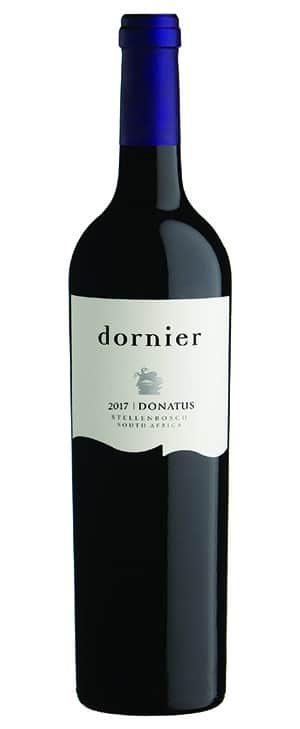
Dornier Donatus 2017
Price: R350
Wine of Origin: Stellenbosch
Abv: 14.5%
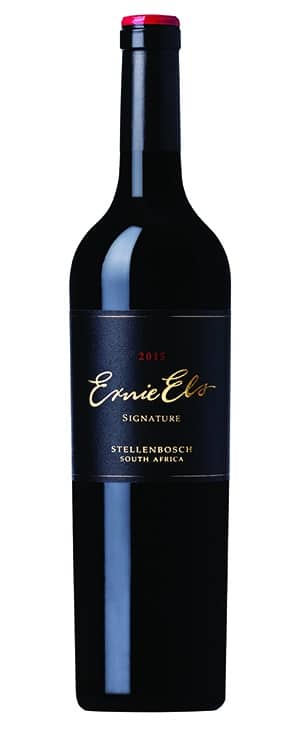
Ernie Els Signature 2015
Price: R740
Wine of Origin: Stellenbosch
Abv: 14.72%
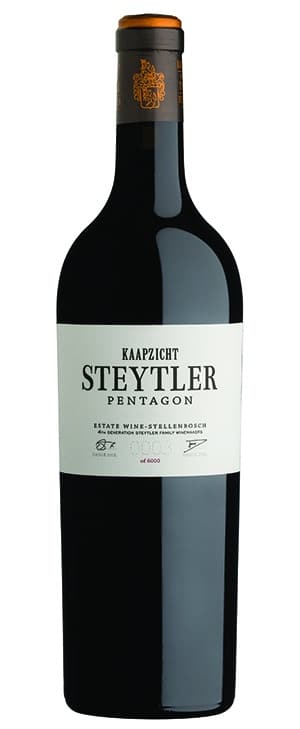
Kaapzicht Steytler Pentagon 2017
Price: R550
Wine of Origin: Stellenbosch
Abv:14.57%
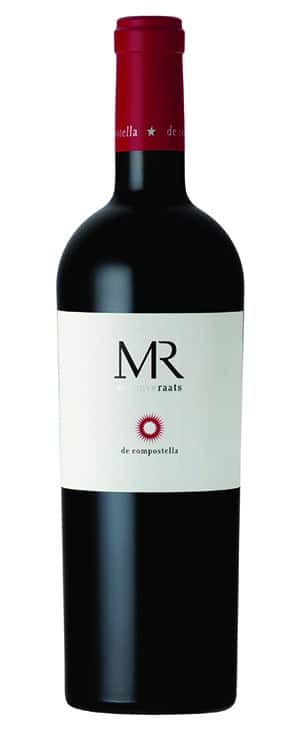
MR de Compostella 2017
Price: R1 500
Wine of Origin: Stellenbosch
Abv: 14.5%

Org de Rac Cabernet Sauvignon Merlot Reserve 2017
Price: R250
Wine of Origin: Swartland
Abv: 14.56%
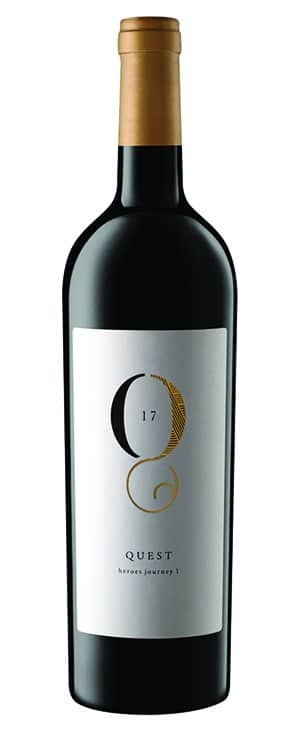
Quest Bordeaux Style 2017 (Du Toitskloof)
Price: R310
Wine of Origin: Western Cape
Abv: 14.5%
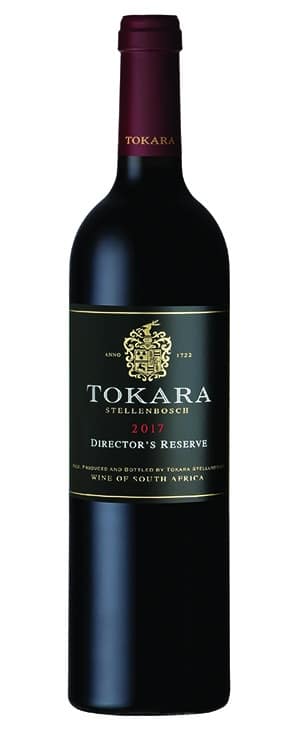
Tokara Director’s Reserve 2017
Price: R400
Wine of Origin: Stellenbosch
Abv: 14.8%
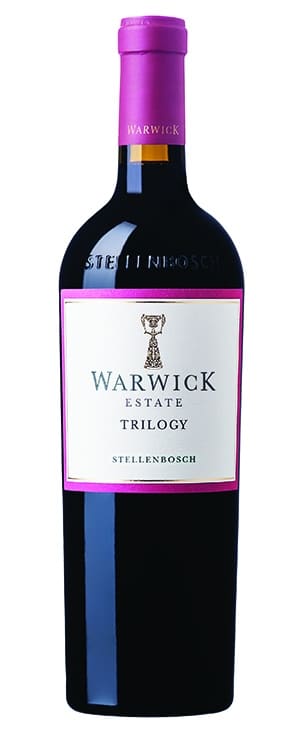
Warwick Trilogy 2017
Price: R550
Wine of Origin: Simonsberg-Stellenbosch
Abv: 14.27%
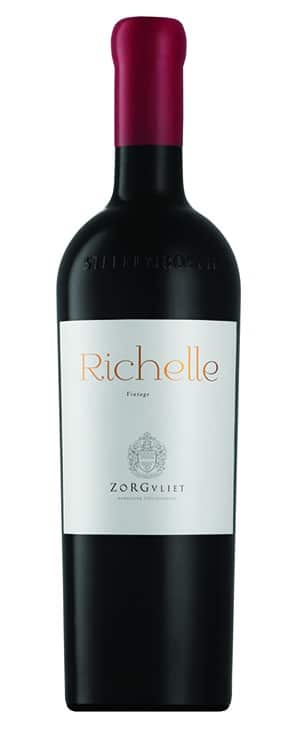
Zorgvliet Richelle 2017
Price: R315
Wine of Origin: Banghoek
Abv: 14.66%

The Bordeaux region in the southwest of France is famous for its red blends, the best of which can age with benefit over many years. The two grapes that feature most prominently are austere Cabernet Sauvignon and fleshy Merlot, although Cabernet Franc, Malbec and Petit Verdot also play a role. This style has been imitated around the world and South Africa is no exception.
The average cellar-door price of the Top 10, meanwhile, is R534 a bottle with Org de Rac Cabernet Sauvignon Merlot Reserve 2017 the most affordable at R250 a bottle.
 |
To read the report in full, including key findings, tasting notes for the top wines, buyers guide and scores on the 100-point quality scale for all wines entered, download the following: Prescient Cape Bordeaux Red Blend Report 2020 |
 |
The producer of the wine judged best overall wins a new 225-litre Biodynamie barrel worth €908 (the equivalent of R17 375 at the time of writing) from Tonnellerie Sylvain. This will be announced towards the end of the year. |
Johannesburg boutique wine retailer Dry Dock Liquor is offering all wines in the top 10 for sale – buy now.
It is entirely my own fault. Everyone told me to stock up on alcohol but I didn’t get it together. Now the ban on booze has been reinstated and all I have left in my house are the super-special, lay-down-and-save for an epic occasion type bottles.
Well, almost. Last year my then 11-year-old son made my husband a gift box for Father’s Day. It contained everything that little boys imagine big boys need to have a good time. In addition to the Super Bang paper roll cap gun refill (1200 extra-loud shots guaranteed), packets of biltong and cashew nuts, he also wanted to include something boozy. So, off we went to the local liquor store – remember when we could still do that?
My son’s pocket money was limited and he was struggling to find anything he could afford until he spied the till-side Totpak selection. For those who haven’t encountered this Ventersdorp-based company, their website says that they “specialize in bringing top-quality alcohol to the customer in a convenient and consumer-friendly manner.” By which they mean 30ml clear plastic sachets. My boy bought two of each bag in the range (whisky, gin, dark rum, vodka, sherry and sambuca both red and black). They were all R5 regardless of the contents within. He also picked out a 100ml sachet of something called Danie Dop (R6). On 21 June 2019, he proudly presented this stash to his father who made all the right appreciative noises and then forgot all about them. Until last week…
Faced with an absence of anything alcoholic chez nous we remembered the sachets. And started snipping open the clear plastic packets. I really don’t think I am a drinks snob. I respect and adore the work of fine wine and spirits producers but I also happily consume all sorts of stuff that posher people turn their noses up at. So, I was surprised at quite how disagreeable I found some of the Totpak’s tipples. To be fair, I didn’t hate the sachets so much that I stopped drinking them. And a couple of them were perfectly palatable. Well, perhaps not perfectly but definitely palatable.
Night one belonged to Totpak whisky. Initial, chlorinated, somewhat gag-inducing notes were followed by an intriguingly awful lava in the oesophagus after-effect. Not a success. The next evening I tried the gin which was better – partly because it had a sentimental schoolroom whiff of that white glue that always had to be peeled from fingertips post art class. With the addition of tonic water, this sachet was pleasant enough for those without other options. Is Dettolesque a descriptive term? I hope so because that is what came to mind when the vodka sachet was subsequently served. Danie Dop (which describes itself on the packet as “made from the finest spirits and brandies”) is indescribably disgusting – so I won’t.
After that things looked up. The recent American election opinion polls made me think of Dark and Stormy cocktails so I combined the dark rum sachets with homemade ginger beer (of more anon). I barbequed stickily, sweet pork ribs to accompany the cocktails and the pairing worked well. The golden-brown sherry was fine. Maybe more than fine with a sweet but not too cloying, relatively smooth palate. I drank mine neat but I can imagine it contrasting nicely with a young and oozy blue cheese. I was wary of the sambucas because, even at the best of times, I don’t terribly like aniseedy alcoholic spirits but they were ultimately the best of a bad bunch. I made a caffè corretto (ish) concoction by adding half of a sachet to an espresso at the end of my meal. Deliciously digestive.
Sadly, the sachets are now finished. After weeks of trying and failing to make a decently alcoholic ginger beer using bread makers yeast, I ordered a tiny packet of Champagne yeast online. This was between lockdown prohibition 1 and 2. They won’t sell it to you now but I have high hopes for its stronger fermentation characteristics and higher alcohol tolerance. Until then I might have to start drinking the saving for special-event bottles. Without wishing to sound unduly morbid, who knows if we will make it to our 30th wedding anniversary…
Attention: Articles like this take time and effort to create. We need your support to make our work possible. To make a financial contribution, click here. Invoice available upon request – contact info@winemag.co.za

Hot stuff.
The Coronavirus world is not so weird that there isn’t a whole bunch of predictable debate about who scored what notable wine too high or too low. First Verse 2017 from Chris Keet (price: R480 a bottle) is not what you might expect from the man who brought you that wine of legendary elegance in the shape of Cordoba Crescendo, this current release bearing an abv of 15% on the label!
Consisting of 35% Cabernet Sauvignon, 34% Cabernet Franc, 14% Merlot, 10% Malbec and 7% Petit Verdot, it has attractive aromatics of red and black fruit, dried herbs and potpourri before a palate that is sweet, rich and broad with a plush texture. It’s certainly flavourful but you’d have to be a brave punter to think that this has the inherent structure to still be drinking well in 25 years’ time or so as those Crescendos still are…
CE’s rating: 90/100.
Find our South African wine ratings database here.
Attention: Reviews like this take time and effort to create. We need your support to make our work possible. To make a financial contribution, click here. Invoice available upon request – contact info@winemag.co.za
Everyone connected with the South African wine industry, either professionally or as a “mere” wine drinker, will sympathise with all those in it negatively affected by the recently re-imposed ban on domestic liquor sales – which means nearly everybody concerned. Even if those mere wine drinkers without a useful stock of their favourite tipple, and no certainty at all about when sales will start again, are probably feeling most acutely sorry for themselves right now….
Hard times for the industry, indeed, though not unshared with other sectors of the South African – no, world – economy. And it is probable that a governmental ban, if it had to be imposed at all, could have been implemented in such a way, with such timing and scope, as to cause less anguish to producers, distributors and retailers. Though, of course, anything other than the ban, if total, taking immediate effect would have led to amazingly problematical scenes as panicking customers rushed the outlets.
However despairingly, I initially found it hard not to accept the validity of the government’s move, as it pointed out the dreadful increase in drink-related trauma cases during the period when liquor was more widely available – the deaths and fights, the drunken driving, the costly clogging of emergency wards at hospitals, the waste of urgently needed resources. I had long known about those things as features of South African society (I believe that many international medical students come here just to learn about such trauma-fields on, usually, weekend nights), but this was a poignant reminder at a particularly poignant time.

Health minister Zweli Mkhize argued the statistics: “Facilities reported up to 60% increase in trauma emergency centre admissions and up to 200% increase in ICU trauma admissions,” he said, and cited statistical models showing that the new ban could mean reducing hospital trauma admissions by 20%, as well as a 40% reduction of all alcohol-related trauma admissions by the third week of prohibition. “Each trauma case does not just take up a bed – it takes up staff, oxygen, medicines and other critical resources necessary for the management of Covid-19.”
That is not negligible. However, my initial sympathy was somewhat weakened by some challenges to the logic involved, and by, for example, the revelation that, at least in some parts of the country, there was as yet no threat to beds and treatment for Covid-19 patients. And that’s quite apart from the possibility of achieving much of the ban’s effects by means less desperately damaging to the industry. At the time of the first ban, one thing that came across strongly was not only a comparative lack of concern for the wine industry in particular (as the sector of the economy presumably most vitally and extensively affected by the ban), but an almost vindictive satisfaction in indulging neo-prohibitionist tendencies in parts of the government – not to mention the usefulness to the forces of law and order of finding a non-policing solution to what was, at least at the immediate level, a policing problem.
So the liquor industry as a whole suffers, and of course it will be its poorest and most vulnerable parts that will suffer the most.
Yet they nag at me incessantly, the images of those trauma units, of those drunken crashes, that domestic violence – all this appalling abuse of alcohol that causes such pain and anguish to the innocent as well as the “guilty”. And I can’t escape the image with blame – by invoking some “Us versus Them” structure that puts the problem all in one place. What has been happening has been a reminder of an aspect of the sickness of violence and abuse that chews like cancer at our society – the society of which we are all a part. (At the more genteel drinking end – us – there is hopefully less of the violence and the bingeing, but which reader of this website has not been, at the least, a drunken driver occasionally or habitually, or had one as a friend, for example?)
The wine industry – or the liquor industry as a whole – is not directly to blame for this symptom, this unhealthy relationship of South Africans with alcohol. Yet it is obviously deeply implicated. The wine industry is not just hard-working (impoverished) vineyard workers plus valiant winegrowers plus vinous heroes seeking out little plots of old vines to make splendidly nuanced chenins for us, plus ingenious and talented distributors and merchants, all contributing cheerfully to the GDP. It also has sections, for example, selling, at cheapest possible price, alcohol to make people drunk (beer sometimes does the trick best, sometimes cider, sometimes spirits – sometimes wine, in bottles, boxes, flagons and, who knows, papsaks filled with the dregs at the back of the winery on a Friday evening).
This is an industry working in a society, especially in the Western Cape, many of whose members are marked by being the ultimate victims of a system that at least used to nurture inebriation as a means of industrial and social control. It’s not a nice society, and ours is not an entirely nice industry. We’ve been reminded of that and I think we should stay reminded, once this is all over, and the industry is putting itself back together as well as it can (and saying farewell to those bits that have been irretrievably broken).
Every few years, some Scandinavian journalist or some human rights organization revives accusations about how little has changed in terms of social, notably racial, relations in the South African wine industry. Some of us wince and are reminded of what we’ve been ignoring, while others continue to deny – the details, at least. The moment passes and comparatively little is done by either of those camps. And now, with this damned pandemic and our struggles to survive it, we’re being reminded of another depressing aspect of an industry that brings heartache and pain as much as it does non-destructive pleasure. We can, and must, rally to defend and support the wine industry – or at least the bits of it we genuinely admire. And we must insist that, for good and ill, it is part of a greater whole. But we must also not forget the trauma, in the part and the whole.
Attention: Articles like this take time and effort to create. We need your support to make our work possible. To make a financial contribution, click here. Invoice available upon request – contact info@winemag.co.za

Da bomb.
Does the 2017 vintage surpass 2015 when it comes to the quality of Stellenbosch reds? The Cape Bordeaux red blend that is Paul Sauer has to be the ultimate bellwether and I reckon it’s as intense but more polished than the 2015.
Consisting of 76% Cabernet Sauvignon, 17% Cabernet Franc and 7% Merlot, it was matured for 24 months in French oak, 100% new. The nose shows a hint of reduction before black fruit, some leafiness, vanilla and milk chocolate while the palate is full bodied with plenty of dense, sweet fruit along with coated acidity and smooth tannins (alcohol: 14%). “Flashy” is the word that comes to mind and it’s sure to impress its legions of fans. Price: R700 a bottle.
CE’s rating: 95/100.
Find our South African wine ratings database here.
Attention: Reviews like this take time and effort to create. We need your support to make our work possible. To make a financial contribution, click here. Invoice available upon request – contact info@winemag.co.za
Subscribers receive daily reviews and in-depth reports before release to the public. Cancel any time.
