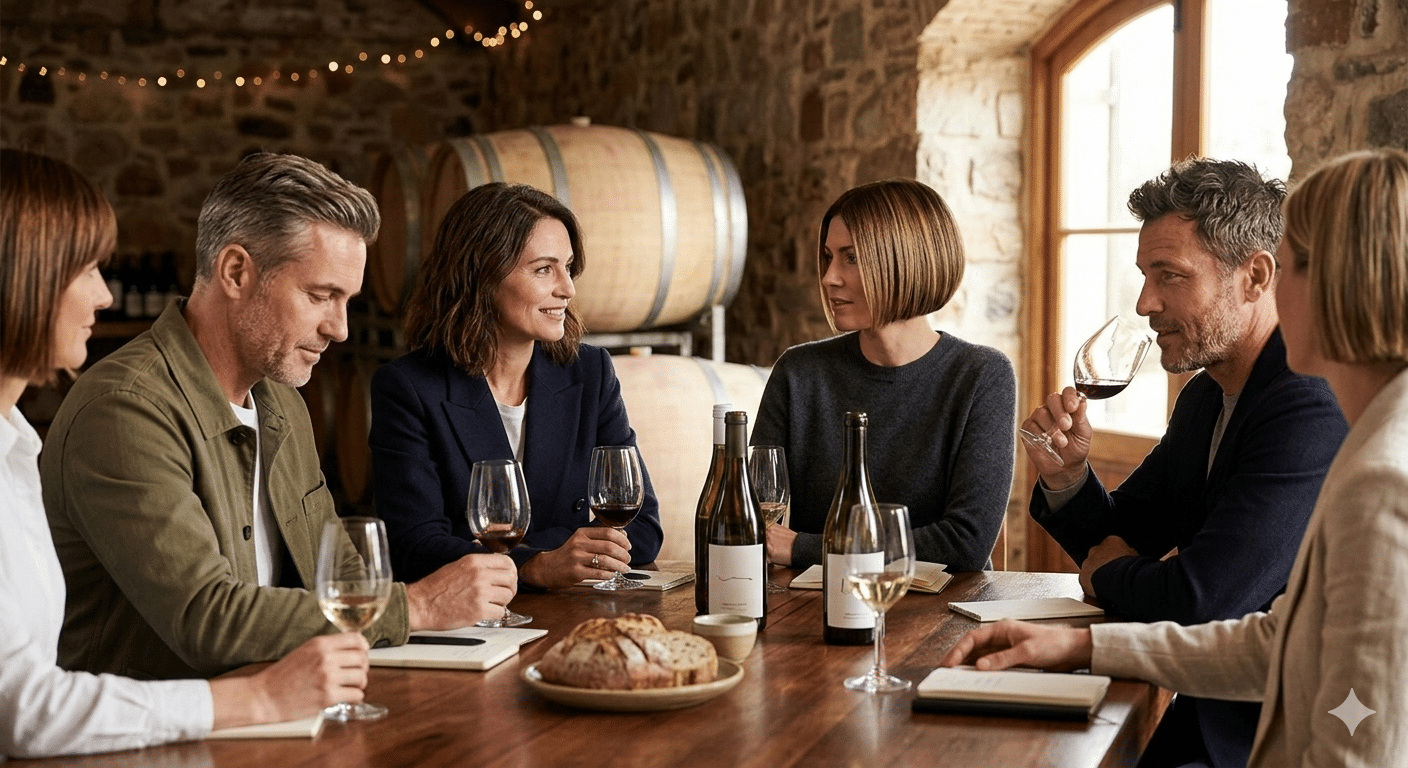
In 2026, the Winemag.co.za reader remains at the absolute centre of South Africa’s fine wine culture. The reader poll was conducted via Google Forms from 26 January to 13 February, yielding 273 completed responses.
80% male
43% aged 35–54, 44% over 55
47% hold a post-graduate degree
56% live in Cape Town
80% in households earning R60k+ per month, 34% in R200k+ households
On closer analysis, the following emerges:
38% work in the wine industry
Of industry readers, 24% are female, and 51% are under 55
We are therefore able to identify two main reader groups
The Affluent Enthusiast: Typically older, wealthier, and guided by high-level ratings to stock significant cellars.
The Industry Insider: Younger, more gender-balanced “insiders” who rely on Winemag for analytical opinion and industry news shaping their daily work.
Wine as an Everyday Pleasure
Winemag readers integrate wine into their daily lives, demonstrating high involvement both at home and in the wider wine community.
Volume & Frequency: 33% drink wine daily; 44% several times a week.
Purchasing Power: 50% buy more than a six-bottle case monthly; 20% buy at least two cases.
Restaurant Patronage: 47% eat out at least once a week, making readers a key driver of the fine dining and hospitality industry.
In an era of heightened health and wellness awareness, wine consumption among respondents appears broadly stable: 48% report drinking about the same amount as five years ago, while 26% say their consumption has increased. 69% declared themselves not interested in trying or buying low- or no-alcohol wine.
In contrast to the mass market’s preference for Merlot, readers show a radical skew toward Chenin Blanc, demonstrating they are leaders in taste rather than followers of trends.
Active Participants: Among enthusiasts, 66% attend wine shows several times a year, and 44% belong to a wine club, actively participating in the “fine wine conversation.”
Favourite Areas: Stellenbosch (65%), Swartland (61%), Hemel-en-Aarde (48%) – respondents could select up to three regions.
The Rating Influence: For the general public, ratings are the primary driver of purchase, outranking brand loyalty and price.
Multi-Channel Purchasing (how and where do readers buy their wine):
In-store retail: 71%
Online home delivery: 71%
Winery tasting rooms: 56%
Click-and-collect: 17%
Shows and festivals: 15%
Retail Channel Preference (which stores readers use, revealing habits, sophistication, and preferences – quality vs convenience):
Wine farms/cellar doors: 79%
Independent/neighbourhood wine shops: 63%
Online-only wine retailers: 62%
Multi-city specialist retailers: 53%
Supermarkets: 44%
Top-Rated Retailer: Wine Cellar, cited by 31% as the best overall source for wine.
Premium-minded: 53% believe a decent bottle of wine requires a spend of at least R120, with a further 35% saying R60 falls short, leaving only 12% who think a decent bottle can be found at that price.
The 2026 Winemag reader is more than just a consumer — they shape the national wine conversation.
They are a small but powerful community that dictates trends, drives the premium market, and supports the industry’s pursuit of excellence.
They appreciate Winemag as an expert-led authority platform, not a lifestyle publication.
Engaging this audience means reaching South Africa’s most concentrated group of affluent, influential wine decision-makers.
This survey reflects a self-selected sample of Winemag.co.za readers, representing our niche audience rather than the general population.
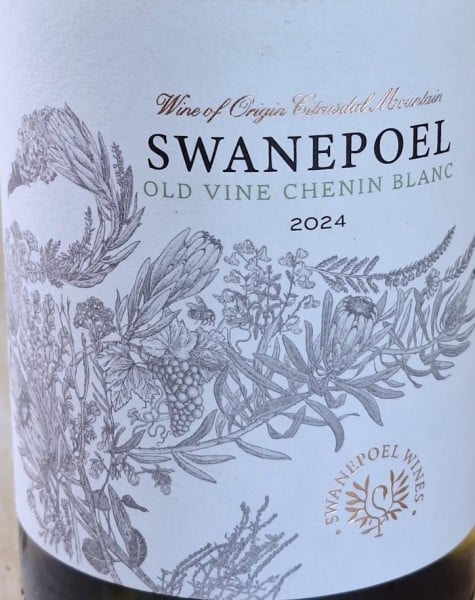 For last year’s iTOO Next Generation Awards, then 29-year-old Dirk Swanepoel entered his White Pinotage 2023 which rated a respectable 90. He makes wine at the family property Oude Compagnies Post in Tulbagh mostly from own fruit but also an Old Vine Chenin Blanc from Citrusdal Mountain (R275 a bottle).
Matured for eight months in barrel, the 2024 vintage shows pear, peach and citrus, a little floral perfume and a hint of wet wool. The palate is light-bodied, pure and precise. Tightly wound, it has crisp acidity and nicely dry finish. Alcohol is a modest 12.5% and it over-delivers on refreshment.
CE’s rating: 92/100.
Check out our South African wine ratings database.
 Established in 1993, the Diners Club Winelist Awards celebrate establishments that demonstrate an commitment to elevating the standard of their wine offerings and enhancing the dining experience for their patrons. The awards are presented across five tiers—Silver, Gold, Platinum, Diamond, and the ultimate Icon Award.
Introduced in 2018, the Icon Award is reserved for restaurants that not only fulfil all the stringent Diamond criteria, but also present an extensive international wine selection, outstanding representation across multiple wine categories, a noteworthy reserve and vintage offering, a demonstrable commitment to thoughtful wine curation, and the presence of a dedicated full-time sommelier.
The 2025 results are as follows:
GAUTENG
ICON
DIAMOND
PLATINUM
GOLD
SILVER
KWAZULU- NATAL
DIAMOND
GOLD
EASTERN CAPE
DIAMOND
WESTERN CAPE
ICON
DIAMOND
PLATINUM
GOLD
NORTH WEST
PLATINUM
NORTHERN CAPE
DIAMOND
LIMPOPO
SILVER
MPUMALANGA
DIAMOND
GOLD
Picpoul, the variety traditionally associated with Languedoc, the central part of France’s southern coast, has become hugely popular in the last 20 years. Easy drinking but not characterless, affordable and seafood friendly. According to Sawis, there were 2.03ha of it planted locally at the end of 2025 putting it just behind Lledoner Pelut and ahead of Petit Manseng. Johan Kruger of Kruger Family Wines believes that Anthonij Rupert, Krone, Mullineux, Sadie and Simonsig have it planted and he’s decide to champion it as a single-variety wine.
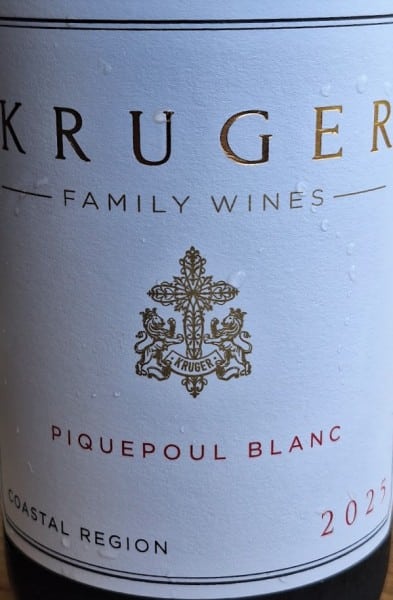 Piquepoul Blanc 2025
Price: R250
70% of grapes from Krone in Tulbagh, 30% from Simonsig in Stellenbosch. Matured in a combination of foudre, stainless steel tank and amphora. The nose shows a floral top note before citrus and green apple. The palate is not overly lean, with some texture, well-integrated acidity and a pithy finish. Neutral without being dilute, it’s refreshing and moreish – a perfect companion to oysters. Alc: 12%.
CE’s rating: 90/100.
Old Vines Sauvignon Blanc 2024
Price: R360
From a Stellenbosch vineyard planted in 1988. Matured for eight months in old oak. The nose is subtle yet alluring with notes of peach, blackcurrant, elderflower and the merest hint of dried herbs. The palate is beautifully weighted – rich and broad with coated acidity, the finish gently savoury. A joy to drink. Alc: 13.5%.
CE’s rating: 94/100.
Check out our South African wine ratings database.
I’ve been following wine for a long time now, and since 2008 I’ve made my living entirely from communicating about it. I’ve learned a few things from my travels around the wine world, but one of the recurring messages is that while it’s challenging to make good wine – and I have full admiration for winemakers who consistently turn out sound, well made wines – it’s even harder to sell it. This is especially true now.
There are some wineries whose bottles are in such demand that they can choose who they sell to, and they allocate their production. Their biggest challenge is managing expectations: customers become upset when they don’t get as many bottles as they’d like. But this is not the norm. For many wineries, selling their full production is really hard work, especially in a situation where global wine supply exceeds demand.
I carry this thought with me when I write about planting new grape varieties and recovering lesser-known varieties, a topic I’ve frequently addressed. This is an important concept at the moment, as climate chaos is starting to make viticulture very tricky in many regions around the world.
It’s clear that, for the future, we need to re-think viticulture as it is currently practised. We need more resilient vineyards, because weather patterns are becoming unpredictable. And for many regions, we are looking at a warmer, drier future. Water availability is becoming a huge challenge for many. And we also need true sustainability, because the way that viticulture is practised now isn’t truly sustainable, and is becoming less so with climate chaos.
So one part of this future is going to be shifting to grape varieties that are more appropriate for current and future conditions, and also which promise higher levels of sustainability.
It makes little sense to grow Merlot and Sauvignon Blanc in Mediterranean-style climates, when there are varieties much better suited to hot, dry conditions. In South Africa we are seeing increased interest in the likes of Grenache (both white and red), Clairette, Roussanne and Marsanne, for example, which have the ability to make fresh wines in hot conditions. And the likes of Assyrtiko and Xinomavro could also work well. It’s a no-brainer from a viticultural point of view to see what works in long-established regions with similar climates when it comes to choosing varieties, so for many of South Africa’s regions, Greece, southern Spain, the southern Rhône are sensible scouting grounds. Bordeaux and the Loire? Less so. You want a grape variety for a region with growing season rainfall? Then take a trip to Rías Baixas or Vinho Verde and see what works there.
And if we are talking sustainability, then there’s a very strong case for ditching Vitis vinifera altogether, and adopting disease-resistant varieties. Vinifera varieties will never have true (R gene) resistance against these maladies. It would be a dream not to have to spray against powdery and downy mildew, in terms of the cost savings, the environmental benefit, and also the reduced soil compaction. Decades of breeding work has resulted in some sophisticated hybrids that make wines that don’t taste terrible. Many of them are best suited for cooler climates (these are often where the disease pressure is highest), but there’s now quite a bit of work to produce longer-cycle resistant varieties that can be grown in warmer regions. The sustainability benefits of these varieties are unquestioned.
I’m encouraged to see people choosing grape varieties better adapted to their climates than the famous French varieties that have become so commonplace around the world. The likes of Torres in Spain and Plaimont in southwest France have both embarked on successful quests to rediscover lost varieties that are more suitable for today’s conditions, and this is great to see. And I’m excited about the new disease-resistant varieties, widely referred to as PIWIs (short for Pilzwiderstandsfähige Reben, German for ‘fungus-resistant vines’), that are being adopted by forward-thinking growers. Champagne has even authorised one of these varieties, Voltis, and there are plans to authorise a second, even more exciting variety in the region.
But I am also worried that commercial concerns might limit the take-up of these newer varieties that we urgently need, and also might slow the transition to more suitable varieties in warm, dry climates.
After all, people have to sell wine. And the fact that the wine world has focused so much on just a few well-known (and almost always French) varieties tells us that the name of a famous name on a label clearly helps as a buying cue for consumers, especially at the entry level.
So what will happen? Will commercial necessity delay or block the much needed shift in varieties? In regions that are strongly attached to specific varieties, perhaps it will. It is hard to see Napa moving away from Cabernet Sauvignon, or Burgundy shifting from Chardonnay and Pinot Noir. And Barolo and Nebbiolo are strongly intertwined.
But there are plenty of regions where blends are the norm, such as Bordeaux, the Douro, the Languedoc, Stellenbosch, Rioja and Champagne. Here the transition is much easier to envisage. And it is beginning, with new vinifera varieties and also disease resistant varieties being trialled in some.
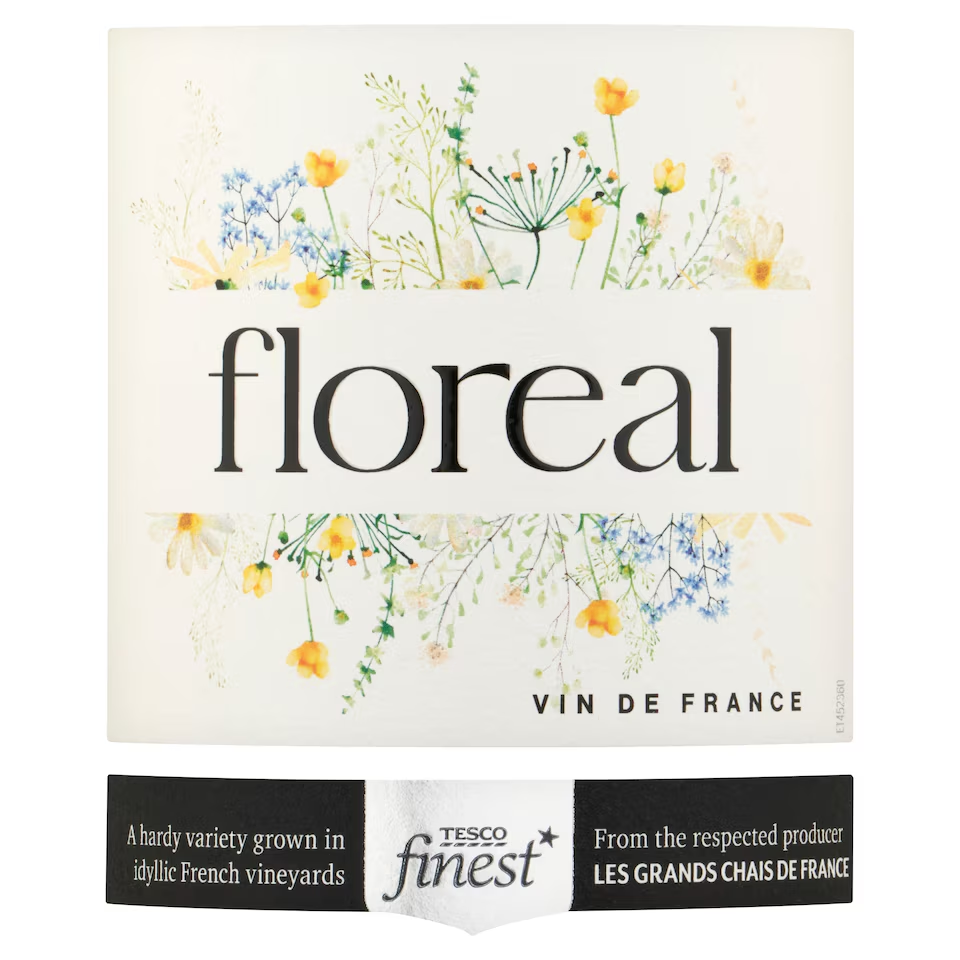
And we have the question: when it comes to consumers, is it all pull, or is there some push? In the UK, supermarkets and retailers have had the courage to begin pushing new disease-resistant varieties rather than hiding them away in brands. Tesco have lanched a Floreal (disease-resistant white variety) that tastes really good, Waitrose have begun selling a Vidoc (red variety) and most recently Laithwaites have launced a Voltis white grown in Chablis. This is really encouraging to see.
I think that this sort of push is needed, especially when the communication is good. Some customers are risk averse, but I suspect more than we give credit for are up for trying something new.
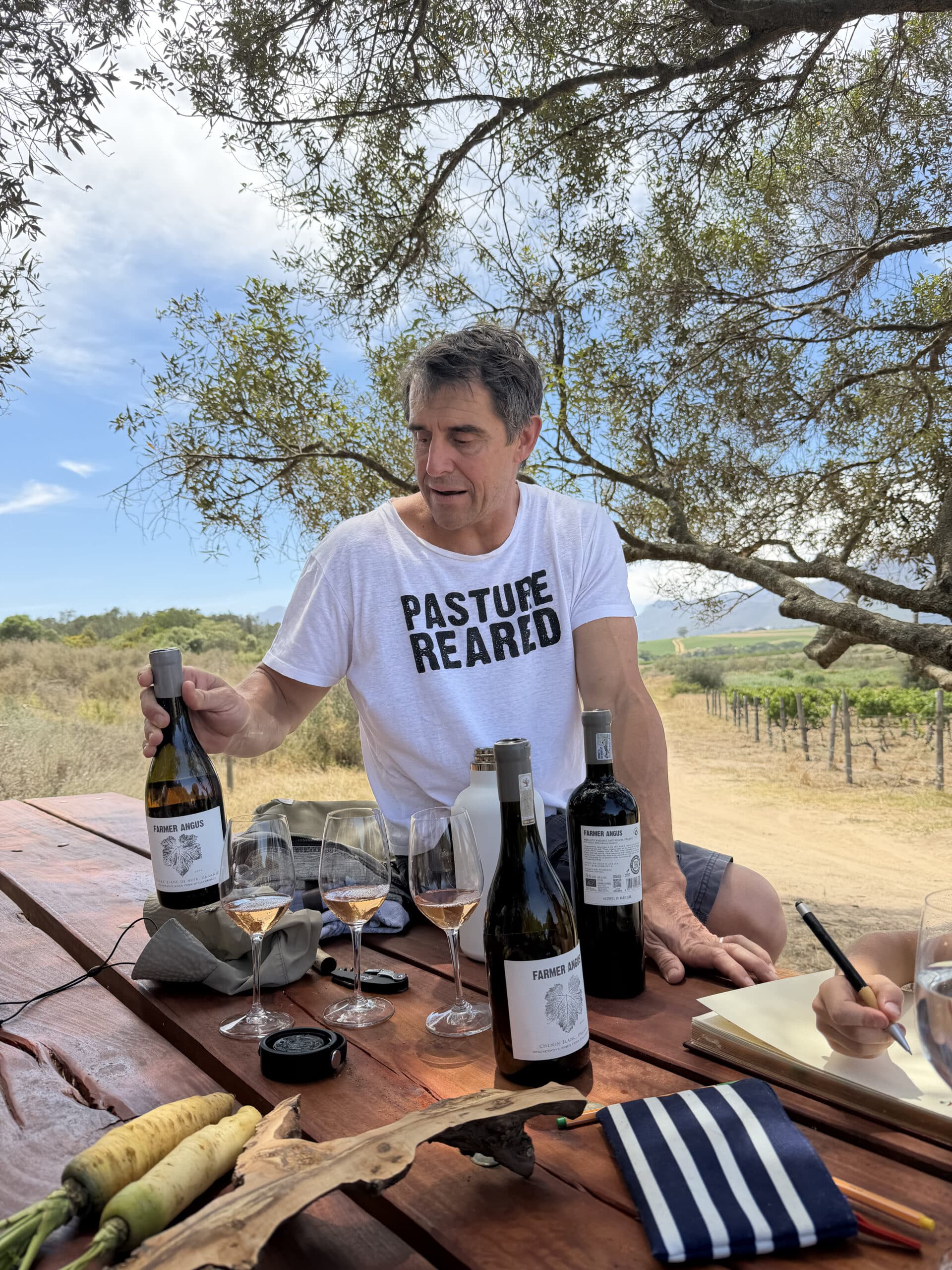 “PASTURE REARED” reads Angus McIntosh’s T-shirt, a white Leghorn chicken tucked under his arm. He’s better known as Farmer Angus, the name under which he sells his food range and, now, own-label wine. We find him at Spier in Stellenbosch, 650-hectares he farms regeneratively.
“These girls,” he says, nodding to the white-feathered hens ranging in and out of, and beneath, his custom-built Eggmobile, “are the biggest component of our business,” the majority of which, he shares, is employee-owned.
The mobile chicken coops move across the pasture behind the cattle herds. After the cows have grazed, the hens are brought in to scratch through the manure, eating fly larvae, spreading dung evenly and accelerating its breakdown, which naturally reduces parasites and boosts soil fertility. The system mimics natural grazing patterns, stacking livestock in a way that builds soil organic matter with the added advantage of producing pasture-raised eggs and beef.
The Leghorn back pecking on the ground, we continue our tour à la bakkie. Among the vineyards are pasture, vegetable plots, fruit orchards, rooibos and indigenous fynbos. “We have planted hundreds of thousands of bulbs, trees, shrubs and succulents,” he says.
Punctuating the vines are cylindrical cypress trees. “I brought the seeds back from Italy,” he says. “Over time, they’ve become epigenetically adapted to the farm.” When asked why plant them in the vineyard, the answer is esoteric. “The vine is the plant of Dionysus, the god of wine and pleasure, a downward force. Apollo, represented by the cypress, points upwards and serves as a kind of energetic counterbalance.”
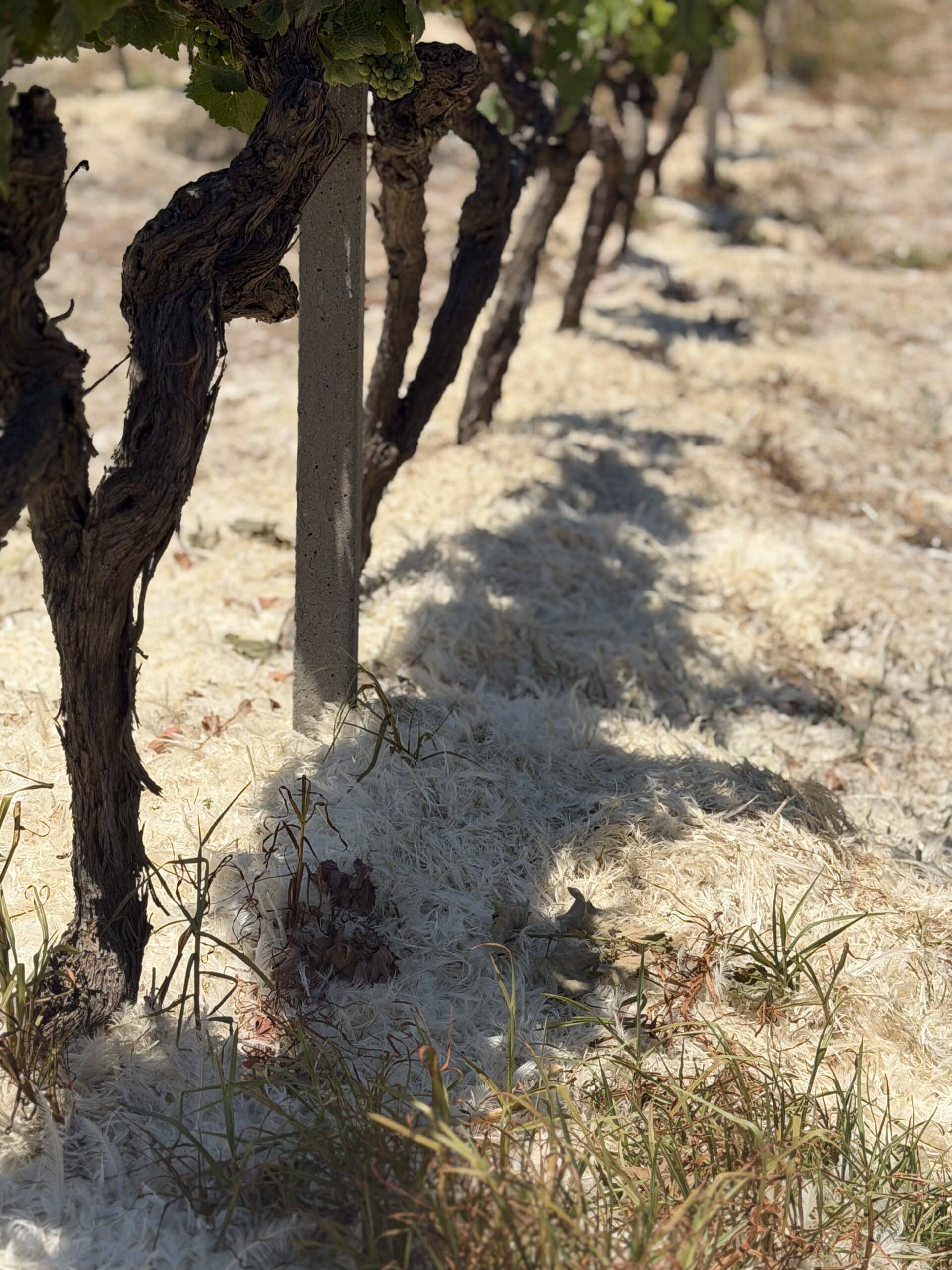 We come to a stop at a table beneath a tree. McIntosh has prepared an outdoor tasting of his range, complete with farm-grown charcuterie, each cut matched to one of the three wines. Beyond us, a block of chenin blanc appears dusted in snow, improbable in 35-degree heat. It is, in fact, chicken feathers spread between the rows as nitrogen-rich mulch (see right).
“We were the first in the country to do this,” he says. “It’s an extraordinary fertiliser, and it keeps the soils cool.”
Carbon credits
Delicious produce aside, what McIntosh is really farming is carbon. “If you’re a farmer, you’re either taking carbon out of the soil and dumping it into the atmosphere, or you’re putting it back. That’s the measure of whether you farm regeneratively or destructively. There is no middle ground.”
Though the project began in 2009, independent audits introduced in 2012 show the farm has removed more than 25 385 tonnes of CO₂ from the atmosphere. In 2014, it became the first farm in the world to be paid carbon credits for increasing soil carbon in grazing land. To date, audited credits exceed 23 000 tCO₂e.
He says the operation has sequestered four times more CO₂ than its wine production emits, meaning each bottle removes more greenhouse gas than it creates. Carbon credits are issued when verified soil carbon gains are recorded and sold on voluntary markets, and at Spier, half of the net income from those sales goes directly to farm workers.
“When producers describe themselves as carbon neutral, it means they’ve calculated their emissions and then offset them through carbon credits,” explains McIntosh. “We’ve taken a different approach and aimed to become carbon negative. In other words, we remove more carbon than we produce.”
McIntosh took over management of the farm in 2009, when 54 hectares of vineyards were still conventionally farmed. Unwilling to have these blocks in the middle of a regenerative system, he began converting the vineyards, and removing sites he felt would never produce quality fruit.
“There’s plenty of organic wine on the market,” he says. “We weren’t prepared to make bad organic wine.” The estate vineyards have been certified since 2015, and practices include biodynamics.
Early chenin experiments in 2006 were, he admits, “questionable.” By 2016, longtime Spier cellarmaster Frans Smit was satisfied with the fruit quality and started making small batches, joined by the farm’s ‘organic winemaker’ Tania Kleintjes. By 2024, they felt ready to release the wines commercially.
All certified organic and bearing the ‘Farmer Angus’ label, today we taste the sold-out 2024 chenin, piercing and Anjou-like; the 2024 blanc de noir from shiraz, limpid and textural; and a merlot-driven 2020 red blend (30% cabernet), all soft cherries and meltwater tannins. The labels are vine leaf rubbings corresponding to each cultivar, a technique McIntosh says he learned from his mother.
His in-laws own Spier, so the relationship between the brands is supportive, operating on a profit-share model.
The reason for creating a separate label is simple, he says. “After caring for these vineyards for so long, wine has become just another farm product, like the eggs. It’s my own expression. In time, I’d like to build a small cellar.”
While Kleintjes officially makes the wines, McIntosh says he is involved in every aspect. “About 80% of the result comes from farming decisions. With merlot especially, ripeness must be achieved in the vineyard; you can’t fix it later. Much of what we do focuses on reducing vine stress.”
On this point, he places a vine spliced in half on the table to illustrate the Italian Simonit & Sirch pruning method. “It preserves the vine’s vascular system,” he says, tracing a furrow, “and maintains sap flow. Traditional pruning creates repeated wounds that block sap movement over time. We believe we’ve extended vine lifespan by five to ten years and improved phenolic development during ripening.”
It is labour-intensive as each vine must be individually assessed, but it also increases engagement. “If the people working in the vineyard are engaged and proud, that energy carries through. It’s the difference between industrial and regenerative farming. There’s an emotional and biological response.
“Everything around us is alive and interconnected. The more we recognise that, the better our farming becomes.”

It’s everywhere on social media: the casual snapshot of someone raising a middle finger with the faintest hint of a smirk, often in a setting of some privilege, expensive wine to hand. The gesture is low-key, offhand, sometimes almost imperceptible, yet it’s meant to convey attitude. At first glance, it might seem like rebellion – a small act of defiance in a world where everyone curates their lives to death.
But I don’t buy it. What started as a statement of defiance has been repeated so often in carefully staged selfies that it’s become predictable. It’s no longer shocking or countercultural; it’s an expected pose in the visual lexicon of social media. Rudeness dressed as irony. What might once have been cheeky, subversive even, now often reads as entitled or self-satisfied. It might be intended as wryly amusing but most times it comes off as performative, signalling coolness or independence without the effort or risk of actual rebellion.
There is a parallel here with the world of fine wine. Wine, after all, thrives on authenticity. It rewards patience, discernment, and effort – a kind of attention to detail that cannot be faked. Influencers are constantly attempting to stage images of bottles in curated environments, but the character of the wine itself cannot be posed. It is, in its purest form, honest. It does not smirk or posture. It simply is.
Much like the subverted finger, many gestures in wine culture can become hollow. Ridiculously high prices, scarcity narratives, prestige branding, trophy bottlings, critic scores, conspicuous consumption rituals – these are the wine world’s equivalent of flipping the bird. They are meant to signal effortless cool and disregard for convention but deliver little substance. In both cases, style overtakes content. The smirk replaces the craft.
But the beauty of wine is that authenticity will always find its way to the surface. A great Chablis, lean and precise, does not need a finger to signal its worth. A Bordeaux from a modest grower, made with minimal intervention and maximum care, communicates more in a sip than any social-media pose could ever hope to. These wines have stories – ambition, and resourcefulness, hardships overcome – that cannot be faked, no matter how aggressively you post. They are quietly confident, resilient, and unapologetically themselves. They persuade rather than announce.
There is something to admire in the gesture of doing more with less. A winemaker on a tiny vineyard, scraping together resources, tending vines with her own hands, is the real-life embodiment of what the middle finger once promised: independence, defiance, and self-determination. Unlike the recycled pose on a smartphone, her rebellion is tangible. Her success is earned in the vineyard, in the cellar, in the patience required to coax something extraordinary from limited means. That is the kind of audacity worth celebrating. It is the kind of story that transforms a simple glass into a revelation.
Increasingly, that defiance shows up in how the land is farmed. Choosing sustainable – even regenerative – viticulture, restoring soils rather than reducing them to a chemically propped-up monoculture, working with biodiversity instead of against it: this is rebellion with consequences. It photographs beautifully – flowering cover crops, cattle between the rows, life returning to tired ground – but unlike the obligatory middle finger, it isn’t staged for effect. In an era obsessed with short-term optics and quarterly returns, committing to the slow renewal of living vineyards might be the most subversive act of all.
Irony and posturing have their place – sometimes, we all need to shake our fists at convention – but they cannot replace craft. The Instagram gesture, no matter how perfectly framed, is ephemeral. Wine, particularly fine wine, offers a different kind of satisfaction: lasting, layered, and infinitely interpretable. It teaches humility even as it inspires awe. It does not care about your followers or your online persona. It rewards those willing to slow down, to taste carefully, and to appreciate context.
Ultimately, the lesson is simple: style may catch the eye, but substance wins hearts and minds. Attitude may garner likes, but craft earns respect. A middle finger is fleeting; a fine wine lingers. And for anyone chasing big dreams with limited resources – whether in the vineyard or in life – there is no substitute for the slow, uncompromising work of creation. That is where real rebellion lives.
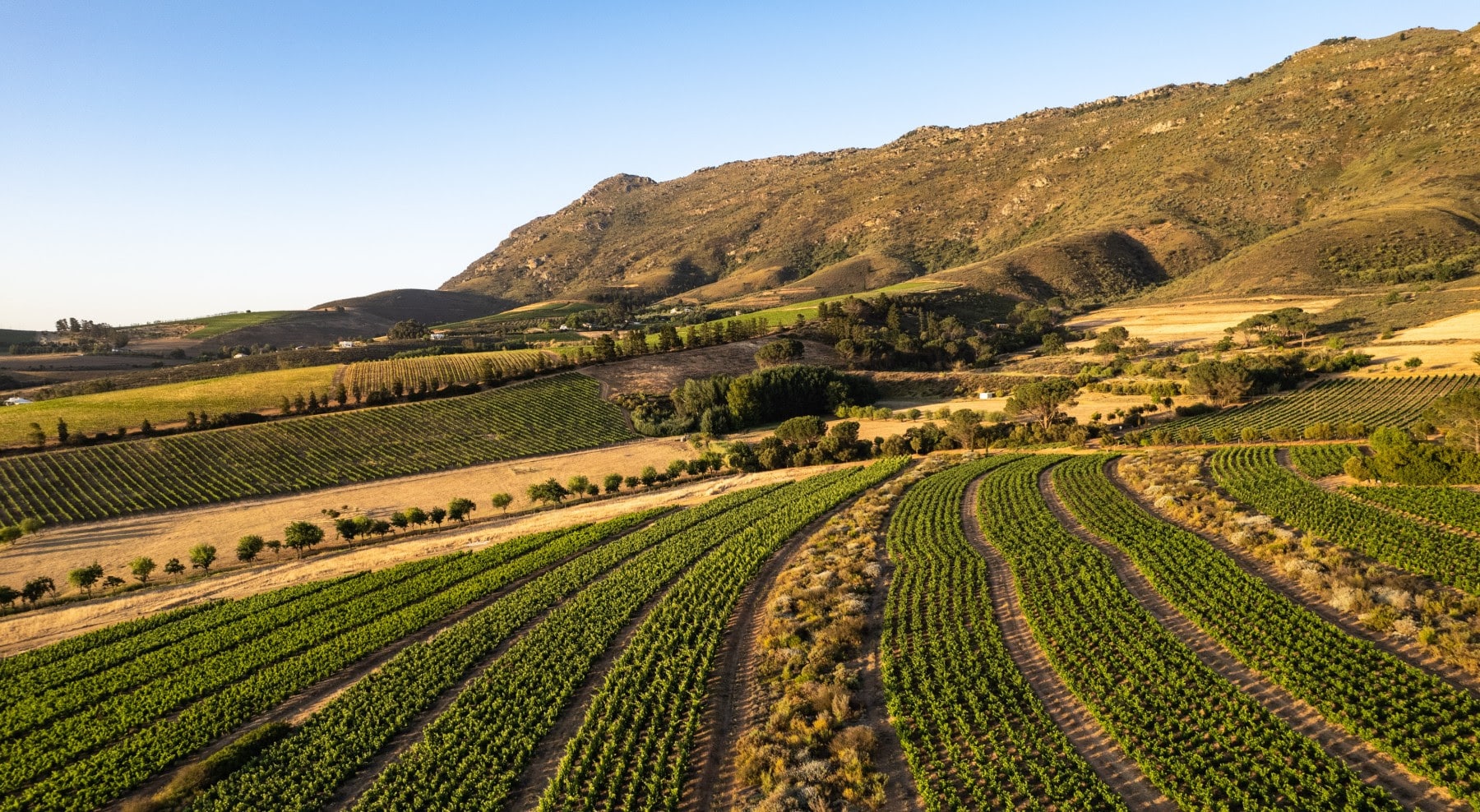
Swartland property Roundstone, part of Mullineux & Leeu Family Wines, has become the first South African vineyard to receive official Regenerative Organic Certified (ROC) status. The global certification recognises farms that meet strict standards for organic practices, ethical labour, and regenerative soil management, including biodiversity promotion and climate resilience. ROC-certified estates internationally include Tablas Creek (USA), Inkwell Wines (Australia), and Champagne Telmont.
To learn more about Mullineux and their regenerative organic farming practices, visit the Sustainability page on their website at mlfwines.com or watch their YouTube video here.
Last week wasn’t a good one for the world and humanity (even working off a low basis) but it was a good one for me food- and wine-wise (working off a pretty high basis by world standards). Friday, for example, saw me and my foodie-lunch pal John taking a rest from Table Seven and the Foodbarn and eating at A Tavola in Claremont, Cape Town. Always reliably delicious trattoria food, excellent service from a team that’s been there for ever (always a good sign of a happy restaurant) and knows just the right amount of friendliness to offer, and part-owner and manager David Haupt in attendance, as he usually is.
I’d taken a bottle and I said to David that I always felt a bit guilty taking advantage of this increasingly rare privilege (remember those good old days when just about all restaurants allowed BYO at a modest charge?) because he has such a good, well-chosen winelist, including some foreign stuff, at very reasonable prices. No, David said, my bottle was very welcome, and all he wanted was for his customers to be enjoying wine – their own, or his. And A Tavola is indeed known as a wine-friendly place, and as often than not there’s at least one other table with wine professionals.
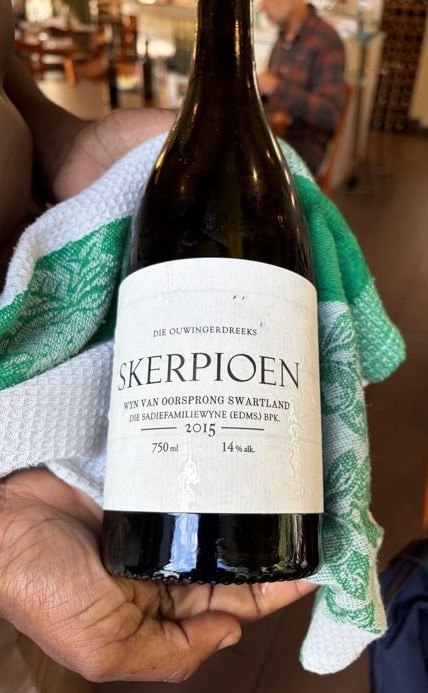 What I’d taken was a 2015 bottle of Sadie Skerpioen, as I know it to be probably John’s favourite wine of the Sadie range. And it lived up to the highest possible expectations – it’s matured beautifully and at eleven years old is certainly not tiring; quite elegant but substantial, with a lovely complex serenity, and that scorpion bite still giving a lip-smacking edge to the succulence. It served our food extremely well and in fact I thought how well it would have gone with a very rich ravioli dish I’d had earlier in the week at Table Seven. That occasion, organised by importers Great Domaines, included a splendid set menu to accompany the three Bordeaux labels made by the Barton dynasty (the wine selection culminating that evening in a pretty sublime Château Léoville-Barton St-Julien 1990). Only red wines, apart from a welcoming Pol Roger Brut 2018, and the ravioli (Pumkin and sage, with walnut beurre noisette) was very rich and could have done with an acidic white like Skerpioen. Altogether a great evening, however, and the wines beautiful.
I thought I’d open another local 2015 white on the Saturday. My friend Joel had been out fishing and had generously given me a handsome yellowtail (duly filetted and skinned, fortunately, by the fisherfolk down at Kalk Bay). With less than half a day having passed since the poor fish had been happily and unsuspectingly cruising False Bay, it was necessary to have some raw (the flesh smelt only of the sea!), so I prepared some as a ceviche and some as sashimi – the latter more successful, as I brought in too much flavour to the ceviche dressing.
It deserved something good as accompanying wine – so I opened a bottle of Alheit Magnetic North 2015. Not without a little trepidation, as I’ve had more than a few pre-2018 Alheits with cork problems (oxidation rather than taint), but this was fine. Or was it? It was drinking quite profoundly and the colour was light, lime-tinged lemon. But unless a tiny element of unintended oxygen had crept in down a little fold in the cork perhaps, it was more developed than I expected. Complexly flavourful, with a beautifully integrated acidity, but not with freshness enough to complete the pleasure. I had a better bottle not long ago. This one I enjoyed (including a glassful just now, a day later, when it is definitely a touch too tired, though still of interest), but not as much as I’d hoped.
Magnetic North is a wine that has, at its best, a unique magic to it. It still certainly does in its youth when I taste it, but I no longer have much experience of its ageing as I don’t buy it now (it became too expensive for me and I was sufficiently committed to some other pricey chenins). I must try some of the 2017 soon, the last vintage I bought, and see if I’ve missed it at its best (quite apart from hoping that random oxidation from faulty cork or perhaps faulty bottling hasn’t damaged the wine).
There’s not enough public record of modern Cape wines as they age. Including when they’re sold at auction, usually with accompanying tasting notes made many years earlier and therefore possibly very misleading, which I think is the unforgivable and weakest part of the current wine auction scene. Generally, I expect many of the best Cape whites to be showing very well at around ten years, although seven years is no doubt a safer limit for even most serious examples. That 2015 Skerpioen is far from alone in the Sadie range to benefit from ten years in bottle and last longer. And there are chardonnays and semillons and Bordeaux-style blends (even some sauvignon blancs, though older sauvignon tends to be as much a matter of individual preference as is coriander) as well as chenins. But there’s not enough discussion – let alone reports from experienced critics, with Winemag’s 10 Year tastings an honourable but very limited exception – to make for greater confidence than can be provided by individual experience plus guesswork, and hope.
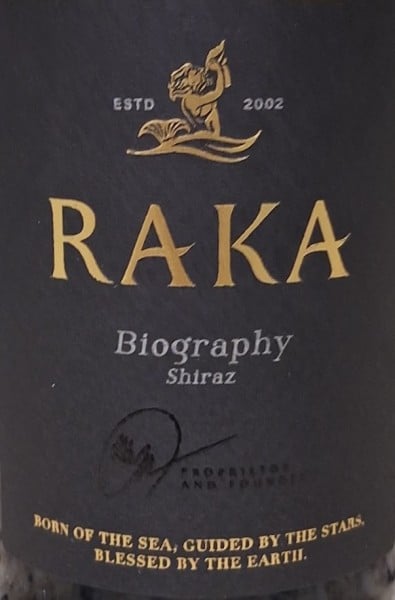 I once rather liked Biography Shiraz from Raka – the property officially designated as Klein River, situated between Stanford and Caledon. My recollection was that the wine was medium-bodied, red fruited and suitably spicy.
The 2022 vintage is currently listed at Woolworths at R209.99 a bottle, so the corporate buyers have clearly decided it ticks the requisite boxes of category fit and margin. I picked up a bottle during a routine shop…
Matured in a combination of French and American oak, partially new, for 12 months, the nose is stylistically and oddly retro with vanilla plus notable toasty, smoky notes before red and black cherry and spice. The palate is rich and smooth textured, a slightly burnt quality to the finish (alc:14.5%). More commercially expedient than it used to be?
CE’s rating: 88/100.
[insert-button id="raka-biography-shiraz-2022"]
Check out our South African wine ratings database.
Subscribe to Winemag.co.za and unlock exclusive wine reviews, ratings and reports.
