
Editorial: How long can South African white wines age?
By Christian Eedes, 10 November 2026
-
Share:


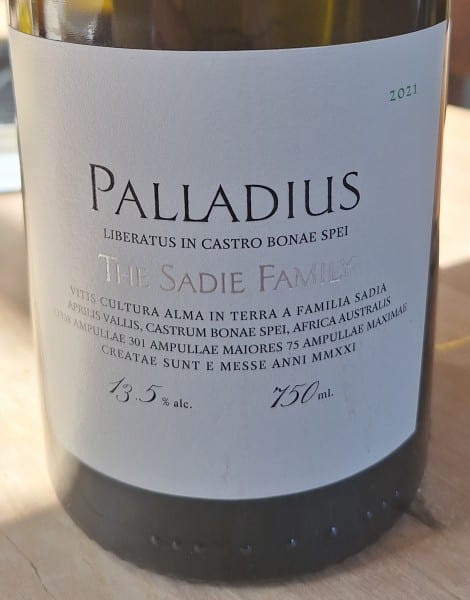 “The hype is real,” was my observation on X after recently opening a bottle of Palladius 2021, the white blend from Sadie Family Wines. The wine had shed the precociousness of youth without yet acquiring any significant developed character. “Five years from vintage is good for me, rather than too little, too late,” I concluded.
Would the winemaker agree? The comprehensive tasting note for the 2021 vintage available online advises: “As always, it is suggested to age this wine for a minimum of 4–6 years.”
There are few things more difficult in wine criticism than proposing a drinking window. Readers quite reasonably want to know when a wine is likely to be at its best, but the honest answer is that nobody knows with any great certainty. We can make educated guesses, draw on experience and point to certain indicators, but predicting the future of a wine is an inexact science at best.
Ian Naudé, a stalwart of the Cape’s boutique scene, opened a tasting of his current releases this past Friday with something unexpected: the 2009 vintage of his white blend (55% Chenin Blanc, 25% Sauvignon Blanc, 20% Semillon). I was amazed to find that has not only survived but is prospering, nearly two decades on from vintage. Still available at R500 a bottle.
Just how relative ageing potential can be was demonstrated later that same day, when a bottle of Huet Le Haut-Lieu Demi-Sec 1962 was opened over lunch. Still very much intact, it showed notes of bergamot, apricot and honey. Sixty-four years had only added to the drinking experience.
When is a wine at its best?
My own preference, especially when it comes to modern-era South African white wine, is to err on the side of caution. Rather drink a wine wondering what it might yet still become than regretting what it must have been like in its prime. Put another way, rather a year too early than a day too late. There is something particularly dispiriting about opening a bottle that has passed its best. The promise is gone, and all that remains is a rather forlorn reminder of what might have been.
Of course, this assumes that we can agree on what constitutes a wine being at its best in the first place. The appreciation of developed white wine, with its tertiary characteristics of deep colour, bee’s wax, nuts, mushroom, earth and all manner of other savoury nuances, is even more subjective than usual. Some drinkers find these qualities fascinating, others regard them as evidence of decline. There is no objective point at which a wine moves from being mature to being over the hill, and the transition is not necessarily a particularly orderly one.
A good old wine, however, is one of the great pleasures of being interested in wine. More than that, it is a reminder of what is at stake when we judge young wine. It is not simply a question of what is in the glass today, but what that wine might become. Often the distance between the two is considerable.
This is one reason why assessing the ageing potential of a wine is such a precarious business. We are effectively being asked to predict how a complex biological product will evolve over a period of years, sometimes decades, based on a relatively brief encounter at a particular moment in its development. Even with a detailed knowledge of the producer, vineyard, vintage and winemaking, there are simply too many variables.
Certain broad generalisations hold true. Wines with good acidity, sufficient phenolics where appropriate, concentration and structural balance tend to have a better chance of ageing gracefully. But these are indicators rather than guarantees. Grand wines can disappoint, while relatively modest wines can prove surprisingly rewarding. Anyone who has spent time opening bottles from a mixed cellar will have encountered both phenomena.
The limits of prediction
I’m no viticulturist, but two things seem to matter most: vine stress and the ripeness window. Severe drought, heat and low soil nitrogen are common in much of the Cape, and badly stressed vines seem more prone to producing wines that fade early. Pick too early and you risk green, unripe wines; pick too late and you get flabby, low-acid wines that oxidise easily. The best ageing whites usually come from fruit with real flavour development and still decent acidity, which is harder to achieve where heat pushes sugar up and acidity down before flavour has caught up.
All of which makes the business of publishing drinking windows something of a fool’s errand. A producer’s track record is perhaps as useful a guide as any when deciding which wines are likely to reward patience, but even this offers no guarantees. Storage conditions matter enormously, and two bottles of the same wine, even from the same case, can develop differently. Cork, in particular, introduces an element of unpredictability with which all of us are familiar.
You may have noticed that I don’t propose drinking windows. There are simply too many variables for the exercise to mean much. The one principle I would urge on readers is this: don’t become so preoccupied with waiting for a wine to reach its supposed peak that you miss the pleasure of drinking it along the way. Opening a bottle a little too soon is a small sin. Opening it a little too late is rather harder to forgive.
-
Share:

Related articles
News
Three reports, one deadline – enter by 11 November
10 November 2026
Category Reports, sponsored by Prescient Fund Services, are being released across four seasonal series: Autumn, Winter, Spring and Summer. The first three are now complete, with Summer still to come....
Opinion & Analysis
Michael Fridjhon: SA wine has the infrastructure. Where are the sales?
9 November 2026
The recent editorial entitled “The Stormers get it. The Proteas less so. What can wine learn?” on Winemag.co.za, which proposed a business case for the wine industry based on the...

2
Opinion & Analysis
Tim James: Three cool Pinotages for a hot summer
9 November 2026
I rather surprised myself last week, when writing about wine-grape crosses, by suggesting that pinotage is, both internationally and locally, an unusually successful one. I think it might be worth...
Comments
0 comment(s)
Please read our Comments Policy here.