
Editorial: What are you really buying when you buy expensive wine?
By Christian Eedes, 17 August 2026
-
Share:





17
Fine wine has for some time been treated as a luxury good. Prestigious names, limited quantities, elaborate packaging, higher prices, allocation lists and carefully constructed stories around provenance are now familiar territory.
There is nothing inherently wrong with this. Wine is a discretionary purchase, and people are perfectly entitled to spend silly amounts of money on it, if they so wish. The problem starts when premiumisation is mistaken for value creation: make something more expensive, harder to obtain and better branded, and assume consumers will regard it as more valuable.
Wine doesn’t quite work that way. For all the industry’s efforts to commodify, segment and premiumise, it stubbornly retains its individuality.
A bottle comes from somewhere. The grapes were grown in a particular vineyard, in a particular season, by particular people. Weather intervened. Farming decisions were made. Grapes were picked at a particular moment. The wine was made according to a particular aesthetic. Perhaps it was then matured for years.
Try putting all that into a neat premiumisation strategy.
The wine business can create brands and scarcity. It can persuade consumers that one label has greater status than another, upgrade the packaging, create a narrative and charge more money.
But it cannot manufacture 2015, 2017 or 2025 retrospectively. It cannot move a vineyard. It cannot make a young vine old. And if a wine is genuinely distinctive, it cannot simply make another one exactly like it.
A Louis Vuitton handbag can be produced in whatever quantity the brand chooses, with supply increased or restricted according to strategy. A vineyard has a finite area. A vintage happens once. You can make another Cape Bordeaux red blend; you cannot make another 2015 Kanonkop Paul Sauer from exactly that vineyard under exactly those conditions. This makes wine unusually resistant to standardisation.
Wine is not infinitely reproducible
It also makes the relationship between price and quality slippery. A R2,000 wine cannot be assumed to deliver twice the pleasure of a R1,000 wine simply because it costs twice as much; nor is there any reason it should necessarily be better than a R200 wine. The more expensive wine will often bring greater complexity, rarity, pedigree or ageing potential, but these things do not translate neatly into more pleasure in the glass. A R89 wine can be brilliant, while a R5,600 wine can be brilliant in an entirely different way.
I was reminded of this recently while tasting Trizanne Barnard’s Signature wines. What makes these wines compelling isn’t primarily their price (they sell for between R405 and R485 a bottle) or their scarcity (approximately between 1,000 and 2,500 bottles per cuvée). It is their specificity: they are unmistakably of the Cape South Coast.
“Terroir” is one of wine’s most abused words, but it is useful here because it describes something that resists industrial logic. A particular combination of vineyard, climate, soil, farming and human intervention produces a result that cannot simply be reproduced by spending more money or applying a more sophisticated marketing strategy.
The forthcoming Cape Winemakers Guild Auction, on 2–3 October, provides another perspective. The CWG is an exceptionally effective South African wine brand and the Auction is, let’s be frank, an explicitly commercial undertaking.
There is nothing wrong with that. The wines are scarce, the winemakers have big reputations, and the organisation has accumulated considerable prestige. Buyers are paying for access to wines they cannot ordinarily obtain.
But the commercial proposition ultimately depends on something the brand itself cannot manufacture: the wines. The CWG can confer status, generate demand and make a bottle harder to get. It cannot guarantee that the contents will be compelling. Winemag’s reviews of this year’s line-up will, in due course, have something to say about that.
Wine can be marketed as a luxury product, but it remains subject to the inconvenient variability of agriculture. That is not necessarily a weakness. It is part of the point.
Some value can’t be manufactured
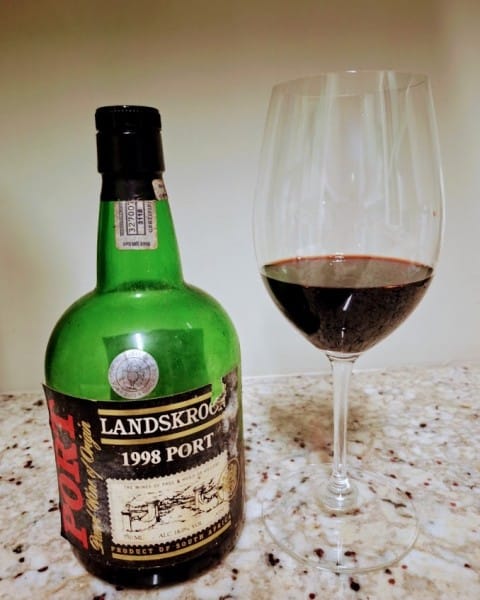
Which brings me to a 1998 Landskroon Port. A bottle from my late dad’s collection, opened idly on a Sunday night.
It was, quite simply, bloody good. “Port was always the strong suit here, and it’s still a stand-out. A vineyard planted equally with souzão and the tintas has produced most the (numerous) award winners”, I subsequently discovered on consulting Platter’s 2003.
Twenty-eight years after vintage, it had developed into the sort of wine that makes arguments about positioning and premiumisation seem rather beside the point. It had acquired value through something no marketing department can manufacture: time.
There was an additional twist. Landskroon was recently sold. After 150 years in the hands of the De Villiers family, the cellar and part of the broader property were acquired by Van Loveren Family Vineyards in mid-2025, with the remainder going to a property development company.
So here was a bottle made nearly three decades ago, from a farm whose ownership has since changed, offering a direct connection to a particular moment in the history of the property and the South African wine industry that cannot be recreated.
That is a form of value wine does exceptionally well. It can preserve a vintage, express a place, record a style of winemaking and reveal what time has done. Occasionally, it becomes more interesting precisely because nobody can make it again.
None of this means premiumisation is suspect. Producers need to capture more value from their best wines, and consumers are perfectly entitled to buy expensive bottles for status, pleasure, curiosity or some combination of the three.
Status is clearly part of the equation, particularly in a relatively young luxury market such as South Africa. There is nothing inherently wrong with buying an expensive wine because it confers a certain status; people have always used purchases to signal taste, wealth or belonging. But at the top end, there is a point at which wine risks becoming less about drinking than collecting trophies – another scarce object to acquire, display and talk about. That is a fairly hollow version of luxury, and one that wine doesn’t need to embrace.
This is where wine criticism can be useful. Not to tell consumers that expensive wine is vulgar, but to ask what, exactly, they are getting for the money. A R500, R1,000 or R5,000 bottle may be entirely justified. But price, rarity and prestige reflect the market around a wine as much as the qualities of the wine itself.
The wine business will continue to premiumise. And good luck to those who do it with integrity. The economics demand that producers capture more value where they can.
The challenge for all, particularly against a backdrop of affordability pressure, is to make sense of what that higher price is actually buying. Is it genuine distinction, or simply the perception of greater desirability? Ultimately, what makes one wine worth more than another is not something you can entirely put on a spreadsheet. Some of it is technical. Some of it is sensory. And some of it is harder to pin down: the sense that the wine matters.
That last bit is what justifies the premium – and it is impossible to manufacture on demand.
-
Share:

Louis | 18 August 2026
Very interesting piece. I was thinking about this very same issue when I read your recent review of the Tokara Telos and its astronomical price tag.
I think the key distinction is between expensive wine and fine wine. They are not necessarily the same thing.
At its best, wine has something most luxury goods cannot manufacture: a unique combination of place, vintage, people and time. But at the very top end, we also have to acknowledge how much of the price comes from reputation, scores, scarcity and the desire to own something others cannot.
I’ve had expensive bottles that genuinely justified the premium, and much cheaper ones that gave me far more pleasure. Ultimately, the wines I remember are rarely those with the biggest price tags, but those with a real sense of personality.
jack moolman | 18 August 2026
Christian , in my opinion one of the best wine price views and what wine is all about that I have read. Well done.
Justin M | 18 August 2026
Value is not a matter of economics but of personal choice. It is an almost entirely subjective equation. I’ve been buying & cellaring wine for 40 years now & what I paid for it years ago is relatively meaningless when it delivers – to my personal preferences of course. The same applies to everyday wines not cellared, but for day to day consumption.
I recently discovered an old handwritten ledger from a wine buying trip back in 1989 where I’d recorded my purchases, price per case (12 bottle cases back then). I was surprised to note the price I’d paid for Kanonkop Paul Sauer, Cabernet & Pinotage from the 1987 vintage – price per bottle in respective order was R12.00; R11.00 and R7.30. The 1984 Meerlust Rubicon cost me R15.00 and their Pinot R14.40.
Using the Paul Sauer ’89 price of R12.00, and applying an average annual inflation rate of 7.2% to 7.5% over the past 37 years, that equates to roughly R125.00 in today’s Rand at the upper inflationary end. That’s almost a relative 9 fold increase to today’s price per bottle of around R1,100.00. Naturally one can’t use an average national inflation rate in a specific category, but it is indicative of the rise to prominence of top private cellars.
That same trip I bought some 1986 Boplaas Cape Vintage Port at R30/bottle. Today the 2016 sells for R150 from the farm – or R315 in today’s terms. Market demand for, and perceived value of Port today is considerably lower than fine wines, but it is instructive to compare the relative values.
As a matter of interest, applying the same metric to the price of petrol, R12.00 would have bought 12 or 13 litres in ’89, whereas today it will yield just half a litre.
I don’t have any Kanonkop or Meerlust left from that era, but I do have some Boplaas and I recently opened a bottle which was absolutely marvellous. In 40 years the relative purchase price is half of what it was back then, while the wines are 8 to 9x. My point about value not being an economic measure is supported by this simple comparison.
Erwin Lingenfelder | 18 August 2026
Excellent article. The reality is that wine is not selling. I suspect some producers are desperately creating HALO brands to compensate. Yes, they have a right to survive…
You specifically mentioned Kanonkop Paul Sauer 2015. Will it be inappropriate if I use this forum to offer two Bordeaux Jeroboams? If so, what do you suggest Christian?
Greg Sherwood | 18 August 2026
Erwin, best send those Jeros to Strauss Auction. A private sale will be far more difficult in reality unless you get lucky. Those large formats should carry a nice premium. I still have 2 x cases of 4 mags of the 2015 Paul Sauer … which I fully intend to enjoy in my retirement. ;-P
Christian Eedes | 18 August 2026
Hi Erwin, Agree with my learned colleague that Strauss & Co is the best avenue for selling your wine. I’d suggest contacting Sarah Jordaan, Head of Department, Wine via email:sarah@straussart.co.za sarah@straussart.co.za
Erwin Lingenfelder | 19 August 2026
Thanks Greg! My experience with them was underwhelming to say the least. Seeing that my retirement is in a few months time I plan to enjoy them all by myself!
Gareth | 19 August 2026
Hi Erwin, I’d like to hear more about your experience. I’ve been considering approaching them with some wines, but would appreciate a ‘real’ experience.
Gareth I | 19 August 2026
Hi Gareth, I’ve sold a few lots through them. Feel free to reach out to me, happy to share my experience. Christian can give you my email address.
@Erwin, I might be interested in one of those, depending on your asking price!
Thapelo Mangope | 18 August 2026
You are in rare form lately, Christian. The penmanship is A1. Lovely read!
Nomfundo Mabaso | 18 August 2026
Interesting, amazing article !
GillesP | 18 August 2026
In short, a Telos wine can’t claim price of a Lafite or there about and most surely righly so. Christiaan is completely right here.
Gareth I | 19 August 2026
This article was really interesting. Am I the only one wishing I’d bought several cases of SA port wines a decade or two ago for next to nothing?
Greg Sherwood | 19 August 2026
On one of my visits back from London to Pretoria in the early 2000s, I popped into a “Bottle Store” in Brooklyn, and it was just after all the Platter 5 Star Ratings were releases. The shop had none of the illustrious 5 Star winners … as expected… but had shelves full of Cape Ports…. ALL 5 star Platter winners… Die Krans, Landskroon, Boplaas, Bredells etc. Despite if being a hot 32c Pretoria day, I bought around two dozen mixed bottles at basically give away prices… barely £100 a bottle or less. I still have most of those wine ageing in my temperature controlled cellar in Pretoria… and I look forward to start popping some corks now they are over 20 years old. Dessert wines and Fortified styles still remain the most incredible bargain on the SA market.
YEGAS Naidoo | 19 August 2026
Thank you Christian for approaching this paradoxical topic with such balanced perspicacity. A most enjoyable dimensioned read.
Richard Gundersen | 21 August 2026
One of the problems for the premium wine producers is that ‘average’ wines have gradually increased in general quality over the past decades making it harder to justify the price gap.
Donald Griffiths | 22 August 2026
True story. And to compound the issue the premium wines haven’t increased in quality commensurate with their above inflation price increases.