
Greg Sherwood MW: Dry January, No/Lo growth and wine’s awkward moment
By Greg Sherwood, 14 January 2026
-
Share:




It’s that time of year again, when my social media feed is clogged up with proud South African parents posting endless pictures of their young ones heading off to primary school or off to high school for the first time. You know the shots… bright new blazers hanging down to the knuckles and white dress shirts with enough spare neck room they might last the poor kid until matric.
But I suppose something has to fill the conspicuous absence of wine-and-bottle “brag shots” on social media as countless wine folk succumb to the ever-growing trend of Dry January after an indulgent festive season. In the Sherwood household, things are a little more complicated. Having a youngest son with a New Year’s Day birthday rather puts paid to any notion of going dry from 1 January. And if you drink on the 1st, you might as well carry on for the rest of the month.
Personally, I have never been one for short-term trends or fads, but with Mrs Sherwood suddenly becoming one of the most enthusiastic No/Lo (no- or low-alcohol) consumers out there, I have recently found my liquor cabinet increasingly congested with every imaginable type of low or no alcohol spirits, aperitifs, vermouths, and Aperol-lookalikes.
No/Lo growth
However, it certainly seems Mrs Sherwood is not alone in her newfound No/Lo love affair. Speaking to a few industry colleagues recently, I was surprised to hear that the UK No/Lo market is currently experiencing a significant injection of growth, driven by health consciousness, changing consumer attitudes, and major brand investments, with sales volumes up 66% since 2020, though still a small fraction of the overall alcohol market.
Digging a little deeper, key trends for the No/Lo category include increasing product availability in UK pubs (one of the main gate keepers), the dominance of large alcohol companies, dynamic product diversification (spirits and Ready To Drink / RTDs), and a pricing gap where beer and cider often cost more, despite general affordability improvements recently.
Interestingly, it is also becoming increasingly difficult to stereotype No/Lo consumers who appear to be a very diverse group of customers, including heavy drinkers increasingly adopting No/Lo products even more so than lighter drinkers. Significantly for the wine trade though, key No/Lo growth drivers seem to be centred on several factors the wider wine trade has been keeping a very close eye on of late.
The rise of health and wellness trends means wine consumers are more aware of alcohol’s impact on physical and mental well-being, reducing consumption among an ageing cohort of Boomers, but also among younger Gen Z consumers. Add to this the well documented cost of living crisis affecting almost every consumer segment, and the shift to cheaper No/Lo options starts to make more sense.
But all major trends need serious market drivers to make significant impact and large companies in the UK like Diageo are investing heavily, expanding the production and marketing of many mainstream brands like Guinness 0.0 and other No/Lo alcohol beverages. Of course, whenever big players join the party, investment in marketing and innovation often see a distinct increase.
With the proliferation of no-alcohol spirits brands on the UK market, it is perhaps unsurprising that overall growth has begun to moderate. Even so, the category is still expected to post growth of around 7% in 2024 versus 2023. More troubling for the mainstream wine trade, low-alcohol wine sales declined by 5% over the same period, while no-alcohol wine grew by 8% b –a figure that looks modest when set against the 20% growth recorded by no-alcohol beer.
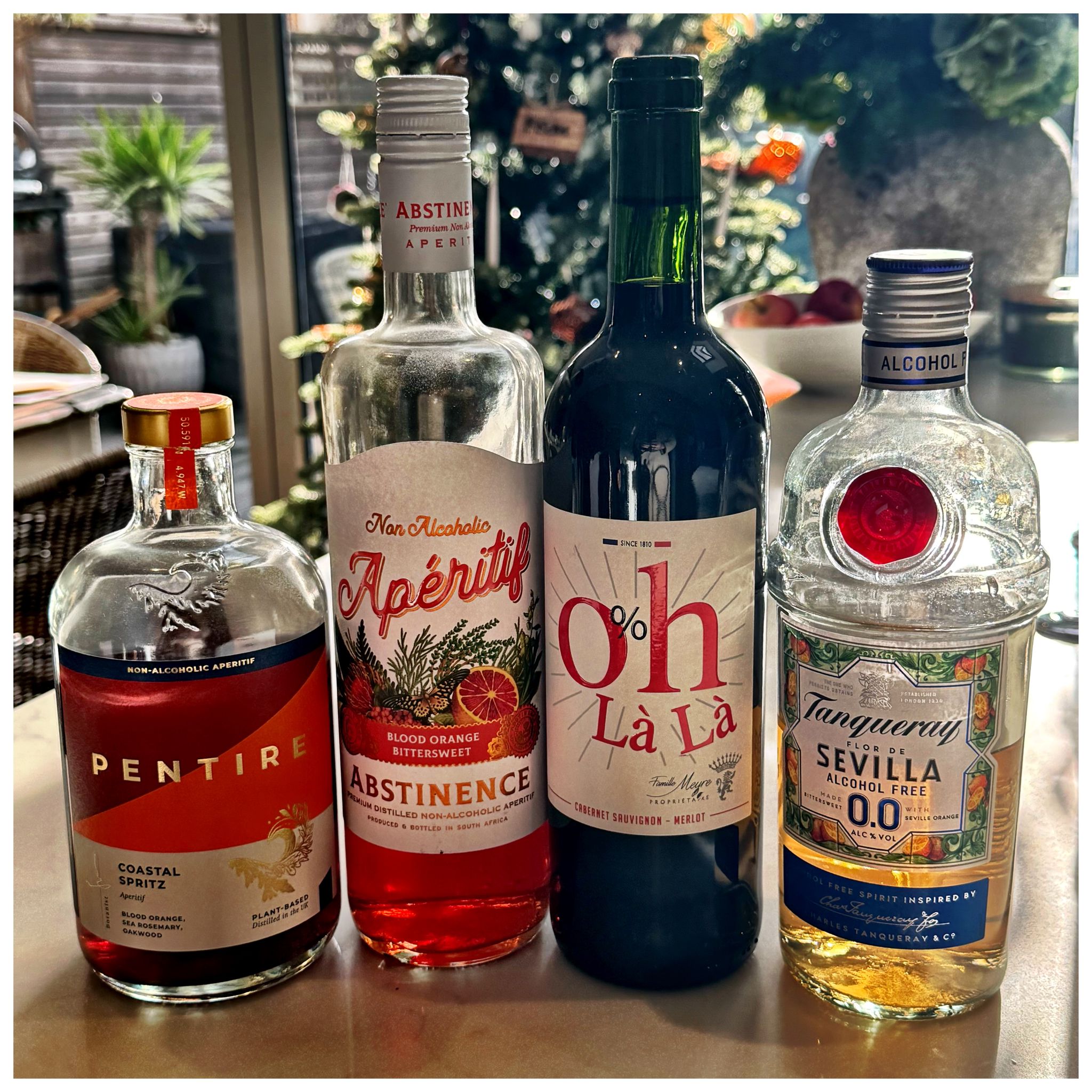
Wherever your tastes for No/Lo products lie, the difficulty in developing palatable, high-quality red and white wines remains a challenge for the industry. De-alcoholised white and sparkling wines certainly seem to have the lead on red wine products, although, while visiting Wine Paris 2025 last year, I did taste the very impressive Oh Là Là 0% Cabernet Sauvignon – Merlot produced by the Famille Meyre, a longstanding quality Medoc producer that has been bottling Chateau Bordeaux wines since 1810.
Putting a few brands to the test
But what else is lurking in the Sherwood No/Lo liquor cabinet I hear you ask? Well, in true Tim James “spring cleaning” mode, I pulled a couple of Mrs Sherwood’s more interesting bottles out to taste and assess. Going from left to right (as per the featured bottle line up) I started with the Pentire Coastal Spritz Aperitif, a plant-based product distilled in the UK from blood orange, sea rosemary and oakwood. Made for blending with tonic and other mixers, this non-alcoholic aperitif is pretty spot on with more than enough botanical intensity without being too sweet. A solid 3.5/5 GSMW score.
Next up, the suitably named Abstinence Non-Alcoholic Aperitif made from blood orange. On the nose, this certainly made me recall hints of the very successful South African Bloedlemoen Gin that I used to be able to buy in the UK. Sweeter and rounder, this could make the perfect pithy, delicately bittersweet mocktail with the right dry Fever Tree tonic mixer. A big thumbs up and a solid 4/5 GSMW score.
Finally, the Tanqueray Flor de Sevilla Alcohol Free 0.0 Spirit made from bittersweet Seville oranges, has become another house favourite of mine. With all the lifted top notes of soapy, pithy, bitter botanicals, this is an incredibly accomplished Gin-lookalike, but without the picante alcohol burn on the finish. Matched with the delicately pithy Fever Tree Elderflower tonic with a splash of regular Angostura Bitters (OK, I know that is No/Lo cheating!) it makes an incredibly thirst-quenching mocktail. A solid 4.5/5 GSMW score.
Recent new launches are certainly pushing the limits of traditional no-alcohol segments with brands creating innovative alternatives using natural ingredients and often boasting health benefits. No-alcohol wine remains dominated by value-orientated legacy brands but new middle market and premium brands are growing faster and are the source of greater levels of innovation, but from a small base, according to the IWSR January 2025 figures.
Some in the traditional wine industry have already decided to jump ship and throw their lot in with the growing No/Lo category. Afterall, few in the UK wine trade will forget hearing the news in late 2020 that Ed Gerard, the respected head buyer of wines and spirits at the world-famous retailer Harrods, had quit his job after 19 years in the wine trade, to join Mocktail Beverages, a No/Lo company specialising in premixed alcohol-free cocktails. As the current Chief Commercial Officer in 2026, I am sure he has no regrets.
For all the media bravado surrounding the growing No/Lo alcohol category and the rapidly improving product innovation, I for one remain a steadfast fine wine disciple, from January to December. Mrs Sherwood’s profusion of No/Lo Aperitif bottles are perfectly safe in the back of the liquor cabinet.
- Greg Sherwood was born in Pretoria, South Africa, and as the son of a career diplomat, spent his first 21 years traveling the globe with his parents. With a Business Management and Marketing degree from Webster University, St. Louis, Missouri, USA, Sherwood began his working career as a commodity trader. In 2000, he decided to make more of a long-held interest in wine taking a position at Handford Wines in South Kensington, London, working his way up to the position of Senior Wine Buyer over 22 years. Sherwood currently consults to a number of top fine wine merchants in London while always keeping one eye firmly on the South African wine industry. He qualified as the 303rd Master of Wine in 2007.
-
Share:
Related articles
Opinion & Analysis
Greg Sherwood MW: As Bordeaux unravels, Burgundy confronts hard truths of its own
10 December 2025
“For centuries Burgundy has produced some of the finest wines in the world, wines steeped in tradition and praised wherever wine is drunk.” It was with these words that Anthony...

7
Opinion & Analysis
Greg Sherwood MW: IWSC Top 50 – SA up, France down
19 November 2025
As we approach the end of another eventful year in wine, the written contributions from both Winemag’s columnists and editor seem to get ever more philosophical and reflective. Christian Eedes’...
Opinion & Analysis
Greg Sherwood MW: Sadie’s ‘T Voetpad and the power of old vines
6 November 2025
The Western Cape winelands have been blessed with a rich tapestry of viticultural diversity, sometimes by design, sometimes by default and sheer luck. Take the 5,159 hectares of old vines, defined...
Comments
0 comment(s)
Please read our Comments Policy here.