
Tim James: 40 years on, the few who changed SA wine
By Tim James, 17 December 2025
-
Share:





2
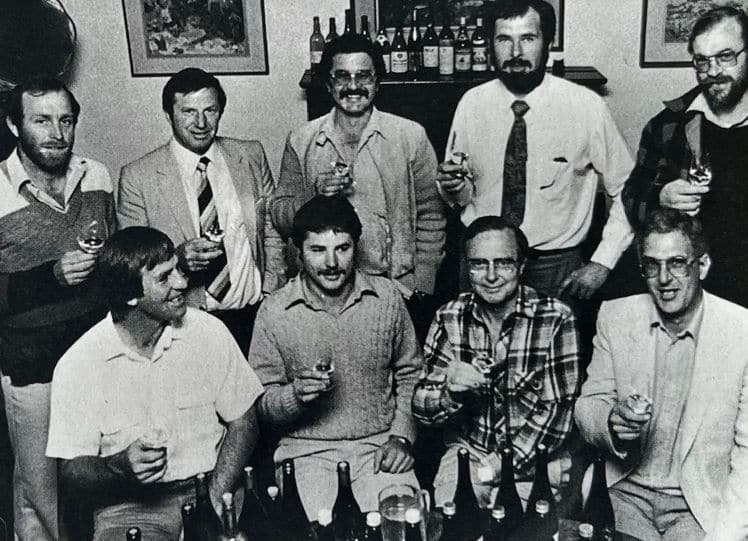
The closing months of this year saw the deaths of two notable members of the immediately past or waning generation of winemakers – heroes of that radical change in South African wine, from around 1980, which saw the full emergence into prominence of estates, as opposed to the merchants. Jan Coetzee (who died in September) and Achim von Arnim (who died earlier this month), were both founder member of the Cape Independent Winemakers’ Guild – which much later dropped the “Independent” bit as no longer relevant and also the apostrophe for no explained reason. That significant membership, which you’d have thought (wrongly, so far at least) might have prompted the Guild to say something graceful about their deaths, prompted me to think a bit about that founding … and then led me on a tasting tangent, as explored below.
Breaking with the merchants
The Guild was founded in 1983, with Billy Hofmeyr of the young Welgemeend estate as its instigator and first Chair, and just seven other members – though numbers were to grow quite rapidly. Billy and Ursula Hofmeyr had established their small Paarl estate with minimal capital in 1974, while Billy was still working as a land surveyor (as he continued to do for many years). He was then largely an amateur winemaker though deeply experienced in wine. (See here for my April article about the early Welgemeend.)
The other seven were seasoned, though youthful, professionals: Walter Finlayson (Blaauwklippen), Achim von Arnim (Boschendal), Etienne le Riche (Rustenberg and Schoongezicht), Kevin Arnold (Delheim), Jan ‘Boland’ Coetzee (Vriesenhof), Peter Finlayson (Hamilton Russell), and Braam van Velden (Overgaauw).
What they had in common was their “independence” – they were not tied in any way to the powerful establishment of merchants and co-ops. Etienne le Riche was quoted in a piece about the founders by Wendy Toerien as saying:
“This was a good group of people who met for support and discussion; the tastings always had a technical angle and everything was centred on quality. It helped to get together to discuss issues, identify problems and try and bring them up in the industry to encourage change and development in areas we felt needed it, whether it was the finer aspects of the newly introduced Wine of Origin Superior rating system of quality and provenance; the importing of new varieties and vine stock; or the prevalence of young wine shows instead of bottled wine shows.”
It’s actually a salutary reminder that the much-vaunted solidarity of this century’s new wave of winemakers – important as it was to the development of the wine revolution – was not something new in South African wine. That mutual support, as well as working on problems together, was the basis of the CIWG in its early years. I would guess that Billy Hofmeyr benefitted particularly from the technical expertise of the others, while countering with the depth of his experience of international wine and his passion.
The annual Auction of members’ wines was held for the first time in 1985, 40 years ago, facilitated by Hofmeyr, who knew the art market, and conducted by Sotheby’s. It took place in Johannesburg, following tastings in Johannesburg, Cape Town and Durban, as well as at some “South African embassies internationally”, according to the press release. The same release quoted Walter Finlayson as saying: ‘Although wine technology in South Africa is excellent, the extra dimension of creative winemaking in the traditional European sense is now emerging…. By linking together in the Guild, creative winemaking will result by studying the ways, styles and traditions of the world’s great wines.” This, of course, at a time when most of the world was starting to resolutely boycott the produce of the apartheid state. Local solidarity amongst the wine fraternity was particularly relevant.
Membership had changed a little by the time of the maiden Auction. As well as most of the original eight (von Arnim had acquired Clos Cabrière and left in favour of his winemaker Pieter Ferreira, who would soon present a wine), also offering wines were Neil Ellis (Zevenwacht), Beyers Truter (Kanonkop), Kurt Amman (Rosendal), Jeff Grier (Villiera), Jannie Engelbrecht (Rust en Vrede), and Johan Malan (Simonsig).
The majority of the wines on auction were red (a tradition that was to persist), reflecting, in fact, the focus of the original group. Just think what was happening at the time, and what they had to discuss: Welgemeend had released its 1979, the Cape’s first Bordeaux blend; Delheim’s maiden Grand Reserve cabernet sauvignon was 1981; Overgaauw’s first Tria Corda was made in 1980 and the first varietal Merlot in the Cape followed in 1982; Hamilton Russell was experimenting with Bordeaux grapes as well as pinot noir; while Boschendal, Blaauwklippen and Rustenberg already had established cabs to work on.
Tasting the legacy
Rustenberg, of course, also had a blend of cabernet sauvignon and cinsault, initially known as Dry Red, which today has become something of a benchmark for winemakers seeking to make a style particularly associated with South Africa rather than France. I recently opened one of the modern recreations of the style, Stellenrust’s 2019 Quota Cuvée (a 76:24% blend). Alongside it, Cavalli Warlord 2022, one of many that follow what Welgemeend had done originally by including all of the five major bordelais varieties (well, Welgemeend thought they had, but later realised they’d misidentified a mystery grape as petit verdot).
Cavalli Warlord was at a slight disadvantage in a comparison of two wines that should age with distinction, being three years younger and that bit more raw. More primary fruit in evidence there, quite dark and cedary as it should be, with cab franc’s fragrance coming through. Ripe, moderately rich and assertive, though not too bold and powerful. Succulent, with grippy but quite friendly tannins. A very good example of modern Stellenbosch red, including in its typicality some ripe sweetness. The alcohol given is 14%, but I suspect it would be on the upside of that, and that there’d be at least a few grams of residual sugar contributing to the slightly sweet finish. Not a problem to drink now.
Paradoxically, Stellenrust Quota Cuvée is closer in spirit to something like the old, classically, modestly styled Welgemeend – despite the horribly heavy, showy moulded “Stellenbosch” bottle (which I keep on hoping has been discontinued, but this is a 2019 after all). It’s not, however, without a touch of sweetness and its declared 14% alcohol certainly a few degrees higher than the early Welgemeends had. It is sufficiently dry, though, and the cinsault adds to the comparative lightness of feeling as well as the aromatic charm. Already with some of the harmony that maturity develops out of a good balance of components, but not yet at its best. The relative restraint and dryness is what I find winning, in conjunction with sufficient fruit intensity. I’m happy to use it to toast Billy Hofmeyr’s groundbreaking release from a vintage exactly 40 years earlier. So much has changed in those 40 years, but classic values remain, here and there, though inevitably – and quite rightly – reinterpreted.
- Tim James is one of South Africa’s leading wine commentators, contributing to various local and international wine publications. His book Wines of South Africa – Tradition and Revolution appeared in 2013.
-
Share:
Related articles
Opinion & Analysis
Tim James: Rooibos-preserved wine? Checkers thinks it’s the next big thing
8 December 2025
The notification of sulphitic presence on (nearly all) bottles of wine is, more than anything useful, a sign of lurking prohibitionist tendences on the part of governments around the world....
1
Opinion & Analysis
Tim James: A candid look at some notable SA wines with a bit of age
1 December 2025
Some recent comments about older Sadie Treinspoors, made to a column of mine from as far back as 2019 (before Covid!), reminded me that there are always at least some...
2
Opinion & Analysis
Tim James: SA wine reputation grows – awards, buying trends point to change
24 November 2025
Recently I asked Eben Sadie what had meant the most to him of the many international or local accolades or lofty ratings he’d achieved. He was in no doubt: it...
eckhard meyer | 18 December 2025
The scientific input of prof. Joël van Wyk, who had to keep the members’ focus on measurable improvement and sustainable process, was critical.
At the time, the IWG was not viewed favourably by some large merchants and co-operative institutions , the same players whom prof van Wyk had to canvas for support and roles for his oenology students . A humble giant of the South African wine industry.
Andrew Gunn | 20 December 2025
A wonderful historical perspective Tim. Andrew