
Tim James: Rams’ scrotums, sweet wine and legal squabbles
By Tim James, 23 February 2026
-
Share:




Have you drunk from a Bocksbeutel recently? Or even seen one – perhaps a Mateus Rosé, which I was surprised and rather disappointed to see is imported into the country? The “iconic” Mateus bottle, still essentially a flat pot-belly flagon, looks to me to have become subtly elongated and with more sensually elegant curves over its many decades of unbelievably many million iterations. (A hundred years ago, on my first visit to London, Mateus Rosé was the first wine that I ever bought at a restaurant, as advised by the person I was taking to dinner, so it has a place in my affections.)
The ellipsoid Bocksbeutel (with a capital letter because it’s German) has been around for just about ever, but gets its most commonly used name, it seems, either from an old word for a small sack used for carrying books or from a ram’s scrotum. Or even both, arguably. (And if the latter, and if hanepoot derives its name – unlikely, but it’s been suggested – from hanekloot, meaning a cock’s testicles, then a Bocksbeutel containing a hanepoot wine should surely be irresistible to the sort of people who think that powdered rhino horn is going to sort out their little problem.)
The shape has been protected in Europe for a few decades, primarily and most prestigiously for the lovely sylvaners and rieslings of Franken in Germany – where, relevantly enough, the glorious Stein vineyard at Würzberg gave its name to “Steinwein” many many hundreds of years back. It’s also allowed for a few other wines (including Portuguese rosé) that had been using the shape prior to the relevant regulations. That might help explain the elipsoid eclipse in South African wine, but the bottle certainly had its long day here, as older winelovers (or at least lovers of sweetish wines) will remember.
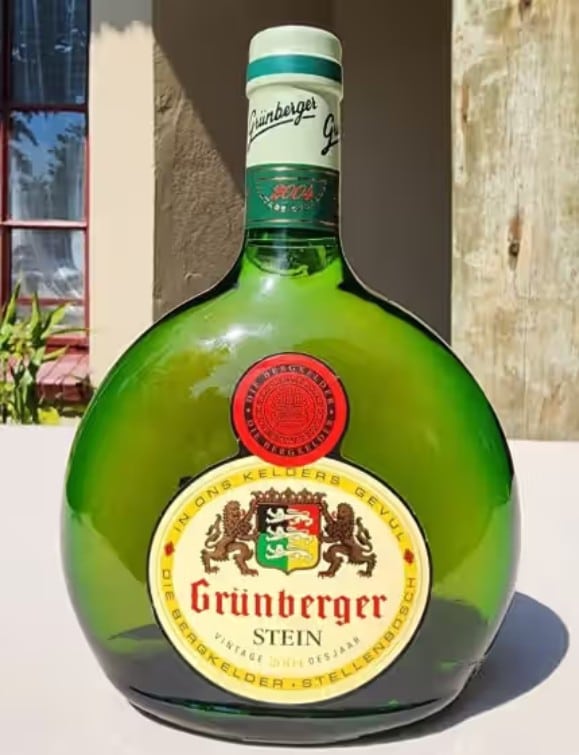
There was a time when Grünberger Stein was one of South Africa’s biggest sellers, alongside Nederburg Stein, Bellingham Johannisberger, and Graça. The “stein” category, signifying semi-sweet white table wine, has largely if not entirely disappeared; its time has gone. The Grünberger Stein bottle shared its distinctive flagon shape with its partners Freudenlese and Rosenlese. Interestingly, another brand in that topselling category had a related form: Bellingham Johannisberger also came in a flattened bottle, but with cascading curves that reputedly approximated the silhouette of the Groot Drakenstein behind the original Bellingham homestead. It later moved into a boringly standard flint bottle, flaunting the name “Legacy”, and I’m not sure it long survived the transformation. Certainly the Grünberger label and bottle have long since disappeared – around 2010, I think.
But either flat bottle might even have been seen, in our days of culinary innocence before the rise of tasting menus and small plates, with a ribbed white candle jammed into it, on the table of an Italianate trattoria of a lesser type, perhaps even a café, that hadn’t managed to get hold of a wickerwork fiasco.
Talking of fiascos (fiaschi?), Grünberger featured together with another of the top sellers, Graça, in a lawsuit in the early 2000s. I was reminded of this when browsing nostalgically through the old Grape, and came across a caustic note in the Widow’s column of gossip and insult about what she called “the squalid little legal battle going on between Distell and Shoprite Checkers over Graça, that glory of Cape viniculture”. She added that “Actually it’s not really about wine, of course, but packaging – apparently the most important part of wine these days, after advertising.”
Checkers had brought out a wine cheerfully named Muchas Gracias, a name that Distell argued was that much too close to Graça. Furthermore, it came in the Bocksbeutel shape that Distell had trademarked (but should never have been allowed to, said Checkers virtuously, as it had long been in the common domain). “Isn’t it sad”, asked the Widow, “to fight over something like Graça? And isn’t it a sign of lack of imagination or conviction to think that we really need a second rather dismal wine from the Cape with a specifically Portuguese name and a specifically German bottle?”
Anyway, the supermarket Goliath later triumphed over the wine-producer Juggernaut, if I may collide two disparate images of belligerent bigness. Regarding the bottle shape interdict application, News24 reported in October 2004 the court’s finding that ”because the bocksbeutel was a commonplace container that had been around since the 1950s in South Africa and since 1400BC as a container shape, it was not distinctive and never registerable.” So the Bocksbeutel had to be removed from the trade mark register.
Happily, there was also a sort-of-David triumphing concomitantly against the big guys. Distell had also wanted to interdict a pair of West Coast winemakers from using the same bottle shape but embossed with a rock lobster; obviously this application was also dismissed. (I’ve been unable to ascertain the winemakers and the brand involved and would be grateful for further info.)
And happily too, if you also want a more-or-less pleasing ending for both the big guys, I’m told that Shoprite Checkers used the victory to wangle a good deal over some matter from Distell, and then withdrew the Muchas Gracias brand that they had spent a lot on legal fees to defend. The new deal was more important. Deals at that level of business usually are. We wine lovers stand by and doubtfully raise a glass.
- Tim James is one of South Africa’s leading wine commentators, contributing to various local and international wine publications. His book Wines of South Africa – Tradition and Revolution appeared in 2013.
-
Share:

Related articles
Reviews
Secateurs Riviera 2025
23 February 2026
Want access to this content? Reviews and Reports are initially reserved for subscribers. Get immediate access to exclusive insights and data. SUBSCRIBE NOW Already subscribed? Login
News
Final call: 10-Year-Old Wine Report 2026
20 February 2026
One of the most important measures of great wine is that it should be age-worthy and with this in mind, Winemag.co.za is running the tenth annual 10-Year-Old Wine Report. Producers...

1
Reviews
Steenberg Black Swan Sauvignon Blanc 2024
20 February 2026
Want access to this content? Reviews and Reports are initially reserved for subscribers. Get immediate access to exclusive insights and data. SUBSCRIBE NOW Already subscribed? Login

Comments
0 comment(s)
Please read our Comments Policy here.