
Tim James: Rooibos-preserved wine? Checkers thinks it’s the next big thing
By Tim James, 8 December 2025
-
Share:





1
The notification of sulphitic presence on (nearly all) bottles of wine is, more than anything useful, a sign of lurking prohibitionist tendences on the part of governments around the world. They feel no need to slap the warning on packs of raisins or bags of lettuce leaves but take every opportunity to point out what a scary thing alcohol is (and indeed its widespread misuse is very scary). As to usefulness, any adult who is significantly sensitive to sulphites will have long since memorised a list of common foodstuffs to be wary of, on which wine will be just one of many items. Justus Apffelstaedt’s recent informative and debunking piece on this website about the rareness of serious susceptibility to sulphur made this all very clear.
There are quite a few “natural” wines these days made without sulphur additions to the small amounts of suphur produced naturally in vinification, and many winemakers have lowered their doses in line with taking added care in the winemaking process. But reliance on sulphur for controlling oxidation and reducing microbial spoilage remains pretty universal.
A curious resource for South African wine buyers scared off by the “Contains sulphites” warning has been available from Stellenbosch producer Audacia for more than a decade or so now. Their 2013 merlot was the first of what would became a range of wines using woodchips from rooibos and honeybush plants, whose tannins (I assume effectively) replaced sulphur as an anti-oxidant agent. After research and development, Audacia developed, I gather, an extract of these vinification tannins to add in very small quantities during the winemaking process – no doubt an easier as well as more calculable way of achieving the same end.
In fact, the use of oenological tannins (one of the very many legal additives to wine in South Africa and elsewhere) seems widespread, and nothing new. A useful science-based website I looked at says that “they are produced through a direct solid-liquid extraction of plant material and can be found both as single species and as botanical species in blends, such as grape, oak, chestnut, quebracho, acacia and tara”. To which we at the foot of Africa can now add honeybush and rooibos.
To be noted in passing is that the other main function of sulphur additions – protection against microbal spoilage – is not helped by oenological tannins when sulphur is avoided. Sterile filtration, however “unnatural” it might seem to have any holocaust of bacteria, is probably the best means to help prevent resultant off-odours and the like.
It doesn’t seem that the world, even the local bit of it, has been beating a path to Audacia’s door (or that of the company they own that now produces the patented extract). Perhaps it is just my ignorance, but I’m not aware of other producers showing interest in the specific idea (grape tannin is the most commonly used oenological tannin, I believe, added for various purposes, and I don’t think it’s all that common either). As to consumer response, well, all I can say it’s not all that easy to find Audacia’s wines at retail.
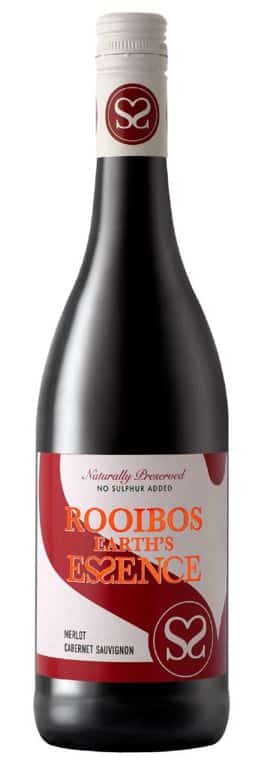 But now there’s a new push, “piloted” by a major supermarket chain, Checkers. A small range of beverages under the general brand name Earth’s Essence has been introduced, obviously as a marketing trial, at 25 branches of Checkers LiquorShop in the Western Cape. A red wine, a beer, and a cider have been introduced as “a totally new category of delicious rooibos inspired naturally preserved” drinks. “Naturally preserved”, they say – fair enough, though whether they are really entitled to suggest, as they do, that sulphur is a “synthetic preservative”, I have serious doubts. Synthetic? It’s certainly as natural a substance as an extract of plant tannin. Elsewhere they speak of “eliminating the need for artificial preservatives”, and suggesting that sulphur is “artificial” is surely going a bit far in the direction of meaningless insult. I reckon that if sulphur could sue, it might well do so!
The media release I received about Earth’s Essence makes it very clear that, although the word “rooibos” is in the products’ names, these “are not rooibos-infused or flavoured drinks—they do not taste of rooibos”. That’s actually a relief to me, as someone who loathes the taste of the stuff. The contribution of rooibos (and perhaps honeybush) is in “minute amounts” (“miniscule” as the website misspellingly has it) of extracts.
This minuscule presence to help combat oxidation surely doesn’t quite justify “rooibos” being by far the most prominent word on the label, partnering “essence”. Although there’s no claim made that these drinks offer any of the benefits of rooibos and honeybush (including its antioxidative properties – they’ve all presumably gone into working on the oxidation), I wonder if that’s what the label conveys.
Anyway, I suppose the real point for most wine drinkers, who don’t give a damn about the antioxidant used, is what the wine tastes like (cider and beer lovers must look after their own). So I braved the Cape Town traffic, which is already getting insane, though school holidays hadn’t even started last week, and then braved one of the city’s larger malls, to find a bottle. It cost me R110 – the introductory price, which will rise to R120.
After that it was easy, especially given the screwcap. The wine is from merlot and cabernet sauvignon; it’s ultra-easy-going and largely inoffensive – ripe, sweetly fruity, smooth as silk, soft and plush as velvet, with scarcely a bit of tannin, whether from rooibos or grape or oak, to give a bit of resistance as it slips down, just some acidity that I suspect might not be quite as “natural” as the preservative. The style has nothing, of course, to do with the way the wine is preserved, so if that’s what you like, go for it, though I suspect you could do better for the money.
But maybe it’s worth a bit extra to feel part of “the global shift toward mindful living and modern wellness values” as you sip your wine, and of “a movement toward mindful consumption, proudly rooted in South African soil”. I think it must be all that mindfulness that’s giving me a headache.
- Tim James is one of South Africa’s leading wine commentators, contributing to various local and international wine publications. His book Wines of South Africa – Tradition and Revolution appeared in 2013.
-
Share:
Related articles
Opinion & Analysis
Tim James: 40 years on, the few who changed SA wine
17 December 2025
The closing months of this year saw the deaths of two notable members of the immediately past or waning generation of winemakers – heroes of that radical change in South...
2
Opinion & Analysis
Tim James: A candid look at some notable SA wines with a bit of age
1 December 2025
Some recent comments about older Sadie Treinspoors, made to a column of mine from as far back as 2019 (before Covid!), reminded me that there are always at least some...
2
Opinion & Analysis
Tim James: SA wine reputation grows – awards, buying trends point to change
24 November 2025
Recently I asked Eben Sadie what had meant the most to him of the many international or local accolades or lofty ratings he’d achieved. He was in no doubt: it...
Gerhard van Huyssteen | 16 December 2025
The label will, unfortunately, not do their product any good, if I may guess. As much as I LOVE rooibos, the few times I have seen their bottle on the shelve, I was uninspired to even pick it up to read what it is all about. The label makes the product looks like a (cheap) fad – similar for me to Woolies’ new range of “aroma”-driven wines. Both are probably causing even more confusion in the minds of people who already think that the plum aromas of a merlot comes from added flavourants. At least in Woolies’ case, the labels are eye-catching and attractive …