
Tim James: The writing and destruction of South Africa’s wine history
By Tim James, 30 March 2026
-
Share:





1
Apparently Henry Ford didn’t quite say that “history is bunk” – he blinked, and included “more or less”. He added that he was talking about tradition, which, he said, we don’t want: “We want to live in the present and the only history that is worth a tinker’s damn is the history we make today.” Hmmm. A notable thing about many of those who have made Cape wine history this century is that remembering tradition and creatively absorbing it has been central to their project. I asked Eben Sadie just recently if he’d read the books that Desiderius Pongràcz wrote while working as a Cape viticulturist more than half a century back. He responded with an “of course”, and put the matter neatly: “If a viticulturist did not read Practical Viticulture, it would be like trying to go somewhere with no understanding of where you should have departed from.”
I suspect that, on a more formal level, history, as opposed to ideas of tradition, doesn’t have much appeal to South African wine lovers or to the industry as a whole. With a few honourable exceptions – mostly some decades back – even academics’ interest in local wine history has been remarkably lacking. Constantia (but only up to mid 19th century) and the earlier decades have been fairly well studied, but generally the 19th and early 20th centuries in particular have not. When I wrote my book on South African wine, I wanted to include a short historical survey. I thought it could be easily and lazily achieved by relying on secondary material, but mostly what I found, if anything, was other people having wanted to do similarly and repeating each others’ truths and mistakes; and always there were serious gaps. I ended up having to do much more proper research than I’d wanted to.
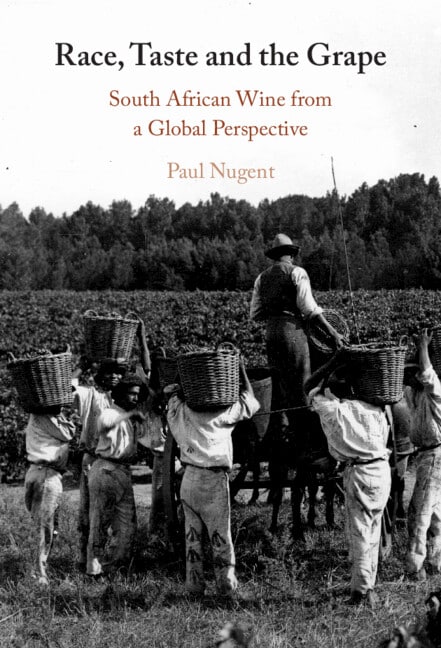 My history chapters would have been altogether easier and better if I’d had a copy of Paul Nugent’s 2024 book, Race, Taste and the Grape: South African Wine from a Global Perspective (published by Cambridge University Press and horribly expensive – R1,015 from Takealot for the paperback version, three times that for the hardback). Certainly for the late 19th century and the 20th, his focus period – though the major developments of the post-KWV era are also discussed. I did refer to the book recently as having prompted me to revisit the “chardonnay scandal”, and plan on being further prompted in the future.
Nugent, born and raised in South Africa, is Professor of Comparative African History at the University of Edinburgh, and this is very much a serious piece of academic work, directed primarily at those for whom history is far from being the account of one damn thing after another. It is theorised, engages with larger or smaller academic debates (hence, for example, the “global perspective” alluded to in the title”, and goes into a great deal of detail at times – the sort of stuff that is sometimes slightingly referred to by outsiders as “only of academic interest”.
I mention this, because it’s not an easy or a racy read, even for those who would claim a genuine interest in South Africa’s wine history. As I do, but there were times, as in the discussion of the struggles between different liquor companies, when I did more skipping of paragraphs or pages than I probably should have. Nugent’s writing is okay, but does tend to the dry and workmanlike, not really enlivened by the frequent clichés (people tend to “beat a path” to somewhere rather than simply “go”). I’m eager to welcome the book as an immense addition to our resources, but recommend it to “ordinary” readers with a warning that it’s not simply telling a story, but arguing and proving and adducing evidence and, as I said, often going into a load of detail that some might find tedious.
But if readers persist, they will learn a lot about Nugent’s categories of race, taste and grape. The first “signifier” there is obviously pervasive in the book, affecting all the discussions. It was, for example, crucial to the long-bubbling story of temperance movements and the racial full prohibition which was in place for some time. But that story more fully belongs to the “taste” theme, considering the ever-changings patterns of wine consumption among race, class and gender groupings. As for “grape” – that would account for farming and wine-making, including the major tensions between primary producers and the merchant dealers, as well as scientific and other developments.
Over it all the KWV looms large. The post-phylloxera decades were very much a pre-KWV period, in the sense of preparatory to its rise to immense quasi-statutory, bureaucratic power over the industry, the period that fills most pages of this book. Nugent reckons the gains, but I think it fair to say that his conclusions about the KWV are not positive. His final chapters look at the decades following the collapse of the KWV’s tight regulation (minimum prices, the quota system, etc), in the context of the new ANC government’s surprising (to some) embrace of open markets for agriculture, the expansion of South African wine into the world market, and the concern for expressing “terroir” amongst the most ambitious.
There are a few somewhat surprising omissions in the concerns of the book worth mentioning. One Nugent mentions himself, when he says that he chose to “pay less attention to labour issues” because so much excellent work already existed. Which latter point is true, but I do wonder at the author not engaging more with those debates. Not doing so weakens the “race” theme – which ideally should have been more fully articulated in terms of class.
Partly connectedly, I think, there’s an absence of considerations of gender, outside the matters of consumption (and aggressive non-consumption in the temperance movement). Undoubtedly, at the levels of activity that Nugent is most concerned with, most discussion about women would have had to be about their absence (though the pretty remarkable recent rise in the number of women winemakers would be worth some examination). There have always been a lot of women involved in producing Cape wine, but most of them have been doing grossly underpaid work in wineries and, especially, vineyards, where Nugent doesn’t venture far.
This book results from Nugent’s long and assiduous research (oh wow, some of it must have been boring!). A rather fascinating and shocking thing quietly emerges when he is discussing in his introduction the sources he used. He doesn’t quite say it, referring to “collateral damage”, but he clearly concludes that the KWV, fearing a “government takeover” in the 1990s, destroyed all its significant records – records amassed while the KWV was performing statutory functions. “In all probability,” Nugent says, “the single most important important set of records documenting the recent history of the Cape winelands has therefore been lost forever”. Just think of the largeness of that fact, and the culpability of those responsible. The authorities at the time were clearly remiss in allowing what was, I’d have thought, an illegal action to take place and never, to my knowledge, speaking of it. As for the KWV doing the shredding, it’s hardly surprising that they would commit this final act to conclude (and obfuscate) their role, at best controversial, in 20th century South African wine.
- Tim James is one of South Africa’s leading wine commentators, contributing to various local and international wine publications. His book Wines of the New South Africa – Tradition and Revolution appeared in 2013.
-
Share:

Related articles
Opinion & Analysis
Tim James: Swartland wines – built to last or better young?
23 March 2026
How well do the once-new-wave Swartland wines mature in bottle – both whites (mostly chenin or chenin-based) and reds (mostly syrah or syrah-based)? We’re starting to amass useful evidence, although...
3
Opinion & Analysis
Tim James: Understanding wine starts with pleasure but what comes next?
16 March 2026
Once it’s been successfully nabbed, a good quotation should not be allowed to get away too quickly. I had three of them in my last column for World of Fine...
3
Opinion & Analysis
Tim James: The Chardonnay scandal – when top SA winemakers faced charges
11 March 2026
Forty years ago, a number of the Cape’s leading winemakers and producers seemed, for a while, likely to be charged as criminals. In my usual look at anniversaries in my...
Greg Sherwood | 30 March 2026
Desiderius Pongràcz’s “Practical Viticulture” was the first book I tried to buy when I started my MW (it took a while to track down a copy!)
The next book I bought, at great expense, was Emile Peynaud’s “Knowing and Making Wine”.
Two seminal volumes.