
Tim James: What a collection of SA wine anniversaries really tell us
By Tim James, 12 January 2026
-
Share:





1
The year’s beginning is a good time to look back – and further than just the last 365 days that brought us to this pass. Conventionally, such musings fixate on the larger portions of centuries past, and who am I to avoid that in 2026? So here’s a random selection of stuff, hopefully convincing, mostly from years with 26 as the final digits, or merely ending with a 6. Or a 1.
Booms, busts and the making of an industry
I can’t say much about 1726, unfortunately, when winegrowing had not really moved out of the Peninsula further than Stellenbosch and Drakenstein – the larger Paarl area. A century later, continued poor communications meant that commercial vineyards had spread only a little further; but the wine industry had grown a great deal, rather spectacularly so in the first quarter of the 19th century, with the arrival of the British to take over the Cape. Population (permanent and passing-in-ships) grew, and so did exports, especially in the years of preferential trade tariffs. But 1826 showed the effects of the 1825 reduction in that preferential treatment; the boom ended and, sadly not for the last time, the Cape wine industry entered a dismal period of overproduction. Or, as producers like to think of the phenomenon, under-consumption.
Different conditions ensured that poor quality and miserable trade prevailed 100 years later. Phylloxera had played a part in this, having been first noted 140 years ago, in 1886. Interestingly, it was the French Consul in Cape Town who recognised its symptoms in a vineyard in Mowbray (now a vineless suburb of Cape Town); presumably his insight emerged from having seen ravaged vines back home. I’d love to know more of that back-story.
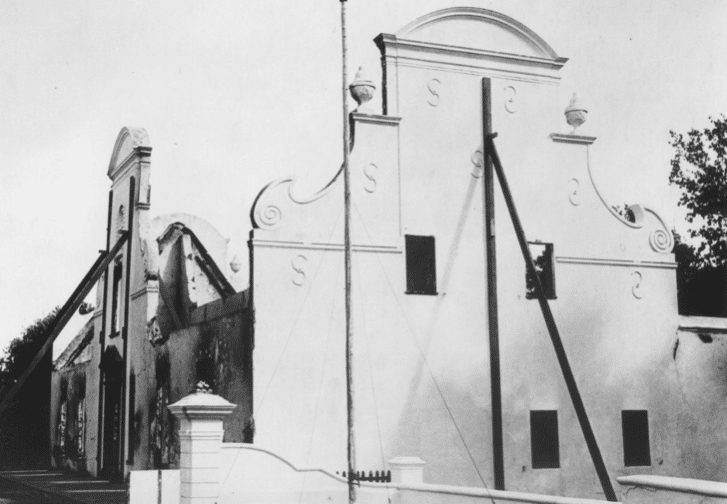
Anyway, by 1926 the KWV was hard at work to do what it could for the wine farmers’ cause. And recognisably modern times were starting to emerge. The same year saw the symbolically powerful restoration of the Groot Constantia homestead, which had burned down the previous year. Then, still in a Constantia that had been neglected to a remarkable degree, the centenary of the local discovery of the phylloxera blight was celebrated, as it were, by the reborn Klein Constantia’s first vintage, in 1986.
Last year’s backward look for the South African wine industry prominently involved the centenary of the invention of pinotage. That grape’s creator, AI Perold, can take another bow this year, for the centenary of his famous Treatise on Viticulture. Or, rather for his Handboek oor Wynbou. The translation into English – giving it an international market – was this good linguist’s own, and published a year later, in 1927.
And so, with some relief perhaps, I turn to more recent anniversaries. As recently as 25 years ago, for starters, the first significant local blend of the Bordeaux white grapes was made, by André van Rensburg at Vergelegen (a whopping 80% sauvignon blanc and just 20% semillon that maiden year – André said he wanted the security of “up-front fruit”).
It was a great time of growth in the post-1994 wine revolution. A number of wineries were founded a quarter-century back, in 2001– including Bosman Hermanus, Epicurean, Hout Bay Vineyards, Kranskop, MAN Vintners, Migliarina, Org de Rac, South Hill, Tierhoek, Vondeling and Withington. And even more new wineries had their maiden bottled vintage that year, among them Allée Bleue, Anura, Arra, Asara, Ashbourne, Black Pearl, Cape Rock, Diemersfontein, Eagles’ Nest, Iona, Jason’s Hill, Journey’s End, Noble Hill, Quando, Quoin Rock, Ridgeback, Skilpadvlei, Stellar, The Foundry, and Tokara.
None of the above featured, obviously, in that year’s Grape’s poll of “experts” on the country’s Top 20 wineries (the third such poll, after 2001 and 2003). The top five were Vergelegen, Boekenhoutskloof, Hamilton Russell Vineyards, Rustenberg and Thelema. Kanonkop was unusually missing, probably simply because Beyers Tuter had left (don’t trust superficial experts).
The changes in reputation/ranking of a few of those wineries in the past two decades you can easily note. Rather more interesting, I think, were a few other categories we asked for votes on. Like “the best up-and-coming wineries”. Tokara at the head has amply justified the vote of confidence. Then came Raka, then Solms-Delta and Quoin Rock – both of which were, in their own ways, to rather disastrously disappear and are now making a comeback. Then Sterhuis, which as far as I know has not been making wine for its own label after a nasty family dispute (see Kruger Family Wines for the good succession story).
We also asked for a vote on the best individual wines being made, and Sadie makes its first appearance in these polls, amongst the reds: Boekenhoutskloof Syrah, Kanonkop Paul Sauer, Sadie Family Columella, Meerlust Rubicon, Vergelegen. None of these would seriously raise an eyebrow in a poll made now, 20 years later. That’s not entirely true, I’d suggest, of 2001’s list of the five best whites: Vergelegen White, Steenberg Sauvignon Blanc Reserve, Hamilton Russell Vineyards Chardonnay, Rudera Robusto Chenin Blanc, Jordan Nine Yards Chardonnay. Hmmm.
To finish on a more general topic, one that still arouses some interest, but not much, the issues having been so well debated. I wrote an article in 2006 looking at bottle-closures, focusing on one that I – happily – haven’t seen for ages, but was horribly common back then: the extruded plastic stopper, in various colours. I think the dominant producer was Nomacorc and, googling, it seems that they are still around, with what looks like a more acceptable range of stoppers.
Back in 2006 they were awful, I thought, cheap and nasty. I said: “The synthetic version is often difficult to remove from the bottle – massive strength is sometimes called for, and many corkscrews have had their lives ruined in valiant battle. If you get it out, it is usually totally impossible to push it back in if you want to re-seal the wine.” It also had a bad record for sealing properly for more than a year or two. I particularly focused in my article on its new application in a pleasant sauvignon from Quando – not a wine I know any more, but see that it is still around, though sealed with one of the uglier versions of metal screwcap.
I concluded with something about the closure debate still rumbling on. And mentioned something I’d long since forgotten: the use, back then playing a very small role, of glass stoppers with an aluminium cap (Vinolok was the brand, I recall). Of course, as with metal screwcaps, part of the crucial seal was plastic. I thought this was, compared with screwcaps let alone extruded plastic, a beautiful, elegant solution to the problems with cork (which were then very apparent and unresolved). But it never caught on, it seems, and I haven’t seen one since. I’ve just checked with the Gottfried Mocke, who was back then at Chamonix in Franschhoek, as I remember him being an early, and rare, user of the glass stopper. The problem, he reminded me, was that you needed to import a bottle from Germany as well as the stopper, which made it prohibitively expensive here.
Gottfried and I agreed, not very controversially, that twenty years ago is a very long time…. And that would be a pleasingly banal and reflective way to end these ramblings. But we also had to talk about the terrible fires raging around Franschhoek as we spoke, that have already caused terrible damage at Chamonix – Gottfired was there earlier, trying to help; as yet the fire is not threatening Boekenhoutskloof where Gottfried is now chief winemaker. Those long 20 years have also made the threat of climate change that much more real.
Wishing you all, nonetheless, good drinking and some happy times in 2026. And, in addition to pleasure in the present, some salutary cogitations about the past as well as the future.
- Tim James is one of South Africa’s leading wine commentators, contributing to various local and international wine publications. His book Wines of South Africa – Tradition and Revolution appeared in 2013.
-
Share:

Related articles
Opinion & Analysis
Tim James: The Chardonnay scandal – when top SA winemakers faced charges
11 March 2026
Forty years ago, a number of the Cape’s leading winemakers and producers seemed, for a while, likely to be charged as criminals. In my usual look at anniversaries in my...
Opinion & Analysis
Tim James: How long should you keep fine Cape whites?
2 March 2026
Last week wasn’t a good one for the world and humanity (even working off a low basis) but it was a good one for me food- and wine-wise (working off...
10
Opinion & Analysis
Tim James: Getting acquainted at last with Allée Bleue
17 February 2026
It feels like a confession to say that although I have any number of times driven past the entrance to Allée Bleue on my way to other parts of Franschhoek...
Kwispedoor | 12 January 2026
Vinolok has all but vanished in SA. The most recent glass closure I’ve encountered, was the Kleine Zalze Syrah du Plateau 2022 (opened in December). Nice wine, by the way.