
Tim James: Getting acquainted at last with Allée Bleue
By Tim James, 17 February 2026
-
Share:




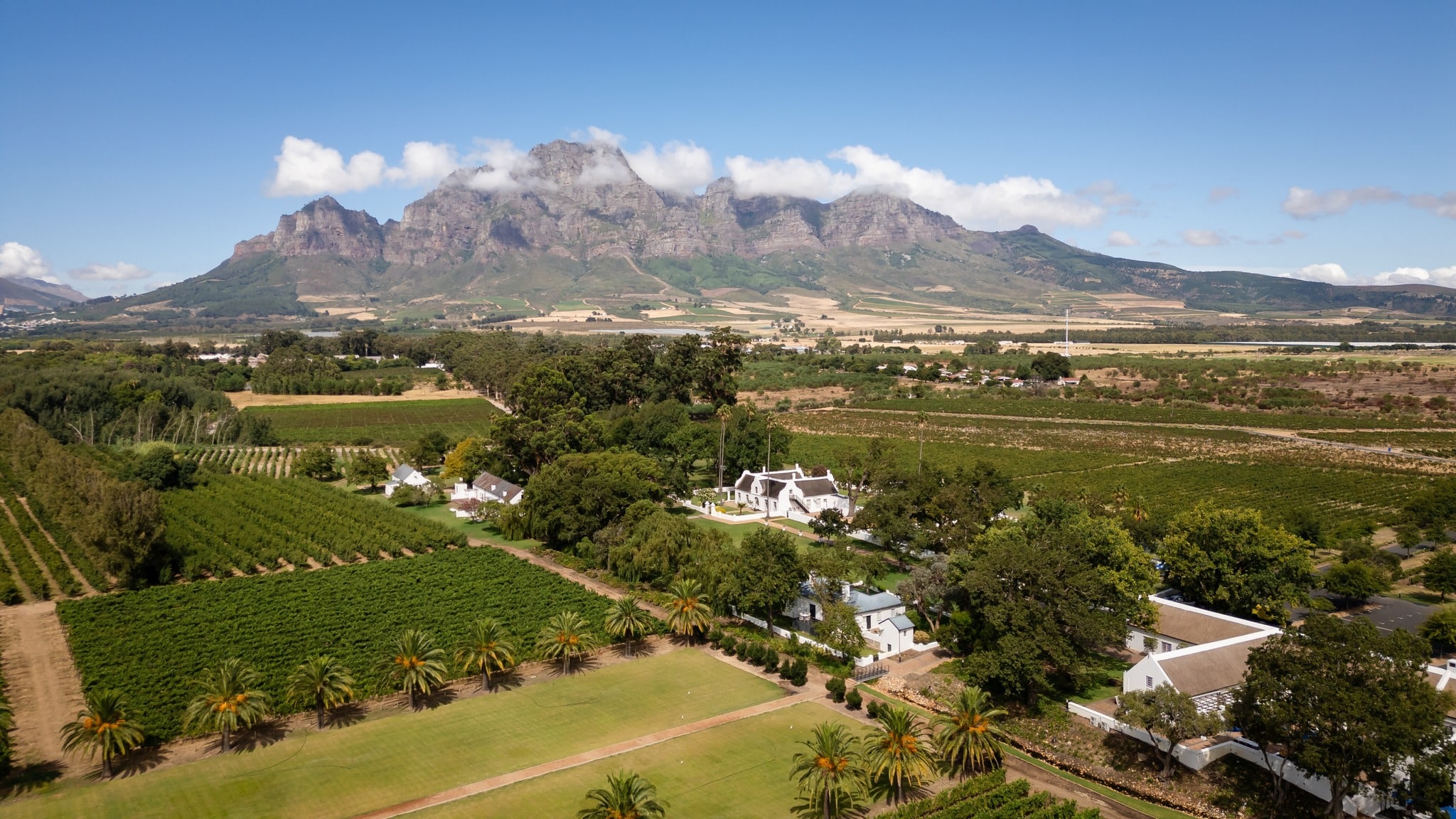
It feels like a confession to say that although I have any number of times driven past the entrance to Allée Bleue on my way to other parts of Franschhoek I’ve never ventured down that avenue of bluegums. I should have, and now that I’ve had lunch with Edo Heyns (not there but in Cape Town) and tasted some of their wines, I am full of intention to do so.
Edo has been the CEO of Allée Bleue for a year or two now. I was startled to be reminded how young he is, given his career in South Africa wine. I last met him some ten years ago when he was even more impressively young for someone who’d already been Communications Manager for VinPro, editor of WineLand, and was moving into his position as Strategic Development and Marketing Director for Advini South Africa to help to build that large French company’s notably successful growth here. I’m not sure when he started (or completed) his PhD at Stellenbosch Business School, focusing on family wine business.
So here he is, boyishly at 40, working on something rather different, certainly more diverse. The Allée Bleue farm has been owned by the German Dauphin family since 1999 and has built up a portfolio that goes beyond wine into hospitality, fruit and herbs (interesting to know the origins of many of the herbs packed in those horrible hard plastic containers in the supermarket that I rather resentfully buy when my garden can’t supply me with what I need).
The Allée Bleue wine offering has never seemed a compelling proposition (hence my driving past the gate) and doubtless the project of changing that sort of perception, supported or prompted by a strengthening of owner interest, is a good part of what interests Edo. He’s working with long-time winemaker Van Zyl du Toit and has also engaged two crucial new parts of the team committed to growing both sales and prices of the wines: Frits Brune, a qualified sommelier, as head of sales, and the eminent vitculturist (and old friend of Edo’s) Etienne Terblanche as a consultant to work with farm manager (also long-time) Douw Willemse.
So viticultural ambition is necessarily there as part of a drive to lift the wine-offering (with the range already being somewhat trimmed), and it interests me, because that part of Franschhoek – the low-lying, flat, and alluvial valley floor – has never had much reputation as wine terroir. Indeed the joke always used to be that the best Franschhoek wines always came from elsewhere – though that’s certainly not the case anymore, especially as many vineyards have been dragged up the mountainsides, as it were. Edo is confident that it is possible to make excellent wines from the estate – and especially mentions the “cobblestone soils” as good for producing shiraz. A planting programme is underway, notably of chardonnay and pinotage, with eight hectares being planted over an initial two years. Edo points out that an advantage of an estate having diversity of crop production is that it is easy to respond usefully to different soils and other growing conditions. Water is not likely to be a problem, with the estate near the confluence of two rivers.
Some grapes are already brought in from elsewhere, in fact, and I gather that it is more than possible that the quest for improved quality will involve buying in complementary grapes from elsewhere – Edo suggested that the top Allée Bleue chardonnay, at present boasting of coming from a registered single vineyard, might take in non-estate fruit if necessary to raise its quality.
Talking of the chardonnay, there were two of them in the five wines (the theme being single vineyards) that Edo brought for me to try, and which I took home with me afterwards to try further at my leisure, an opportunity which proved significant. Both chards seem reasonable value for money, especially the more serious one. The estate 2025 version (matured in concrete eggs), at R210 ex-farm, is quite rich, but fresh, balanced, flavourful and lively and will certainly be better in six months or so, once it’s fully shaken off its infancy. Isabeau 2023 is that bit more interesting and intense, with a useful few more years in bottle after maturation in barrel and amphora, and well worth the extra R85. Both are very drinkable (as I proved, with a little help from others) over the next few days.
The two shirazes are more ambitiously priced. And a touch less convincingly so to me (and, given the available vintages, I wonder if they are to consumers too). The standard version (R235) is ripe and spicy, softly rich with an acidity that seemed a touch apart and out of kilter – but the balance certainly improved over a day or two after opening, even though it’s from 2021, so not very young. The Black Series Single Vineyard Syrah 2022 is a more intense, dense and powerful version, slightly sweet-finishing, notably smooth-tannined and velvety, the oak unobtrusive. I didn’t much enjoy it at first (the alcohol and a disjointed acidity seemed intrusive), but its being open for a day starting working wonders on the balance and approachability. I do, incidentally, wonder what Allée Bleue customers make of the changing use of varietal synonyms for the grape name: confusing or pretentious or both? A decent example of this big style of shiraz, but for around R550 you can arguably do better (Boekenhoutskloof, also from Franschhoek, for example, though the grapes for that are perhaps sensibly imported from Swartand).
The shirazes improved greatly with air, but, talking of sensible imports, the Allée Bleue Old Vines Cinsault 2024 from Piekenierskloof was rather delicious and impressive from the start (also at R550, I’m told, but it’s not on the website and doesn’t seem easily available locally). As with all the best examples of this variable grape, it combines charm with some restraint and a firm structure. I believe that Allée Bleue is doing something interesting with a mid-style of pinotage, and planning on more, and discovering that is a further push for me to make a visit out there.
Herbs are herbs, more or less, and nectarines and plums vary within tolerable limits. Wine? Well, it’s much less easy, and Edo has some interesting challenges ahead, I’d say. He’s thinking creatively about the possibilities and I reckon we are even in for a few surprises in the years to come.
- Tim James is one of South Africa’s leading wine commentators, contributing to various local and international wine publications. His book Wines of South Africa – Tradition and Revolution appeared in 2013.
Winemag doesn’t charge for most of what it publishes. Subscriptions exist to protect the one thing that can’t be sponsored: independent judgement. Join today.
-
Share:

Related articles
Opinion & Analysis
Tim James: Who really wins at wine auctions?
12 October 2026
The Strauss & Co wine auctions began in 2019, in good time to benefit, as is clear in retrospect, from the pandemic that was soon to hit us. The stated...

6
Opinion & Analysis
Tim James: Why do we drink? And why do I?
5 October 2026
We all drink alcohol, it’s surely fair to say (unless there are some teetotal voyeurs – liseurs? – readingthis; “we” being the readers, extended to “people generally”). But why? That’s...
Opinion & Analysis
Tim James: A visit to Callie Louw’s Sonkop
28 September 2026
Fans of Callie Louw – there are many, and I think “fan” is the right word – will be pleased to know that all is going well at his new...
Comments
0 comment(s)
Please read our Comments Policy here.