
Tim James: How long should you keep fine Cape whites?
By Tim James, 2 March 2026
-
Share:





12
Last week wasn’t a good one for the world and humanity (even working off a low basis) but it was a good one for me food- and wine-wise (working off a pretty high basis by world standards). Friday, for example, saw me and my foodie-lunch pal John taking a rest from Table Seven and the Foodbarn and eating at A Tavola in Claremont, Cape Town. Always reliably delicious trattoria food, excellent service from a team that’s been there for ever (always a good sign of a happy restaurant) and knows just the right amount of friendliness to offer, and part-owner and manager David Haupt in attendance, as he usually is.
I’d taken a bottle and I said to David that I always felt a bit guilty taking advantage of this increasingly rare privilege (remember those good old days when just about all restaurants allowed BYO at a modest charge?) because he has such a good, well-chosen winelist, including some foreign stuff, at very reasonable prices. No, David said, my bottle was very welcome, and all he wanted was for his customers to be enjoying wine – their own, or his. And A Tavola is indeed known as a wine-friendly place, and as often than not there’s at least one other table with wine professionals.
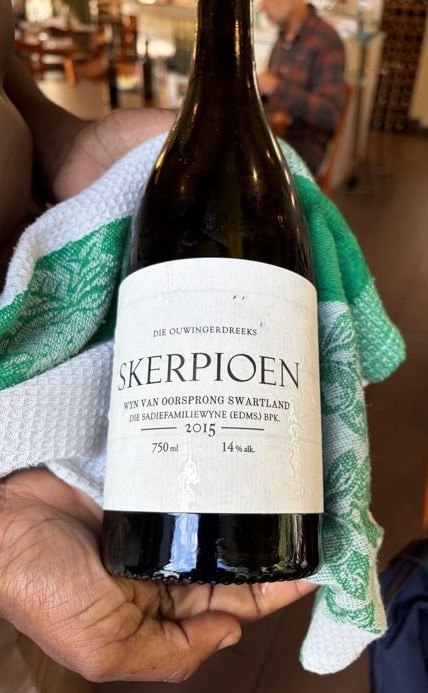 What I’d taken was a 2015 bottle of Sadie Skerpioen, as I know it to be probably John’s favourite wine of the Sadie range. And it lived up to the highest possible expectations – it’s matured beautifully and at eleven years old is certainly not tiring; quite elegant but substantial, with a lovely complex serenity, and that scorpion bite still giving a lip-smacking edge to the succulence. It served our food extremely well and in fact I thought how well it would have gone with a very rich ravioli dish I’d had earlier in the week at Table Seven. That occasion, organised by importers Great Domaines, included a splendid set menu to accompany the three Bordeaux labels made by the Barton dynasty (the wine selection culminating that evening in a pretty sublime Château Léoville-Barton St-Julien 1990). Only red wines, apart from a welcoming Pol Roger Brut 2018, and the ravioli (Pumkin and sage, with walnut beurre noisette) was very rich and could have done with an acidic white like Skerpioen. Altogether a great evening, however, and the wines beautiful.
I thought I’d open another local 2015 white on the Saturday. My friend Joel had been out fishing and had generously given me a handsome yellowtail (duly filetted and skinned, fortunately, by the fisherfolk down at Kalk Bay). With less than half a day having passed since the poor fish had been happily and unsuspectingly cruising False Bay, it was necessary to have some raw (the flesh smelt only of the sea!), so I prepared some as a ceviche and some as sashimi – the latter more successful, as I brought in too much flavour to the ceviche dressing.
It deserved something good as accompanying wine – so I opened a bottle of Alheit Magnetic North 2015. Not without a little trepidation, as I’ve had more than a few pre-2018 Alheits with cork problems (oxidation rather than taint), but this was fine. Or was it? It was drinking quite profoundly and the colour was light, lime-tinged lemon. But unless a tiny element of unintended oxygen had crept in down a little fold in the cork perhaps, it was more developed than I expected. Complexly flavourful, with a beautifully integrated acidity, but not with freshness enough to complete the pleasure. I had a better bottle not long ago. This one I enjoyed (including a glassful just now, a day later, when it is definitely a touch too tired, though still of interest), but not as much as I’d hoped.
Magnetic North is a wine that has, at its best, a unique magic to it. It still certainly does in its youth when I taste it, but I no longer have much experience of its ageing as I don’t buy it now (it became too expensive for me and I was sufficiently committed to some other pricey chenins). I must try some of the 2017 soon, the last vintage I bought, and see if I’ve missed it at its best (quite apart from hoping that random oxidation from faulty cork or perhaps faulty bottling hasn’t damaged the wine).
There’s not enough public record of modern Cape wines as they age. Including when they’re sold at auction, usually with accompanying tasting notes made many years earlier and therefore possibly very misleading, which I think is the unforgivable and weakest part of the current wine auction scene. Generally, I expect many of the best Cape whites to be showing very well at around ten years, although seven years is no doubt a safer limit for even most serious examples. That 2015 Skerpioen is far from alone in the Sadie range to benefit from ten years in bottle and last longer. And there are chardonnays and semillons and Bordeaux-style blends (even some sauvignon blancs, though older sauvignon tends to be as much a matter of individual preference as is coriander) as well as chenins. But there’s not enough discussion – let alone reports from experienced critics, with Winemag’s 10 Year tastings an honourable but very limited exception – to make for greater confidence than can be provided by individual experience plus guesswork, and hope.
- Tim James is one of South Africa’s leading wine commentators, contributing to various local and international wine publications. His book Wines of South Africa – Tradition and Revolution appeared in 2013.
-
Share:

Related articles
Opinion & Analysis
Tim James: Drill, Baby, Drill – wine’s unlikely alliance with Big Oil
17 August 2026
The wonderful Kogelberg Biosphere, home to 1 880 species of fynbos (and with a number of grape varieties as guests), asks on its website: “The Kogelberg and a changing climate:...
9
Opinion & Analysis
Tim James: The story of semillon (white and red) in the Cape
11 August 2026
What is probably the world’s newest grape variety (for a while at least) has its past firmly rooted in three centuries or more of Cape winemaking. As reported last week,...
16
Opinion & Analysis
Tim James: Eben Sadie and making wine in the vineyard
3 August 2026
Great wine is made in the vineyard, they say – essentially claiming little more than that you need good grapes for good wine, and the better your grapes the better...
Vernon | 2 March 2026
Tim, the principal point of your last paragraph is an important one: “not enough public record … not enough discussion …” of older wines.
Highly desirable, not easy to achieve but getting the auction houses to do more due diligence on the older wines they’re selling would be an excellent development.
Ryan Coetzee | 2 March 2026
Hi Tim
I’ve had both the 17 and 19 Magnetic North recently and both are spectacular. Would definitely not wait any longer for the 17. The 19 could go a few years yet but for me, it’s at its peak now.
Ryan Coetzee | 2 March 2026
Also keen to know which chenins you’re more committed to than the Magnetic North!
Tim James | 6 March 2026
My opinion is that a fifteen year old Palladius, especially a bottle whose history you can’t be sure of, would be a very risky proposition.
Victor | 2 March 2026
Lovely article Tim!
Happy to bring another data point as we had a bottle of the Skerpioen 2015 end of October ’25 and it was exactly like you describe for the first hour, but became very tertiary about 1 to 2 hours after opening it. Very enjoyable in the first phase but surprising how quickly it evolved. Our thinking was some cellaring issue for that specific bottle
We had the 2021 just before NYE and it was quite different in style, still very young, we paired it with pâté en croûte, which might seem an odd choice but worked magnificently
Kwispedoor | 2 March 2026
People have such different tastes, and when wine gets old, that becomes even more apparent. But the trickiest thing about how long to keep fine Cape whites (or just about any wine), is bottle variation. Even if provenance is a constant, old bottles of the same wine can still be astoundingly different from each other.
I had a perfectly stored 2015 Skerpioen about six weeks ago and it was a really lovely wine, but definitely seemed far developed. Getting a bit nervous about my last remaining 2015 is only natural, but chances are that that bottle might well have quite a bit of life left in it.
That same week, I had only one wine that was better than the Skerpioen, and it was a Landau du Val Semillon 2018. Now with that 2018, I’ve definitely had worse bottles – though that particular bottle was a cracker with many years left in the tank.
I think it’s quite obvious that natural cork brings about the most bottle variation, especially over a longer time period. But I think some of the more “natural” approaches to winemaking also contribute to this. If producers want consumers to take their wines seriously as long term propositions, their whole winemaking process, from vineyard to bottle, should reflect this.
My wine club, The Noble Rotters, had a blind tasting this past Saturday, themed “Golden Oldies”, where we explored some older white wines. Here’s the line-up:
*2003 J.C. le Roux Scintilla Vintage Reserve MCC
*2016 Rickety Bridge Road to Santiago Natural Ferment Semillon (ex the famous 1905 Landau du Val vineyard)
*2017 Boplaas Bobbejaanberg Family Reserve Sauvignon Blanc (such a great surprise, from Durbanville & Darling fruit!)
*2016 The Giant Periwinkle Blanc Fumé
*1997 Klein Constantia CIWG Semillon
*2010 Kleine Zalze Vineyards Selection Chenin Blanc
*2009 Durbanville Hills Biesjes Craal Sauvignon Blanc
*2018 The Giant Periwinkle Blanc Fumé
*2003 Vergelegen Chardonnay Reserve
*2005 Rudera Chenin Blanc
*2010 Badenhorst Secateurs Chenin Blanc
*Some obscure Chenin Blanc from Worcester that even a call to SAWIS couldn’t shed any light on. Unfortunately, it was corked.
*1982 Moulin Touchais Coteaux du Layon
Some of these wines seemed positively young, like the Road to Santiago, the 2018 Giant Periwinkle and yes, the Boplaas. Thing is, all of these wines (discounting the one with TCA) were very good. Out of seven tasters, nobody scored less than 92 points! My favourite was the 1997 KC, under cork. It has always been a spectacular wine, but it just became extra special with enough years on it. Moving stuff! My second best wine was the 1982 MT, also under cork. Since we were only seven tasters, there were some leftovers, and the following day, the 2010 Secateurs (under screwcap) was almost better than the day of the tasting. In fact, all the screwcap wines seemed young for their age and in great shape.
So yes, the question of when to open that maturing fine wine is a complex one, fraught with disappointments and delights.
Wessel Strydom | 16 March 2026
Kwispedoor, you tickled my interest when you mentioned Landau du Val. Having grown up in Franschhoek I am lucky to know Ludwig Maske, proprietor of La Cotte Wine Shop. He did not have any stock left but generously offered me a 2017 vintage from his private library. Not having too much exposure to Semillon I could easily described the wine as an oaked Chardonnay if I had to taste it blind. Nevertheless, a beautiful rich and complex wine.
Kwispedoor | 16 March 2026
It’s just such a special vineyard, Wessel. And yes, both Semillon and Chardonnay usually show yellow fruits. The similarities are further multiplied when both have been matured in oak. Chardonnay and Chenin Blanc can also sometimes be difficult to pick in a blind tasting. For me, Chardonnay often tends to have more citrus fruit (especially lime) than Semillon, while Semillon’s yellow fruit tends to be more like loquat & perhaps quince. Another telling point of difference between the two is the acidity. Semillon’s lower acidity often translates to a broad (even waxy) mouthfeel – especially from warmer terroirs – while Chardonnay has a more racy acidity. This distinction might be more tricky to make with age as good Semillon matures well, while Chardonnay’s acidity is tempered with age.
Timothy Conn | 5 March 2026
We’ve just moved to Boston, MA and live above a small liquor store that’s selling Palladius 2011 for $100. Sorely tempted…. What do you reckon aha?
Greg Sherwood | 6 March 2026
I suppose many critics that consumers might actually read don’t get to taste older Cape whites on a regular basis. I have a lot of older odd bottles from the Cape and certainly more than a few cases knocking about… which is why I started to document these older wines I drink on my own website… A Fine Wine Safari – From the Archive Cellar… not to show off but because of the grateful feedback I often receive from readers looking for information and drinking windows. It is a new series but recent examples like the Rall White 2012 was the perfect example of a wine drinking beautifully at the moment and certainly not past its peak but that probably won’t improve. But as Kwispedoor points out, you will almost certainly get bottle variation in the same case of older bottles.
Claude Felbert | 7 March 2026
The aging potential of Cape Wines may vary but the most important factor, in my experience, is how the wines are stored.
Tim James | 7 March 2026
Yes. That criterion clearly applies to all wines from everywhere. I suppose it’s generally taken for granted, but one does need to be reminded occasionally.