
Greg Sherwood MW: The great Grenache revival
By Greg Sherwood, 12 March 2026
-
Share:




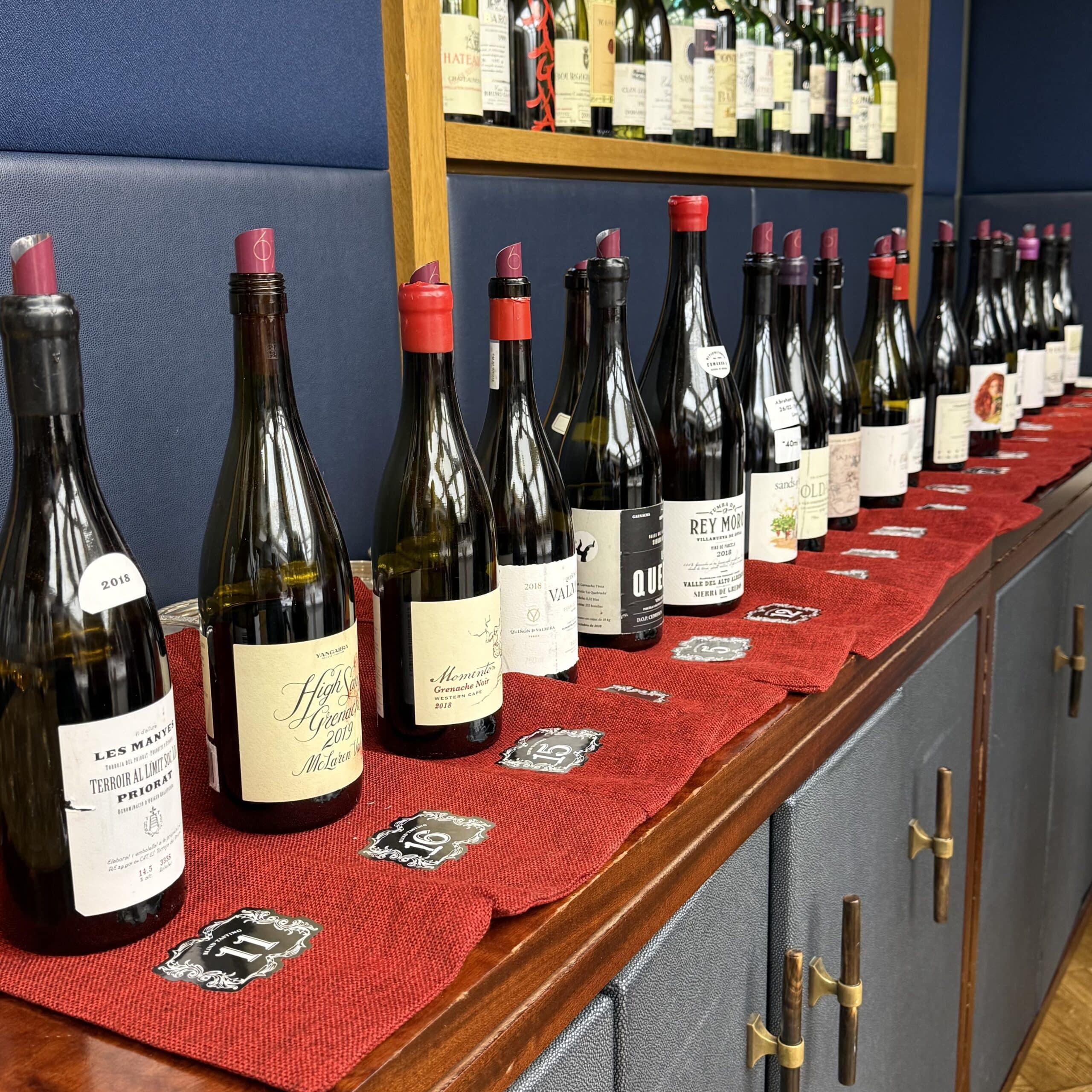
Over the years, I’ve taken part in numerous blind comparative tastings, some organised purely for fun, others as part of a commercial exercise. But whatever the motivation, none has proved as enduring as the Judgement of Wimbledon Blind Grenache Tasting. Perhaps that’s because the concept captured an evolving trend for this “Cinderella” grape. Named after the venue for the first tasting a decade ago, the Judgement of Wimbledon became not a celebration of power but a genuine search for elegance, site specificity and terroir expression.
Having just completed the 10th anniversary Judgement tasting, it has been on my radar for some time to write a summary of the evolution of this blind Grenache showdown, not so much to highlight the significance of the tasting itself, but rather to spotlight the growing success of Grenache, not only in Europe but also further afield in South Africa, the USA and Australia.
A Grenache benchmark takes shape
 Over the past decade, the Judgement of Wimbledon, named tongue-in-cheek after the famous 1976 Judgement of Paris tastingm, has become one of the most respected global benchmarks for Grenache, pitting the world’s finest Grenache (and Garnacha) expressions against one another in a rigorous double-blind format.
The selection process, overseen by convenor and judge Riaan Potgieter, a fellow London-based South African wine obsessive, can only be described as painstaking. The aim is always to seek out the most focused, elegant and finely tuned terroir-driven styles of Grenache produced anywhere in the world. In some ways, the tasting was probably a subconscious response to the never-ending upward price spiral of top-end Pinot Noir, as well as a recognition that Grenache might represent the future for many warm-climate regions increasingly challenged by climate change and global warming.
In South African terms, a pivotal moment came in 2014, when Ian Naudé produced a significant wine, his first Grenache sourced from a small vineyard not far from Eben Sadie’s Paardeberg farm. Picked and made in a relatively ripe Southern Rhône style, this 14% alcohol Grenache quickly became something of a mythical wine, helped in large part by Cape Town wine merchant Roland Peens, who included it in a blind tasting of top Grenache expressions from around the world (see more here).
Naudé himself recalls nervously attending that tasting, aware that the line-up included prestigious names such as Château Rayas. When the wines were revealed, many tasters had inadvertently grouped his wine with the famous Rhône estate. That moment signalled the beginning of the wine’s legendary reputation, one later embellished by several subsequent “copy-cat” Judgement tastings in London.
Adding to the mythology, Naudé subsequently lost access to the Agter-Paardeberg vineyard until 2019, when he was finally able to source grapes again. The early Judgement of Wimbledon tastings regularly featured the maiden Naudé Grenache 2014, where it often trumped the competition, including icons such as Château Rayas, just as it had done at that now-infamous Cape Town tasting years earlier.
Style evolution and Grenache’s global moment
With later vintages, Naudé Grenache 2019, 2020 and 2021, South Africa continued to assert its place among the Judgement’s top performers, alongside impressive expressions from Sadie Family Wines in the form of Eben’s Old Vine Series Soldaat Grenache from Piekenierskloof, as well as Marelise Niemann’s Momento Grenache from the granitic soils of the Paardeberg. But it soon became clear that the stylistic aesthetic of South African Grenache was evolving. Blind tasting notes praised the Naudé 2021 for its “sleek, sinewy” architecture, proving that the Swartland’s old vines could produce a style as much about texture and dusty, chalky tannins as it was about fruit.
This emphasis on purity, elegance and terroir character became an enduring theme in subsequent Judgement of Wimbledon tastings. Key to this shift was a decline in oak use, with many producers favouring neutral vessels such as large foudres, concrete eggs and amphorae. Judges frequently remarked that Grenache is a “transparent” variety that can easily be “bruised” by heavy oak. The highest-scoring wines almost always proved to be those where wood remained a silent partner to the fruit and mineral core.
Another notable feature was the increasing use of whole-cluster fermentation, a technique that provides herbal lift, peppery spice and structural grip, essential in preventing Grenache from becoming too soft or sweet. This approach allows the wines’ mineral and stony terroir character to shine through, particularly in the top Spanish examples sourced from high-altitude old-vine granite plots in the Sierra de Gredos west of Madrid, as well as from the famous llicorella slate soils of Priorat in Catalonia.
The recently held 10th anniversary tasting marked this milestone with a retrospective look at Grenache from the 2018 and 2019 vintages. One clear conclusion emerged: the gap between the “Old World” of Spain and France and the “New World” of South Africa, the USA and Australia has effectively closed. Today, the masters of Grenache are no longer confined to a single hemisphere.
Looking back over a decade of tasting notes, it is fascinating to see how the Judgement of Wimbledon has become a kind of living record of Grenache’s renaissance – a grape that has shed its old “workhorse” image to become a darling of fine-wine collectors. When treated with the same reverence as Pinot Noir or Syrah, Grenache is capable of producing wines that are profound, haunting and intensely site-specific.
Whether it’s a sought-after Comando G single-vineyard micro-vinification from the mountains of Gredos or a Sadie Old Vine Grenache from Piekenierskloof in the Cape, the Judgement tastings have shown that the future of fine wine may increasingly be written in the “glorious, pale and perfumed” language of world-class Grenache.
For the Judgement of Wimbledon panel, the annual tasting is not just about crowning a winner – it’s about celebrating a variety that has finally found its voice on the global stage.
For more on this year’s Judgement of Wimbledon, including overall results and my tasting notes, see the following post on my website Greg Sherwood MW – A Fine Wine Safari.
- Greg Sherwood was born in Pretoria, South Africa, and as the son of a career diplomat, spent his first 21 years traveling the globe with his parents. With a Business Management and Marketing degree from Webster University, St. Louis, Missouri, USA, Sherwood began his working career as a commodity trader. In 2000, he decided to make more of a long-held interest in wine taking a position at Handford Wines in South Kensington, London, working his way up to the position of Senior Wine Buyer over 22 years. Sherwood currently consults to a number of top fine wine merchants in London while always keeping one eye firmly on the South African wine industry. He qualified as the 303rd Master of Wine in 2007.
-
Share:

Related articles
Opinion & Analysis
Greg Sherwood MW: Is the fine wine market starting to bounce back?
18 February 2026
After this year’s highly successful Wine Paris wine trade fair, the wine world seems to have rediscovered a notional amount of new momentum and positivity. How long this sentiment will...

4
Opinion & Analysis
Greg Sherwood MW: Dry January, No/Lo growth and wine’s awkward moment
14 January 2026
It’s that time of year again, when my social media feed is clogged up with proud South African parents posting endless pictures of their young ones heading off to primary...
4
Opinion & Analysis
Greg Sherwood MW: As Bordeaux unravels, Burgundy confronts hard truths of its own
10 December 2025
“For centuries Burgundy has produced some of the finest wines in the world, wines steeped in tradition and praised wherever wine is drunk.” It was with these words that Anthony...
Comments
0 comment(s)
Please read our Comments Policy here.