
Tim James: Swartland wines – built to last or better young?
By Tim James, 23 March 2026
-
Share:





3
How well do the once-new-wave Swartland wines mature in bottle – both whites (mostly chenin or chenin-based) and reds (mostly syrah or syrah-based)? We’re starting to amass useful evidence, although the changing climate is posing new questions about the vintage aspect, and vintage is a crucial aspect of the answer to the larger question as I’ve recently been reminded (see below). A few of the producers help by offering tastings of older vintages, even substantial verticals, though probably more to the international commentariat than the local one, unfortunately, so we can be grateful to the likes of Greg Sherwood for reports on such things as verticals of Porseleinberg.
Too few producers share their wine-libraries, but Sadie Family Wines are generous and none is more so than Mullineux, who often show older wines to a paying public as well as to wine media, sommeliers, retailers and so on. When releasing their latest Signature wines vintage, for example, they often offer examples from the ten-year-previous vintage. Chris Mullineux did just that last week in Cape Town, and the experience was as illuminating – though also as question-raising – as ever. Andrea was at work marketing in Milan, apparently (how they work, these two!), so the usual deft double-act gave way to an excellent solo performance.
Christian Eedes has reported here on the current releases, and I’m in substantial agreement with his judgements – if, as usual, a touch unconvinced of the helpfulness of lists of flavours and aromas – so I’m going to concentrate on the older parts of the pairings that preceded and then accompanied a pleasant lunch at Ëlgr restaurant.
Old Vines White makes a compelling case for ageing
For me the 2025 Old Vines White blend was a touch too richly ripe, though not without freshness and there was also a succulent, textured and long-lingering intensity, with a pleasing earthy note to the peach and lemon ones. In terms of ageing, I see no reason why it shouldn’t be offering something good when its turn comes up in 10 years (if the Ms are still doing this thing, if not for me), and I do think it will gain in harmonising its parts in a few years. Perhaps that slightly excessive richness will even get pulled in a bit.
The 2015 version, interestingly enough, showed as a little drier in effect athough it has a little more residual sugar (at 2.2 g/l), while the alcohol declared is lower (13.5%). No lack of vivacity here as a price to be paid for the ginger-spice complexities of development – even more appealing on the palate than on the bouquet with its edge of honeyed waxiness. A really beautiful bottle, as great an advertisement for the ageability of well-stored Swartland whites as I can think of (with emphasis on the well-stored bit). It’s somewhere around its peak, I suggest, for those who prefer mature wines (by no means everyone does), harmonious and elegant. There was no doubt in my mind as to which of the vintages I would choose to accompany my lunch.
Syrah tells a trickier, vintage-driven story
There was doubt, though, when it came to the Syrah. The new 2023 is undeniably enjoyable in youth. (Chris suggested that Syrah tends to show well for five years or so, then goes into a dip and emerges again, hopefully gloriously, at about ten.) Perfumed, with lovely fruit as well as dried-herbal notes; silky fine tannins still prominent. The 2013 had a rather similar light-feeling elegance, perhaps despite the also-similar touch of sweetness to the finish; more savoury that the younger wine of course, but still with some aromatic charm. I found the tannins to be showing too much and thought this was because the fruit flesh was already falling away somewhat, starting to leave the still-firm bones exposed. I felt I’d have enjoyed this more a few years back. I discussed this question with my neighbours and found some agreement, but also disagreement from someone whose judgement I respect. And I must say that when it came to sipping with food, the wine came into its own and was an immensely satisfying accompaniment. But especially with bottles less perfectly stored than this one had been, I wouldn’t hang on to the 2013 any longer.
I have more than once in the past concluded that the Mullineux Syrah is best before or at about 10 years of age – unlike most of their single-terroir syrahs, which seem to, for whatever reason, mature better and longer. Though I see from a 2024 note that I much enjoyed the 2012 Signature then – though also feeling it wouldn’t benefit from further ageing.
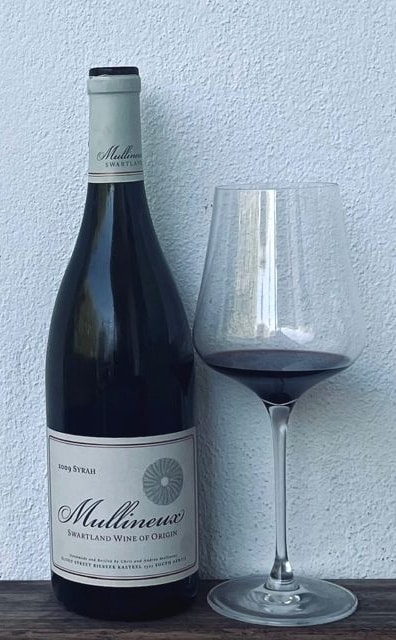 But now I’m suspecting that I need to pay deeper attention to vintage variation. Over the weekend, prompted by the above tasting, I opened my last bottle of Mullineux Syrah 2009. Frankly, I didn’t expect much. How wrong I was. An excellent, mature bottle of wine, savoury and deeply flavourful, the acidity holding in a firm grip the richness that the sunny Swartland can deliver – not exactly refined, I suppose, but gorgeous and complex. What struck me most was that the tannins had melted, as it were, completely into the whole, informing the structure fundamentally but not overtly – which is exactly what I want tannins to do in a mature red. They hadn’t done it in the 2013 earlier in the week, and, as I said, I don’t think that vintage has enough fruit remaining for the magical harmonisation to happen.
Back to the lunchtime tasting last week, and so to the 2025 and 2015 vintages of Mullineux Straw Wine. Two remarkably different iterations, most obviously in colour, but also in the glass, and in the technical specifications. Chris did say that of all their wines this one tends to show the most radical vintage differences. The 2025 is superb (here I thought Christian could have been more generous than his score of 92); delicate, refined, elegant and balanced, very sweet of course but with a vibrant acidity holding that in check. The darkly glowing 2015 had certainly gained in interest and intrigue of aroma and flavour, but I found it to be verging on cloying. I confess I tipped the remains of the 2025 into the remains of the 2015, and thought the blend wonderfully better than either of the components. A sin against vinous rectitude, I suppose – but really, it’s just a crude version of what happens in the Mullineux Olerasay; and it worked.
- Tim James is one of South Africa’s leading wine commentators, contributing to various local and international wine publications. His book Wines of South Africa – Tradition and Revolution appeared in 2013.
-
Share:

Related articles
Opinion & Analysis
Tim James: Drill, Baby, Drill – wine’s unlikely alliance with Big Oil
17 August 2026
The wonderful Kogelberg Biosphere, home to 1 880 species of fynbos (and with a number of grape varieties as guests), asks on its website: “The Kogelberg and a changing climate:...
9
Opinion & Analysis
Tim James: The story of semillon (white and red) in the Cape
11 August 2026
What is probably the world’s newest grape variety (for a while at least) has its past firmly rooted in three centuries or more of Cape winemaking. As reported last week,...
16
Opinion & Analysis
Tim James: Eben Sadie and making wine in the vineyard
3 August 2026
Great wine is made in the vineyard, they say – essentially claiming little more than that you need good grapes for good wine, and the better your grapes the better...
Louis | 23 March 2026
I recently tasted the 2015 and 2017 Signature Syrah side-by-side, and both were showing beautifully, with that hallmark Mullineux elegance and a distinctly “feminine” touch, especially when set against the firmer, more structured style of Porseleinberg.
The 2015 felt more resolved and harmonious, with tannins fully integrated into a silky, seamless palate and aromatics leaning savoury and gently perfumed. The 2017, by contrast, shows more tension and energy, brighter fruit, a touch more grip, and a clear sense that there’s still more to unfold with time.
Greg Sherwood | 25 March 2026
Funnily enough, until not too many years ago, so many South African producers used to try and talk down vintage variation in case it perhaps damaged the consistency image of their premium brands, year in, year out. Now of course we all know that vintage variation is becoming even more marked on South African wines, magnified by cultivars matched to specific regions over the past decade or two. Vintage variation is a joy to behold … and keeps the winemakers on their toes.
Tim James | 25 March 2026
A joy, yes, I do agree, Greg. Given skillful, responsive winemaking, vintage variation is another validation of the great concept of terroir.