
Tim James: Are fancy tasting menus killing great wine?
By Tim James, 4 May 2026
-
Share:





1
Wine and food matching has never much interested me beyond the broadest principles. I have vaguely decided, for one example, that for me cheeses tend to go rather better with white wines than red, though I have no problem at all greedily eating them with red, including port. And I remember the moment when I suddenly realised how wonderfully well riesling (dry or off-dry but maybe especially the latter) goes with smoked fish. Mind you, riesling seems to me to go notably well with most foods – I’ve heard that on the Mosel they even swear by sweet Auslese with wild boar.
Talking of Germans, I’ve had many meals designed to accompany particular wines by the food-and-wine master, Harald Bresselschmidt of Aubergine restaurant in Cape Town, and have usually enjoyed and seen the point being made, while not being totally convinced of the usefulness of the effort. For me, that is: I don’t in the least disparage the interest – it’s just an aspect of the great wine game that doesn’t command my attention.
One larger principle regarding food and wine I strongly believe in, however. I was reminded of it last week at a splendid event put on for the Cape Town trade by Leeu Passant, the excellent label of Andrea and Chris Mullineux and Analjit Singh, based in Franschhoek. We’d spent some good morning hours tasting vertically, guided as deftly and full-heartedly as ever by Andrea and Chris, through the ten released vintages of Leeu Passant Stellenbosch Chardonnay. A very-much alive 2015 was the oldest and a brilliant 2024 the youngest. We then worked, if that’s the right verb for such an experience, through the other current Leeu Passant releases: 2025 Franschhoek Sémillon (they Frenchly retain the accent on the variety name while most others in the New World have lost it); 2024 Wellington Cinsault (joining the modern majority in their spelling here); 2024 Stellenbosch Cabernet Sauvignon; 2020 Radicales Libres, the long-barrel-aged chard; and 2023 The Leeu Passant, the modern reworking of the mid 20th century blend that produced most of the era’s grea wines in the Cape.
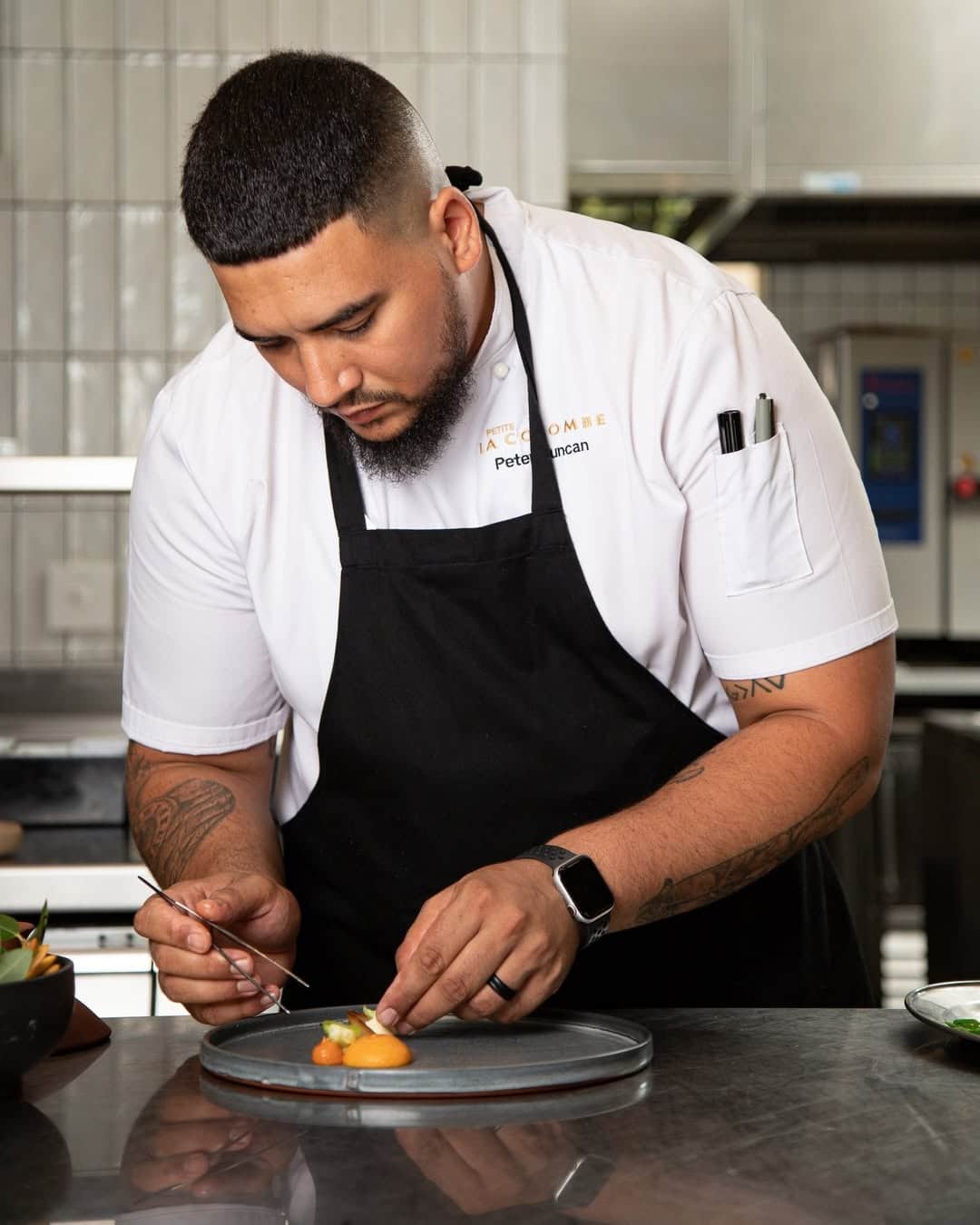
Those new releases were offered again with lunch, most generously held at La Petite Colombe, the renowned restaurant in the remarkably beautiful gardens of the Leeu Estates but privately owned. The food was predictably fine, shaped by the expectations of, I suppose, rich tourists: many small dishes (some with their own sub-array of taste experiences, like a bread course with whole lot of different “butters”, flavoured by anything from pine-nuts to truffle), all beautifully and intricately presented, expertly served, with a touch of theatricality. Not really my favourite sort of dining experience (fortunately for my bank balance) – it seems to me somewhat pretentious and somewhat exhausting, but fascinating as an occasional treat: when next will I have a single pretty mouthful with what looked like at least a dozen components in minuscule quantities, artfully arranged with the help of a surgeon’s scalpel and tweezers?
When the food gets clever, the wine disappears
The only problem was that all that intricacy and complexity of flavour didn’t do any favours to the wines that were being poured with the different courses. A cheese dish did sit very nicely with the powerful Radicales Libres, but otherwise the wines were largely overpowered or thrust into obscurity by the food’s flavour-power. I was told that there was a bit of comparative restraint being evidenced, but it wasn’t enough so for me. Last year’s release Leeu Passant lunch was held at the altogether more modest Protégé restaurant, and I confess I enjoyed it more in all ways, including the showing of the wines. Leeu Passant wines are pretty much luxury objects, but they deserve more than this kind of luxuriousness.
So, the principle that I was reminded of was one that I vaguely remember the great connoisseur Michael Broadbent invoking, or perhaps it was the equally great Hugh Johnson. It’s basic enough: with great wines, serve simple food. With complex food, simple wines. In neither case, it should not need to be pointed out, does “simple” necessarily imply anything like inferior quality. It’s why I think the more modest levels of Bordeaux (not the grand ones) are perhaps the greatest red wines to accompany smart food; and there are many mid-priced Cape chenins which offer a similar generosity of partnership. I mentioned Harald Bresselschmidt, and I’ve never faulted his ambitious pairings on these, or indeed any, grounds.
I did mention this “rule” to a few people at my table at La Petite Colombe, and there was general agreement, and of its relevance to the current experience. A sommelier from another Cape restaurant of this calibre (and style, more or less) made what I thought was an interesting and relevant point. That restaurant offers a “tasting menu”, with the possibility of wine pairings. The clientèle, he says, are spending a lot of money, and want to see the big wine names that they recognise. While he might agree that some “simple” wines better serve the food (and would arguably provide a superior gustatory experience), it’s not an easy principle to put into practice.
Talk about a First World problem, of the most rarefied kind!
- Tim James is one of South Africa’s leading wine commentators, contributing to various local and international wine publications. His book Wines of the New South Africa – Tradition and Revolution appeared in 2013.
-
Share:

Related articles
Opinion & Analysis
Tim James: Sherry meets pseudo-sherry in the kitchen
27 April 2026
If I were an impoverished drunk with a sweet tooth (at least a few sweet teeth remaining, I trust), instead of a bourgeois heavy drinker with a sweet tooth, I...
1
Opinion & Analysis
Tim James: Cape white wines continue to offer top value – just don’t overchill
20 April 2026
I admit to something of a disconnect as I sit here writing about a handful of white wines I’ve drunk recently while the window that I spend too much time...
11
Opinion & Analysis
Tim James: Re-reading SA’s wine revolution through terroir
14 April 2026
A few weeks back, I warmly welcomed Paul Nugent’s 2024 book, Race, Taste and the Grape: South African Wine from a Global Perspective, as a valuable contribution to our understanding...
Jamie Johnson | 4 May 2026
Another great article, Tim, which I whole heartedly agree with, especially as everyone’s perception and sensitivity to tastes are slightly different. We mostly drink our best wines on their own in a quiet space, maybe paired with some simple tapas, to let them shine and give us time and space to really contemplate and understand them especially for the first time. Last time we went to Protégé we opted for Saurwein Chi Riesling and worked fine for us overall.