Reviews and ratings - only R55 per month.Subscribe
The Best White Wines of 2020
Introduction
winemag.co.za reviewed a total of 927 wines across 20 wine categories in its various reports sponsored by multinational financial services company Prescient over the course of the year. Each report was based on the outcome of a blind tasting of wines entered within the specific category.
A Top 10 was then announced with the release of each successive report. Now the individual best wine per category plus ratings on the 100-point quality scale for all the Top 10 wines can be revealed. Next up, the best white wines.
Johannesburg boutique wine retailer Dry Dock Liquor is offering all the best in category wines for sale – buy now.
I have it on good authority (the urgings of every supermarket I enter, for instance) that a Festive Season is nigh. A modest suggestion, then, for enhancing the festive mood: buy a bottle of good brandy, and start sipping. And I don’t mean cognac. If ever there’s a reason to abandon cultural cringe and drink local, brandy offers it – except at the highest level of extremely old spirits, where the Cape can’t (and scarcely tries, as yet) to compete with the ethereal fire of the finest old cognacs. But that’s stuff for millionaires – who, if they deign to shop at Makro, can buy a decanter of Rémy Martin Louis XIII for one rand short of R60 000. I could say nothing to that except stutter my envy. Makro offers three other aged cognacs for R40K and more, with the priciest local being KWV Nexus 30 Year Old, at a mere R24K.
But that’s not the level I’m talking about here, where I’m pushing brandies costing about R300 upwards, many of which compare favourably with cognacs at three times the price. Not that that stops the appeal of the showiest cognac brands to cultural cringers with a greater sense of image than of value, or even, perhaps, taste.
I’ve been here before with this suggestion that we should buy more brandy (well, that you should – I already do my bit), but somehow it hasn’t hit home, judging by the shocking paucity of serious brandies in most liquor shops, implying a sad lack of demand. Lots of the likes of Wellington VO, Klipdrif Export and Parow, pretty good in their own way, destined for a mixer and lots of ice (and the Parow almost worth getting for its packaging alone). But very little of the older, grander brandies.
Coming out of the early Covid liquor lockdown, when I’d been rather deprived of spiritous stuff, I had a yen for some of the great Van Ryns – especially the magnificent 12-Year-Old, one of the Cape’s (and even the world’s) internationally most awarded brandies: three times best in the world at the International Wine and Spirit Competition, three times at the International Spirits Challenge. You’d think its absence from the shelves would be because of shortage, but no, it’s more likely because of a shocking lack of interest. As soon as permissible, I took a trip out to the Van Ryn Distillery on the outskirts of Stellenbosch and bought three bottles of one of the greatest products of the Cape wine and brandy industry, costing less than, for example, a single bottle of (estimable!) Vilafonté Series C. What sort of a bargain is that?
If serious brandies – from some estates, most notably Boplaas, and from KWV and Van Ryns, etc – are hard to find (though Makro does have quite a few available online), it is happily pretty easy to find one of the finest bargains around. KWV 10 Year Old is ridiculously underpriced, given the superb quality, usually at just under R300. In fact, look around, and you’ll find it at that price in a presentation box with two pretty decent glasses – effectively brandy snifters without stems. It’s almost enough to make me go some way to forgiving KWV for the harm they did to the South African wine industry in the 20th century (along with a little good, I suppose). Not that I use the glasses for the contents of the bottle. I prefer something a bit smaller and more tulip-like in shape.
Interestingly, the KWV box pictures the stemless glasses with some hefty blocks of ice chilling the brandy. Again, not the way I choose to drink fine brandy like this after dinner, but one must tolerate the preferences of others, whatever one’s doubts. And, while I’m recommending brandy to make you more festive as this troubled year draws to a close, I have to admit that the reality of room temperature in midsummer is something of a problem…. It’s too high for volatile spirits, really, though I confess I tend to not often engineer enough coolness.
Winelands tourists – those that there are in this strange time – will find estate brandies here and there, often beautifully bottled and often expensive compared with the likes of the products of the big players. And often good, too, and interesting; but some inevitably suffer from, at least, the smaller scale on which they’re produced (less potential for blending) and perhaps the lack of specific expertise. This can become obvious as the brandies start entering their second and third decades in oak. Backsberg, for example, offers a tiny volume of a 1991 distillation called Sydney Back First Distillation, which is undoubtedly fascinating, but lacks the freshness of younger versions. Similarly, Kaapzicht now has a 20 Year version of its brandy, which has the refinement of age, but some will find that it shows rather too much in the way of oak-derived characters and too little fruit for balance.
Brandy is one of the glories of the Cape Winelands. Again let me plead that you give it a try, if you don’t already realise this. One great advantage of a bottle of spirits over a bottle of wine, of course, is that you don’t need to worry about rapid deterioration once opened. After enhancing the year-end celebrations, you can keep it till your birthday, if you have the willpower.
Tim James is one of South Africa’s leading wine commentators, contributing to various local and international wine publications. He is a taster (and associate editor) for Platter’s. His book Wines of South Africa – Tradition and Revolution appeared in 2013
Attention: Articles like this take time and effort to create. We need your support to make our work possible. To make a financial contribution, click here. Invoice available upon request – contact info@winemag.co.za
The Eden vineyards are two blocks established by Bruwer Raats just behind his Polkadraai house in the late 2000s with the aim of exploring what improvements in quality might be had when aiming for excellence from the outset rather than working with long-established vineyards that weren’t necessarily planted according to the very best practices.
There is 0.6ha of Chenin Blanc planted to the low-yielding Montpellier clone, Raats having obtained cuttings from the mother block in the Nuy Valley and 0.2ha of Cabernet Franc – resulting volumes are inevitably small.
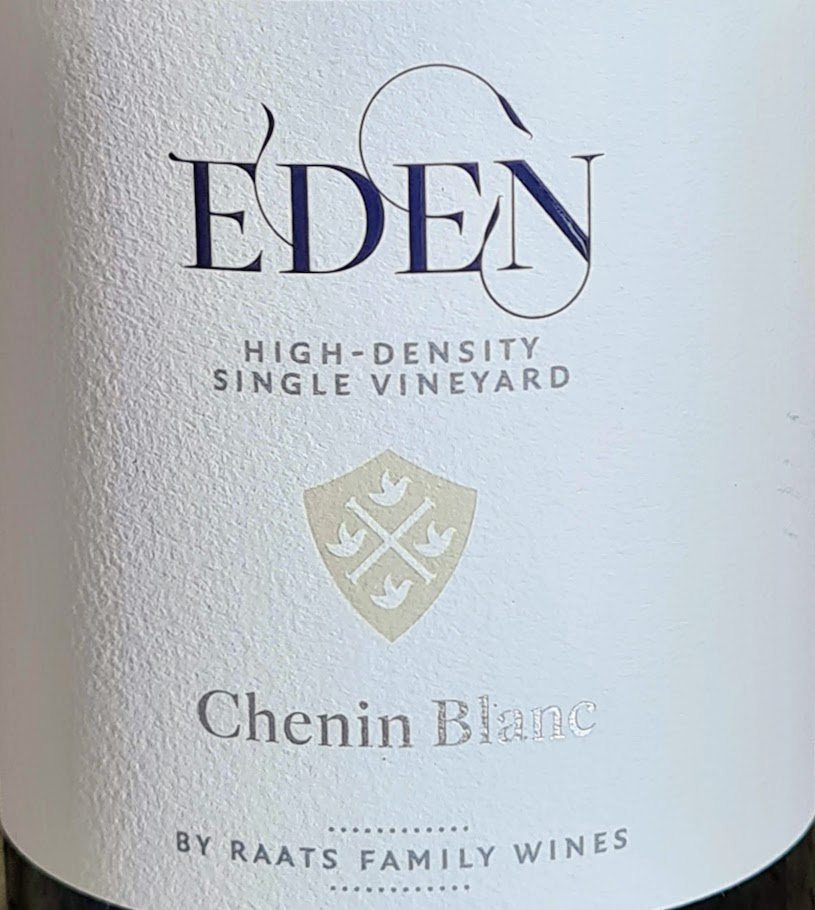
Eden High-Density Single Vineyard Chenin Blanc 2019
Price: R850
Peach, yellow apple, oatmeal, a little waxy character plus hints of ginger and baking spice. The palate is relatively rich and broad with nicely integrated, seemingly quite moderate acidity – full of flavour with a gently savoury finish. Total production: 2 390 bottles.
CE’s rating: 94/100.
Eden High-Density Single Vineyard Cabernet Franc 2018
Price: R2 200
15% whole-bunch fermentation. Aromatics of red berries, herbs, rose, a hint of earthiness and a little vanilla. The palate is light-bodied with fresh acidity and fine tannins, the finish long and dry. Elegant and energetic. Total production: 365 bottles.
Attention: Reviews like this take time and effort to create. We need your support to make our work possible. To make a financial contribution, click here. Invoice available upon request – contact info@winemag.co.za
Introduction
winemag.co.za reviewed a total of 927 wine across 20 wine categories in its various reports sponsored by multinational financial services company Prescient over the course of the year. Each report was based on the outcome of a blind tasting of wines entered within the specific category.
A Top 10 was then announced with the release of each successive report. Now the individual best wine per category plus ratings on the 100-point quality scale for all the Top 10 wines can be revealed. To begin with, the best sweet wine and fortifieds.
Best Muscadel
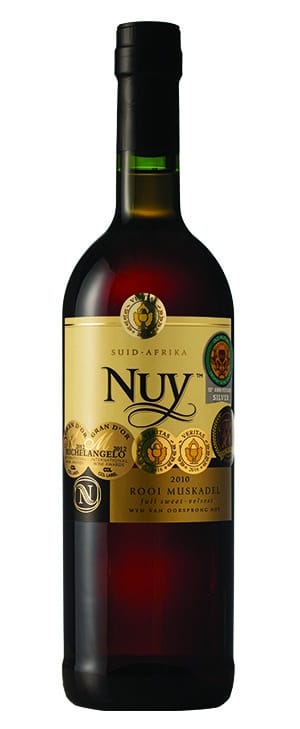
Nuy Rooi Muskadel 2010 Price: R136
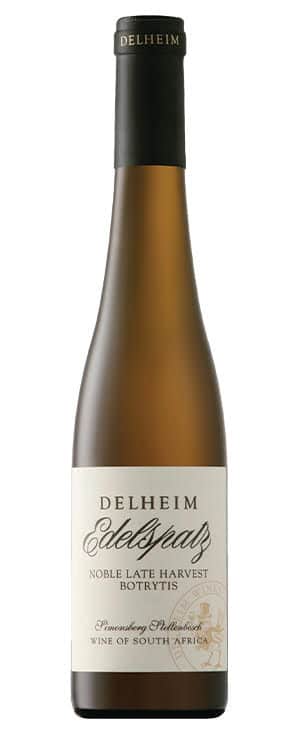
Best Noble Late Harvest
Delheim Edelspatz 2019 Price: R310 per 375ml bottle
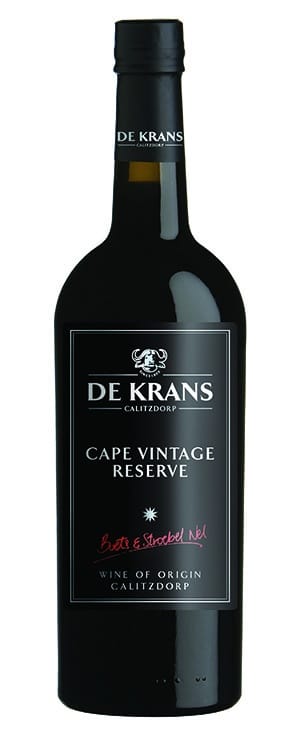
Best Port-style
De Krans Cape Vintage Reserve 2016 Price: R325
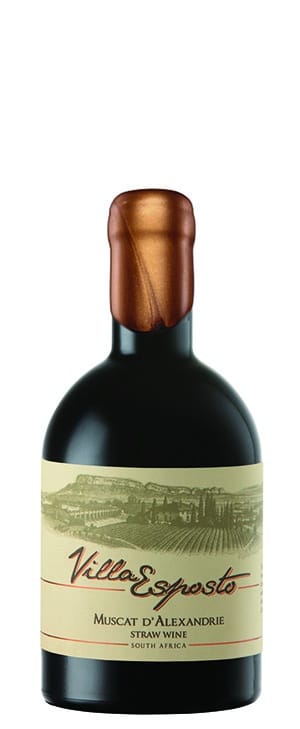
Best Straw Wine
Villa Esposto Muscat d’Alexandrie 2017 Price: R190 per 375ml bottle
Restaurant Mosaic at the Orient outside Pretoria is entering its last season – final service will be dinner on Friday 26 March. Chef Chantel Dartnell opened the establishment in 2006 and it has won many awards since then – most recently placing ninth in the Top 10 at last year’s Eat Out Mercedes-Benz Restaurant Awards. It was also acclaimed for its well-appointed wine cellar. Dartnell’s immediate plans after closing the restaurant include producing a cookbook and enhancing her technical skills. Read the full media release here.
There’s something to be said for a touch of cultural cringe on occasions – I’ll come back to that claim. Unsurprisingly, the term came up in Christian Eedes’s think-piece on the best name for Bordeaux-style red blends in South Africa, and the interesting discussion which followed it. (A lively and largely courteous discussion of a matter of some significance it was, and I can see no reason for Greg Sherwood to peevishly dismiss it as part of his diagnosis of an “introspective and insecure” industry; actually, it would also be possible to diagnose parts of the industry as brilliantly confident and also as happily integrated into the wider world of wine – it depends on where and how you look.)
There was no conclusive answer in that BB debate, inevitably, but I can’t see any reason to worry. It seems fair enough to me that if a wine style originates in a particular place, that place name should be widely associated with it. And if we prefix it with “Cape” to assert the new displacement, so much the better. I don’t think referring to the origin diminishes any claims to excellence or distinctiveness by later users. Similarly, l see no reason to not refer to the white equivalents as “white Bordeaux-style” wines – though, as Christian points out, it’s easy enough to, rather, speak of sauvignon-Semillon blends, which is what they invariably are here.
Of course, origin-place-names can be used only for useful categorisation or description, not officially. South Africa wine labels can’t invoke the name Bordeaux any more than they can Port or Sherry or Champagne. Cape Bordeaux Blend or Cape Claret could never become an official category like Cap Classique or Cape Vintage or Cape Blend. But a guide like Platter’s easily and usefully talks about “Cape Bordeaux”, “Rhône-style blends” and even “port” (though the latter always with inverted commas, unnecessarily in my opinion).
But it’s not only for traditional foreign blends that it’s hard to find an accepted name (or recipe). Witness the uncertainties over the use of “Cape Blend” for reds with a certain percentage of pinotage. And one of modern Cape wine’s greatest achievements – the sort of warm-country white blend including chenin, of which Sadie Palladius was the pioneering serious example – remains unnamed as a category. Some people call it “Cape White Blend”, which seems fine to me. Others have suggested “Mediterranean Blend”, which is nonsense in all ways, especially given the paucity of chenin blanc in southern Europe. On the analogy of Bordeaux, I’d prefer calling it a Swartland blend, even if it comes from Stellenbosch or Paarl (or Languedoc or Western Australia or California, for that matter) – but that wouldn’t work officially here, given that Swartland is the protected name of a district, not to mention the appalling fact that it is allowed to be a registered trademark of Swartland Winery.
Chenin blanc is in some ways the category most at ease with itself in terms of cultural cringe. It’s probably a good thing that Loire chenin is so little known in this country, meaning that there has been little deferring to it. In fact, so confident is this category that just about everyone is happy to accept that the Cape could never produce high quality Loire-style chenins, just as the Loire could never produce the likes of South Africa’s best. A highly satisfactory solution, with the triumph of terroir and mutual respect!
“Rhône-like” or proudly Polkadraai?
With syrah, however, there’s still a bit of a problem. Too often (and I’m quoting from Platter’s in these examples) tasting notes about local syrah include phrases like ”showing classic Rhône violets”, “Rhône-like”, “has Rhône spiciness”, “distinctly Rhône style”. Such notes are, I suppose, intended as cringeing compliments. But really they are the opposite, given that syrah producers have been at the forefront of trying to offer wines that express local conditions. At best, such remarks are meaningless nonsense (especially given that most local readers will have no understanding of what “Rhone-style” means). There will inevitably be similarities to syrahs from the northern Rhône – but that must because of variety rather than terroir character. Reference to the Rhône would have had more significance when there was more of a perceived battle between “Barossa-style shiraz” (big, ripe, oaky) and a more French, “syrah”, alternative. Nowadays, we can, surely, see both styles as valid Cape expressions of the grape.
Which actually, and perversely, brings me back to my initial mention of a possible defence for some cultural cringe. Firstly, I would say generally that it is suitably modest to recognise superiority in others, when appropriate, just as it is correct to make grand claims when appropriate. The idea of cultural cringe (Australian in origin, I think) inherently includes comparison to the metropolitan, culturally powerful “colonising” country (mostly France when wine is in question).
South African winemakers’ element of deference to classic French styles were, it seems to me, what allowed for the great wine revolution in this century. In the latter 1990s, when we rejoined the world, big, ripe, oaky wines were on the advance, especially in the Anglo-Saxon countries. The modern Australian style was immensely successful internationally, and seen as relevant to South Africa, given similarities of climate. And there were strong forces in this country that were pushing that style as the answer to the undoubted problems of quality and marketability then limiting Cape wine’s appeal.
The failure of South African wine to measure up to Australia’s in the “Test match” of 1995 was seen by some as indicating both the problem and the solution. The reluctance of many producers to accept this analysis was not, in fact, necessarily a stupid, blind assertion of self-satisfaction – it was an assertion that this was not the sort of wine that they wanted to make, however successful it might be in the UK market. I think if the test match had been against France (I wonder why it wasn’t), the result and the lessons would have been accepted more gracefully – cringeing to France being more ok than cringe to Australia, perhaps.
That style of sunshine-and-oak-in-a-bottle wine didn’t stay fashionable for long, even in Australia (which was able to adapt, to an extent, quickly). If the Cape had widely adopted it, it would surely have, at the very best, delayed the development of the wine revolution here. Cape wine was saved and taken forward by basing its revolution on its own best traditions, its own terroir – and the guiding light of classic Europe. A dose of appropriate cultural cringe, in fact. Happily less needed now.
Tim James is one of South Africa’s leading wine commentators, contributing to various local and international wine publications. He is a taster (and associate editor) for Platter’s. His book Wines of South Africa – Tradition and Revolution appeared in 2013
Attention: Articles like this take time and effort to create. We need your support to make our work possible. To make a financial contribution, click here. Invoice available upon request – contact info@winemag.co.za
David Sadie, Chris Alheit and CWG chair Andrea Mullineux.
The Cape Winemakers Guild has two new members, namely Chris Alheit and David Sadie, bringing total membership to what would appear to be 47 (including four non-producing members).
Alheit is co-owner along with wife Suzaan of Alheit Vineyards. Sadie is co-ower along with wife Nadia of David & Nadia.
Wines from the 2016 vintage generally do not have the greatest reputation – growing conditions were exceptionally hot and dry and of course, it was sandwiched between 2015 and 2017, both stellar years that tend to make everything else look that much more ordinary.
There will, of course, always be exceptions and the Martin Melck Cabernet Sauvignon Family Reserve 2016 from Muratie in Stellenbosch is one of them. Matured for 24 months in 100% new oak and carrying an alcohol of 14.94%, it is much more elegant than you might expect. The nose shows cassis, some leafiness and pencil shavings while the palate is lean and linear with fresh acidity and pleasingly firm tannins. It doesn’t perhaps have the opulence or fruit density that 2015 or 2017 tend to offer but it is beautifully balanced and should mature with benefit. Price: R460 a bottle.
Attention: Reviews like this take time and effort to create. We need your support to make our work possible. To make a financial contribution, click here. Invoice available upon request – contact info@winemag.co.za
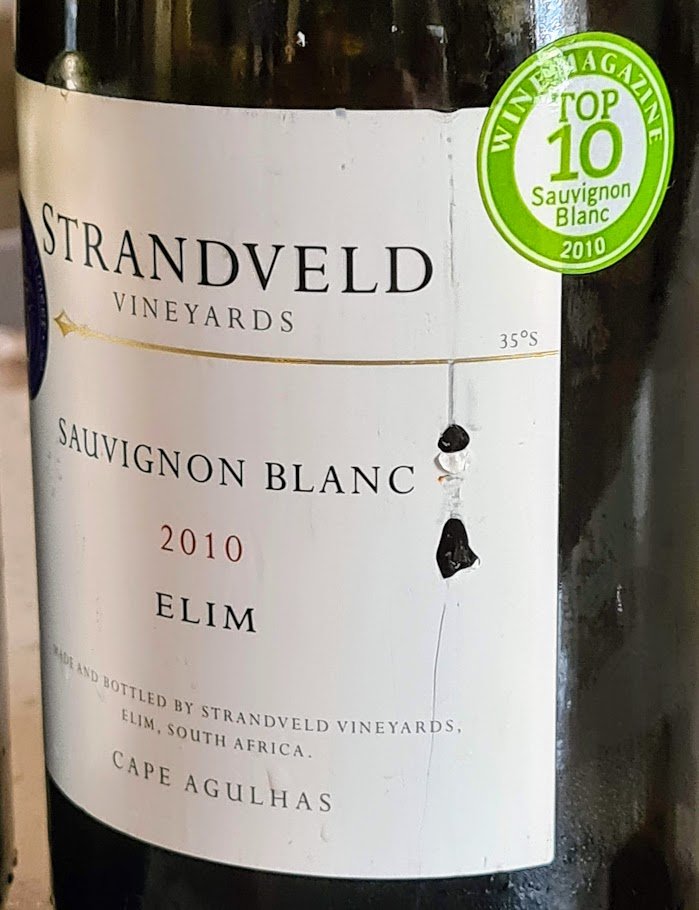
Yesterday, a vertical tasting from 2010 to 2020 of the Pofadderbos Sauvignon Blanc from Strandveld in Elim (no 2014 as not a single bottle remains).
Grapes come from a single vineyard, planted in 2002 and 3ha in size – winemaker Conrad Vlok advises that he typically he typically has to undertake extended skin contact (between 10 to 18 hours) in order to deacidify the must – final TAs in the wines tasted varied between 6.1g/l in 2016 and 6.9g/l in 2017 and everything in between.
It was particularly interesting to taste the 2010 (not year bearing the Pofadderbos designation) as this was one of the winning wines in the last Sauvignon Blanc Top 10 to be run by Wine magazine before the title became defunct and the competition was taken over by producer body Sauvignon Blanc SA. It rated Four and a Half Stars in the November 2010 issue of the magazine, my individual score back then being 18/20 and panel advising “Drink now – 2013”.
Re-visiting it now, my tasting note is as follows: “A waxy note before citrus and peach plus hints of herbs and white pepper. Rich and smooth textured with a salty finish. Lots of flavour. Has kept its shape very well.” Rating: 93/100.
The current-release 2020 (price: R160 a bottle) rated 89 in this year’s Prescient Sauvignon Blanc Report – see here.
The greatest song in celebration of drink is not the famous rousing New Year soprano aria “Champagner hat’s verschuldet” from Johann Strauss’ delightful Die Fledermaus. Neither is “La tazza e il cantico” (‘the cup and the song’) from Verdi’s La Traviata, even though much about life, love, destiny and tragedy is captured in that lofty theatrical moment of the Brandisi.
The greatly jolly “Drink, drink…” song from Sigmund Romberg’s 1924 operetta The Student Prince. is a sing-along-feast, but not the ultimate imbibement tune either. (Mario Lanza’s dubbed voice compelled the students to swirl beer in the 1954 movie.)
And, beloveds, “Red Red Wine” – UB40s’ 1983 master hit of Neil Diamond’s 1967 composition – is certainly a great karaoke soundtrack for the love of merlot, but not the special anthem to wine.
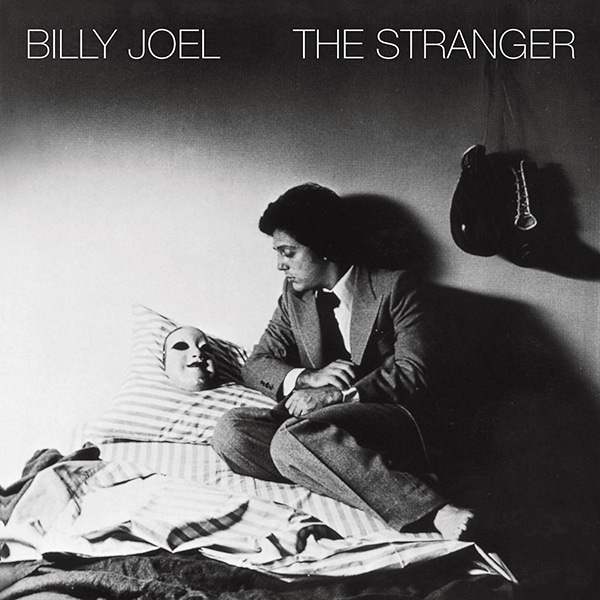
Album cover for “The Stranger” by Billy Joel.
Let me pay homage then to Billy Joel and his truly glorious ode to wine, be it rosé, white or red in “Scenes from an Italian Restaurant” from his 1977 album The Stranger. This is the go-to wine song.
It is the sound of wine because somehow in the fabulous structure of the 7 minute 37 second that moves from gentle piano ballad to Dixieland jazz (that sax entry by Richie Cannata titillates the toes) to full-on rock ‘n roll one imagines the bottles being opened, the glasses poured.
It is the song of wine because the words spin a soft, sentimental story of young love, break-up and meeting again after all that time – the kind of two-hander theatre piece suggested by the title that unfolds over sips and increasing larger slugs as reality hits home.
“Scenes” is famous in the rock pantheon and I won’t be surprised if there are a couple of M.A. and M.Mus. theses written about it. Over a glass and a keyboard one could, for example, analyse how the first lines frame a small story but also reach out in world-widely wisdom:
A bottle of white, a bottle of red/ Perhaps a bottle of rosé instead/ We’ll get a table near the street/ In our old familiar place/ You and I, face to face
A bottle of red, a bottle of white/ It all depends upon your appetite/ I’ll meet you any time you want/ In our Italian Restaurant
What is life but a choice (depending on one’s desires) between red, white or rosé wine? And within those parameters the entire wine world is your playfield, metaphorically speaking and otherwise.
Of course, if you’re going to meet an old flame for a long catch-up at an Italian eatery and the waiter offers you “a bottle of white, a bottle of red/ Perhaps a bottle of rosé instead”, the likelihood is that you’ll order a chianti, barolo, prosecco. If the environment is more adventurous there may be a brunello or some arneis, a soave, verdicchio or even, my favourite, a falanghina, on the wine list.
Joel admitted that the restaurant was real and a New Yorker called Fontana di Trevi, where a real waiter asked him which wine. No eatery name could be more evocatively romantic and Roman – think Respighi’s beautiful symphonic poem Fountains of Rome which includes an ode to the Trevi.
If the link between song and wine is indeed an Italian (opera) thing (Verdi’s Il Trovatore, Puccini’s Suor Angelica, Donizetti’s L’Elisir d’Amore), blame their gods of yore: Bacchus, Apollo and Cupid – all also at work in Joel’s lovely song.
Mozart’s The Magic Flute has, of course, well, the flute. (It also features a singing bird catcher, a prince, a queen of the night and a trio of deep-voiced priests in a long line-up.) While no libation is expressively embedded in that opera’s mysterious beauty, it is not difficult to match a fine wine to sip when the soprano goes for the famous ultra high note.
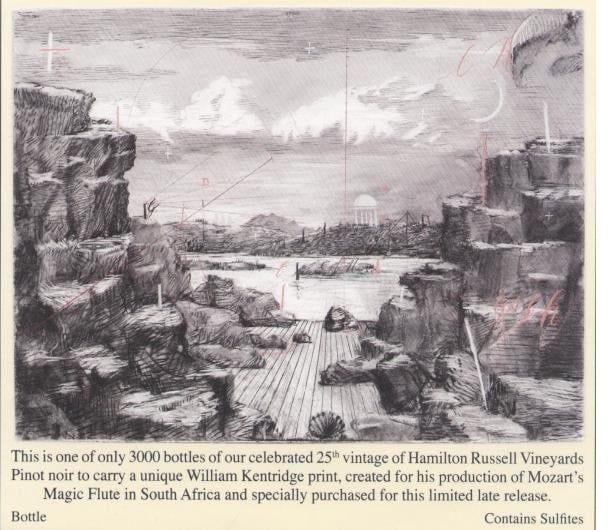
Kentridge design drawing as featured on Hamilton Russell Vineyards Pinot Noir.
And so it was in 2007 when our famous William Kentridge directed a splendid version of the opera to international recognition and offered some grand local wineries a chance to come on board. As artist, wine is go-to inspiration for him, but Kentridge had another idea: to offer a handful of wineries one of his design drawings to use on exclusive bottling. For this they had to support a charitable effort to bring youngsters to see the opera.
Included in that line-up: Boekenhoutskloof, Hamilton Russell Vineyards, Meerlust, Quoin Rock, Rustenberg and Tokara. In every special bottle there was music. Some still singing gloriously today.
Melvyn Minnaar has written about art and wine for various local and international publications over the years. The creativity that underpins these subjects is an enduring personal passion. He has served on a few “cultural committees”.
Attention: Articles like this take time and effort to create. We need your support to make our work possible. To make a financial contribution, click here. Invoice available upon request – contact info@winemag.co.za





 Eden High-Density Single Vineyard Chenin Blanc 2019


 Restaurant Mosaic at the Orient outside Pretoria is entering its last season – final service will be dinner on Friday 26 March. Chef Chantel Dartnell opened the establishment in 2006 and it has won many awards since then – most recently placing ninth in the Top 10 at last year’s Eat Out Mercedes-Benz Restaurant Awards. It was also acclaimed for its well-appointed wine cellar. Dartnell’s immediate plans after closing the restaurant include producing a cookbook and enhancing her technical skills. Read the full media release

 Wines from the 2016 vintage generally do not have the greatest reputation – growing conditions were exceptionally hot and dry and of course, it was sandwiched between 2015 and 2017, both stellar years that tend to make everything else look that much more ordinary.
 It was particularly interesting to taste the 2010 (not year bearing the Pofadderbos designation) as this was one of the winning wines in the last Sauvignon Blanc Top 10 to be run by Wine magazine before the title became defunct and the competition was taken over by producer body Sauvignon Blanc SA. It rated Four and a Half Stars in the November 2010 issue of the magazine, my individual score back then being 18/20 and panel advising “Drink now – 2013”.