
Editorial: 2015 vs 2017 – which vintage holds up?
By Christian Eedes, 24 March 2026
-
Share:





12
“Early vintages often make for good wines, but do they make for great wines?”, Rudiger Gretschel, Vinimark’s Production Director, remarked to me shortly after the grapes from the 2015 harvest were in and general sentiment was running high.
In the Vinpro Harvest Report for that year, the producer support body confirmed that it was “one of the driest and earliest in years” but also predicted that exceptionally high quality would result.
Of course, Tim Atkin MW would go on to give his first 100-point perfect score to Paul Sauer 2015 in the 2018 edition of his South Africa Special Report cementing the reputation of this as one of the standout vintages of the modern era.
Along came 2017, however, and the consensus was that the resulting wines were again very good indeed. The infamous Western Cape drought that had begun around 2015 still very much applied, but cooler conditions slowed ripening – not extremely late, but later than the warm, early vintages immediately before it. A longer, steadier season, the thinking goes, should favour phenolic maturity.
The Blind Tasting Verdict
Recently wine merchants Brice & Burnett (previously Wine Cellar) facilitated a tasting billed as “The Great South African Stand-Off – 2015 vs 2017.
Seven pairs of wines were poured, in the following order:
Flight One
Mullineux Syrah 2015 vs 2017
Boekenhoutskloof Syrah 2015 vs 2017
Porseleinberg Syrah 2015 vs 2017
Flight Two
Thelema Cabernet Sauvignon 2015 vs 2017
Meerlust Rubicon 2015 vs 2017
Flight Three
Kanonkop Paul Sauer 2015 vs 2017
Le Riche Reserve 2015 vs 2017
Each pair was randomised and we tasted blind. In all but one instance, I found it possible to distinguish the 2015s from the 2017s. The 2015s, as expected, were often richer, seductive in their scale and generosity, but typically maturing relatively quickly. The 2017s, by contrast, tended to show greater composure – better fruit definition, fresher, more detailed, more restrained, their structure suggesting greater longevity.
The only exception was Kanonkop Paul Sauer, where I had no clear sense of which wine belonged to which vintage. Tasting blind, I had the wine that turned out to be the 2015 just ahead on 96 points, with the 2017 on 95. The fruit density on both is remarkable – the 2015 at 14.47% alcohol, the 2017 a slightly more moderate 14%. It poses the question: does a later, cooler vintage deliver the same va-va-voom at lower alcohol?
Overall, I favoured 2017. Two wines to buy, only available from Brice & Burnett: Boekenhoutskloof Syrah 2017 (96, R850) and Meerlust Rubicon 2017 (96, R825).
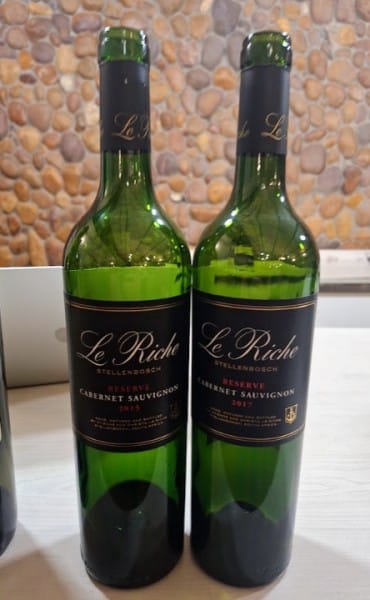 That said, my wine of the night came from 2015. Le Riche Reserve Cabernet Sauvignon was profoundly good – unmistakably of its vintage yet ageing with dignity rather than haste. I rated it 97 points and it’s priced at R1,350 (versus R3,750 for the Paul Sauer 2015).
Showiness vs endurance
Reflecting more broadly, what became apparent during the tasting was not just that 2017 outperformed 2015, but that it did so by exposing a fundamental fault line in our conversation around quality.
If this sounds like a familiar dichotomy – opulence versus structure – that’s because it is. But what felt different on this occasion was how consistently the latter triumphed. Not in a blowout kind of way, not in every glass, but often enough to shift the centre of gravity.
Which raises an uncomfortable question: have we been too easily seduced by early drinkability masquerading as greatness?
Warm, dry vintages like 2015 tend to produce wines that show well young. They arrive with a kind of instant authority, the fruit plush, the tannins accommodating. They flatter both critic and consumer, rewarding early attention. Cooler, more measured seasons such as 2017 demand more patience, their virtues less obvious at first glance but ultimately more enduring.
This matters because, in the age of scores, social media and rapid-fire opinion, immediacy is currency. Wines that impress on release are more likely to be talked about, traded, celebrated. Those that require time risk being overlooked, at least initially.
And yet, if the Brice & Burnett tasting is anything to go by, it is precisely these slower-unfolding wines that may offer the greater long-term reward.
None of this is to diminish 2015. At its best, it remains a vintage of real consequence, capable of producing wines of depth and impact. But perhaps its reputation has been amplified by the very qualities that make it so appealing in youth. The halo effect of a few benchmark bottles – Paul Sauer chief among them – may have cast too flattering a light over the vintage as a whole. By contrast, 2017 is less about standout bottles and more about across-the-board quality.
For the drinker, the takeaway is refreshingly simple: don’t buy the vintage, buy the wine. But more than that, interrogate your own preferences. Are you drawn to immediacy and scale, or to tension and longevity? Neither is inherently superior, but the distinction is worth making explicit.
For producers, there may be a more existential implication. If cooler, slower ripening conditions are indeed conducive to greater balance and detail, what does that mean in a warming climate? The success of 2017 might not just be a stylistic triumph but a glimpse of what is at stake.
And for the industry at large, perhaps it’s time to rethink how we define a “great” vintage. Not as one that shouts the loudest on release, but as one that continues to speak, quietly and persuasively, long after the initial excitement has faded.
Because if 2015 was about arrival, then 2017 is about endurance. And in the end, endurance is the rarer, and arguably more valuable, quality.
-
Share:

Gareth | 24 March 2026
PS 2015 seems to be improving with age, I think that’s the highest you’ve ever rated it Christian?
Could you also share your thoughts on how the Porseleinberg held up?
Christian Eedes | 24 March 2026
Hi Gareth, I rated PS 2015 94 tasting sighted on release in July 2018, 96 in a blind tasting of Stellenbosch vs Bdx 2015 in January 2019 and it got a panel 95 in the 10-Year-Old Report last year.
As for Porseleinberg, I was slightly underwhelmed, although they were clear crowd favourites. I’ve long argued that Syrah has been the most exciting red category over the past 10 to 15 years, but I do have some reservations about how it ages. If you’re investing for the long term, whether in a financial sense or purely for enjoyment, then I think Cab and Cape Bdx still have the edge.
Josua | 24 March 2026
Hi Christian, informative article, always great to see how wines are evolving and more info on vintages of the past.
Your point around opulence and structure is definitely important and it would be really helpful if your reviews could incorporate these. I like that you have added a descriptor to each review, but “serious” seem a bit nebulous. Descriptors like elegant, structured, linear, broad rich, round etc would add more value and you could add more than one if they are applicable.
As an example, your review of Vilafonté’s Series C doesn’t make it clear on which side of spectrum the wine falls in. If I wanted to buy a bottle for long-term storage, would this vintage be more appropriate compared to the 22 or 21? Those kinds of insights would be great.
I get that this isn’t an exact science, but it would add value to the review in my opinion.
Christian Eedes | 24 March 2026
Hi Josua, Thanks for the feedback. The intention is that the tasting notes themselves carry those nuances — weight, structure, shape — so as not to overload the bottom-line descriptor. Trying to avoid mixed messaging.
Julian Wannell | 24 March 2026
Very well thought out and well written propositions. Thank you.
Louis | 24 March 2026
Great tasting and a really thoughtful take. I was at the Joburg session too and found myself leaning clearly towards Porseleinberg 2017. That tension and precision you mention really stood out. That said, for sheer value, the Thelema Cabernets were a real highlight on the night.
Hayden Reinders | 24 March 2026
I recently also paired off Meerlust Rubicon 15 vs 17 and to me the clear winner was the 15. 15 had softened considerable where earlier on it had grunt, it tasted more like the 17 of a few years back while the 17 was excellent, the 15 I felt would go the distance in comparison.
Clem Donian | 24 March 2026
Hi guys, Marble restaurant at the Cape Town waterfront has a 2015 Jordan chardonnay barrel ferment in magnum available by the glass via a coravin at 195.00. It is just magical and shows how our whites are able to age. Goes well with the seafood paella🥳
keith | 24 March 2026
Personally , much prefer the PS2015 over the 2017 but as I have many cases of both , it’s reassuring that you think the 2017 has a potentially longer life .
As with you though, my favourite Bordeaux blend is the Le Riche but I also rate the Neil Ellis Cab 2015 although I appreciate that was not included in the tasting .
SJB | 24 March 2026
Do you plan to post the scores for all the wines Christian?
Christian Eedes | 24 March 2026
Hi SJB, I wish there was less obsession about scores but here you go…
Mullineux Syrah 2015 – 91 |2017 – 94
Boekenhoutskloof Syrah 2015 – 94 | 2017 – 96
Porseleinberg Syrah 2015 – 92 | 2017 – 92
Thelema Cabernet Sauvignon 2015 – 91 | 2017 – 92
Meerlust Rubicon 2015 – 93 | 2017 – 96
Kanonkop Paul Sauer 2015 – 96 | 2017 – 95
Le Riche Reserve 2015 – 97 | 2017 – 94
Ryan Coetzee | 24 March 2026
Great piece Christian. I got some of those 15 Le Riche Reserves, and the 17 Rubicon.