
Editorial: Pinotage at 101 – the case for less muscle, more imagination
By Christian Eedes, 20 January 2026
-
Share:





6
The centenary of Pinotage has come and gone. Did last year’s celebrations amount to anything meaningful? I’m not sure. There were dinners, tastings, specially minted medallions and plenty of back-slapping, yet it’s hard to say whether the year shifted perceptions or merely reinforced existing positions. If anniversaries are supposed to be moments of recalibration, then Pinotage’s hundredth birthday may have been more polite nod than hard look in the mirror.
Michael Fridjhon, in his usual acute way, noted that Pinotage is an unusually successful varietal crossing. Whereas most crossings die quietly in research labs or linger as curiosities in obscure vineyard corners, Pinotage occupies around 7.5% of South Africa’s national vineyard. Whatever your feelings about it, this grape will always be with us. The question is not whether Pinotage has a future, but what kind of future it should have.
At present, the style most visibly rewarded is, more often than not, big and bold. Dense colour, high alcohol, plenty of extract, ample oak: these remain the attributes that perform well in competitions and traditional critical spaces. This isn’t to take anything away from the skill involved in making such wines, nor from the pleasure they can give. But it does mean the debate around Pinotage has become oddly narrow, as if the variety’s legitimacy rests on producing muscular statements rather than something more varied and responsive to context.
In this regard, Kanonkop, Beyers Truter and the Absa Top 10 competition have had an outsized influence on how Pinotage is understood. Again, this is not a criticism of the wines themselves, many of which are excellent, nor of the people involved. But the cumulative effect has been to frame Pinotage as a grape that proves its worth primarily through power and performative seriousness. Alternative expressions have emerged over the years, but they’ve tended to be treated as asides rather than part of the main conversation.
One argument that stubbornly refuses to die is the fixation on Pinotage’s parentage. Pinot Noir and Cinsault, we are constantly told, are “elegant” and hence Pinotage, too – yet in practice, elegance often remains more aspiration than reality. It’s worth asking whether dwelling on its origins is even useful. David Trafford of De Trafford neatly skewered this thinking recently by pointing out that Cabernet Franc and Sauvignon Blanc gave us Cabernet Sauvignon. Family resemblances are at best passing limited to a vague shared “greenness.” What matters is not where a grape comes from, but what it can do here and now, in the hands of thoughtful growers and winemakers.
Far more relevant is the context in which Pinotage now finds itself. The market is steadily moving away from high-alcohol, heavily extracted reds. This isn’t a fad but a recalibration, driven by growing health awareness and a shift away from wines that dominate the table. Freshness, drinkability and energy are increasingly prized, not as markers of simplicity, but as signs of confidence and restraint.
Freshness, restraint, and the emergence of New Wave Pinotage
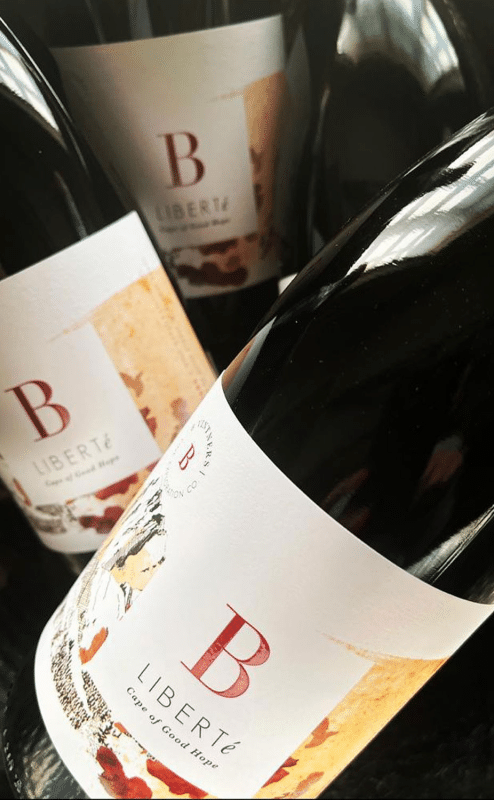
It’s into this space that some of the more compelling recent Pinotages comfortably fit. Gavin Slabbert of Bruwer Vintners speaks explicitly about targeting a new generation of consumers, with Liberté Pinotage at the centre of that strategy. The ambition is to change perceptions by giving the grape a new identity, one that can occupy its own niche rather than constantly competing, and losing, against Cinsault, Grenache, Pinot Noir or Syrah. He notes growing awareness of “New Wave” Pinotages, showing greater restraint and vibrancy, but admits these are yet to be fully embraced. Part of the problem, Slabbert suggests, is a lack of intent in communicating these wines.
Lucinda Heyns of Illimis is more forthright. The old guard, she argues, has tended to be dictatorial about what Pinotage should be, stylistically. That approach may once have provided direction, but it now feels constraining; the category needs a bigger circle, not a tighter one. Different styles don’t dilute Pinotage’s identity; they create talking points, and talking points are the lifeblood of relevance.
If you want evidence that this isn’t just theory, consider a growing list of Pinotages quietly but determinedly defying expectation. Liberté from B Vintners and Illimis have already been mentioned. Angus Paul’s Transient Lands may not be the centrepiece of his range, yet it is elegant and understated. Beaumont Arturo’s Pinotage 2023, sold at last year’s CWG Auction, shows particular finesse, while the standard Jackals River label is similarly premised on understatement. Dorper, as made by Reg Holder, Kottabos from Reenen Borman, and Alex McFarlane’s Saturdays Child all approach the grape with a delicacy that feels deliberate rather than apologetic. Radford Dale offers both Vinum and Frankenstein as emphatically “light reds,” while Atlantikas and Féniks from Bernard Bredell of Scions of Sinai display his deft touch. Wolf & Woman, by Jolandie Fouché, again proves that Pinotage doesn’t need to be pumped up on steroids to impress.
What these wines share is less a single flavour profile than an attitude. They prioritise freshness and work effortlessly at the table, particularly in warm weather or al fresco settings. They suit menus increasingly focused on purity of ingredients and simplicity of preparation. In such contexts, there is no room for wines that intrude or demand attention at the expense of everything else.
If the centenary of Pinotage achieved anything, perhaps it was to remind us that enduring alone is not enough. Pinotage doesn’t need defending so much as reimagining. The debate needs a shake-up, not to discard what has been achieved, but to make room for what is already emerging. As Pinotage enters its second century, we need more wines that charm and satisfy. And to lose the idea that subtlety equals insignificance.
-
Share:

Related articles
Opinion & Analysis
Clash of the titans: Bordeaux 2016 vs South Africa 2017
16 October 2026
A wine can look very good in isolation. Put it alongside its counterparts from the rest of the world, and the context changes. In a tasting billed as “Clash of...
3
Reviews
Kruger Family Wines new releases
15 October 2026
Want to read this? Christian Eedes’ latest wine reviews are initially reserved for subscribers. Get full access now. SUBSCRIBE NOW Already subscribed? Login
News
12 top restaurants set for Taste of Cape Town
14 October 2026
Taste of Cape Town takes place at Green Point Cricket Club on 28 and 29 November, with 12 restaurants including La Colombe, FYN, Vuur, Upper Union, EDGE Africa and Basson...
Louis | 20 January 2026
An excellent and necessary editorial. I’ll be honest: some of the most unpleasant wine experiences I’ve had in South Africa have been with Beyerskloof wines that feel heavy, forced and out of step with how and why we drink today. It’s unfortunate that this style is still held up as flag bearer for the varietal. The real excitement lies firmly in the new wave: freshness, imagination, drinkability and wines that belong at the table, not on a pedestal.
Edi James | 20 January 2026
Thanks for the article. Lucinda Heyns’ Pinotage from Illimis is always fresh and delightful to drink. The first Pinotage I ever tasted in this style was several years ago Spioenkop’s 1900 by Koen Roose.
Riaan van der Westhuizen | 20 January 2026
Van Loveren African Java my ultimate favourite. Each year tastes the same.
Alan Glass | 20 January 2026
Wasn’t pinotage created with the expectation that the crossing of cinsault (a hardy grape with a similar flavour profile to pinot noir) with pinot noir would result in a pinot noir-esque wine which could be produced in higher volumes, at either cheaper prices or higher profit margins?
Shouldn’t the aroma and flavour profiles therefore not match the elegance of pinot noir?
I could never understand the push for over extracted, bold pinotage; it seemed so at odds with the logic behind its creation.
Angela Lloyd | 20 January 2026
Well said, Christian, I’m with you on every point & agree with those on your list of fresher, more elegant, with lower alcohol, less extraction & new oak.
I’ve checked last year’s ABSA Top Ten in Platter &, apart from Warwick & maybe Wellington (a different vintage from 2026 Platter), they all fit the views in your third paragraph.
Apart from the other competitions featuring pinotage – Cape Blend, Rosé & Vintage Award of Excellence – ABSA Top Ten is likely the most influential as far as wine lovers are concerned.
Where does the problem lie? Is it that the more elegant, fresher etc wines aren’t entered because producers believe their wines don’t stand a chance, or the judges aren’t sufficiently familiar with those wines & are influenced by the halo effect?
If the Pinotage Association is serious about growing the popularity of our home-grown variety, it, preferably, needs to encourage wider participation in the Top Ten , while ensuring judges have wide experience across all styles, without promoting any one.
Dieter Gugelmann | 20 January 2026
That’s exactly it! I miss the new styles and the new interpretation of Pinotage. To be honest, I love the old Pinotage style. But I’d also like to explore the new, somewhat lighter style. It seems to me, however, that these wines aren’t getting enough attention.
Perhaps consumers simply don’t want the new Pinotage style. But it’s clear that younger wine drinkers prefer lighter wines with lower alcohol. But wines that are clearly recognizable as Pinotage. Producers shouldn’t forget to try new things, otherwise they risk being left behind sooner or later.