
Malu Lambert: Palomino – the grape that refused to die
By Malu Lambert, 6 October 2026
-
Share:




“It’s hellishly special in the fact that it’s own-rooted,” says Leon Coetzee, not known to mince words. Coetzee is referring to the 1962 vineyard that produces their Klein Karoo Palomino, now in its third vintage with the 2025.
The wine belongs to the Fledge & Co. portfolio, an independent label run by Coetzee and his wife, Margaux Nel. They source fruit from across the Cape, making the wines in the Boplaas cellar, where Margaux is also the sixth-generation winemaker at her family estate.
The pergola trained site growing along the Gamka River, “has seen many droughts, floods and sometimes a good year in the extreme climate of the Klein Karoo”. The vineyard, he says, is on the De Kranz farm, close to the cellar that belonged to Margaux’s family before her great-grandfather died, and where her father, Carel, and Boets later made wine together. The vines grow on sandy alluvial soil over deep red clay.
“The training keeps the vines off the ground so that flood irrigation as well as flooding from the river doesn’t cause too much damage,” explains Coetzee of the ancient system. “It also helps prevent sunburn.
“We are contemplating pergola for alvarinho now too.” The dakke (‘roofs’) are also handy in that pickers are protected from the heat and livestock can graze under the vines.
“The old vines still produce an obscene amount of grapes.” While the majority of fruit gets siphoned off elsewhere, for the Fledge, they make just two 500-litre barrels per vintage, with the remainder of their parcel going into their solera-style white fortified project.
“The fruit never gets super-ripe, even though it’s the last we take in each year. The alcohol hovers around 11 per cent. The last two years have produced fruit with subtle pear flavours and seriously chalky tannins.
“Winemaking is weird and wonderful,” says Coetzee, citing whole-cluster fermentation and some destemming, gentle punch-downs, foot-treading, extended post-ferment maceration and then ageing in old oak for around 16 months. The wine develops a layer of flor, and they bottle directly from cask.
As well as being a workhorse grape, a palomino is also a kind of horse, hence the Fledge’s striking label of a stallion charging through a gold Karoo desert. “The grape is lekker ’70s, so we went with the same aesthetic as a TV tray in Margaux’s gran’s house.”
The vineyard, he says, is due to be grubbed up to make way for muscat. When it goes, they plan to plant a few rows of it at Boplaas.
Just 10,67-hectares (ha) remain in the Klein Karoo.
Ride or die
Once a workhorse of the South African wine industry, palomino has all but been stabled. Said to be one of South Africa’s earliest grape varieties, there is evidence that Fransdruif (French grape), its colloquial Cape name, was present in the 17th century, with some sources suggesting it predates the arrival of Simon van der Stel in 1679.
By 1909, it had a real presence. The name, of course, was incorrect. In the 1920s, Abraham Perold identified the supposedly French grape as Spain’s palomino fino. It became a variety appreciated for high yields and widely used for brandy, sherry-style and inexpensive white wines. As recently as 1981, it still accounted for more than 13,000 ha of vineyard, before chenin and colombar increasingly displaced it.
By 2025, just 91.4 ha remained, a collapse of more than 99 per cent. Around 96% of those vines are more than 20 years old, with 80.92 ha declared as Old Vine.
Many of these old vines are found in the Piekenierskloof, a treasure trove of ungrafted, pre-phylloxera sites. Though famed for grenache and chenin, increasingly special bottles of palomino are popping up: Dan Colombo’s Agape and Piekenierskloof Platklip Palomino Old Vine spring to mind.
It was also in the Piekenierskloof that Fairview rediscovered palomino too, for the Bloemcool Ploegperd, a blend also including chenin and grenache blanc. Charles Back remembers pulling out his Paarl estate’s old palomino bushvines, once used for KWV sherry. “If I knew what I knew today, I certainly would have kept a block.”
Palomino-philes
Though such sites are rarities, the majority of South Africa’s palomino is still found in the Olifants River (44.22 ha), followed, perhaps surprisingly, by the Swartland (22.80 ha). Here, Eben Sadie can be widely credited with making the grape interesting again through wines such as ’T Voetpad, an ancient Piketberg field blend, and of course, the celebrated Skerpioen.
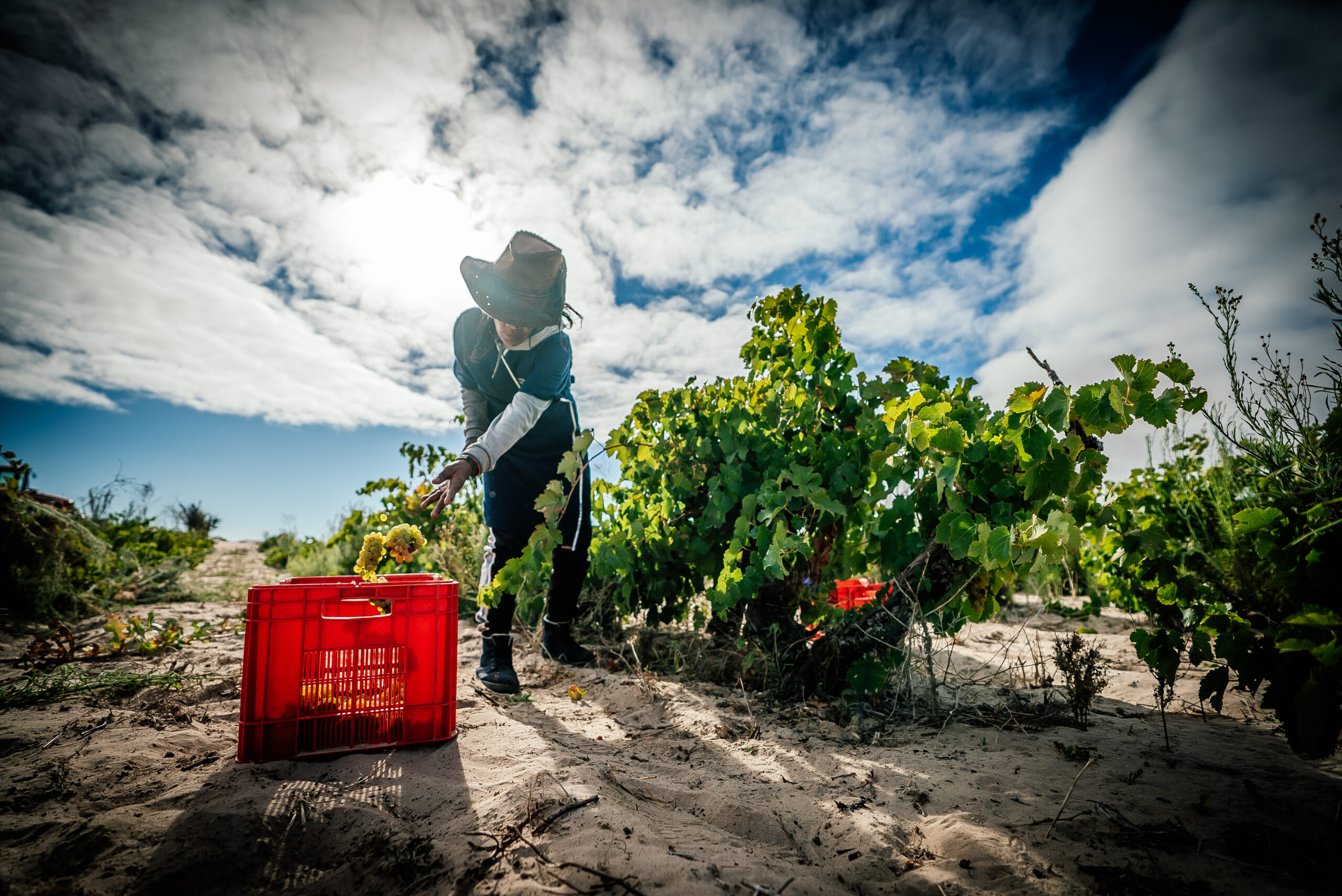
“I was blown away the first time I saw the vineyard,” says Sadie reflecting on when he saw the garrulous, old bushvines sprawling over white sand. Located in a satellite ward of the Swartland, St. Helena Bay, the Old Vine registry estimates it was planted in 1963.
“Rosa Kruger introduced me to the vineyard. I knew it existed, as many people from the West Coast knew about the witblits made from the vineyard, but I had no idea about its potential. The magic is that it’s co-planted to chenin and palomino, which complement each other in the limestone soils.”
The soils, combined with the cooling Atlantic fog and underground aquifers, are what prompted Sadie and consulting viticulturist Jaco Engelbrecht to start a planting programme here in 2019. Currently, the 6.5 ha includes chenin blanc, vermentino, verdejo, assyrtiko, bastardo do castello, grenache blanc, grenache noir, cinsault and, yes, palomino. Though he cautions that plantings of the grape are minimal, “It’s always going to be a niche thing.
Swartland contemporary Adi Badenhorst has a theory as to why palomino is still so widespread in the area: “No one could afford to uproot the vines,” he laughs. “The vines are old, but they still produce an uncomfortable quantity of fruit.”
Badenhorst bottles ‘Sout van die Aarde’ from the same West Coast vineyard. He also sources palomino from several sites, including his home farm, for fortified wines at The Saldanha Wine & Spirit Co, his sherry-style ‘bodega’ in an old gasoline-pink filling station.
Casting a wider view, Badenhorst says, “It’s certainly on the wane worldwide too, especially in its spiritual home of Jerez. Once a staple of the SA industry, it’s lost ground to tractors of the grape world. No doubt palomino makes some of the finest food wines on the planet and has, of course, been championed by a few producers worldwide. The wines of Envínate, Luis Pérez and Ramiro Ibáñez are household names amongst the world’s palomino-philes for the intriguing and complex wines they produce from this grape.
He says they are still planting “a bit of Vaalblaar”, another colloquialism, this one meaning ‘pale green’, referring to the leaf’s dusty-green appearance.
“We are also,” he says, burying the lead, “propagating a South African crossing of palomino and colombard. This is called, wait for it … colomino.” Crossed by Pall Steyn in 1978, it “from our early trials, contains and expresses the finest traits of these two varieties.”
Colomino, folks. You heard it here first.
- Malu Lambert is a freelance wine journalist and wine judge who has written for numerous local and international titles. She is a WSET Diploma alum and won the title of Louis Roederer Emerging Wine Writer of the Year 2019, among many other accolades. She sits on various tasting panels and has judged in competitions abroad. Follow her on X: @MaluLambert
-
Share:

Related articles
Opinion & Analysis
Malu Lambert: South Africa’s vineyards – ageing out or growing up?
25 June 2026
The occasion, Paul Sauer 2023 vintage release (read the review here). Hosted as always in the room adjacent to the barrel cellar. Winter light pours through an arched window, the...
Opinion & Analysis
Malu Lambert: Are SA’s best red blends hiding in plain sight?
27 May 2026
Two tastings recently underscored the vast potential of South Africa’s more creative red blends. Those that fall outside the familiar Bordeaux model and its trusty trio, sometimes quintet, of grapes....

11
Opinion & Analysis
Malu Lambert: Farmer Angus, chickens, carbon and how it all relates to wine
4 March 2026
“PASTURE REARED” reads Angus McIntosh’s T-shirt, a white Leghorn chicken tucked under his arm. He’s better known as Farmer Angus, the name under which he sells his food range and,...
Comments
0 comment(s)
Please read our Comments Policy here.