
Malu Lambert: South Africa’s growers need a new deal
By Malu Lambert, 28 October 2026
-
Share:


South Africa’s wine industry has been built on what critic and commentator Michael Fridjhon describes as “a history of production-driven enterprises”. Speaking at the University of Cape Town’s Business of Wine graduation, he touched on how the industry has evolved from one dominated by growers supplying cooperatives to being increasingly defined by the estate model.
Official figures tell a story of contraction. According to SAWIS, the number of primary grape producers has fallen from 3,667 in 2009 to 2,176 in 2025; a staggering 41% decline. Stellenbosch, despite its concentration of premium estates, has lost almost a third of its growers.
Private wine cellars have also declined, from 524 to 434 over the same period, suggesting broader consolidation across the industry.
The distinction between growers is important: traditional suppliers to cooperatives, specialist growers for premium brands as well as for independent winemakers, and wine estates growing fruit for their own labels, either on-site or on satellite properties, such as Bosman Family Vineyards’s Hemel-en-Aarde holding.
Sitting beside me at the graduation is Raphaela van Embden, a 2018 graduate of the programme who has since become a co-convener, alongside her work as a content producer. Having graduated the previous year, I myself am back to hand over the class medal.
Michael’s speech gets us talking. Raphaela has recently completed a dissertation, Price Variation of South African Old Vine Grapes According to Social Ties, examining the economics of grape growing, specifically how power and trust influence the prices.
“You can’t bank sentiment”
Drawing on 387 old-vine grape transactions between 2019 and 2024 and interviews with 25 industry participants, Raphaela’s research reveals a disconnect between the perceived value of old vines and the prices the growers receive.
While wines made from old vines command a retail premium of R2.96 for every additional year of vine age, Raphaela found that this has no measurable effect on the price for the grapes themselves.
South Africa’s grape-pricing model is structured around volume rather than quality. Old vines, however, typically produce around 4 tonnes per hectare, compared with an industry average of 18 tonnes for younger vines.
“What struck me was how you can divide grape growers into those who have been able to leverage the reputation of their old-vine grapes, as well as their connection to reputable winemakers; and those who haven’t.”
Her research found that some have moved away from traditional per-tonne pricing altogether, negotiating fixed payments per hectare, with winemakers sharing farming costs.
Instead of carrying the financial risk of lower yields, growers receive an agreed return for maintaining the vineyard to a particular standard. And, winemakers gain secure access to fruit.
“There’s almost this courtship that producers have to undergo,” Raphaela laughs. “Knowing the family, the children and even the dog’s name is important. Trust doesn’t necessarily mean a higher price, but it does open doors.”
And while sentiment keeps many of these vineyards alive… as one grower said to Raphaela: “You can’t bank sentiment.”
Regions are under significant pressure. The Northern Cape for example has lost 71 per cent of its growers between 2009 and 2025.
The cooperatives are also consolidating. Producer cellars and crush facilities, too, continue to drop off the spreadsheet – Stellenbosch and Paarl have seen particularly pronounced declines in private cellars.
The potential it seems is in the newer territories. On the Cape South Coast, private cellars have increased from 47 in 2016 to 59 in 2025, alongside a growing number of (uncalculated) independent brands.
The modern South African wine revolution, it can be argued, was built in part by these kinds of producers: ambitious young winemakers who source fruit without having to own land. But clearly, that model is coming under pressure. So what does the future of grape growing look like?
The future of grape growing
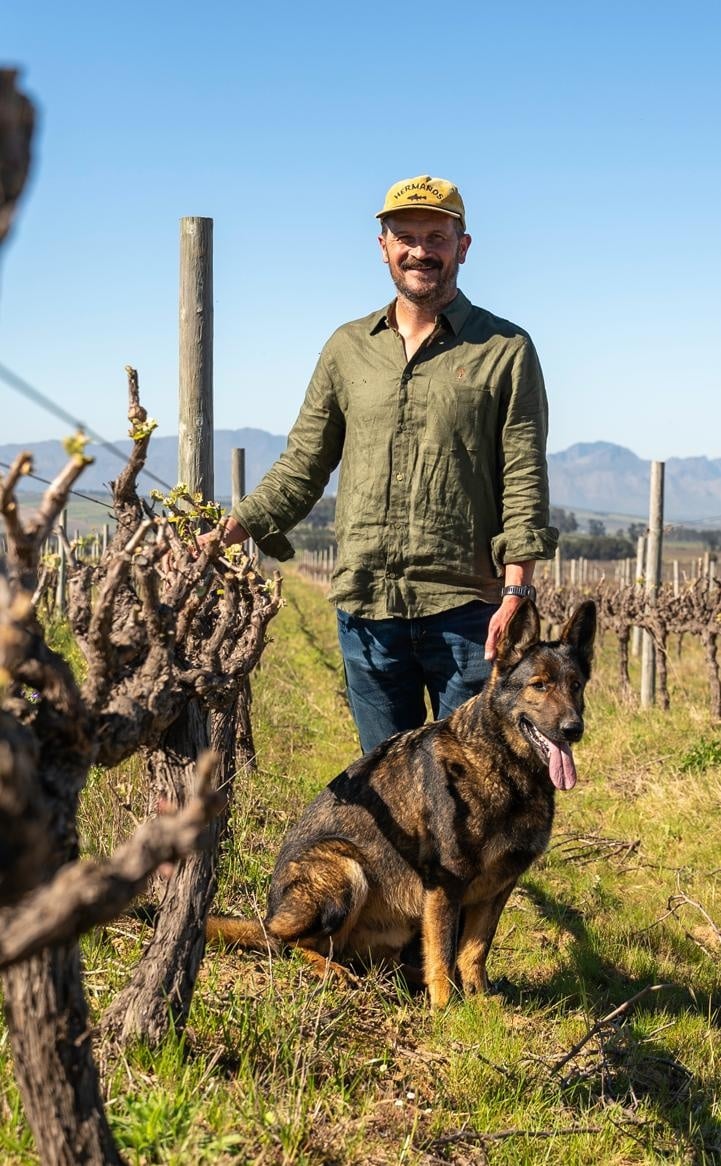
There’s no one better to talk to about this than Danie Carinus, sixth generation grower and co-founder of Carinus Family Vineyards in Stellenbosch’s Polkadraai Hills.
“I doubt whether there are new Basie van Lills coming through,” he says, referring to the legendary Skurfberg grower whose vineyards sprung some of the country’s most celebrated wines. “The only way I now plant vineyards is on an offtake agreement; where I know there’s going to be a home for that fruit”.
After completing a vintage in California in 2006, Danie returned home with the idea that South African growers needed to take greater control of their destinies. At the time, the family supplied virtually all its fruit to Stellenbosch Vineyards. Rather than continuing to depend on a single buyer, he picked up a copy of Platter’s and started calling producers. One of the first to respond was Bruwer Raats. In 2008, Danie planted cabernet franc and malbec for him, fruit that would eventually find its way into MR de Compostella.
The family’s Polkadraai property is approximately 180 hectares, of which around 40 is currently under vine. Danie envisages a smaller, more focused vineyard area and as part of this restructuring, he is planning to establish approximately 30 hectares of new vineyards over the next three years, replacing marginal blocks with sites designed from the outset to produce premium fruit. The programme is being developed in partnership with producers he has long-standing relationships with.
“If we design vineyards from the soil up, the potential for quality is considerably greater.”
Much like the arrangements Raphaela identified in her old-vine research, Danie is exploring agreements in which winemakers contribute towards planting costs, then pay a fixed price per hectare rather than per tonne.
“We already have deals like that in place,” says Danie. “So if we need to drop fruit for quality considerations, we can because we know what we’re getting paid.”
“It’s not a new model. It works in Europe.”
Danie believes such partnerships will become increasingly important as the economics of grape growing continue to deteriorate. “Vines are making way for strawberry tunnels.”
Then there’s own-label producers, whose ability to quickly establish brands has been made possible by under-valued grapes. Danie compares it to a winemaker approaching Domaine de la Romanée-Conti and asking to buy a few rows. “They would laugh at you”.
He questions whether enough of those businesses have subsequently reinvested in the vineyards on which their success depends.
Established producers he says are also a part of the problem having become accustomed to buying premium fruit at prices that don’t adequately reward growers.
“We need to start promoting the wards, the places and the slopes more than we do the growers or the winemakers,” he argues. “In Europe, the vineyards are the heroes. If you make the vineyard the hero, then suddenly grape growing becomes more attractive”.
Things need to change.“Otherwise, there aren’t going to be vineyards left,” he says.
The next generation of vineyards is a question that interests James Downes of Shannon Vineyards in Elgin. He distinguishes between replanting ageing blocks, which simply maintain the existing footprint against the establishment of new vineyards on previously unplanted slopes.
These new sites, he believes, could yield South Africa’s next great discoveries. And where to plant must increasingly take into account water availability, rising temperatures and the potential of cooler, higher-altitude regions.
“Being in the Cape South Coast, I’m biased towards the region’s resilience to global warming as well as the urban sprawl threatening traditional areas.”
During a harvest in Chile he says he was struck by how many wineries sourced grapes beyond their immediate surroundings. He sees a similar trend emerging, citing Elgin wines from Thelema, Tokara, Vrede en Lust and Boschendal as well as Boekenhoutskloof’s Cap Maritime wines in the Hemel-en-Aarde.
“It is very difficult to change the address of a cellar,” he rightly says, “and much easier to plant vineyards or source grapes.”
Prospecting new territories, pricing per hectare rather than per tonne, and valuing vineyards over brands. The recipe seems simple enough, but are these growing pains too much for an industry so comfortable with the status quo?
The proverbial frog in slowly boiling water comes to mind.
- Malu Lambert is a freelance wine journalist and wine judge who has written for numerous local and international titles. She is a WSET Diploma alum and won the title of Louis Roederer Emerging Wine Writer of the Year 2019, among many other accolades. She sits on various tasting panels and has judged in competitions abroad. Follow her on X: @MaluLambert
-
Share:

Related articles
Opinion & Analysis
Malu Lambert: Palomino – the grape that refused to die
6 October 2026
“It’s hellishly special in the fact that it’s own-rooted,” says Leon Coetzee, not known to mince words. Coetzee is referring to the 1962 vineyard that produces their Klein Karoo Palomino,...

2
Opinion & Analysis
Malu Lambert: South Africa’s vineyards – ageing out or growing up?
25 June 2026
The occasion, Paul Sauer 2023 vintage release (read the review here). Hosted as always in the room adjacent to the barrel cellar. Winter light pours through an arched window, the...
Opinion & Analysis
Malu Lambert: Are SA’s best red blends hiding in plain sight?
27 May 2026
Two tastings recently underscored the vast potential of South Africa’s more creative red blends. Those that fall outside the familiar Bordeaux model and its trusty trio, sometimes quintet, of grapes....
Comments
0 comment(s)
Please read our Comments Policy here.