
Tim James: Battling Franschhoek’s fires and what comes next for its vineyards
By Tim James, 26 January 2026
-
Share:





3
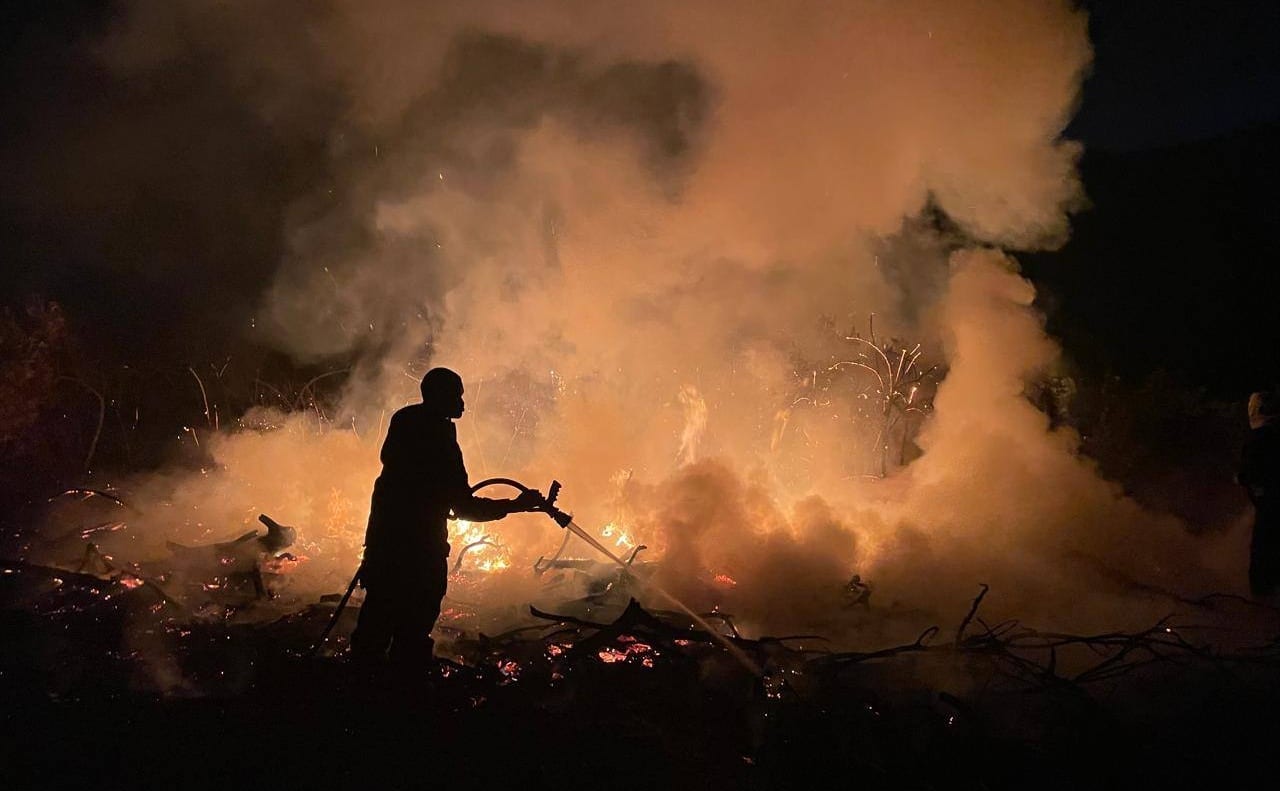
When I went out to Franschhoek early last Friday, some two weeks after the devastating run of fires had begun, there was little to be seen of smoke and flame. From small and sluggish billows of smoke I could guess at fires in inaccessible parts of the mountain between Franschhoek and Theewaterskloof, and there was smoke haze blown over from the other side, where the blaze persisted (the blown smoke increased greatly later in the morning, and made my eyes smart). But the mountains ringing the town, no. There was so little left to burn.
In the grey, smouldering aftermath of it all, the total reckoning of damage to buildings and vineyards has still to be compiled – not to mention the implications of possible taint on the wines to be made from the smoke-drenched grapes. I heard a recent figure of more than 23 500 hectares of vegetation destroyed in the mountains since 8 January – and still counting. The number of small animal lives that ended in pain and terror on the burning mountains must be uncountable.
On the frontline
Gottfried Mocke of Boekenhoutskloof drove me around parts of the valley, first showing me how threatened some of the farm’s own vineyards had been, as the fire swept around the mountain slopes above them. He, along with many others, had spent exhausting days and nights fighting the fires as the veering wind drove it in all directions. The photographs of the fire that I saw were terrifying enough. There have been plenty on social media, I think, that many readers will have seen.
It’s been said that the life of a soldier is one of boredom punctuated with moments of agonising fear. For professional firefighters it must be the same. The amateurs who come in response to the call for help, sometimes again and again, mostly know the fear, I suppose.
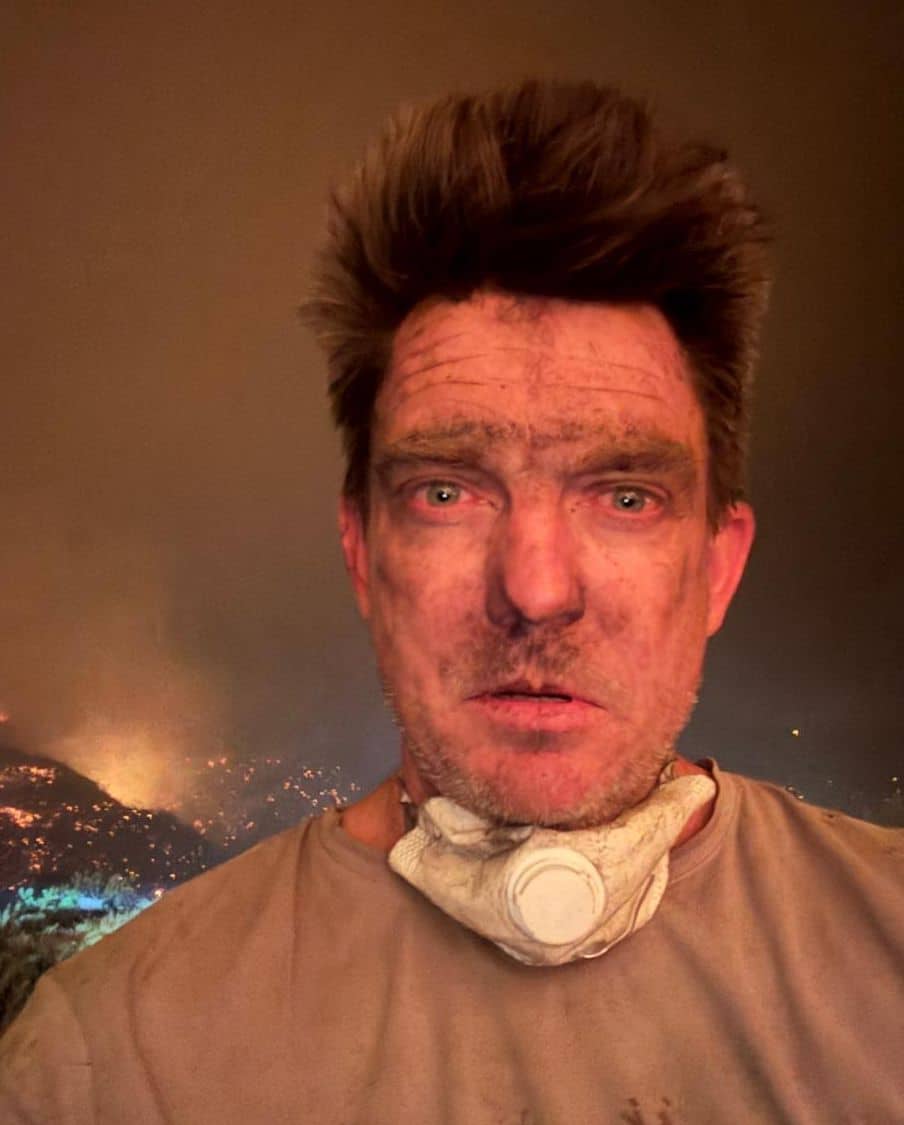 Perhaps no photo more remarkably summed up for me the human effort in our age-old struggle against fire than the one shown here of Evan Alexander, head of Boekenhoutskloof’s sales and exports, tired beyond expression and looking like he had somehow (just) survived, though emptied by something horrifying. But when I asked his permission to use the photo, he didn’t refer in his reply to his own experiences, rather to “the incredible community spirit that comes with such natural tragedy”. So perhaps the picture can primarily stand for that.
The official Winelands fire services take responsibility only for buildings, so the protection of orchards and vineyards is up to the landowners and their employees and whatever help can be mustered. For some time there was a fire engine stationed near the Boekenhoutskloof winery, and driving around the valley later I could see farmhouses and barns intact while the vegetation around them was burnt.
There were fires all over, through the week – Gottfried was involved in firefighting not only at Boekenhoutskloof. It sounded all too pervasive and even chaotic for me to understand what recent times must have been like. At Boekenhoutskloof itself, said Gottfried, volunteers came with vehicles with water pumps on their trucks; and the team from Lewis Bush Clearing that he works with in the winter; the external team of vineyard workers that Boekenhoutskloof employs; and many locals that contacted him, offering to help – with no prospect of reward. And “lots of guys with bakkies came – they’d phone up and say do you need help? Can we come? Some with four-wheel drives got up to the top part of the farm to be with us there.” A few, it seems, appeared after every flare-up around the valley.
Community support came in other forms too. Restaurants in Franschhoek town prepared food and delivered it for the teams of firefighters. For guesthouses and restaurants this should be, of course, a time of peak tourism, but I guess that many sensible tourists had fled – apart from the usual disaster-gawkers and sensation-seekers (perhaps I’m being unfair) to take videos for posting on social media. And Gottfried told me, laughing, about someone who’d booked a tasting at the winery for the Tuesday and was most upset to have to accept that his birthday treat had been cancelled.
Don’t forget about the expense alongside the generous community support. The helicopters, with their brave and skilful pilots, so vital for dousing those vast sheets of mountain flames with their huge water-buckets, don’t come cheap. It costs hundreds of thousand of rands per hour to send up a small team of private helicopters, but enough contributions came in to pay for them where most needed. In extreme windy conditions helicopters were grounded (their local base was the lawns in front of the Huguenot menorial). Gottfried told me of a powerful Black Hawk that battled on for a while after the weaker Hueys had been forced away. He saw its 2,000-litre bucket flying behind it parallel to the ground so strong was the wind; that one too was obliged to retire from struggle for a time.
And so to coping with what follows. In a way it must seem like an anticlimax, dealing with the work of clearing up where necessary and repairing damage where possible. When I was driving around the Boekenhoutskloof vineyards near where the fire frontline had been, workers were spraying the vines. Just with water, said Gottfried, to wash the bunches. “We’re just going to keep on washing the whole day. I don’t know if its going to do anything useful, but at least I feel like I’m doing something.” Smoke can penetrate the wax layer that forms on the grape when it’s ripening; it doesn’t seem certain how much exposure time is necessary to do the harm. “Next week”, said Gottfried, “we’ll pick some bunches, ferment it and send it to the lab, because you only pick up smoke taint once fermentation has happened, because it’s a volatile phenolic that needs to be released.”
For this year the Franschhoek fires are over, with perhaps the occasional flareup in an area not entirely emptied of inflammable material [Cape Winelands District Municipality said a fire line at the top of the Banghoek Valley remains active]. Some of those who fought them are doubtless a little singed, and touched with the appallingness of it all, but will have rested and washed their own smoke taint away. Most of the vineyards, happily, are living green, and with hanging, swelling fruit. Today or soon, no doubt, the secateurs will be checked for sharpness. Harvest 2026 not long off.
- Tim James is one of South Africa’s leading wine commentators, contributing to various local and international wine publications. His book Wines of South Africa – Tradition and Revolution appeared in 2013.
-
Share:
Related articles
Opinion & Analysis
Tim James: Cinsaut comes good in the Cape
19 January 2026
A silly, sentimental and conventional thought it doubtless was – but there you are. Or there I was, at the small and rather joyful Cinsault Fest organised for the trade...
6
Opinion & Analysis
Tim James: What a collection of SA wine anniversaries really tell us
12 January 2026
The year’s beginning is a good time to look back – and further than just the last 365 days that brought us to this pass. Conventionally, such musings fixate on...
1
Opinion & Analysis
Tim James: 40 years on, the few who changed SA wine
17 December 2025
The closing months of this year saw the deaths of two notable members of the immediately past or waning generation of winemakers – heroes of that radical change in South...
James | 26 January 2026
Tim, rosa kruger mentioned that the la colline vineyard burnt. Was it entirely destroyed?! It would be a great shame if that incredible site was damaged.
Tim James | 26 January 2026
What I’d heard, though not authoritatively, is that only the top portion of La Colline was destroyed (bad enough). Actually it felt to me almost ghoulish to try to find out details of damages at this stage. We must wait and see and hope that few
vineyards, famous or not, have been badly damaged.
Josua | 26 January 2026
The refusal of governments and large corporations to take climate change seriously is only going to exacerbate this. Especially the US with the Republican Party considering climate change a hoax.
In the Global South, it hasn’t just been SA that experienced multiple large-scale fires this year.