
Tim James: Cinsaut comes good in the Cape
By Tim James, 19 January 2026
-
Share:





7
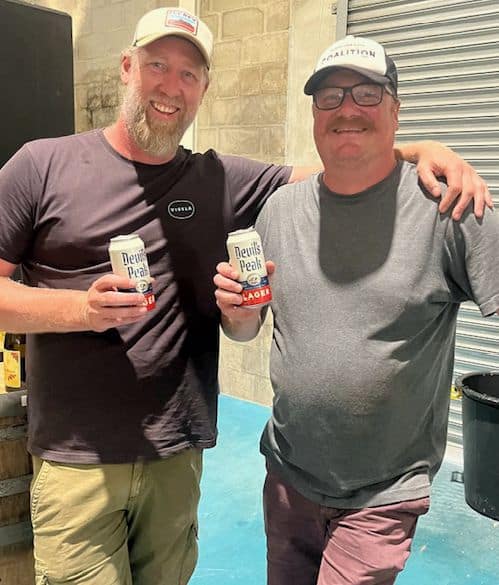
A silly, sentimental and conventional thought it doubtless was – but there you are. Or there I was, at the small and rather joyful Cinsault Fest organised for the trade by Mick and Jeanine Craven in their Stellenbosch winery, with something more than a dozen of the Cape’s best producers of wines from this grape. And it occurred to me how nice it would have been if the great IA Perold could have seen and tasted what was on offer – and, I suspect, would have with even more interest discussed viticulture with some of the people there.
I daresay he’d be even more surprised and impressed at a modern pinotage fest than at this, devoted to one of the grapes he crossed to produce that increasingly less controversial variety. He wrote interestingly about cinsault in the book I mentioned last week as celebrating its centenary this year, the Handboek oor Wynbou / Treatise on Viticulture. He there discusses the grape as hermitage, of course, giving cinsaut as one of the synonyms (without the ell, which is better,I think, but the other version has become dominant), and points out with acceptable pride that “I was the first to prove the identity of the Cape Hermitage with the Cinsaut of the South of France”.
From Cape workhorse to fine-wine curiosity
At the time of his writing, 1927, he says, “fully 75 per cent” of the Cape’s red wines were made from cinsaut, on account of its high productivity. He mentions the extreme case of a farm near Durbanville that was producing just under 300 hectolitres of (unsurprisingly!) “thin, light red wine” per hectare – probably a world record he says. It remained the most planted variety here until chenin took over in the 1960s.
Some of the producers at the Craven Fest will be getting about 10% of that volume per hectare, and some rather less. And if we would agree to call some of those on show “light” (in colour and volume), we wouldn’t mean Perold’s “thin, light”.
Some of the cinsaults I sampled last week were designed to be lighter than others – we are by now accustomed to revel in the range of styles. But all were of impeccable quality and all delicious in their own ways – we’re accustomed to that too, happily. It does seem, though, that the really overt, rather simplistic (and ultimately rather boring) whoosh of perfume is not to be found at the more ambitious end.
Style, seriousness and the virtues of dryness
Forgive me, if you’re still quite young in spirit at least and want to view wine as a competition, but this experience was a lesson in tolerance. Strangely, I find tolerance and a reduced temptation to be judgmental coming more easily as I age, though personal prejudices and preferences remain. In cinsault, they guide me to those wines that downplay the perfumed charm and easy, sometimes trivial lightness, and stress the grape’s potential for structure, and have genuine dryness. More body, interest and concentration come with greater ripeness of fruit, but crucially – as ever, whatever the variety – must involve a balance with freshness. But I know that not everyone wants, in all circumstances, more than charm, exquisitely presented.
A good thing at this little show was that many of the producers brought an older vintage along with the current. That included some of the lighter-stylists like Craven, whose 2018 is drinking beautifully now, with just a touch more complexity than the current sweet-fruited 2024. I doubt if there’d be much point keeping it as long as Badenhorst’s Ramnasgras – the 2012 vintage of that was remarkably impressive, mildly tertiary and with deliciously balanced tannins. Sadie’s even older, appealing 2010 Pofadder showed elements of the expected elegance and depth in its aliveness, etc, but the tannins seem now a touch exposed by receding fruit. I had a bottle of the 2014 at home recently, and that was more satisfying, with room to go. As Eben says, they’re making the wine better these days, and the 2024 combines a gorgeous richness with subtle perfume and effective structure. Fine wine.
Natte Valleij’s Stellenbosch version (there were also the admirable Darling and Coastal versions on show, as well as the only rosé in the room) from 2016 showed that cinsaut should not always be pushed too far in bottle. It was attractive, but showing a lot of development in colour and flavour, with just enough fruit left to balance the tannins. The current 2024 is lovely, from its aromatic opening to its firmly structured core.
The only current-release wine at the more “serious” end that I thought still too young to be really enjoyable, demanding more time in bottle to make it worth the substantial cost of buying it, was Leeu Passant Basson 2023, despite its having had two years in barrel and another in bottle already. The aromas are lovely and the wine is potentially great, but the big tannins need further ageing. What a splendid wine this will be was pointed to by the subtly perfumed, textured and suave 2017, where the tannins were still very present, but considerably more approachable (I actually remember tasting this wine in tank and being astonished at its massive structure). Both vintages show a little sweetness, but I think that is from fruit concentration and, probably, the (declared) high 14.5% alcohol.
There are two of the other producers present at this little Fest that I want to mention, although they didn’t have older comparisons. Donovan Rall had two wines, however. The Cinsault 2024 appealed to me greatly – beautifully dry and vibrant unique in its aromas, in which the usual perfume is underplayed. He also had the only Cinsault Blanc, a 2024. I hadn’t had this wine since the maiden 2017, which I hadn’t thought particularly highly of, but I found this one – savoury, bone-dry and elegant – entirely pleasing. Apart from anything else, Donovan says the vineyard has greatly improved since he first took grapes from it.
Incidentally, don’t wait for the 2025 Blanc, as all the grapes were eaten, or gathered, by locals before the official pickers arrived…. Cinsault is a delicious grape, and the Mullineux old Wellington vineyard, also near a major road, necessarily has a permanent guard as the grapes approach ripeness.
If there’s a touch of winning, elegant austerity on the Rall wines, so too is there on the two cinsaults from Van Loggerenberg, which have a real and rare complete dryness to them and not a shred of the frivolous vulgarity that can sometimes come with that cinsaut perfume. Characterful Geronimo 2022, with its chalky tannins, even has an edge of bitterness on the finish that I appreciated. But Lotter 2023, from the 1932 Franschhoek vineyard that Leeu Passant once drew from, is among the small handful of cinsaults that almost convince me that the grape can make a truly fine wine standing on its own: intense and powerful, but pure and refined, with that bit of austerity I mentioned, and promise of complexity. Again, bone-dry – which I’m increasingly regarding as my first condition for true excellence in red wine.
- Tim James is one of South Africa’s leading wine commentators, contributing to various local and international wine publications. His book Wines of South Africa – Tradition and Revolution appeared in 2013.
-
Share:

Related articles
Opinion & Analysis
Tim James: Who really wins at wine auctions?
12 October 2026
The Strauss & Co wine auctions began in 2019, in good time to benefit, as is clear in retrospect, from the pandemic that was soon to hit us. The stated...
6
Opinion & Analysis
Tim James: Why do we drink? And why do I?
5 October 2026
We all drink alcohol, it’s surely fair to say (unless there are some teetotal voyeurs – liseurs? – readingthis; “we” being the readers, extended to “people generally”). But why? That’s...
Opinion & Analysis
Tim James: A visit to Callie Louw’s Sonkop
28 September 2026
Fans of Callie Louw – there are many, and I think “fan” is the right word – will be pleased to know that all is going well at his new...
Wessel Strydom | 19 January 2026
Thank you Tim – another delightful article!
I have recently enjoyed the Geronimo from Lukas together with his Breton Cab Franc. Both wines is exceptional. In the topic of Cinsaut – I enjoyed a bottle of Darling Cellars Old Bush Vines Cinsaut yesterday and at R241 per bottle I think it is an absolute steal.
Marelise Janse van Rensburg | 21 January 2026
We love Cinsaut!
Would it be possible to get a list of the producers at the Cinsaut Fest, then we can visit all their wineries?
Thank you 🍷
Christian Eedes | 21 January 2026
Hi Marelise, Producers in attendance as follows: AA Badenhorst, Ampersand, Blacksmith, Bosman, City on a Hill, Illimis, Kaapzicht, Mullineux, Natte VallSadie, Van Loggerenberg.
Mick | 21 January 2026
Funnily enough, Craven Wines was there as well
Christian Eedes | 22 January 2026
Goes without saying!
Marelise | 31 January 2026
Thank you for the names of the wineries/producers 🍷
Tim James | 22 January 2026
Christian’s list not quite right in inlusions and exclusions, I think. In additions to those mentioned in my article (including Rall and Craven), I also tasted Scions of Sinai, Bosman, Blacksmith, Savage. But there are, of course, many other good cinsuts around, as Wessel reminds us.