
Tim James: Old hands, new labels – when winemakers go it alone
By Tim James, 3 February 2026
-
Share:




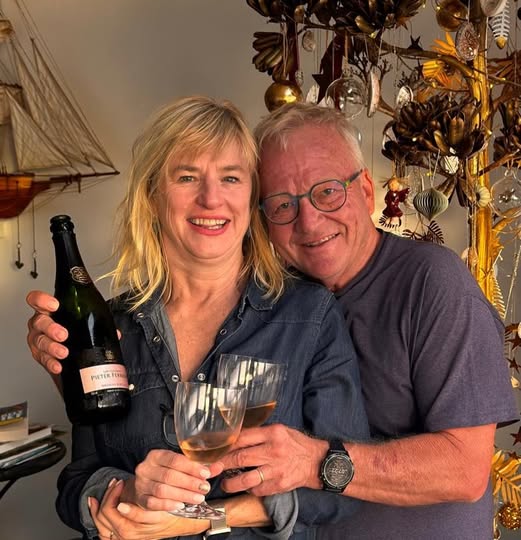
Pieter Ferreira and Abrie Beeslaar have quite a bit in common. Primarily, they’re two of this century’s finest Cape winemakers, best known for their work for two important wineries – Pieter making bubbles (and more, in the past) for Graham Beck and Abrie making Kanonkop’s great reds. Abrie left Kanonkop a few years ago, and Pieter finally retired just last Friday as CEO of Graham Back (having previously been chief winemaker for decades). Best known for those positions, I say, but that’s for now, and it’s likely that as the decade marches on they’ll both be better known for their own labels: Beeslaar Wines and Pieter Ferreira Cap Classique. A nice coincidence is that the maiden vintage for both of these eponymous labels was 2012, many years before their makers left their day jobs – an important delay, I’ll come back to that.
I made this conjunction between two illustrious winemakers because I tasted Abrie’s wines recently and then heard of Pieter’s retirement (when I confirmed it with him he said he was “so happy that I can enter into my new chapter and finally live the dream of my own label. This is fantastic”). And it got me thinking about winemakers who leave the security of employment in the latter part of their lives for the trials, tribulations and rewards of their own labels.
It’s very common, of course, for a move to be made in the winemaker’s youth – much younger than Abrie (who celebrated his 52nd birthday on the day of the small trade tasting I attended) or Pieter, who retired at the mandatory age of 65. It’s not hard to think of young winemakers striking out on their own after a smallish number of years of formal employment – sometimes already with an infant own-label, sometimes not. Just looking at the early founders of the modern Swartland, many fall into that category, including the famous trio of Eben Sadie (formerly at Spice Route after some co-op experience), the Mullineux pair (Tulbagh Mountain Vineyards), and Adi Badenhorst (moving from Rustenberg). It’s a different story with the fourth of the winemakers who appeared on the famous posters and T-shirts of the Swartland Revolution. Callie Louw only last year joined the ranks of the lateish-middle-aged winemakers leaving security to start out under his own name – trusting that his measure of established fame and his skills and hard work will be enough to get ahead without the marketing power and support of a well-established company
Not all older winemakers (or even younger ones) leave their day jobs out of choice. Sometimes they are pushed – however much this situation is hidden from the public by, I’d guess, non-disclosure agreements – but I’m not going to go nosing there. One of the first older winemakers to set up on his own was the late Ross Gower. He and Klein Constantia parted ways in 2003 after a long time together with varying results in terms of winemaking achievement, and he established a small Elgin farm and his own label. It had only a moderate measure of success, and seemed to dwindle away after his sad death in 2010.
I don’t know the full story behind Kevin Arnold’s break with Waterford, but it seemed intuitively unjust and unattractive that he was not able to take his own name with him – obliged to leave it behind, as it were, on the estate’s shiraz. So he called his own brand The Family Wines; I don’t know the wines and they don’t seem widely available, but I can’t imagine that they are anything other than good.
André van Rensburg’s move after a long and devoted stint at Vergelegen was certainly not unexpected – like Pieter retiring from Graham Beck, it happened at the age that the company policy dictated. He quickly set about establishing a range of wines under his own name. Again, I confess I scarcely know the wines. The only report of them on this website came with the first few releases, but they do seem to be fairly available locally and internationally, so we can hope that the venture will enjoy a success comensurate with the winemaker’s lustre – not an inevitability.
Carl Schultz was an apparently sudden mover, more recently, after a long and greatly successful career at an estate, in this case Hartenberg. He announce the establishment of Solo Wines, but as far as I know the only wine so far released under that label was a widely praised Cabernet Sauvignon sold for a high price last year at the Cape Winemakers Guild Auction.
The examples mentioned above differ in an important way from the cases of Pieter Ferreira and Abrie Beeslaar. By the time that they started fulltime work on their own labels, those labels were well established and highly regarded (and both with the substantial benefit of having that excellent distributor Ex Animo on their case). In Pieter’s case, the brand was formally owned by his wife Anne, a formidably capable and energetic person with great understanding of the sparkling wine category to which the brand was devoted. So Pieter starts his “new chapter” already at speed.
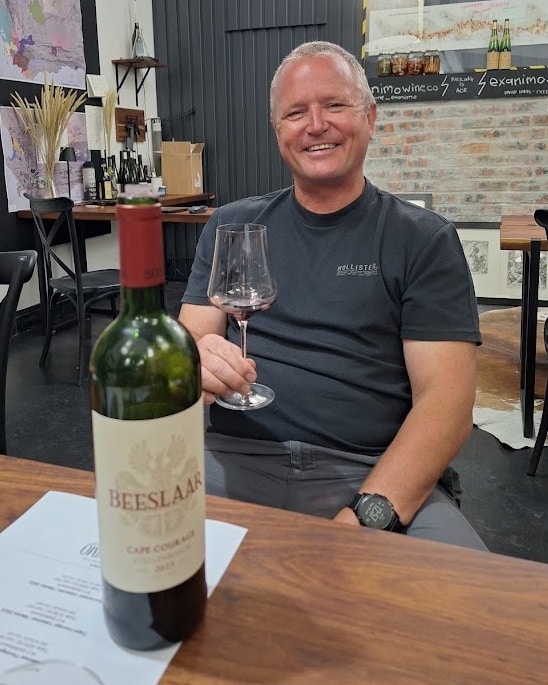
Abrie Beeslaar.
Abrie was more than jogging by the time he decided that it was the right age to leave and enjoy perhaps the last real chance of a major new stage in his career. His Pinotage was famous, but the sole wine for some years, until it was joined by a Chardonnay from the 2020 vintage. An expensive red blend recalling his famous Kanonkop Paul Sauer came in 2022 with The Sacrament. And now there is a cab-based red blend (with pinotage, merlot, cab franc and petit verdot), made for earlier drinking, at R245 a fifth of the Sacrament’s price and aiming to be a much bigger seller (I really think it deserves to be).
Christian Eedes rated these two reds the same, which seems fair enough to me. Cape Courage is, of course, intended to be the more approachable of the two, but I myself suspect that in 10 or 15 years (I should be so un/lucky!) I would still prefer the less expensive wine. Gently fragrant, it has a lighter, fresher feel to it at declared 14% alcohol, balanced firm structure, a delicious succulence, and I thought it finished a little drier, despite actually having a bit more residual sugar. Perhaps it’s the 14.5% alcohol and the 2.2 g/L residual sugar on the Sacrament that made me demur a little, as I do about most ambitious Stellenbosch cabs and Bordeaux blends (not including Abrie’s at Kanonkop); but that’s a personal taste and opinion.
We also tasted the current Chardonnay 2023. For all Abrie’s fame as a red-wine maker I think he is doing stunningly well with this wine (we also tasted the still unreleased 2025) – he generously acknowledges the advice he gets from Graham Weerts of Capensis. There is some richness, a silky generosity, but there is a brilliant, beautifully balanced acidity, modestly unobtrusive oaking, and a freshness at under 13% alcohol.
I don’t know if Abrie is intending to further expand the range of Beeslaar Wines. I hope so, and I must say I’m rather pleased that he’s set out his own table. Kanonkop will manage extremely well without him, and here we have a fine new label – no, not new, of course, but an expanding one with a new, concentrated force and focused attention behind it.
- Tim James is one of South Africa’s leading wine commentators, contributing to various local and international wine publications. His book Wines of South Africa – Tradition and Revolution appeared in 2013.
-
Share:

Related articles
Opinion & Analysis
Tim James: Battling Franschhoek’s fires and what comes next for its vineyards
26 January 2026
When I went out to Franschhoek early last Friday, some two weeks after the devastating run of fires had begun, there was little to be seen of smoke and flame....

3
Opinion & Analysis
Tim James: Cinsaut comes good in the Cape
19 January 2026
A silly, sentimental and conventional thought it doubtless was – but there you are. Or there I was, at the small and rather joyful Cinsault Fest organised for the trade...
7
Opinion & Analysis
Tim James: What a collection of SA wine anniversaries really tell us
12 January 2026
The year’s beginning is a good time to look back – and further than just the last 365 days that brought us to this pass. Conventionally, such musings fixate on...
Comments
0 comment(s)
Please read our Comments Policy here.