
Tim James: The story of semillon (white and red) in the Cape
By Tim James, 11 August 2026
-
Share:





4
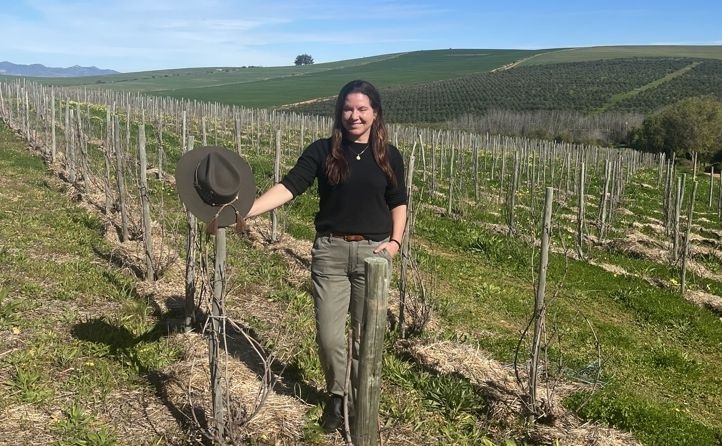
What is probably the world’s newest grape variety (for a while at least) has its past firmly rooted in three centuries or more of Cape winemaking. As reported last week, the world’s first officially certified sémillon gris vineyard is thriving at the Roundstone estate of Mullineux in the Swartland. No other vineyard in the world can, as yet, claim the grape, though the official mother block is derived (via a long process of propagation and evaluation) from the “red semillon” vines on an old Swartland vineyard – and there are other such vines scattered around the Cape, mostly interplanted with what is now the dominant variety of semillon in the Cape, the standard white version.
Given this, it seemed a good idea to look at what we know of the story of red semillon in the Cape, including revived interest in it this century. I’ve been interested in the topic for some time – and can probably claim my own small “first”: I’d guess that my 2009 article in World of Fine Wine. “Red Semillon: Return of the wine grape” was the first substantial journalistic report on the gris version. I’d been prompted in this research by having recently seen red semillon vines for the first time, at the mixed ‘T Voetpad vineyard from which Eben Sadie was that year making a wine, which would help bring attention to the variety.
The rise of the Cape’s “wine grape”
The much-cited figure of 93% as the proportion of semillon in the Cape vineyard in the 1820s comes from an estimate made by civil servant William Bird in his “State of the Cape of Good Hope in 1822”. He was referrring to “the common green grape”, or groendruif – so common that it was often simply called wijndruif, or “wine grape”. (The colour reference was apparently to the bright foliage, not to the grape.) It gained this dominance in the context of a huge expansion of Cape vineyards following the British occupation in 1795 and later full colonial ownership. In 1795 there were about a million vines in the Cape; in 1822 Bird estimated 22 million. Groendruif was obviously the easiest to grow in various ways, including resistance to the dominant diseases.
What we don’t know is when the mutation that produced “red greengrape” happened. It could have been a century or more earlier, any time since semillon was first planted here (probably imported by Van Riebeek in 1653). But by the time Bird was writing red greengrape was already common. The great viticulturist Abraham Perold published some historical notes in the 1930s, which quoted evidence given in 1826 by farmers to an official wine-trade committee (Perold translated them from the Dutch). A Paarl farmer said that most of his 100 000 vines were interplanted red and white greengrape: “For ordinary wine I […] crush the red and white Greengrape together in order to equalize the colour and taste.” And a Stellenbosch farmer only had greengrape, “all of the same age, about 12 years”. But, crucially, he refers to “ordinary and white Greengrape”, implying that the red version was predominant and regarded as the more basic.
It was probably the vineyard destruction caused by phylloxera in the last decades of the 19th century that most prompted a major change in plantings and hugely reduced the predominance of greengrape. It was only about half of the vineyard at the turn of the century, and its presence continued to decline.
From greengrape to Sémillon
The identification with semillon came only later in the 20th century – I don’t know exactly how and when (and would be very grateful to learn this, and to know the first Cape wine with the name on the label). Perold in 1927 writes in his Treatise on Viticulture of the white and red versions of greengrape, and mentions two types of the white – one “worthless”, one better and agreeing ”very closely with the Sémillon of Sauternes”. But he says he hadn’t been able to determine greengrape’s identity.
Someone already had, however, at least to his own satisfaction. One of my wine heroes, J P de Waal, manager of Groot Constantia, while making an international wine study tour had apparently noted in Bordeaux that white greengrape is identical to semillon. But nothing came of this observation (reference to which I came across in an obscure book); no doubt de Waal would have taken it further had he not been accidentally killed on the same tour. By the time C J Orffer wrote his little book on Wine Grape Cultivars in South Africa in 1979, the relevant section is entitled “Sémillon (Greengrape)” and it reports that greengrape is a clonal variation of the semillon of south-western France. The plantings were down to just 3.4% of the total. Orffer makes no mention of the red version; nor does Platter in his description of semillon in his 1980 Guide.
Red semillon/greengrape lingered on here and there in older vineyards, however, interplanted with the white. It was in this century, as interest grew in the Cape’s viticultural heritage, that significant attention started being paid to these remnants. In my 2009 article I mentioned (and now forget the source) that Nigel McNaught at Stony Brook had made a few vintages of a dessert wine from the red version. McNaught guessed that about a tenth of Franschhoek’s old bushvine semillon was red at the time. And in Wellington, Graham Knox of Stormhoek in 2006 took cuttings from the red-fruited vines amongst his semillon to plant a small new vineyard – but that was, sadly, fairly soon lost.
I also elsewhere noted that that, probably in the wake of the attention brought by the Sadie/Rosa Kruger explorations and winemaking, Pieter Euvrard of the Orangerie farm on the Paardeberg had bottled some wine from red semillon for his sadly short-lived wine-label of that name. In fact, I reported in my book of 2013 that this “was certainly the first bottle of wine labeled Red Semillon” – but that was my mistake, unless it was uncertified, as the authorities would never have allowed a then-non-existent variety to be credited on a label.
And so to Franziska Wickens’s planting of a red semillon vineyard in 2013, and Andrea Mullineux’s maiden vintage in the same year of The Gris for the CWG Auction, made from the red semillon vines on a 1960-planted Paardeberg vineyard. Chris and Andrea Mullineux had started working with that vineyard in 2012, and had immediately taken the cuttings which inaugurated the lengthy process of propagation, evaluation and, eventually, the establishment of the semillon gris vineyard on their Roundstone farm. It’s this vineyard that is the basis on which, first, the local authorities recognised semillon gris as a distinct variety, to be followed by the formal recognition of the OIV (International Organisation of Vine and Wine) via its International List of Vine Varieties.
It seems to me a rather nice coincidence that this vineyard was planted in 2022 – exactly two centuries after the famous report on the great predominance of semillon in the Cape. And the first wine off the young vines was made in 2025, the centenary of Abraham Perold’s planting of the first seeds from his experimental crossing of cinsaut and pinot noir. I happily drank a few glasses of it with Andrea recently (it was predictably gorgeous) – it’s intended to be offered for the CWG auction next year, replacing “The Gris” Old Vine Sémillon with, of course, Sémillon Gris, the first, and so far only, wine allowed to carry that name.
A note on the name
A brief note on the accented e, etc: The official name in France (and South Africa) is sémillon. Here, as in Australia for example, the accent is frequently dropped, which the authorities seem to allow even on labels. Journalistically, it’s seldom included here – as in this article, except when I’m quoting directly or using the full French name (so it admittedly looks a bit of a muddle). Mullineux has always used the accent. As for the capital letter, that’s also generally treated as a matter of house style. And the official name is Sémillon Gris – very French; but it’ll take me a while at least to stop referring casually to red semillon.
- Tim James is one of South Africa’s leading wine commentators, contributing to various local and international wine publications. His book Wines of the New South Africa – Tradition and Revolution appeared in 2013.
-
Share:

Related articles
Opinion & Analysis
Tim James: Eben Sadie and making wine in the vineyard
3 August 2026
Great wine is made in the vineyard, they say – essentially claiming little more than that you need good grapes for good wine, and the better your grapes the better...
3
Opinion & Analysis
Tim James: Varietal wines, mono-varietals, and multi-blends
27 July 2026
Questions around the blending of grape varieties have been milling around in my mind this past week, prompted by a comment and query on my article about the latest Sadie...
2
Opinion & Analysis
Tim James: The latest Sadie releases
22 July 2026
The Swartland has, like the ANC flag, three colours: In summer there’s the pervasive ochreous gold of the harvested wheatfields, in winter the brilliant green of growing cereals and lush...
Jono Le Feuvre | 11 August 2026
Thank you for all the hard historical sleuthing, Tim! Sincerely appreciated!
There was also an amber wine, produced by Swerwer Wines’ (which was actually called “Rooi Groendruif” on the label). I think the first vintage was 2018. From the Wickens vineyard.
Kwispedoor | 11 August 2026
Yes, wonderful stuff, right Jono! I’m pretty sure that 2017 was the first bottled vintage of the Swerwer Rooi Groen, but that was probably mostly exported to the East. Franziska actually planted a second red semillon vineyard on their farm, but they have also ordered some of the new registered vines. Gotta love this whole story!
Bobby Berkowitz | 11 August 2026
Shared a bottle yesterday of an amber rooi groendruif 2016 made by Adam mason for his yardstick raised by wolves label. That was from la Colline in franschhoek.
It was excellent.
There are reviews of other vintages for that wine and it’s sister groendruif wine from the same vineyard on this website.
Angela Lloyd | 11 August 2026
Such an interesting & valuable article, Tim, thanks.
Andrea recently presented a vertical of her CWG The Gris in the Netherlands. I’m hoping she can be persuaded to hold one here.