
Tim James: Eben Sadie and making wine in the vineyard
By Tim James, 3 August 2026
-
Share:





3
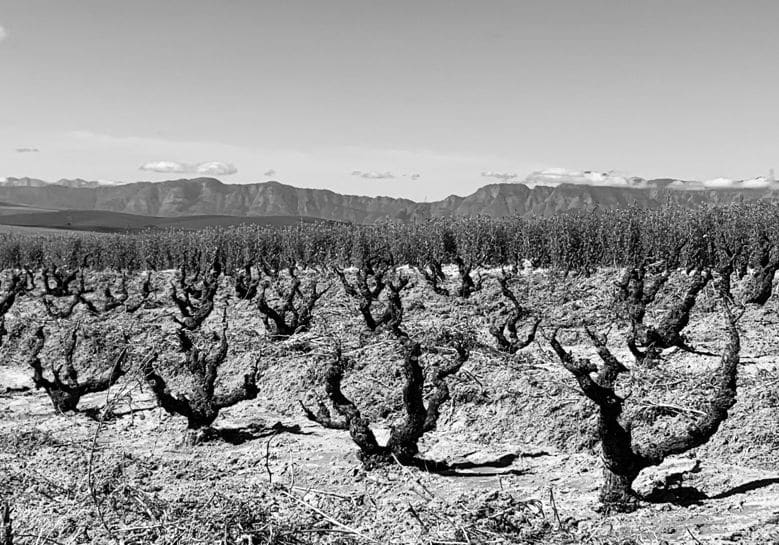
Great wine is made in the vineyard, they say – essentially claiming little more than that you need good grapes for good wine, and the better your grapes the better your wine (as long as you don’t stuff it all up in the winery). Fair enough, but there’s another, more radical way of looking at the idea, and Eben Sadie is doing just that, with the multi-varietal wines he makes. The Palladius and Columella blends make for the really complex, fascinating story – one that I think I have come to comprehend, but only recently. A report here, admittedly for the more geekishly inclined.
Let me start the exploration, though, with a few more explanatory words about the two field-blends that I spoke about a few weeks ago when reporting on the latest batch of new releases. Red Songvang and white Twiswind come from two mixed vineyards on the home farm, planted with 12 grapes each (white varieties in the one vineyard, red in the other, obviously). Inevitably they don’t all ripen perfectly at the same time (there does, in fact, seem to be a tendency for such mixed vineyards to start homogenising ripeness in the longer term). So Eben does two picks in each vineyard, about a week apart, averaging for the earlier- and later-ripening varieties. Then, with no selection except to discard poor quality individual berries, the grapes of the two vineyards will naturally ferment together in their own tanks, and, voilà, the two wines are born and start growing up, heading for the bottle.
As to those youngish vineyards, the plantings in both were informedly experimental. If any of the varieties planted perform somewhat disappointingly or unusefully over the years, they might well be replaced, and, in time, if interplanting is necessary tweaks could be made. The vineyards will evolve, but the concept of expressing the single mixed vineyard will remain: all the varieties unquestioningly accepted and cofermented. Any change to the blend will come from changes in the vineyard.
And so, mutatis mutandis, to the more complexly-treated blends of Palladius (15 varieties off 17 vineyards) and Columella (seven grapes, seven vineyards). I suggested before that they’re perhaps best thought of as field-blends too – with the Swartland serving as an enormous vineyard/tract of terroir to be expressed in all its aspects. A big difference though, is that each of the contributory vineyards is vinified separately. It would be hard to do otherwise but, says Eben, the practice means that the vineyard and how best to manage it can be continuously observed, from year to year (for example, he once came to realise that a particular block was being too heavily composted, with a resultant richness of soil that produced results in the wine that he didn’t want). “I realised”, Eben told me, “that you can’t study a system [that is, Swartland terroir], if you have too many exceptions”.
So, for a year the two sets of wines made from each vineyard mature individually. Then they are blended together according, approximately, to soil type; these going into large foudres for a year – to be further observed – before the final blending is done. I should perhaps say “mixing” rather than “blending”, for the traditional, standard idea of blending wines is for the judicious cellarmaster to sample all the candidate barrels and choose the ones that will make the best wine through quality or character or variety, or perhaps to best continue the established style of the wine. Frequently, as in Bordeaux, the varietal mix of the vineyard is there to allow for the strength of the different varieties in a particular vintage to shine (Cabernet didn’t uniformly ripen, perhaps, but merlot did, or the cab franc performed particularly attractively).
In the Sadie cellar, however, there is no such selection at blending time. There hadn’t even been selection in the vineyards – no picking on two or three different dates to allow for all the grapes to be picked at optimal ripeness; they must all be picked together on the date chosen (a crucial choice, of course). And in the cellar, as I say, no picking and choosing – once the vineyard is picked, its grapes are destined for the final blend and the bottle.
This is a pretty remarkable practice for wines of such ambition (and such reputation and price). Everything is thrown onto the quality of the viticulture, and the selection of vineyards, which of course involves a basic selection of varieties.
Eben has never thought of Columella and Palladius as anything other than works in progress. Over the years they will evolve – primarily through viticultural practice, not in the cellar. We can expect, I think, more vineyards to come into play, rather than any being abandoned while they produce good grapes. Eventually some will die, or need progressive radical interplanting – as is already happening. Some will be tweaked in various ways. Eben tells, for example, of an old chenin vineyard on the home farm that goes into Palladius. He would like more acidity from it, so he’s removing dying or dead vines, replacing them with colombard, clairette and picpoule.
Long ago Eben said to me that “building a great wine is not the work of one generation” – and great Swartland wine is what his ambition and all his efforts are directed towards. He has always serenely accepted that his continuing project will outlast him. More recently he put a slightly different angle on this, talking about what he learns from observing what his component vineyards are offering, year after year, in seasons of different character: “The study of a region”, he says, “is the work of generations”. Even more so in this time of climatic change. Making wine in the vineyard, as done in pre-industrial times, is the hard option.
- Tim James is one of South Africa’s leading wine commentators, contributing to various local and international wine publications. His book Wines of the New South Africa – Tradition and Revolution appeared in 2013.
-
Share:

Related articles
Opinion & Analysis
Tim James: Who really wins at wine auctions?
12 October 2026
The Strauss & Co wine auctions began in 2019, in good time to benefit, as is clear in retrospect, from the pandemic that was soon to hit us. The stated...
6
Opinion & Analysis
Tim James: Why do we drink? And why do I?
5 October 2026
We all drink alcohol, it’s surely fair to say (unless there are some teetotal voyeurs – liseurs? – readingthis; “we” being the readers, extended to “people generally”). But why? That’s...
Opinion & Analysis
Tim James: A visit to Callie Louw’s Sonkop
28 September 2026
Fans of Callie Louw – there are many, and I think “fan” is the right word – will be pleased to know that all is going well at his new...
GillesP | 4 August 2026
Thanks Tim once again for thos very educational reading on Eben’s wines.
A question: are all these varietals indigenous to the Swartland or does he brings some clones from elsewhere to plant or replant?
Tim James | 7 August 2026
There are no vinifera varieties indigenous to South Africa. A few, like some clones of chenin and semillon have significantly adapted. Most of the Sadie plantings are of Mediterranean varieties, indigenous to Spain, souther France, Italy and Greece.
GillesP | 7 August 2026
I realized after posting the word indigenous was indeed very silly of me. I think what i tried to convey was to try understand if Eben was a pioneer in the planting of these varietals in the Swartland to experiment with or if these varietals were already present for long time.