
Tim James: The latest Sadie releases
By Tim James, 22 July 2026
-
Share:





6
The Swartland has, like the ANC flag, three colours: In summer there’s the pervasive ochreous gold of the harvested wheatfields, in winter the brilliant green of growing cereals and lush cover crops around bare vines; and always the hills have patches of the renosterbos whose sombre darkness the early settlers, we surmise, named this part of the country for – when there was no wheat or vine to push it aside, and the newcomers had not yet shot all the zebra-like creatures for which they named the Paardeberg.
It was the Paardeberg I was driving towards, to taste the latest Sadie releases at the home-farm. And as a symbol of the expected and much-feared drought, there on the left was a huge green field of wheat being irrigated by one of those vast overhead systems of pipes and wheels and water. Irrigation, in the middle of the Cape winter! Drought is a looming threat to the grape-farmers too in this dryland area – though I’d been earlier in the week at the Mullineux’s Roundstone farm, where the dams are full, thanks to the run-off from the Kasteelberg mountains during the April downpour.
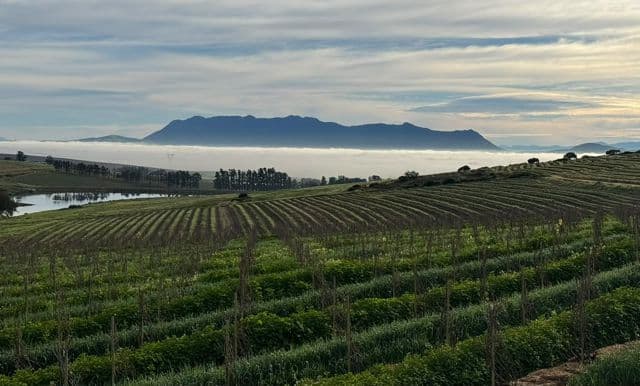
The Sadie dam is well short of full and, introducing the tasting, Eben spoke of what he called the current “groen droogte”, or green drought. But we were there to sample, mostly, wines from last year’s altogether benign harvest. For once, it seems, we can safely generalise about a vintage across the whole of the Cape: 2025 was great, and Eben spoke of how promisingly wonderful the grapes looked as they arrived at the cellar.
We started with the reds, as usual, and Eben warned that the first two were reduced (a complex matter, read this piece by Jamie Goode if you want to know more). It can produce some off-odours, sometimes paradoxically welcome ones, and Eben says that time in bottle will deal with the “problem” – even six months should help. All the more reason to not drink these or any of the wines early, though aeration via splashy decanting or vigorous swirling should serve.
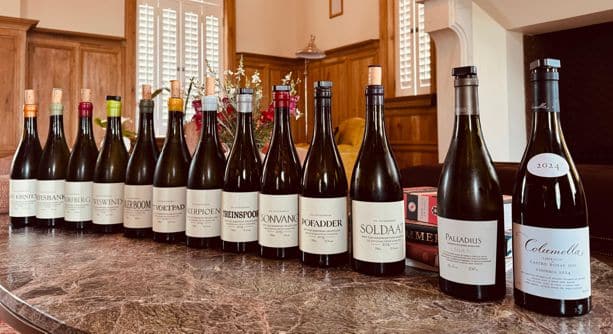
With Soldaat, the Piekenierskloof grenache, I thought the aromas were rather masked at first, but the characteristic red fruit (cherries, cranberries) came through with a lovely perfume. With more substance than the wine occasionally has, it seemed an excellent example: nervy and understated but not too light and certainly not austere; quite airy yet the flavours intense and lingering.
The aromas of Swartland cinsault Pofadder I found more difficult to penetrate, but there’s no doubt from the palate about how good the wine is and I’m sure the aromas will regain their glory. It’s richly textured, with a sweet charm at its core that’s also a succulent dry and complex fruitiness intertwined with tannins of great finesse. A joy to have in the mouth.
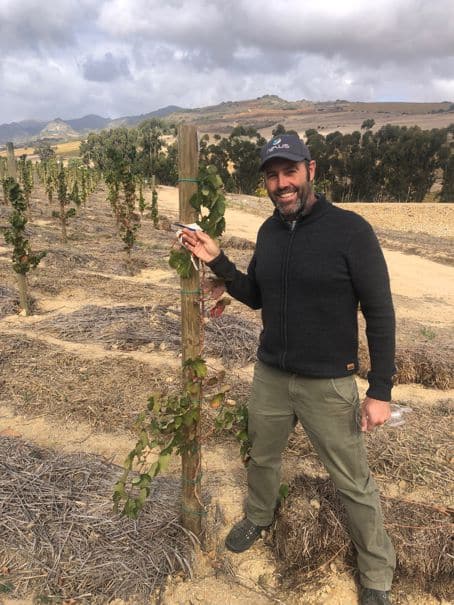
Eben Sadie in the young Sonvang vineyard.
The second vintage of Sonvang, the multi-varietal blend off home-farm youngish vines, is very pleasing too, a touch more “obvious” than the two wines just tasted, and with the feeling that something is being held back (waiting for more vine maturity perhaps?). Full-fruited with spicy and herbal overlay, a hint of youthful rawness and a firm tannic presence. Should benefit from a good few years in bottle.
Introducing Treinspoor, as always Eben argued his belief in the potential of tinta barocca to make great varietal wines, although this is inevitably the hardest sell in the range, he says. And, as always, I edge closer to being convinced, without quite arriving there. It’s intense, serious wine with big but sufficiently balanced tannins and persistent dark-fruit flavours. Balance yes, but seamless harmony no. This will come and the wine will undoubtedly age well and beneficially; tasting it in ten or 15 years will make one regret not having bought a case of the stuff.
The final red was Columella, from the rather more difficult year 2024. Difficulties, if any, have been surmounted, and the wine is presenting beautifully. Floral, syrah-suggestive perfume, not overstated, with dried herbal notes. Very complete and remarkably drinkable now, I fear, although I thought the tannic structure (steely but Swartland-characteristically melting around the fruit) more forward than it often is, though there’s plenty of flesh and presence.
And so to the excitement of the whites. Skerpioen as always showed the saltiness that the chalky soils on the edge of the sea up the Atlantic Coast produces, and a characteristic bright lemony acidity. But although it has finesse and focus, with a dry stoniness, there’s a lot of fruit-forward flavour – with chenin at this stage showing more than its equal partner palomino, I thought.
‘T Voetpad is always wonderful for me, and that’s only partly because I know the extraordinary, unique vineyard alone in its far corner of the Swartland. It’s rich and full, with ripe flavours, yet also restrained, the generous texture matched by a grippy structure. Altogether intense and profound, and well worth laying down.
Eben didn’t mention reduction on Kokerboom, but I thought there was some, light and even rather attractive “gunflint”. But there’s no denying the zesty lemon and lanolin of semillon (mostly white, some red), along with a sweet-fruited core that’s almost peachy in the midst of a stony minerality. As always, perhaps even more so here, a special wine from the magical (if rather scruffy) Skurfberg Citrusdal Mountains.
The Skurfberg connection was broken (so the chenins could be tasted together), by a return to the Rotsvas farm on the Paardeberg and the other field blend, Twiswind. Again, the argument with the wind was won by the vines – all dozen varieties of them, gathered in just two pickings, for the earlier and the later ripening. Pretty aromas I thought, with both apple fruit and apple blossom present. Grippy and firm, with some character, complexity and charm. Surely this is going to be a great vineyard.
The chenins then. Skurfberg shows a lot of sweet-fruited ripeness, with even a tropical edge of pineapple alongside the peach, at 14.5% alcohol – though Eben says that that is not an unusual level for this wine. The firm, grippy acidity holds it all together, however, and it’s fresh as well as textured, and the structure carries the fruit to a long finish. This should be as popular a wine as ever.
If the home farm has some great emerging fieldblends, it already has a truly splendid chenin vineyard. The 2025 is the fourth bottling of Rotsbank and probably the finest, which is claiming a lot. A stone-and-steel expression of chenin, pure and brilliant, superbly balanced, both elegant and gorgeous, really alive. Only Mev Kirsten could not be a disappointment after that wine, but this very different expression of chenin was as satisfactory as ever. An incredible intensity of sweet fruit in its lovely, refined elegance, though “intense” seems almost the wrong word for something as gracefully weightless as this. It reminded me, though I’d be hard put to explain the connection, of a German dry auslese riesling.
And to complete a remarkable concluding trio (which was for me the highlight of this truly impressive tasting) was Palladius 2024. Eben’s notes list 15 varieties for it, from 17 vineyards; made in clay pots, concrete tank and old wooded foudre. Could it be less than complex, to say the least? To mention lemon and peach (as my inadequate notes do) is just to make a start. Penetratingly intense, without losing refinement; lifted and light-feeling.
- Tim James is one of South Africa’s leading wine commentators, contributing to various local and international wine publications. His book Wines of the New South Africa – Tradition and Revolution appeared in 2013.
-
Share:

Related articles
Opinion & Analysis
Tim James: Who really wins at wine auctions?
12 October 2026
The Strauss & Co wine auctions began in 2019, in good time to benefit, as is clear in retrospect, from the pandemic that was soon to hit us. The stated...
6
Opinion & Analysis
Tim James: Why do we drink? And why do I?
5 October 2026
We all drink alcohol, it’s surely fair to say (unless there are some teetotal voyeurs – liseurs? – readingthis; “we” being the readers, extended to “people generally”). But why? That’s...
Opinion & Analysis
Tim James: A visit to Callie Louw’s Sonkop
28 September 2026
Fans of Callie Louw – there are many, and I think “fan” is the right word – will be pleased to know that all is going well at his new...
GillesP | 22 July 2026
Hello Tim. Thanks a lot for this report which is most insightful.
I would like to ask your opinion about one particular topic Do you think that a blending of 8 or more varietals as much as the end result in a tasting be pleaseant can actually reveal any specific personality in a wine expression? As we are mostly used to blend of 2 to 4 varietals, it seems like a very diluting exercise and find it quite challenging to sense the expression of what the wine style actually is supposed to represent.
Thoughts?
Tim James | 22 July 2026
That’s an interesting thought, Gilles. I would suggest the following in a brief response, as part of the answer. Essentially, I think you are over-stating the importance of varieties.
First. It’s easy to over-estimate the historical importance of varieties in many wine-growing parts of the world. After phylloxera in the late 19th century, the vine landscape became very different, and farmers became much more aware of what varieties they were planting, and often changed them radically, or concentrated on only a few. It was a new kind of control and management (perhaps better suited to modern capitalist agriculture). Most French vineyards had been field blends (even in the Côte d’Or, though there with a smaller range of varieties), and the nature of plantings now changed. You can still see the previous kind of situation in large parts of Portugal, where in many vineyards noone can be certain exactly what is planted. I’d guess the same might be true in parts of Eastern Europe – with large numbers of vines that few winelovers have even heard of.
Second. Fast forward to the rise of varietalism in marketing wine, which is essentially a 20th century phenomenon (with the American market being an important). A century ago, even keen winelovers wouldn’t have had the vaguest idea of what grape varieties they were drinking. Again, the lesson is that we mustn’t fetishize the importance of variety. Don’t forget about terroir!
With most of his wines, Eben is trying to express single vineyard terroir, most of them planted with one variety, some with two, ‘T Voetpad with more. With Columella and Palladius, which seem to have more varieties involved each year, his aim is to express the Swartland as a whole. But with his new field blends Sonvang and Twiswind, he is aiming to express those total vineyards in the wines. Would the vineyards be better expressed if they had only one or two varieties each? Which varieties should those be? If you consider those two questions, perhaps you’ll understand better what the aim of the wines is.
I think you’re looking for the wrong thing, perhaps.You’re wanting to find varietal expression rather than place/climate/etc expression. Nothing is “diluted”, I’d say. The “specific personality” is very definitely there – it’s just not to be found where you’re looking.
I hope this helps a bit. It might be worth it for me to think and find out a bit more and return to this undoubtedly fascinating matter. Thanks for raising it.
GillesP | 23 July 2026
Thanks for bringing your perspective on my question Tim. Much appreciated.
Gareth | 23 July 2026
Tim it sounds like all the wines are fantastic, except perhaps for the ‘young vine series’ whose vines need more time to establish.
Is this an accurate takeaway?
Tim James | 24 July 2026
Fantastic, yes. I hope I didn’t indicate anything less than enthusiasm for Sonvang and Twiswind. They’re very good wines – but as fieldblends undoubtedly lesser than the blends Columella and Palladius (taking the Swartland as a very big field!). I guess that one day those vineyards are going to get so adapted that they will ripen almost as one (two pickings each, now), and the vines will all be mature. If one didn’t think this means that these wines will be better in a decade and more, then Eben would be now wasting an enormous amount of viticultural skill and devotion. That’s the theory side; the structure now confirms there’s a little way to go, it seems to me. But I have bought Sonvang myself and only didn’t buy Twiswind because I have enough whites.
Dianne | 25 July 2026
No rave review and coming form Tim , says a lot.
Just curious , where is South Africas next push coming from ? Stellenbosch wines recently feel fresher , better priced and even cooler