
Tim James: Three cool Pinotages for a hot summer
By Tim James, 9 November 2026
-
Share:


I rather surprised myself last week, when writing about wine-grape crosses, by suggesting that pinotage is, both internationally and locally, an unusually successful one. I think it might be worth repeating as I don’t recall this competitive point being made last year, despite all the rah-rah about the centenary of Perold’s bringing together of cinsaut and pinot noir.
As with so many crossings, his aim was to unite the quality of the one grape with the high yield and vineyard strength of the other. But what was unusual was that in pinotage’s case it worked. I don’t want to exaggerate things, but the past decade or two have shown that Kanonkop’s earlier shining success with the grape while there was so much unsuccess (and sneering) all around was not a totally weird anomaly. We are still stuck with a lot of over-ambitious, over-ripe, over-oaked, big, too-tannic, and heavy wines. They do win some awards but not a whole lot of friends and admirers internationally and among more sophisticated locals. But there are now so many excellent examples of pinotage, so well made, in a range of styles from light hipsterness to long-lived grandeur that we can surely accept that the grape itself need no longer be called “controversial”.
And pinotage has been successful in the wine industry, and its place is surely secure. And that’s not true, as I suggested, of most crossings in the longer term. Certainly not in South Africa, and this suggests that pinotage’s achievement was not due only to the Afrikaner nationalist hype around it (that arguably did more harm than good, especially in the over-ambitious and inappropriate treatment given the wine). In terms of hopes for the cross, pinotage is inevitably not as great a grape as pinot noir, but I would be inclined to argue, based on the evidence, that it is a superior wine-grape to cinsaut: there are, surely, more excellent pinotages around than there are cinsauts (though there certainly are some of the latter) – but that would be fun to have an argument about.
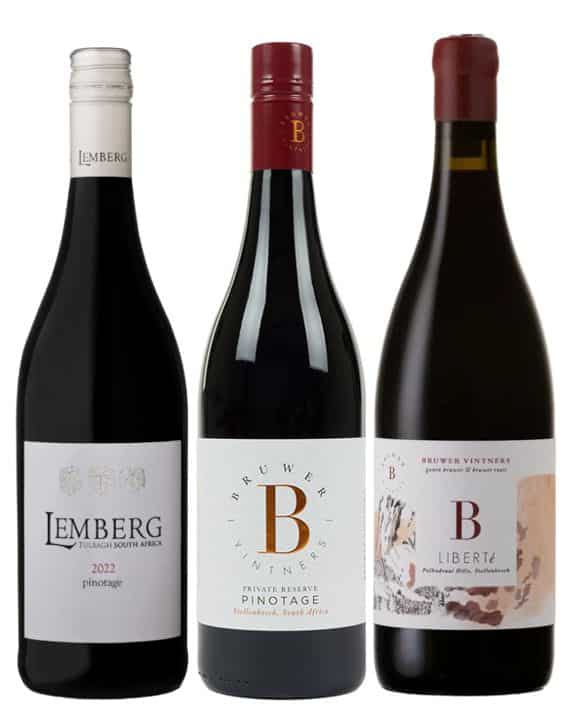
I was vaguely thinking about pinotage as I wandered into the small wine department at my local branch of Woolworths. And I was also vaguely noticing that the selection looked better and more interesting than it did a year or two back, when I remember thinking it had declined. Those two vague thoughts coalesced into something approaching focus when I noticed a big, familiar B on a label amongst the pinotages. I thought at first that it must be Bruwer Vintners Liberté, long one of my favourites. But I put on my glasses (which helps combat some aspects of vagueness) and saw it was indeed Bruwer Vintners, but a wine called Private Reserve Pinotage and at a comparatively modest price (R170).
So then I had to call in at my first-class local wine-shop, Constantia Wine and Craft, where I knew I’d find a bottle of Liberté for purposes of comparison; I did indeed, the 2022 at R446. And also snatched up, to have an outsider present, a bottle of Lemberg Pinotage 2022, appealingly priced at R100. It made for an enjoyable little tasting with my friend Wesley (who makes a pleasant modest pinotage himself, brandishing a Flying Pug on the label – but it seldom gets beyond the ambit of his own very active corkscrew).
All three proved to be in the more modern style of pinotage: fresh, without obvious oaking, stressing fruit charm, tannins far from overweening, the alcohol levels neither too low for vinosity nor too high for liveliness. Lemberg’s declaration of alcohol was the highest at 13.5%, but in fact it’s much closer to the 13% on the other labels. With a little perfume, red-fruited, light-feeling, a properly dry finish and an easy-going tannic grip, it is a delicious wine. No great intensity, but that’s part of its unpretentious good balance. Really excellent value, I think, and I’m pleased my hand lighted on it in the shop. It will do so again – more deliberately next time.
Bruwer Vintners Private Reserve has rather darker fruit, and a greater feeling of depth and fullness of flavour to it, supported by a slightly firmer tannic grip, and also blissfully dry. Altogether unsurprising to a long-time admirer of Liberté. From Stellenbosch vines, while Liberté is fimly rooted in Polkadraai Hills. Gavin Bruwer tells me that Woolworths, having done a wide-ranging tasting of pinotages, approached them to produce something in a more modern, lighter and fruit-driven style, as a tribute to the grape’s centenary. As one of great ambassadors of new-wave pinotage, he relished the opportunity. It’s a lovely wine and generously priced. Gavin says that there’s something of a promotion of the wine due, but even without it this is very good value. And, happily, it’s not a one-off: 2025 has also been made.
The only problem with moving on to Liberté 2022 is that it puts the Reserve in its place. You’re paying well for it (though not outrageously), so it should. A few years have added to its depth, complexity and refinement. There’s a bit more of everything here. More whole-bunch fruit has added to the perfume; there’s no overt concentration – that’s not what this wine is about – but there’s a completeness of fruit in balance with the refined but firm tannic structure and making for a graceful and compelling whole, long-lingering, understated in its seriousness. The wine was even better on the second day, especially the aromatic pleasure it gave – a sign that this wine should develop well for some years (longevity is something associated with pinotage, another aspect of its claims).
As the hot weather starts intruding, it’s worth remembering that all three of these wines can, perhaps should, be drunk fairly cool. Not cold (though Lemberg would be most suited to that), definitely not chilled. But if you’re having a bottle at some restaurant over lunch or on a warm evening, don’t be shy to ask for an ice-bucket to plonk the bottle in occasionally. In fact, generally, be reminded that many restaurants will want to serve their reds too warm, for the sake of their own ease. Don’t let them. And don’t forget your own fridge – sometimes you’ll forget to take the bottle out before it’s too cold, but it’ll warm up again only too quickly.
- Tim James is one of South Africa’s leading wine commentators, contributing to various local and international wine publications. His book Wines of the New South Africa – Tradition and Revolution appeared in 2013.
-
Share:

Related articles
Opinion & Analysis
Tim James: Travels and wine – a few irritations, some great bottles
26 October 2026
Something was needed, I thought, to jolt me from my rut. So I resolved on a rare foreign break, despite all the awfulness and anxiety (as it seemed from the...

3
Opinion & Analysis
Tim James: Who really wins at wine auctions?
12 October 2026
The Strauss & Co wine auctions began in 2019, in good time to benefit, as is clear in retrospect, from the pandemic that was soon to hit us. The stated...
6
Opinion & Analysis
Tim James: Why do we drink? And why do I?
5 October 2026
We all drink alcohol, it’s surely fair to say (unless there are some teetotal voyeurs – liseurs? – readingthis; “we” being the readers, extended to “people generally”). But why? That’s...
Comments
0 comment(s)
Please read our Comments Policy here.