Trizanne Barnard’s top-end range has undergone a packaging make-over, the labels generally featuring seascapes. “The vineyards I work with are all more or less close to the ocean and I wanted to reflect that,” she says. Tasting notes and ratings for the 2022s as follows:
Groendruif Skin Contact Semillon 2022
Price: R340
Alc: 11.16%. Left on the skins for two weeks before maturation lasting 11 months in barrel, 20% new. Multifaceted aromatics of potpourri, peach, citrus, green apple, dried herbs and hay while the palate has surprising weight given an alcohol of just 11.16% to go with big acidity and a saline finish. Unashamedly geeky.
CE’s rating: 92/100.
Sondagskloof White 2022
Price: R445
From Sauvignon Blanc, 50% given skin contact for approximately two weeks before maturation in new 500-litre French oak barrels, 50% fermented in older barrels. Extraordinarily complex aromatics of black currant, citrus, peach, kiwi fruit, floral perfume and fennel while the palate has dense fruit, snappy acidity, some pithy texture to the finish. A seamless wine with great flavour intensity. Alc: 12.5%.
CE’s rating: 96/100.
Benede-Duivenshokrivier Chardonnay 2022
Price: R445
50% whole-bunch fermentation and malolactic fermentation inhibited. Matured for 11 months in partly new barrels. Pear, peach, citrus and a hint of vanilla on the nose. The palate is light and fresh with a gently savoury finish. Delicate and poised. Alc: 11.83%.
CE’s rating: 92/100.
Hemel-en-Aarde Ridge Pinot Noir 2022
Price: R445
100% destemmed. Matured for 10 months in 300-litre barrels, 20% new. Strawberry, red cherry, a hint of musk and white pepper on the nose. Good fruit expression, moderate acidity and powdery tannins. Well balanced and immediately accessible. Alc: 13.64%.
CE’s rating: 91/100.
Elim Syrah 2022
Price: R340
100% destemmed, maturation lasting 11 months in partly new French oak barrels. Subtle aromatics of red and black berries, fynbos and pepper while the palate is lean with lemon-like acidity and silky tannins, the finish deeply savoury. Super-elegant, precise and stylish. Alc: 13.17%.
CE’s rating: 95/100.
 Hemel-en-Aarde Ridge Barbera 2022
Price: R445
Violets, red and black berries plus a hint of fresh herbs on the nose. Impressive fruit density matched by a great line of acidity and crunchy tannins. Pure and vivid, this is an arresting wine that will certainly not leave you indifferent – alcohol is 14.05% and TA is 7.6g/l! I love it…
CE’s rating: 96/100.
Check out our South African wine ratings database.
As is now well documented, heatwaves made the 2022 vintage challenging in Swartland and Olifants River, Eben Sadie saying that the resulting wines in the Old Vine Series (Ouwingerdreeks) are fruit forward and open, the tannins on the red wines softer and rounder than usual. Tasting notes and ratings as follows:
Skerpioen 2022
Price: R495
From a Swartland vineyard co-planted to Chenin Blanc and Palamino. Matured for 12 months in acacia and oak foudres. Top notes of hay and potpourri before pear and peach. Dense fruit matched by a good line of acidity, the finish pithy. Direct and surprisingly forceful – alcohol is 13.4%.
CE’s rating: 94/100. ‘T Voetpad 2022
Not generally available.
From a Swartland field blend of Chenin Blanc, Palomino, Semillon Blanc and Gris. Matured for 12 months in acacia and oak foudres. Haunting aromatics of pear, peach, citrus, flowers, hay and earth. The palate has lovely fruit purity but equally is not short of weight and texture, the finish possessing a slight but not unpleasant bitterness. Great focus and drive. Alc: 13.34%.
CE’s rating: 98/100.
Kokerboom 2022
Price: R495
From Citrusdal Mountain Semillon. Matured for 12 months in foudre. Fragrant aromatics of lime, blossom and fresh herbs. Great clarity of fruit, zippy acidity and a dry finish – lean and direct with great length. Alc: 12.8%.
CE’s rating: 95/100.
Skurfberg 2022
Price: R495
From Citrusdal Mountain Chenin Blanc. Matured for 12 months in big-format oak casks. Citrus and peach plus hints of potpourri and hay on the nose. The palate is dense with punchy acidity and a savoury finish. Alcohol is lower than usual at 13.08% and the wine currently comes across as a little incomplete and lacking in detail – time in bottle will be revealing.
CE’s rating: 93/100.
Rotsbank 2022
Price: R495
NEW. From Swartland Chenin Blanc – a Paardeberg vineyard approximately 40 years old. Matured for 12 months in foudre. A leesy note before citrus and peach. Rich, broad and pleasantly smooth textured – well integrated acidity with a gently savoury finish. Alc: 13.01%.
CE’s rating: 93/100.
Mev. Kirsten 2022
Price: R1 095
From Stellenbosch Chenin Blanc. Matured for 12 months in foudre and amphorae. Exotics aromatics of peach, apricot, orange, herbs and spice. Rich and round on the palate but also possessing no shortage of freshness, the finish long and dry. Lots of detail, well balanced and just immensely satisfying. Alc: 13.6%.
CE’s rating: 96/100.
Soldaat 2022
Price: R495
From Piekenierskloof Grenache. 60% whole-bunch fermentation. Matured for 12 months in concrete tanks. Pretty aromatics of red and black cherry, pomegranate, fynbos and white pepper. Lovely clarity of fruit, punchy acidity and powdery tannins – taut and poised. Alc: 13.18%.
CE’s rating: 95/100.
Pofadder 2022
Price: R495
From Swartland Cinsault. 50% whole-bunch fermentation. Matured for 12 months in foudre. Red cherry, plum, earth and some reduction on the nose while the palate has good fruit density offset by snappy acidity, the tannins fine and smooth. Alc: 13.5%.
CE’s rating: 94/100.
Treinspoor 2022
Price: R495
From Swartland Tinta Barocca. 50% whole-bunch fermentation. Matured for 12 months in foudre. The nose shows red and black berries, fynbos, earth and spice while the palate is relatively full and flavourful (alc: 13.25%) with fresh acidity and nicely grippy tannins, the finish savoury. Rustic in the best sense.
CE’s rating: 93/100.
Check out our South African wine ratings database.
The first observation to make about any wines from the 2021 vintage is that the world was amid Covid-19 lockdowns – in the lead-up to harvest, producers couldn’t travel on their usual international marketing trips and were compelled to spend more time in the vineyards…
Over and above that, Swartland was characterised by relatively moderate weather conditions and slow ripening – the infamous drought had broken even if the effects lingered. The Sadie Family Wines Signature Series wines from this year are profoundly good, tasting notes and ratings as follows:
Palladius 2021
Price: R1 000
A blend of Chenin Blanc, Grenache Blanc, Clairette Blanche, Viognier, Verdelho, Roussanne, Marsanne, Semillon Gris, Semillon Blanc & Palomino and Colombard from 17 separate vineyards. Matured for 12 months amphora and concrete before a further 12 months in foudres. Complex and almost inexpressible aromatics – white, green and yellow fruit, hay, fennel and other herbs and fynbos. Pure fruit, fresh acidity and nicely grippy on the finish – powerful but harmonious. Great structure in terms of the interplay between fleshiness, acidity and tannin. Serious and uncompromising.
CE’s rating: 97/100.
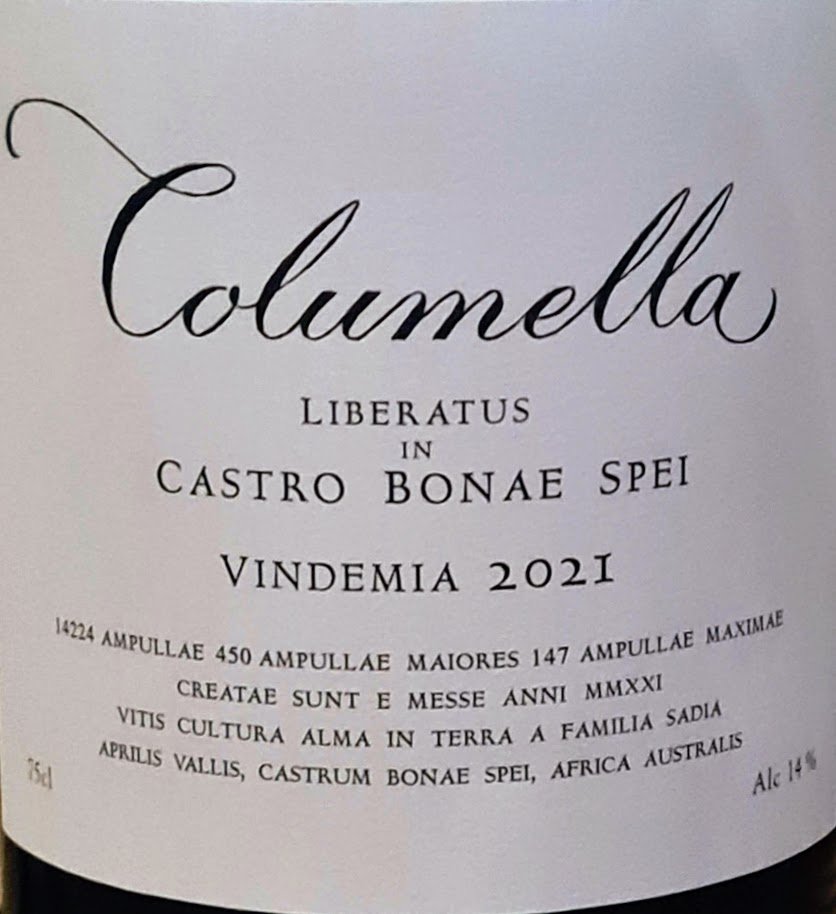 Columella 2021
Price: R1 095
A blend of Syrah, Mourvèdre, Grenache, Carignan, Cinsaut and Tinta Barocca from 10 separate vineyards. Maturation involves 12 months in barrel, 5% new before a further 12 months in foudres. Brooding aromatics of dark berries, fynbos, liquorice, earth and spice. Massive fruit concentration matched by fresh acidity and firm but not coarse tannins. Super-complex – layers and layers of flavour – plenty of power but also verve, an irresistible umami-quality to the finish.
CE’s rating: 98/100.
Check out our South African wine ratings database.
Wine is a complicated category with many thousands of wineries making tens of thousands of wines a year. Or is it hundreds of thousands? It’s a lot, whatever. The profusion of styles and quality levels is confusing even to experts, and add into the mix vintage variation, and the need for some sort of purchase guidance becomes acute.
At one level of the market, however, wine is more-or-less a commodity. Do you want red, white or rosé? You don’t want nasty wine, but these days the chief sin of most wines is that they are neutral or boring, and they are rarely nasty. Light red or heavy red? Bright fruity white, or richer and oaky? Do you want your wine dry or off-dry? Then we are sorted.
Customers might learn some brand names and then stick with a few favourites. In a restaurant they might go with the house wine. Or the second cheapest wine. It is only when someone has a bit more of an interest that they are likely to seek guidance from critics or competitions.
The modern era of wine criticism began in the 1980s with the emergence of Robert Parker. I remember buying his wine buyer’s guide in the early 1990s as I made my first faltering steps into wine appreciation. In those days, his ratings covered quite a spread of scores. Anything more than 90 was potentially pretty serious. He also appended each score with a letter indicating a price from cheap (A) to expensive (F), with FFF designating a super-pricey wine. And this is in an era where wine prices at the top end weren’t as bonkers as they are today.
An 86 A from Parker would be something worth picking up for me as someone on a budget. Remember, this is a time when, for example, Penfolds Bin 389 was £11.99 and Penfolds Grange was £35. For guidance, Grange is now retailing at £670 and Bin 389 is £71. And at that time Lindemans Bin 65 Chardonnay was £4.99, and today I can find it for £6 online. The rich have got richer.
The late 1990s saw the emergence of Parker competitors. First, the Wine Advocate (his publication) took on new reviewers to keep up with the expanding world of wine. The Wine Spectator, a major US magazine, had critics issuing their own ratings, and later one of its own, James Suckling, went out on his own. Independent critics emerged; Parker retired. Now there are a bunch of wine critic publications, and no single voice dominates in the way that Parker’s did.
Recently, though, we have seen point scores become less useful for one reason in particular: score escalation.
Back in Parker’s day, for anything interesting we were already dealing with a compressed scale of say 15 points, from 85-100. Now the range is even further narrowed. There’s a simple human reason for this: competition. Critics have become less focused solely on consumers, but now have an eye on each other and the trade. They provide something useful: third-party endorsement. Often, they have considerable tasting experience and have tasted broadly. So what they offer to producers is of use, so why shouldn’t producers pay towards their work?
Parker’s original model was to be fully independent from the trade, selling his verdicts to consumers through subscriptions to his newsletter. Wineries and retailers would in turn use positive ratings to sell wine.
But as the critic publications employed extra reviewers and costs went up, they began to look to make some money from wineries who were benefiting from their services. The wineries now often have to pay to use scores through pro subscriptions and buying stickers. And they also pay to show their wines at consumer and trade events run by the critic publications and magazines. The focus of the critics was initially consumers; now it is largely the trade who for some publications pay more than subscribing consumers do.
And the critic publications and magazines rating wine are now in fierce competition. They rely on wineries and retailers to cite their reviews as a form of marketing. They want to be the ones quoted on the shelf-talker, in the releases, or as the sticker on the bottle. I don’t doubt the integrity of any of the wine critics out there, but as humans our judgement can be swayed unconsciously by other factors, and the pressure to score more highly is subtle but pervasive. Scores have certainly risen in recent years across the board.
Has wine quality got better? Yes, but not to the extent, in my opinion, that could explain the rise in scores. It’s really getting a bit silly. Soon, serious wine will be scored on a 3-point scale: 98, 99 or 100!
I find this frustrating, because I score wine too. But if I were to use a properly useful scale, producers will be upset because they simply won’t understand an 88-point scale for a wine I liked very much. So I’m forced into the same silly elevated space where a sub-90-point score is akin to a critical pasting.
There are very few critical voices left, and almost no heretics. It would be refreshing to have proper wine criticism back. When I began drinking wine, the internet was just emerging. In the mid-1990s I started hanging out on wine bulletin boards, where there would be a mixture of novices like me, plus some collectors, plus some trade folk. The discussion was rich, but above all it was very honest. People with good knowledge were buying wines, and thus felt free to say what they really thought. They had incisive commentary which many wine journalists lacked. The journalists were generalists, were taking trips, were generally less critical. The collectors said what they really thought, and there were some properly contrarian views.
I’d like to see more of this from the critics. There’s currently a dull uniformity in many critical views brought about by the score escalation that has brought everyone into more-or-less the same range. The challenge is, of course, that if you are well known you have a responsibility not to damage someone’s business by a false negative review. If you pan a wine, and you’ve got it wrong, you can create an injustice. But on the other side of things, too many false positives – high ratings for mediocre wines – are going to make you useless as a critic. It is a big challenge.
The range of Pinotage styles is expanding. All of a sudden, lighter-bodied, New Wave examples stand in contrast to the more Old School wines of greater extraction and more obvious oak. Is this a case of two camps that are so different that they cannot exist alongside each other? Or is it time for a more nuanced look at the category?
“Punchdown schedules were a part of my life from a young age,” says seventh generation winemaker Bernhard Bredell of own-label Scions of Sinai, a range of minimal intervention wines. Though the family estate as it were is now lost in the wash of time, Bredell keeps his lineage alive by looking after heritage plots in the Helderberg, some of which his grandfather planted. Once Bredell was tall enough to be let into the winery (dangerous gases from fermentation hang low to the ground) he says the first fermentation he ever smelt was Pinotage.
“There’s a nostalgic connection: my mother was a florist – and the Pinotage filled the cellar with the scent of roses and other flowers. It always had some of the best aromatics in the winery.”

Bredell is addressing this story to the crowd gathered for the workshop at Ex Animo’s new tasting venue in the heart of Woodstock, Cape Town. The distribution comapny , run by former sommelier David Clarke, has one of the most enviable portfolios in the country. While Clarke has long slung Bredell’s wine, newer to the range is Abrie Beeslaar’s eponymous label, Beeslaar Wines. The project began in 2011 and produces a Pinotage from a single-vineyard site in the Simonsberg. He is also, of course, the famous winemaker of premium red wine specialist, Kanonkop (also in the Simonsberg) and has been for the last 22 years.
The workshop is part of a series Clarke started a couple of years ago. The first sessions consecutively on semillon and cabernet franc. “I want to dig into topics that don’t get explored very often,” he explains.
“Pinotage has a horrific reputation in the fine wine world,” says Clarke. “But it has so much potential, and is the first wine I have put my own name on.”
Clarke has made two collaborative Pinotages, which are served to lubricate the crowd. And, while they may sound like the mastheads of a lawyer firm, both wines – Rossouw, Gouws & Clarke Pinotage Pinotage 2022 (Swartland), and the Bredell, Bredell & Clarke Pinotage 2019 (Stellenbosch) are on the fresher, lighter side of the variety, heroing the red-berried fruit of its parents (pinot and cinsault).
Smelling roses, or rusty nails?
Following Cabernet Sauvignon and Shiraz, Pinotage is South Africa’s third most planted red grape (and sixth overall). There are now 6520 hectares, comprising approximately eight per cent of the national vineyard.
Comparatively to Sauvignon Blanc which dates back to the Middle Ages, Pinotage is a fledging grape, it’s barely begun to crawl. While it was seeded in 1925, Pinotage has only really been commercially produced since 1959. That’s just 64 years. And, because of this there are currently only five clones available, compared to pinot’s 1000. With more clonal diversity, one can only assume quality will continue to rise too.
The first time the name ‘Pinotage’ was officially used on a label was the 1959 Lanzerac, released in 1961, from a vineyard planted in 1953 on Bellevue Estate (Bottelary, Stellenbosch). The wine went on to receive the General Smuts Trophy as the overall SA Champion Young Wine of that year. It was off to a good start. Paul Sauer, late patriarch of Kanonkop, was said to have planted it quite prolifically, too.
Then, infamously a group of British MWs visited in the ‘70s. The reports on Pinotage were damning: ‘rusty nails’ and ‘rubber’ being the preferred descriptors for the wines they tried.
“It was a reputational blow from which Pinotage has never fully recovered,” says Beeslaar. “We don’t know what rusty nails taste like…” he says tongue firmly in cheek. “We needed the guys to come and tell us.”
Thanks to the soon global notoriety, plantings quickly dwindled. In 1979 there were only 66 639 vines left standing.
“Pinotage is on its way back now,” Beeslaar asserts. “There is a broader range of styles being produced, and that can only be good.”
Known for being difficult in both the vineyard and the cellar, Beeslaar with over two decades of working with the grape says: “I liked the challenge of the variety.”
The panel discuss the difficulties and rattle off a list: high pH, high nutritional levels (food for microbes that can attack the wine), high amino acid levels, high malic acids (so there can be a quite robust malolactic conversion), and it undergoes a very fast fermentation. “You need to macerate at the right time otherwise you get a wine that is over-xtracted and harsh on the palate,” says Beeslaar. “When you taste a wine like that, it doesn’t mean the grapes weren’t good. It just means it was made in the wrong way.
He presses the point: “To get Pinotage stable, you need to know what you’re doing.”
Site matters
“So far we’ve only been talking about the grape – and not about where it’s planted,” jumps in Bredell. “We’re quick to blame Pinotage as a variety. That’s pretty unjust. We don’t do this to pinot noir when it doesn’t do well in South Africa, but rather blame the climate and where it’s planted.
“Maybe the pH isn’t the problem? What about bushvine versus training on trellis; the best quality Pinotage grapes come from bushvine, it really helps to balance the variety. What about the soils or distance from the ocean?”
He has a point, Pinotage is naturally a lush grower and when planted on fertile soils, high big-berried yields and problematic shading of the grapes can be exacerbated. Bushvines deliver smaller berries and good sun interception for ripening. The air movement through the canopies also cools down the fruit, and helps with disease pressure. Bushvines have better longevity too, as you avoid the pruning wounds from trellising methods.
“When we start adding these things up, the answer doesn’t seem as simple as it is a ‘difficult grape’,” says Bredell impassioned.
“It can be so receptive to its environment. So yes, in order to express this I don’t overwork it, or wait too long to pick it.”
Proof of its potential to speak of site are Bredell’s two Pinotages we’re tasting. The Féniks (2022) comes from an old vine parcel planted in 1976; elevage was partial de-stemming and old French oak. The Atlantikas (2022) as a point of difference is 100 per cent whole bunch and unoaked.
Beeslaar picking up a glass of the Beeslaar Pinotage 2021 to the light says: “When you look at our wines side by side like this, of course one seems heavier and one lighter. But they both have length, density and tension. That’s quality.
When considering the differences between oaking for the brands, Abrie says: “If your wine can handle new oak, it does add value. Look at some of the great wines of the world. There’s a reason for barrels,” he says laughing.
The numbers are convincing for both brands. “With Kanonkop we can’t supply enough,” says Beeslaar. His own-label is likewise following in this success. Bredell currently exports almost 80 per cent of his production, the rest sold locally.
Beeslaar and Bredell agree that an integral route to global markets is through restaurants and sommeliers, calling Pinotage a ‘gastronomy wine’ with its red fruited-profile and generally amiable tannin structure.
Both climbing local and export sales for these divergent brands are evidence of a maturing market when it comes to accepting different styles of Pinotage. Doesn’t chardonnay for example wax from steely and unwooded all across the spectrum to rich, buttery and oaky?
“It’s just a style difference,” shrugs Bredell on the new wave versus traditional Pinotage debate. “It’s not sport, you don’t have to choose a team.”
“Can we see what makes the site unique or does winemaking dominate?” was the question posed by Vergelegen winemaker Luke O’Cuinneagain before a recent blind tasting that included Verglegen GVB 2005 as well as the five Bordeaux First Growths of that vintage among others.
Presuming that it is possible to taste regional identity in wine even if you’ve never experienced those wines before is a classic case of privileging definitions and first principles. The conventional wisdom is that with enough education, wine drinkers can become at first basically and then gradually more qualified in wine appreciation.
Research climate, soil types and winemaking methodology and you will have a foundation to appreciate the wines better. Attend wine tasting events. Seek expert guidance. Follow all these steps and the absolute truth of wine will eventually reveal itself.
In the case of Helderberg versus Bordeaux mentioned above, it turned out that the wines disclosed their identities paradoxically because site facilitated a particular approach to winemaking – the producers of the First Growths were so confident in the depth of fruit available to them that their approach to oaking was entirely uninhibited.
More generally, however, I think we must allow that taste is not just a sensory experience but a portal to the metaphysical identity of a region. The essence of wine goes beyond soil and climate and includes the history and culture of the place it originates from.
Most winemakers will insist that vineyard is far more important than any intervention in the cellar but very often the various regions, districts and wards embue their respective wine with an intangible and distinctive aura.
Stellenbosch exudes a sense of luxury and high-end reliability. It’s where Cabernet Sauvignon reigns supreme and facilities are grand – think Kanonkop, Delaire Graff and Tokara. The Swartland is the obvious counterpoint to this, possessing far less a sense of tradition, it’s rise to prominence much shorter, but it’s credentials as a source of excellence now well established, Chenin Blanc and Syrah the champion varieties. It has up until now been all about trucker caps, flannel shirts and working out of converted barns. Sadie, Mullineux and AA Badenhorst have shown the way… Then, of course, there’s Little Burgundy or the three wards of Hemel-en-Aarde where Chardonnay and Pinot Noir producers benefit from the seemingly insatiable demand for these varieties from the well-heeled. Hamilton Russell and Newton Johnson are prominent practitioners plus more recent market entrants such as Creation, Crystallum and Storm.

I was again reminded by the sociological underpinnings of wine on a recent visit to The South Coasters. Paul Hoogwerf and Doug Mylrea of Maanschijn are fervent advocates of the greater Walker Bay area, sourcing grapes variously from Bot River, Hemel-en-Aarde, Stanford and Sondagskloof. Their Herbarium White and Red have intrigued for a few vintages and the time had come to view their cellar situated on the banks of Klein River between Hermanus and Stanford. Their 2022s are again worth seeking out – see review here.
Also in attendance were: Stu Botma of Kindred Coast Wines; PJ Geyer of Thamnus Wines, the Overberg property previously known as Broad Valley; Chris Keet Jnr, viticulturist at Gabriëlskloof in Bot River and who makes wine under his Weather Report label; Wade Sander of Sondagskloof family-owned property Brunia; Jessica Saurwein who make a Riesling from Elgin plus two examples of Pinot Noir, one from Hemel-en-Aarde Ridge and the other from Elandskloof; Mark Stephens, regenerative farming consultant and owner of the Deep Rooted Wines label; and Natasha Williams who was recently appointed as winemaker at Hasher Family Vineyards in Upper Hemel-en-Aarde but also has her own label called Lelie van Saron.
A rather loose affiliation in terms of geography or any signature grape variety but more closely united in terms of aesthetic, the wines on show generally possessing a particular elegance – fruit concentration but not at the expense of freshness. Philosophically, also, there was a sense of a group of youngsters not wanting to be swayed by peer pressure or too inclined to slipstream their more established colleagues. Are we anywhere near being able to recognise a definitive regional identity in these wines? Probably not but is the wine world better off for this bunch of free-thinking new winemakers? Most definitely.
Paul Hoogwerf and Doug Mylrea launched their Maanschijn label in 2016, the wines initially quite offbeat but more and more sophisticated as time has gone by. They operate out of a small cellar on the Klein River lagoon between Hermanus and Stanford and source from across Walker Bay, convinced that this district gives them vital point of difference in the market place. Tasting notes and ratings for the 2022s as follows:
Maanschijn Herbarium White 2022
Price: R250
40% Sauvignon Blanc, 30% Chenin Blanc, 20% Semillon and 10% Chardonnay sourced from across Walker Bay. Matured for 10 months in older oak. Intriguing aromatics of stone fruit, naartjie, kiwi plus spice and some nutty, yeasty notes. The palate is initially smooth textured but there is some pithy bite to the finish. Medium bodied with well-integrated acidity, this is again a wine with plenty of interest. Alc: 13.5%.
CE’s rating: 92/100.
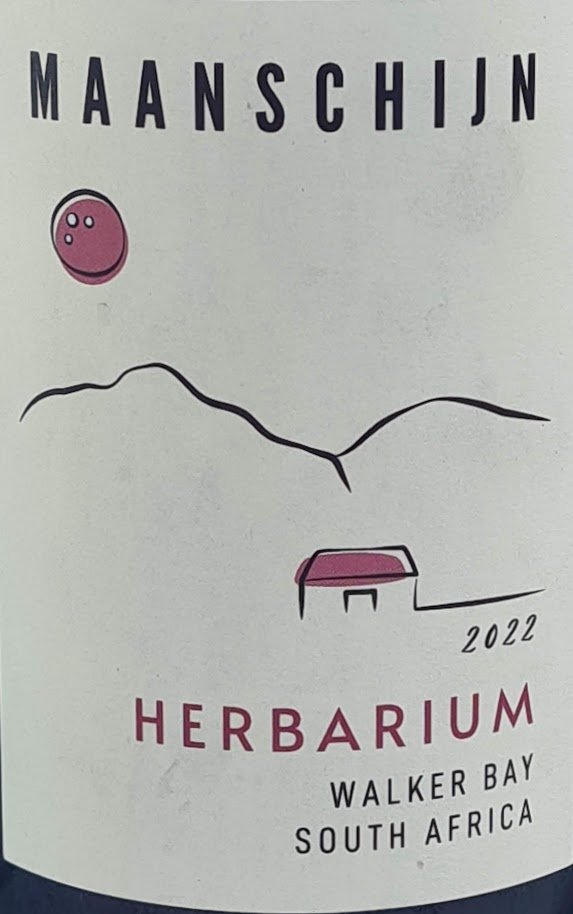 Maanschijn Herbarium Red 2022
Price: R250
42% Pinotage, 38% Syrah and 20% Mourvèdre again from across the district. Picking date nudged out to ensure a little more substance and flavour (alcohol is 13.5%) while whole-bunch fermentation was reduced to 25% compared to 50% in 2021 and 75% in 2020. Compelling aromatics of red and black beries, intense fynbos, lilies, cured meat and white pepper. The palate is poised and flavourful – pure fruit, bright acidity and crunchy tannins, the finish deeply savoury. A wine of impressive structure but also provides no shortage of pleasure.
CE’s rating: 95/100.
Check out our South African wine ratings database.

98/100.
Here are our ten most highly rated wines of last month:
Rall Ava Syrah 2022 – 98/100 (read the original review here)
Rall White 2022 – 97/100 (read the original review here)
Boplaas Cape Vintage Reserve Port 2006 – 96/100 (read the original review here)
Bruwer Vintners Liberté Pinotage 2021 – 96/100 (read the original review here)
Carinus Family Vineyards Polkadraai Heuwels Chenin Blanc 2022 – 96/100 (read the original review here)
City on a Hill Sky Chenin Blanc 2022 – 96/100 (read the original review here)
David & Nadia Plat’bos Chenin Blanc 2022 – 96/100 (read the original review here)
David & Nadia Skaliekop Chenin Blanc 2022 – 96/100 (read the original review here)
Kanonkop Cabernet Sauvignon 2019 – 96/100 (read the original review here)
Rall Syrah 2022 – 96/100 (read the original review here)
The Single Vineyard wines from David and Nadia Sadie are categorically driven by acidity rather than fruit power with the result that they are less immediate than some of the corresponding wines from other producers.
David Sadie is uncompromising about this. “Ageability of our wines is a core focus. We aim for that wines are tight and austere when young knowing that time in bottle will be beneficial – this is especially relevant in warmer vintages like 2022”, he says. Tasting notes and ratings as follows:
Rondevlei Chenin Blanc 2022
Price: R900
Grapes from a 1984 vineyard on iron-rich gravel situated in one of the more arid parts of the Swartland. Citrus, hay, some nuttiness and waxy character on the nose. The palate is relatively broad and textured even though alcohol is just 12.5%. With dense fruit and a gently savoury finish, it’s an accomplished wine but that little bit flatter than the maiden 2021.
CE’s rating: 94/100.
Hoë-Steen Chenin Blanc 2022
Price: R900
Grapes from a 1968 vineyard planted on deep iron-rich clay. A hint of reduction before citrus and a herbal note on the nose. The palate shows impressive fruit concentration and snappy acidity. Good focus and balance, layers of flavour, the finish long – a striking wine, the challenges of the vintage well met. Alcohol: 12.5%.
CE’s rating: 95/100.
Skaliekop Chenin Blanc 2022
Price: R900
Grapes from a 1985 vineyard on shallow shale. Pear, peach, citrus and potpourri on the nose while the palate has dense fruit and moderate acidity before a pithy finish. Super-detailed, poised, the finish possessing great length. Alcohol: 12.5%.
CE’s rating: 96/100.
 Plat’bos Chenin Blanc 2022
Price: R900
Grapes from a 1981 vineyard on granite. Some flinty reduction precedes pear, peach and citrus on the nose while the palate is linear and direct – somewhat neutral in terms of flavour but it has great elegance and energy. Focused and propulsive, very much true to the Sadie philosophy. Alc: 12%.
CE’s rating: 96/100.
Check out our South African wine ratings database.
There were six wines in the 280 boxed sets of Sadie Family Wines’ Ouwingerdreeks 2009, with labels featuring drawings especially made by William Kentridge. Not six standard bottles, as one was a half-bottle of a sweet muscat called Eselshoek (from the same vineyard that supplied ’T Voetpad), which soon disappeared from the range to no-one’s real lamentation. Incidentally, that might make for a good wine trivia question, along with one about the first vintage of a Sadie wine called Palladius (a one-off 2000 red; even shorter-lived). Another wine trivia question of admittedly less import could ask who designed those initial Kentridge labels – the answer (probably never mentioned in print before) is, strangely enough, me.
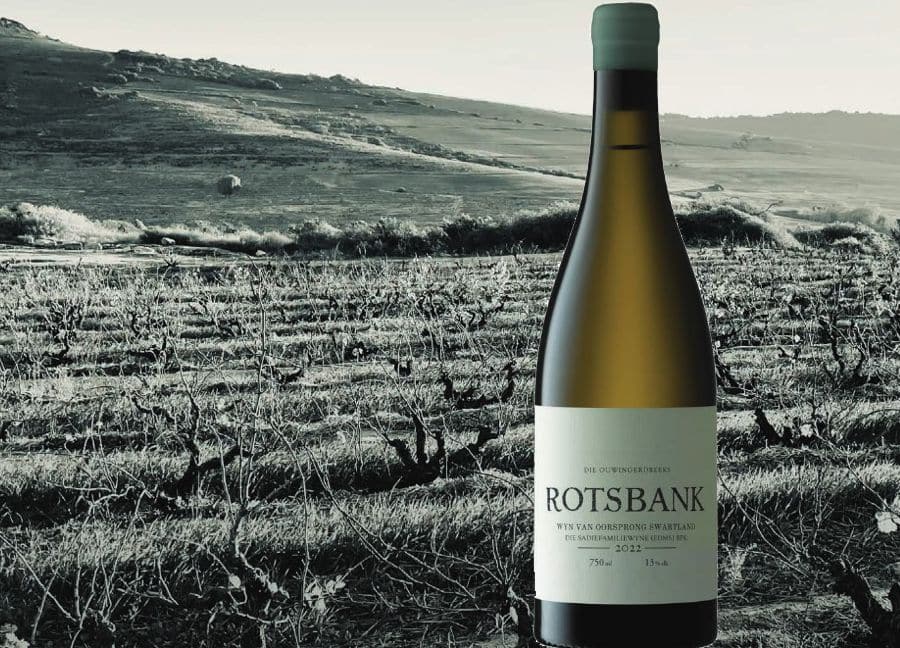
The number of Old Vineyard Series wines soon swelled, despite the early deletion of Eselshoek, with the addition of Treinspoor, Soldaat and Skerpioen. But it took more than another decade, until now, for another wine to join the range – rather ironically, the first Swartland chenin blanc. It’s called Rotsbank, the name linking nicely to that of the Sadie farm on the Paardeberg, Rotsvas, where the vineyard is. This is, in fact, the first Sadie Family wine from a Sadie-owned vineyard, which is pretty significant in itself. (See here for my account of the farm’s enlargement and acquisition of the vineyard.)
Rotsbank Chenin Blanc 2022 is being released about now, along with the other Ouwingerdreeks 2022s and the 2021 Columella and Palladius. I’d tasted it from cement last year, but it was good to have it in bottle at a small trade tasting held on the farm recently (I wrote expansively about the ’T Voetpad 2022 last week, here.) So there are now three chenins in the range, and the good news is that they are not only all good, but really distinct – something that doesn’t always apply when producers offer more than one chenin.
The 2022 vintage was a difficult one, especially in hot areas for varieties that didn’t escape the heat spikes that significantly cut acid levels. Most producers who generally avoid adding acid will have been more or less obliged to have done so last year, even if they are reluctant to admit it (Eben and winemaker Paul Jordaan speak of a tiny degree of acidification in a few instances). In fact, the serious 2022 Swartland whites I’ve tasted so far have nearly all been great, only very few rendered a bit softly flat – probably because no acid adjustment was made.
For the Ouwingerdreeks wines it was a “dry and desolate” vintage, says Eben, one that, at least partly because of some earlier picking, resulted in generally the lowest-ever levels of alcohol across the range. All are between 13% (Skurfberg and Rotsbank) and 13.6% alcohol (Mev. Kirsten). Eben argues that “great sites have wider windows of expression capacities”, but gave particular praise to the work of his viticulturist Morné Steyn and the team he’s built up. Certainly all these wines – while many of them show a particularly early drinkability – are all well balanced, sufficiently ripely fruited, and of excellent quality; wines of elegance and finesse. Curiously, there is a general tendency to citrus notes, and to a slight phenolic expression, even amongst the whites. Whether it will be a particularly long-lived vintage I can’t say; I’d guess possibly not, but we don’t have enough experience to make a reliable call.
As to those chenins. Skurfberg has a core of lovely full, sweet ripe fruit (peach, pear, apple etc) in its citrusy shell and tannic hint. Persistent and elegant. Rotsbank – meaning “rock shelf’ and so called for the rock beneath the very shallow soil, with cracks into which many roots have apparently penetrated – is less obviously about fruit. The lingering sweet fruit essence is there, but a herbal, scrubby note is more apparent, with a flinty-earthy character, and there’s plenty of grip and a bright vitality. A fantastic and welcome addition to the range. And Mev. Kirsten… I confess I might have decided in advance that this would be perhaps my favourite white of the tasting as usual, and it did seem to me quite magical: great purity or aroma and flavour, with an intensity and volume that comes across as near-weightless – refined, precise, delicate, tense.
‘T Voetpad 2022 I wrote about before. Skerpioen, the West Coast blend of chenin and palomino off chalky soil, perhaps lacks the bite it sometimes shows, but is succulent and stonily grippy. Ripe pineapple notes along with citrus, all in balance and very satisfying. Kokerboom is more angular, perhaps, tightly tannic and seeming particularly youthful. Plenty of semillon lanolin, with the lemony citrus shading into a riper tangerine on the finish.
The three reds are particularly attractive this year. I didn’t much care for the hipsterish lightness of the previous Soldaat (Piekenierskloof grenache), but the rather darker-coloured 2022 is wonderfully delicious, and it was hard to resist swallowing all of my tasting portion. As I recall, I didn’t succeed. It’s extraordinarily perfumed, light and energetic, with depth and length, the tannins soft but firm enough. Pofadder continues to be one of the best arguments that cinsault can make serious wines outside being a great contributor to blends. Though less complex than Soldaat, it has depth and structure and a bright acidity. Still a bit raw, it seemed to me, needing time to attain the remarkable drinkability of Soldaat. Treinspoor, with more perfume than usual, continues on its lighter, more elegant trajectory, still with tinta barocca’s big tannins but these in more muted form nowadays – lovely tannins they are, in fact, I must admit. “Tinta is ’n ding”, says Eben, and probably he’s right to push the grape’s claims as he does. Though less harmonious than the other reds, in youth at least, it is arguably more profound, characterful and ageworthy.
I realise I do look forward to another addition to the Ouwingerdreeks: pinotage, if Eben could find a suitable vineyard, would be great. Incidentally, along with alcohols and acidities being mostly down across the range, volumes are also down. Prices are not, though they remain very much lower than they could be – hence the fairly short supply of many of wines.
Also released around now are the 2021 vintages of Columella and Palladius. I sometimes guiltily feel that these are such approaches to perfection and, as widely-sourced blends, much less susceptible to vintage vagaries, that they are that bit less exciting to encounter for the first time than the more changeable wines from (mostly) single vineyards. Palladius is now from 11 varieties and 17 vineyards, so there’s lots of room to play and achieve the complex intensity that makes it hard for me to write any notes approaching adequacy. Lamely, I will say that it’s tight, focused, stony and altogether magisterial and splendid.
Columella is less obviously perfumed than the Ouwingerdreeks reds, but more obviously complex – spicy, fruity, savoury – with an extraordinarily subtle power. A bit wild, a bit tamed. Gorgeous texture. All of the six varieties off ten vineyards and many soil types pull together; all is in fine balance, but greater, profounder harmony will come. No, after all, this wine is in no way less exciting; it’s perhaps the most exciting of all.
Subscribers receive daily reviews and in-depth reports before release to the public. Cancel any time.
