
Greg Sherwood MW: Can being an unknown wine region be an advantage?
By Greg Sherwood, 21 October 2026
-
Share:


If I mentioned the French wine region Duché d’Uzès (pronounce dooshay dooz) to any number of seasoned wine trade professionals globally, I am willing to wager a sizable sum that most, if not all, would never have heard of the appellation, and all would certainly have absolutely no idea where it lay on a map of France.
So, when I was invited on a press trip to this unknown appellation, I went straight to my bookshelf and pulled a copy of the Oxford Companion to Wine to explore further. As it turns out, it lies close to several not so obscure wine regions of France, including the wider Rhône Valley and the Languedoc.
Quietly tucked away into the northern reaches of the Gard department, between Nîmes, Avignon and the Cévennes foothills, the Duché d’Uzès appellation is one of France’s quieter wine secrets. Indeed, so quiet that in all my years of travelling in the Southern Rhône and the Languedoc Roussillon on buying trips, I had never once come across this little wine region over the past 30 years!
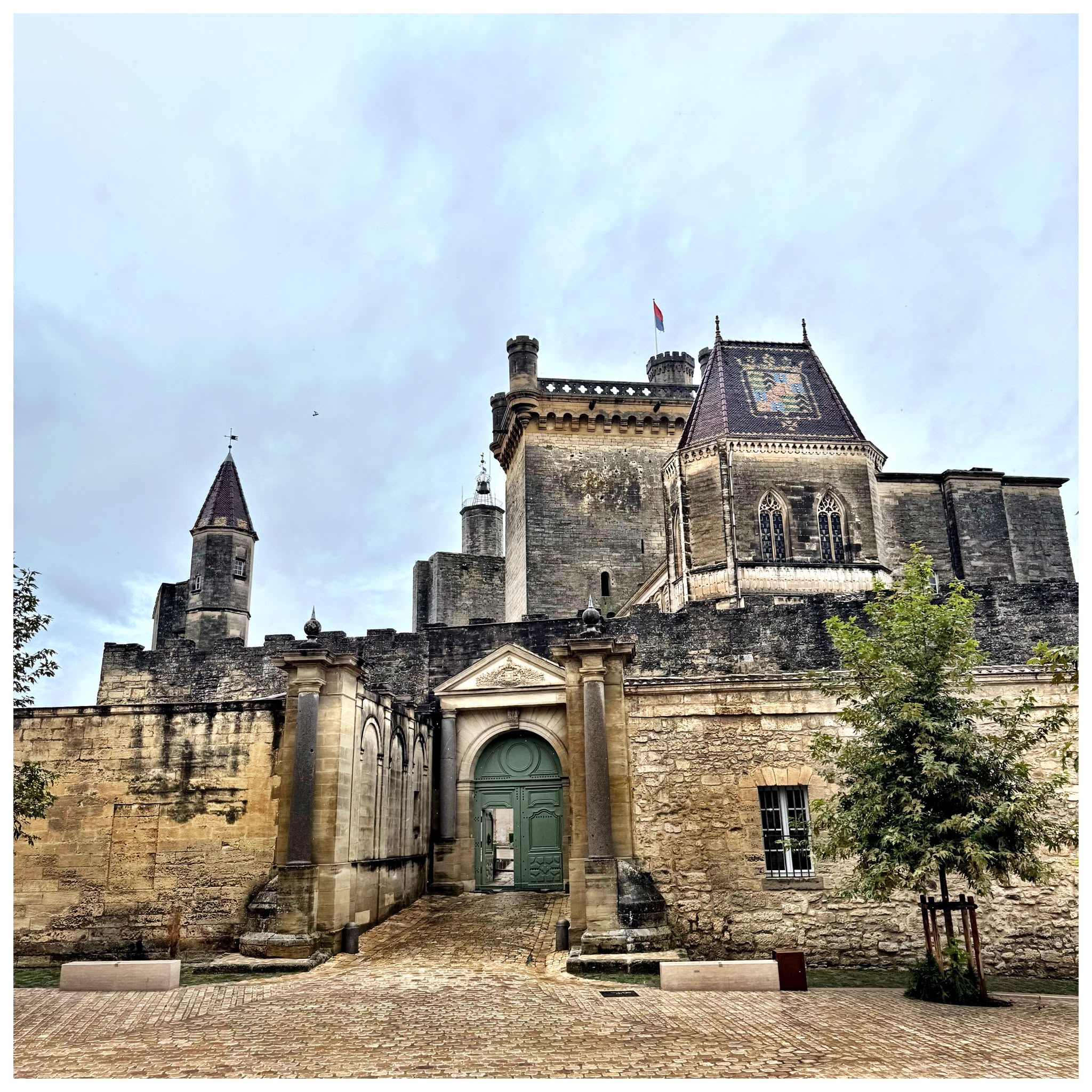
The region takes its name from Uzès, a honey-stoned market town village that interestingly held the title of France’s first duchy, created in 1565. Its ducal family still lives in the château that dominates the centre of the old town, and when we visited Uzès, the flag of the current fifty-something year old duke was flying above the castle indicating that he was in residence.
Few wine drinkers outside the region have heard of it probably because the appellation was only granted AOC (now called AOP or appellation d’origin protégé) status as recently as 2013, and it remains a tiny wine hamlet beside its more famous neighbours.
To the east, the famous Rhône Valley commands international attention with the famous names of Châteauneuf-du-Pape, Vacqueras, Gigondas and Rasteau. To the south and west, the broader Languedoc region dominates most wine conversations about value and innovation. Duché d’Uzès sits between them, often overlooked by visitors who come to visit the nearby Pont du Gard aqueduct or the lavender-scented lanes of nearby Provence.
It seems that obscurity is part of its appeal. Production is still small, with only 285 recognized AOP designated hectares of vines scattered across roughly twenty villages, with most bottles never leaving France. The terroir is fabulously distinctive: limestone and clay soils, garrigue scrubland, and vineyards planted at moderate altitudes, where cooler nights and the drying Mistral winds preserve freshness in the grapes.
The wines reflect their Rhône and Mediterranean heritage, reds built around Syrah, Grenache, Carignan, Cinsault and Mourvèdre, offering spice, dark fruits and a herbal, sun-warmed character. Whites, made from grapes such as Viognier, Grenache Blanc, Roussanne, Marsanne and Vermentino (Rolle), are aromatic and textured, with a saline lift. Dry Rosés round out most producers’ ranges, made from mostly 50/50 Grenache and Syrah grapes.
Many estates are family-run, often farming organically. For curious travelers and adventurous wine drinkers, Duché d’Uzès seems to offer something increasingly rare nowadays, namely authentic, characterful wines at modest prices, from a corner of Southern France still waiting to be discovered by the mainstream wine trade.
During my many numerous tastings with local Duché d’Uzès producers, I couldn’t help but compare their appellation’s obscurity with the relative hometown anonymity of Western Cape wine regions and wards such as Koekenaap, Slanghoek, Malgas, Bot Rivier, Baardskeerderbos and Piketberg. Similarly, fairly illustrious wine regions in the Cape producing some deliciously innovative wine styles. Nevertheless, most knowledgeable wine trade professionals across the UK, Europe or the USA would draw a blank if asked to recognise and pinpoint most of these wine localities.
Over dinner on one of the tasting evenings, it prompted a question from a Duché d’Uzès producer as to how I thought they should go about marketing their region to consumers in the UK? Or was that simply a very expensive marketing battle that was not worth fighting?
Somewhat paradoxically, I pointed out that in many ways, promoting a completely obscure region like Duché d’Uzès might in fact be an easier proposition than trying to convince young Gen Z’ers to drink Bordeaux. For many of them, these are the wines of their parents or grandparents and represent an abstract and somewhat old fashioned wine category that they would sooner avoid… that’s even presuming they could afford to buy the wines in the first place.
Unknown can mean novelty. Obscurity can equal a cool new wine discovery. After all, we are not talking about wines made from strange esoteric cultivars like those offered from Georgia, Turkey or Croatia. We are firmly in the realms of easily identifiable premium varietals such as Syrah, Grenache, Viognier and Cinsault.
With only circa 10% of the Duché d’Uzès wines exported, opening up new markets might seem like a lot of unnecessarily hard and expensive work when most of the wines can be sold locally cellar door or further afield around France. But home market sales are always vulnerable and with falling French consumption, especially for red wines, it’s always good to have a Plan B.
With many Duché d’Uzès producers pivoting towards dry white wines and Rosé styles, it makes sense to try and promote their succulent sun-kissed reds to a wider European audience. Similarly, the idea that South Africa’s local hotshot winemakers should take the easy path of least resistance and only sell their more obscure regional wines locally at home makes absolutely no commercial sense either.
The unknown should be embraced as just like the producers of Duché d’Uzès, South Africa’s producers making wines in more obscure regions, are for the most part, utilising grape cultivars that already have valuable international recognition and a ready appeal. This is an undeniable stoke of fortune that should not be overlooked or dismissed.
- Greg Sherwood was born in Pretoria, South Africa, and as the son of a career diplomat, spent his first 21 years traveling the globe with his parents. With a Business Management and Marketing degree from Webster University, St. Louis, Missouri, USA, Sherwood began his working career as a commodity trader. In 2000, he decided to make more of a long-held interest in wine taking a position at Handford Wines in South Kensington, London, working his way up to the position of Senior Wine Buyer over 22 years. Sherwood currently consults to a number of top fine wine merchants in London while always keeping one eye firmly on the South African wine industry. He qualified as the 303rd Master of Wine in 2007.
-
Share:

Related articles
Opinion & Analysis
Greg Sherwood MW: The evidence for 2021’s greatness keeps mounting
7 October 2026
In my previous Winemag column, I profiled a wonderful selection of 2021 Cabernet Sauvignons presented in London recently by the Cabernet Collective. Bordeaux-style blends are not normally included in these...

2
Opinion & Analysis
Greg Sherwood MW: 2021 – the Cape’s next great Cab vintage
25 September 2026
If you have been following numerous wine commentators and wine social media accounts of late, you would have found it pretty difficult to miss all the debates comparing the 2015...
Opinion & Analysis
Greg Sherwood MW: Why young people are ditching fine wine
9 September 2026
The fine wine market has long consoled itself with a comforting explanation for its generational problem: prices are simply too high, and this keeps younger, less wealthy consumers on the...
Comments
0 comment(s)
Please read our Comments Policy here.