
Malu Lambert: The man who built a 100-strong sommelier army in paradise
By Christian Eedes, 25 November 2026
-
Share:


2
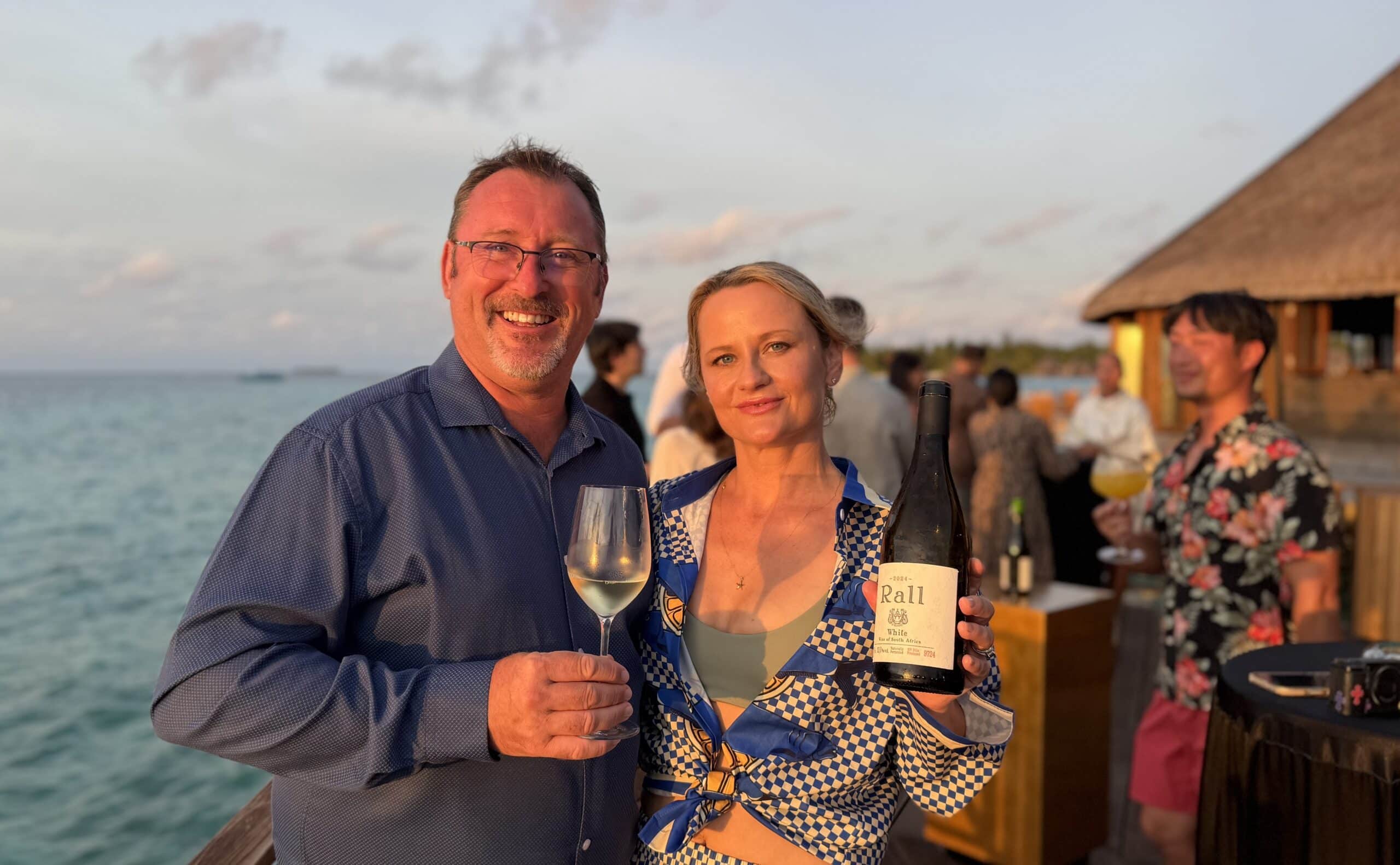
“Ring for Rall,” proclaims a sign on a white booth. The activation has been set up at a restaurant on the island of Halaveli in the Maldives. South Africa’s own Donovan Rall is headlining the event alongside three celebrated Italian chefs. I do as I am told, tugging on a brass bell. A gloved hand emerges from the darkness holding a chilled glass of white wine. I’m here for ‘Escapade Gourmande’ by Constance Resorts & Hotels, which takes place across two islands.
The itinerary has been peppered with tastings and Michelin-starred dinners, all of which have highlighted Rall’s wines. Alongside this, copious amounts of other fine wines have been enjoyed, eagerly poured by the most charming and knowledgeable contingent of sommeliers.
This is Jérôme Faure’s army. Prior to this trip I was of the persuasion that fine wine and tropical islands just didn’t mix. Well, they proved me wrong. Constance employs over 100 sommeliers across their 12 resorts and, importantly, they approach it as something of a wine school.
Over the last two decades under the title of corporate sommelier Faure has created this flourishing community from virtually nothing. His diverse brigade of 15 nationalities hail from countries such as Kenya, Sri Lanka, Mauritius, China, and, of course, the Maldives.
In-between snorkelling and the next glamorous event, I caught up with Faure, grabbing a beach-side table for lunch.
Origin story
From the age of four Faure wanted to be a chef. This was in part inspired by his mother who loved to cook. He recalls how she made her way through a ten-volume culinary encyclopaedia. “It took two years,” says Faure. “She just turned the page and did a new recipe each day, scribbling notes in the margins.”
By just ten-years-old, he was spending his summers working in a local boulangerie and butchery in the northern Rhône. He went on to complete his formal training in Grenoble graduating as a chef at the tender age of 14. He had plans to open a restaurant in the French Alps, but it soon became clear to him: “I understood the kitchen and front-of-house, but I didn’t know a thing about wine.”
Putting the Alps on ice, he set out to rectify this. He found his champion in Jean-Claude Ruet, the head sommelier of the two-Michelin-starred La Pyramide. His mentorship is a generosity Faure has spent his career paying forward. “He’s the reason I love sharing what I know with young sommeliers.
“The passion comes because you learn.”
Some travel followed before French military service, during which he served as private chef to the governor of Les Invalides in Paris, cooking for diplomats and dignitaries. After which, Faure landed his first job as a sommelier at La Mirande in Avignon. This was followed by Le Mas des Herbes Blanches in the Luberon, where he met his wife, Sarah.
After a holiday in South Africa, the couple wanted to stay. Faure secured an offer at The Plettenberg, only to turn it down when there wasn’t a position for Sarah. Weeks later, she showed him a newspaper advert for jobs in Bora Bora. Faure balked: “Bora Bora, a small island! What is there for a sommelier?” Yet he decided if another role like that came along, he would grant her wish of island life.
As it turned out, this was a miscommunication they only discovered once they were in the Seychelles at Constance Lémuria. Two months in, sweating under a ceiling fan and a mosquito net, Sarah turned to him and asked why on earth he had wanted to move to an island. “I said, “It’s you who wanted to!” Faure recalls with a grin. Turns out Sarah was just looking for somewhere that wasn’t France.
Build it and they will come
Faure’s rapport with then-CEO Jean-Jacques Vallet quickly saw him promoted to Mauritius. What he inherited was a 200-reference list dominated by commercial heavyweights, stored in poor conditions, with just two sommeliers across the entire group.
Faure immediately set out to improve things. “A guest once told me that they don’t drink wine at the buffet as there’s no service for it. This lit a lightbulb, “Maybe I can sell some wine by getting sommeliers on the floor.” His next move saw him cutting out third-party importers to secure a direct import licence. While this was better for quality control, it also stripped away hefty mark-ups, making fine wines more accessible.
South Africa though was still in Faure’s imagination. He makes an annual pilgrimage every year and has done so for the last 23. A pivotal moment, he says, was meeting Chris and Andrea Mullineux when they were still at Tulbagh Mountain Vineyards. He happened upon their white cottage by spotting a pile of wine bottles outside the front door, before sharing a spontaneous pot of soup. He was also the very first buyer to taste Cartology inside Chris Alheit’s cellar when Alheit had just 18 barrels to his name, and he famously ignored a Stellenbosch sommelier who dismissed Adi Badenhorst’s wines, tracking Badenhorst down personally.
Today, Faure buys allocations in advance to support small-scale Cape producers and actively champions the Old Vine Project. He views Constance’s resorts as a launchpad for South African wine into Europe.
“The French are stubborn,” Faure says candidly. “They won’t try South African wines at home. Yet when they arrive at one of the resorts they try the wines and say, ‘Oh, wow! Where can I find it?’
Midnight cellar runs
Running a fine-wine programme in the tropics requires some creative thinking. Early on, Faure installed humidors in his Mauritian cellars, only to rip them out when natural tropical moisture turned the rooms into swamps.
To mitigate the daytime heat, containers are unloaded after midnight. The team forms a human chain to carry the boxes into the cellars. The climate he says also changes the way wine behaves in the glass. High humidity amplifies aromatics and alcohol. “I can predict a tropical rainstorm simply by tasting a wine’s heightened intensity.”
Consequently, his cellars have flipped from 65% red two decades ago to 70% white and rosé today. During service both red and white are kept in coolers and poured in smaller, more frequent measures.
Supply-chain timing is his biggest headache. Christmas allocations are ordered and shipped by September. When geopolitical disruptions temporarily slowed guest arrivals earlier this year, containers holding 10,000 bottles apiece kept arriving to a full cellar forcing Faure to convert air-conditioned guest rooms into makeshift wine vaults, as Maldivian law strictly forbids selling resort stock to outside buyers.
Investing in the new wave
Faure founded the Mauritian Sommelier Association in 2008 and is now planning a full-time sommelier academy in Mauritius complete with restaurant and harvest placements.
To teach wine to staff who had never tasted European berries or orchard fruits, Faure has abandoned Eurocentric tasting wheels in favour of local sensory memory. “Wine is personal.”
That commitment to education also drives Escapade Gourmande. “In the beginning, when I brought winemakers over for events, it was purely to train the team,” Faure admits. “The directors said, ‘But we need to do something for the guests, too.’ And of course, it works for both.”
Donovan Rall walks up the beach, grinning after a windsurfing lesson. Eyeing the square of blue ahead, he says he’s ready for a poolside lunch. It works for the team, it works for the guests, and judging by Rall, the winemakers are more than happy to be here too.
- Malu Lambert is a freelance wine journalist and wine judge who has written for numerous local and international titles. She is a WSET Diploma alum and won the title of Louis Roederer Emerging Wine Writer of the Year 2019, among many other accolades. She sits on various tasting panels and has judged in competitions abroad. Follow her on X: @MaluLambert
-
Share:

Related articles
Opinion & Analysis
Malu Lambert: South Africa’s growers need a new deal
28 October 2026
South Africa’s wine industry has been built on what critic and commentator Michael Fridjhon describes as “a history of production-driven enterprises”. Speaking at the University of Cape Town’s Business of...
4
Opinion & Analysis
Malu Lambert: Palomino – the grape that refused to die
6 October 2026
“It’s hellishly special in the fact that it’s own-rooted,” says Leon Coetzee, not known to mince words. Coetzee is referring to the 1962 vineyard that produces their Klein Karoo Palomino,...
2
Opinion & Analysis
Malu Lambert: South Africa’s vineyards – ageing out or growing up?
25 June 2026
The occasion, Paul Sauer 2023 vintage release (read the review here). Hosted as always in the room adjacent to the barrel cellar. Winter light pours through an arched window, the...
Barry | 26 November 2026
That is a beautiful upbeat story and so positive to see what a cascading effect wine knowledge can have on others!
Malu Lambert | 26 November 2026
Thank you Barry! It was so encouraging to see how passionate these sommeliers are, and all from outside traditional wine backgrounds.