
Michael Fridjhon: Fine wine fame is earned one visitor at a time
By Michael Fridjhon, 15 July 2026
-
Share:





4
Many South African wine producers, especially those who are relatively recent arrivals on the international stage, lament the years of isolation – not just the 1980s as an era, but also the impact this decade had on Brand SA and our competitiveness in the two decades which followed Nelson Mandela’s release. Implicit in this is a sense that as a result of these lost years we arrived – as a wine-producing nation – just a little too late to find gaps on the wine store shelves, on the racks of well-heeled consumers, and in the minds and expectations of baby-boomer wine collectors.
It’s easy to sympathise with this view, and even to see how the undoubted loss of marketing time/opportunity has translated into the assumption that, had it not been for the missing decade, our reputation as a source of fine wine would have been vastly different. There’s a knock-on effect to this: if, as an industry, we had launched at the time that fine wine was taking off and we had been able to claim our place on the world stage, the key international consumer markets would have “discovered” us. This would have changed the balance of power. Instead of us knocking on doors and begging for an audience we would have owned the fulcrum point, controlling by strategies such as allocations the rights and entitlements we think others enjoyed instead.
There’s obviously some truth to this, but it’s probably the lesser part of the story: no one had it easy, not even the keepers of the vinous grail, those sitting at the high table of the great appellations of the Old World. Aubert de Villaine, whose family has owned the Domaine de la Romanée-Conti for several generations, was evidently the first of his line who did not need to have an alternative income source (in other words, a paying job) because the revenues from wine sales were sufficient for him to be full-time employed at the estate.
In the past fifty years there has been a dramatic increase in demand for fine wine. New buyers became wine drinkers by their hundreds of thousands during our famous “lost decade” and they were spoilt for choice. They didn’t need South Africa: supplies of the most collectible European wines were equal to the growing demand. This in turn fuelled the hard currency increase in the selling price of Classed Growth Bordeaux which in time created the speculation market which has only now well and truly collapsed.
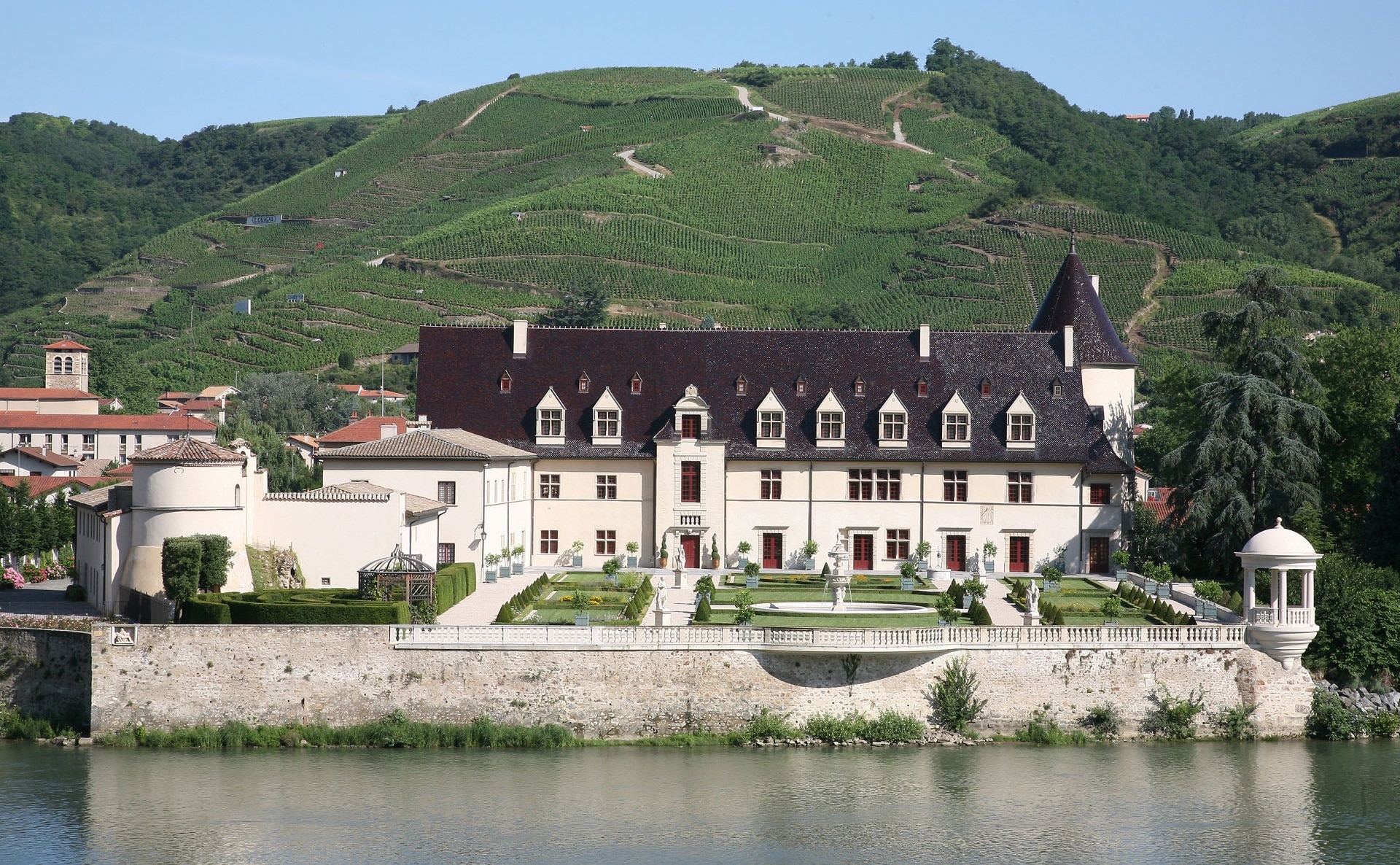
A few weeks ago I attended a dinner at the Chateau d’Ampuis – Guigal’s home base – where the family was celebrating the 80th anniversary of the company. It was in 1946 that Marcel Guigal’s father – who had arrived as a penniless fruit picker in the Rhone valley twenty two years earlier – left the safety of employment at Vidal-Fleury and set out to establish his eponymous brand. Fifteen years later his 17-year-old son had to assume the role of winemaker because his father had suddenly lost his eyesight. By the 1980s, after an extraordinary sequence of Parker 100-point scores, Guigal became the highest profile wine producer in the Northern Rhône, selling many of his most famous wines by allocation only. Seen from the perspective of the Cape, Marcel Guigal had an easy enough passage to his throne on the vinous Olympus.
However, what I discovered at the 80th anniversary dinner, where guest after guest stood up to make largely spontaneous speeches of gratitude and appreciation, was how very directly Marcel Guigal built those relationships. People spoke of arriving unannounced, being received by Marcel rather than by a tasting room assistant, of spending hours longer than they had expected to, and of Guigal going to fetch different and older bottles to make a point, to illustrate differences and nuances. He may have been, in Parker’s words, the “greatest winemaker on the planet” but he was also front of house, ready to take guests around his cellar and freely offer his vinous treasure. Even today the business is very much a hands-on enterprise: the family shares one office, with a desk in each corner: Marcel and his wife Bernadette, Philippe and his wife Eve. Everyone can hear everyone’s conversation – anyone can step up for the other.
A few days later I spent time with several small growers in Burgundy, and the same pattern was repeated: the owner-winemaker was also the person receiving the visitors, deciding which bottles to open, which additional bottles to fetch. Admittedly these were appointments made in advance, but the point is ownership/production/sales is proprietorial and personal. The interface between the property and the customer is not delegated, the custodianship of the brand is not abdicated.
I’m not certain how much this can truly be said of producers in the Cape. I suspect that part of the success of the Swartland was the perceived authenticity of the engagement. This may still be true of the geekier producers, the heirs to the Swartland Revolution who have understood, either consciously or intuitively, that this is how relationships have to be built if the wines are to be remembered for longer than the time it takes the visitors to drive from one tasting room to the next. It’s certainly true of Boekenhoutskloof: tasting is by appointment, and only on two weekdays. There’s no tasting charge and guests are received by Marc Kent, or the winemakers. It’s no surprise that Kent has been the singularly most successful producer – by value and volume – in the modern era of the Cape wine industry.
Guigal’s multiple 100 point wines raised his profile, and made possible the pilgrimages to his northern Rhône cellar, but it was his commitment as much to customer engagement as to wine production that determined his success. Awards and scores bring focus, but they are no substitute for personal contact: submitting a wine for review is the easy part. It doesn’t replace the hard graft of talking your wine onto the market.
- Michael Fridjhon has over thirty-five years’ experience in the liquor industry. He is the founder of Winewizard.co.za and holds various positions including Visiting Professor of Wine Business at the University of Cape Town; founder and director of WineX – the largest consumer wine show in the Southern Hemisphere and chairman of The Trophy Wine Show.
-
Share:

Related articles
Opinion & Analysis
Michael Fridjhon: The great wine shakeout
16 September 2026
The world of wine is shrinking. Pretty much in every country – with very few exceptions – more vines are being removed than replaced. Less wine is being drunk, and...
3
Opinion & Analysis
Michael Fridjhon: Wine scores haven’t failed – we’ve debased them
12 August 2026
Christian Eedes’s recent piece on judging, scoring and the role of the critic was a masterly summary of the issues being debated in the admittedly rarefied space where people ponder...
4
Opinion & Analysis
Michael Fridjhon: The Tim Atkin Special Report and the question of independence
10 June 2026
The news, announced recently by Wines of South Africa (WOSA) to its members, that henceforth producers would have to pay to have their wines rated by Tim Atkin MW for...
Jamie Johnson | 15 July 2026
It is exactly this personal touch that I respect and admire so much about SA winemakers. I’ve been very fortunate to spend time tasting with most of winemakers I now regularly purchase directly from. It definitely influences buying behaviour in my case as I like to support those producers who take the time to engage and go out of their way to share their stories, trials and tribulations each vintage. Nothing quite like hearing directly from the horse’s mouth. All have been exceptionally friendly, open and willing to take the time to answer questions. Their passion is infectious and something that I can’t help but share with other serious wine buyers primarily in the UK.
The biggest issue I see in SA isn’t the wine producers but a few critics who seem to be spending more time nitpicking each other and quickly losing credibility and respect in the process. Interestingly, it is the ones who tend to have least traction in the UK market and the ones that do have are the ones being attacked.
Andrew Johnson | 15 July 2026
Well said Jamie. I made a similar comment on the last article by Tim James. Whatever people’s motivations, these little potshots do no one any favours and just come across as petty swipes at others integrity. Whether true or not these unwelcome comments come across and fuelled by jealousy or a fear of losing once’s relevance.
Vernon | 16 July 2026
I guess if you have a hobbyhorse you’re going to ride it every chance you get. The mention of “petty swipes” is ironic, though, as that’s all you’re aiming at Tim & Michael.
Nosce teipsum.
Jabulani Debedu | 18 July 2026
Totally agree with Michael. The personal proprietor experience delivered at Silverthorne in Robertson is one that comes immediately to mind. Through the experience at farm, me and my friends have made a visit to the farm an annual pilgrimage.