
Tim James: Drill, Baby, Drill – wine’s unlikely alliance with Big Oil
By Tim James, 17 August 2026
-
Share:





15
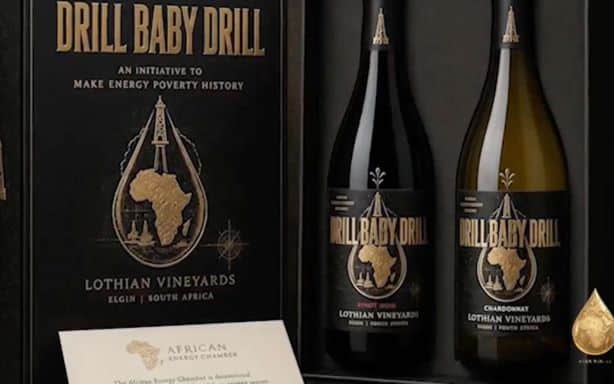
The wonderful Kogelberg Biosphere, home to 1 880 species of fynbos (and with a number of grape varieties as guests), asks on its website: “The Kogelberg and a changing climate: What can you do?” Lothian Vineyards is based in the biosphere, and even has a range of wines named for it. It has a dourly implacable – and treacherous – answer to the website question: “Drill, baby, drill”. Or maybe that’s an answer to another question and Lothian doesn’t much care about the implications for this and other biospheres.
“Drill, baby, drill” is the infamous American slogan supporting increased mining and production of fossil fuels and denying anthropogenic climate change. Especially beloved of obtuse right-wing Republicans, it was made most familiar to the world by those great leaders and friends of the planet Sarah Palin and Donald Trump (who deployed it during his latest presidential campaign and inauguration).
And it seems to be in tune with the climate politics of Lothian’s owner Gavin Wilson, who profitably spent decades in the oil and gas industry before turning to wine production in Elgin. And, connectedly, it’s also a favourite of NJ Ayuk, the Executive Chairman of the African Energy Chamber (he’s a controversial Cameroonian lawyer and oil and gas lobbyist once convicted of fraud and expelled from the USA, and apparently investigated for money laundering by Ghana’s central bank; and see here if you can bear to). The two of them are behind a new pop-up wine brand to be launched, with a pinot and a chardonnay, at the African Energy Week to be held in Cape Town in October.
Boldly bearing this notorious slogan “Drill baby drill”, the predominantly gold and oil-black labels are replete with images of oil and gas rigs. In what the climate-change lobby will see as breathtakingly cynical, the announcement comes with unself-conscious references to Elgin’s cool climate – this at a time when the wine industry generally (as well as environmentalists like those of the Kogelsberg Biosphere) is desperately concerned about rising temperatures and extreme climate events connected to the historical and continuing burning of fossil fuels. That cool climate is also under threat.
However, “working in harmony with nature”, is the bland boast on the website of the winery producing “Drill baby drill”.
The release article announces, it should be pointed out, that the wine label celebrates “the international energy industry and the community that invests in, builds and supports it” and also “Africa’s energy industry, investment and ambition”. The labels themselves claim “An initiative to make energy poverty history”. This is all in line with the African Energy Chamber’s account of itself, as “represent[ing] and advocat[ing] for Africa’s energy industry, bringing together governments, energy companies, investors, entrepreneurs, and international partners to promote investment and development across the continent”.
The Chamber is very obviously an advocate for the fossil fuels industry, but its rhetoric is couched in populist terms that emphasise themes of putting Africa first, development as a priority, ending poverty though development based on oil, etc. African Energy Week will, I guess, be attended by African government ministers and state industrialists galore, smirking encouragingly at the representatives of big oil and big gas. There are undoubtedly arguments to be made in favour of this developmental stance (unless you take a longer view) – but whether they need to be buttressed by a crude and vulgar intrusion from a part of the South African wine industry is surely another matter.
I would guess that the African Energy Week will pull in some more-or-less corrupt apologists for the fossil fuels industry that care as little for genuine development as they do for climate change. They, and the oil and gas companies will love these wine labels, even if some might possibly prefer a slightly subtler approach. But surely there will be some well-meaning and decent delegates too; if so, I hope they’ll be embarrassed by this egregious venture with Gavin Wilson’s winery. Perhaps even to the extent of wanting nothing to do with Lothian Vineyards at all – an avoidance I’d certainly support.
On the other hand, non-attending wine lovers who think this a great initiative will not find the wines generally available locally or abroad; they’re at Energy Week, that’s all. But that’s okay for me – I suspect they’d be a little oily for my taste.
- Tim James is one of South Africa’s leading wine commentators, contributing to various local and international wine publications. His book Wines of the New South Africa – Tradition and Revolution appeared in 2013.
-
Share:

Related articles
Opinion & Analysis
Tim James: Why do we drink? And why do I?
5 October 2026
We all drink alcohol, it’s surely fair to say (unless there are some teetotal voyeurs – liseurs? – readingthis; “we” being the readers, extended to “people generally”). But why? That’s...
Opinion & Analysis
Tim James: A visit to Callie Louw’s Sonkop
28 September 2026
Fans of Callie Louw – there are many, and I think “fan” is the right word – will be pleased to know that all is going well at his new...
4
Opinion & Analysis
Tim James: America has discovered Chenin. Again.
21 September 2026
Something like “The Great Chenin Blanc Renaissance” has been a common article title here for a few decades now. But the one published recently on Wine-searcher was primarily about America. There,...
Justus | 17 August 2026
Thanks for making this known, Tim.
Judy Scott-Goldman | 17 August 2026
Thank you, Tim James, for calling out this nonsense for what it is. I will be avoiding Lothian Vineyards, whatever greenwash they write on their website.
Evelyn Jacobs | 25 August 2026
Has the supposed ‘greenwashing’ been proven? Would be an interesting task to see exactly what has been promised and proven. Without solid facts, it does feel more like a jab at Lothian rather than an informed and valid argument.
Josua | 17 August 2026
Great to see people getting called out for anti-intellectualism, especially as the impact of climate change is more visible than ever.
John Weaver | 18 August 2026
Wierdly ironic. Lothian has a range of wines called Biosphere. They claim that for every bottle sold a portion will go towards supporting local wildlife. Strange thinking.
Moraig Peden | 18 August 2026
Thanks for this article! I’ll make sure to avoid Lothian wines and share the information. Though the astonishing label is a giveaway.
Evelyn Jacobs | 18 August 2026
Interesting indeed – however I dont see the link between the farm having reputable sustainable practices and taking on a deal to supply wine?
Jesse Burton | 19 August 2026
As a consumer, I tend to find in my limited interactions with the industry that climate change, and energy, is top of mind. Winemakers and growers can see well the effects of global warming (caused primarily by the extraction and use of fossil fuels) on their sector and their products. For me, it is astounding that Lothian would align – with such dramatic flair, and erm exuberance (see the oil rig ejaculating its product merrily into the air!) with an industry lobby group who consistently elide the nuance and complexity of energy transformations and climate change, especially in developing countries. It’s hard to take seriously a line of wines called ‘Biosphere’ under the circumstances. Please Winemag, could you do a series on the industry response to climate change (in viticulture practices, new varietals, and in energy choices). I would love a list of those in the sector who are going above and beyond on sustainability and climate AND making delicious wines!
David Swingler | 22 August 2026
What does Richard Kershaw – a thoughtful vintner I deeply respect – the Lothian winemaker according to its website, say?
Tim James | 22 August 2026
I did contact Richard, Dave. He said he doesn’t have any responsibilities beyond being contracted to make the wines for Lothian, so knew nothing about this. I too have respect for him, so I left it there. It’s up to him, of course, if he comes to think it right to pay attention to what is done with wines that, in a sense, also carry his name.
Liezel | 24 August 2026
Hi David
Just to clarify, Richard is not Lothian’s winemaker. He provides Lothian with technical winemaking consultancy. He has no involvement whatsoever in its branding, marketing or other commercial decisions and had no prior knowledge of the branding decision discussed in the article. Their website needs to be corrected.
Rob Henley | 25 August 2026
I have visited Lothian and there is a high regard for sustainability and best practice.
This is an opinion article so here’s a different opinion. Any writer or industry participant needs to be careful not to jump on the high horse.
Many wine farms are owned by people with colourful histories, some of the most famous being in mining, another pilloried industry. There is no evidence of any illegalities by Mr Wilson, just in the wrong industry according to the author.
Have you considered the environmental damage that is done when manufacturing glass? Mining for the raw ingredients and extremely high energy which in South Africa means about 80% coal powered. Are you railing against the use of glass in the industry?
Renewable energy / recycling is preferable of course but unfortunately life is not possible right now without certain products which are derivatives of mining / oil & gas. Do you use a laptop, phone, plane, car, how do you fuel your car, anyone wear jewellry? Yes, thought so and that’s before we consider the thousands of hydrocarbon derived products, including plastic.
If anything, aiming for energy security for Africa is timely and ensuring that wealth is spread more evenly is admirable.
This is marketing, albeit a bit clumsy but stigmatising a wine farm is a high-handed view to take. That’s just an opinion!
Josua | 25 August 2026
Copilot said:
I think you’re missing the main point Tim was making. The issue isn’t simply that the label is pro-fossil fuel, or that Gavin Wilson made his money in oil and gas. Most people understand that the world, and especially developing economies in Africa, cannot switch from fossil fuels to renewables overnight. Even many environmentalists accept that the transition will take time.
The problem is the specific use of the slogan “Drill, baby, drill”. This isn’t a neutral statement about energy development or energy security. It is a slogan that has become closely associated with Donald Trump and sections of the Republican Party in the US who have gone far beyond arguing for continued oil and gas production. They have actively promoted the expansion of fossil fuel extraction while simultaneously dismantling renewable energy initiatives, rolling back environmental protections initiated under Biden, and rejecting the overwhelming scientific consensus on climate change.
Tim even acknowledges in the article that there are legitimate developmental arguments in favour of oil and gas investment in Africa. His criticism is not aimed at those arguments. Rather, it is directed at a winery located within one of the world’s most significant biospheres choosing to market itself using a slogan that has become synonymous with anti-science and anti-climate-action politics.
So yes, this is an opinion piece. But it is an opinion rooted in the very real history and meaning of that slogan. In that context, I think Tim is entirely justified in calling out Lothian’s decision. The issue is not fossil fuels per se. It is the deliberate embrace of a slogan that represents much more than that.
Rob Henley | 25 August 2026
You make some good points and it is certainly clumsy marketing. The slogan has an interpretation (which you outlined) to some. To others, like people in the energy industry, it’s just business in a marginally more pro-oil world. This pop-up wine is solely for an industry conference so it’s aimed at the latter.
There is no suggestion that Lothian itself does not respect the biosphere but the way I read the opinion piece was about the whole vineyard’s approach and Wilsons legitimate investment record where there is no evidence there has been a circumvention of environmental edicts from either.
To me, its oversensitive and precious.
Josua | 25 August 2026
Looking at the impact climate change is already having, and the impact it is projected to have in future, I do not think this is being oversensitive or precious at all. I think it is completely necessary to call out people in the wine industry when they choose to align themselves with individuals or groups that are actively contributing to the destruction of the planet.