
Tim James: How Boekenhoutskloof crafts its Semillon
By Tim James, 7 April 2026
-
Share:





3
The significance of blending in making wine is probably not sufficiently realised. We tend to think of “blends” as bringing together different varieties or, occasionally, wines from different areas (whether of the same variety or not). But, given the differences that emerge in fermentation and elevage, virtually all wines that are assembled from more than one barrel or tank can be said to be blended by the winemaker. Carefully and with due consideration, one hopes. Though it was suggested to me by a winemaker, who’d better stay nameless, that some wines would be of improved quality if those crafting them were better tasters and therefore able to create better blends though improved selection.
Blending is everywhere – even when you don’t see it
Wine lovers seldom get to taste the components going into a final blend, unless they’re lucky enough to get a cellar tour with a winemaker willing to offer barrel- or tank-samples of the different varieties, origins, or even perhaps different pickings of one vineyard. Occasionally (very rarely) some components might be bottled and sold commercially. The most nerdy and overt of these projects is undoubtedly the “deconstructed” range of Richard Kershaw: small (and correspondingly expensive) bottlings of components of his final chardonnay and syrah, according to clone and vineyard origin. And Mullineux bottles, in the Single Terroir range, selected components of their Signature Syrah and Old Vines White, labelled according to the soil types, although the wines are not presented as components. The cabernet sauvignon and cinsault parts of Leeu Passant’s flagship wine are also bottled separately. And I daresay that, in less consciously “deconstructionist” fashion, some estates will have substantial overlap between, say, their Bordeaux-style red and their varietal merlot and cab.
A rare glimpse behind the blend
Mostly, however, what we wine lovers get to taste is only the final blend. A rare and unexpected opportunity for invited media and trade to dig deeper into one vintage of a famous wine came last week in the tasting room at Boekenhoutskloof. The tasting was held partly to celebrate in low-key fashion the 30 years since the vintage of their maiden wine, Cabernet Sauvignon 1996. In fact, their first wine on the market was the Porcupine Ridge sauvignon blanc from 1997 – also the vintage of the first Boekenhoutskloof Syrah and Semillon. The Platter Guide of 1999 summed it up as a “sensational opening performance”.
Semillon played the largest role in this celebratory tasting. First came a look, via the 2007 and 2009 vintages, at how well the wine responds to bottle maturation of some years (both were drinking beautifully, especially the excellent 2009). Then the middle-aged 2017, with oak still subtly obvious, but the dense, honey-finishing, brilliantly tight and fresh whole already developing towards full maturity. After that came the surprise, with 2019.
Marc Kent, who’s been at Boekenhoutskloof since producing those first releases (first as winemaker and farm manager, now as part-owner and “technical director”) is no longer much involved with the basics of the home-farm and the winemaking – he’s pleased to leave that to Gottfried Mocke, whom he too self-deprecatingly hails as a better winemaker than he is, and who is undoubtedly doing splendidly in managing the farm and the wines. But Marc is proud of the fact that he still leads the blending of the wines, and signs off on every one. The late Tim Rands of Vinimark, the force behind the founding of the estate and the brand, told me many years ago that what he valued most about Marc was his vision and his blending abilities. (The Chocolate Block is certainly not a triumph of marketing alone.)
In 2020, however, with Covid19 making its shattering progress across the world, Marc found himself in a flat in Amsterdam with his two children, unable to fly to Franschhoek for blending those 2019 components getting readied for bottling. So, with a typical grandeur of gesture, he had Gottfried prepare essential samples and airfreight them across. The cost must have been substantial, as was that of the large number of Zalto glasses he bought in Amsterdam for tasting the wines alongside some invitees – some of Amsterdam’s top sommeliers (presumably – but let’s not check – all observing careful social distancing) around the large table in Marc’s flat). Marc proceeded with the tastings, with the home team led by Gottfried also present on Zoom.
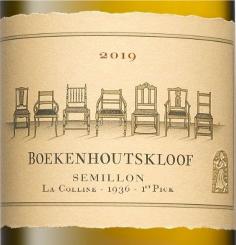 Semillon 2019 was one of the subjects. Sent over were bottles containing wines off some of Franschhoek’s most venerable vineyards: firstly, two pickings of the famous 1936 La Colline vineyard, separated by picking date and vineyard area); secondly, two different sections of Eikehof farm – planted in 1902 and 1942 respectively; and finally, muscat d’Alexandrie (hanepoot) from La Terra de Luc’s 1902 vineyard.
A word is needed about the muscat, as many will be surprised by that, not thinking of the Semillon as including another variety in the blend. It had only been used as a component in a very small way for a few years, essentially for the sake of its acidity (I think few would guess it’s presence from aroma and flavour.) Previously, since 1998, Bordeaux’s traditional blending partner for semillon, sauvignon blanc, had been used. The Bordeaux appellation does, though, also allow for a grape called muscadelle – no relation to the muscat family, though apparently also with a vaguely grapey quality. And how to argue against using these old vines when they became available?
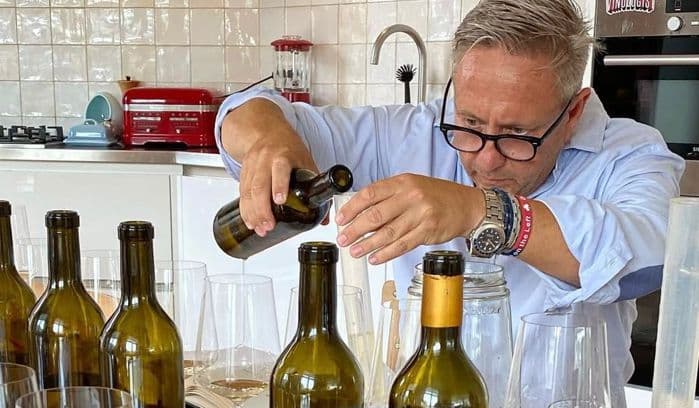
The tasting proceeded in Amsterdam and Franschhoek – the former shown in the photograph above. Afterwards, partly enabled by its being a generous vintage, Marc had the idea of getting Gottfried to produce 150 bottles of each 2019 component, each with a properly inscribed cork and a label indicating the specific origin. Six years later, a bunch of lucky people sitting around the table at Boekenhoutskloof were the first outsiders to get to taste through the wines – Marc himself hadn’t tried them since 2020.
All of the components would have deserved commercial release, in fact, in their own bottlings. Each was characterful in its own way, from the austerely and stonily magisterial La Colline 1st Pick, to the more relaxed, supple and full fruited Eikehofs and the totally winning Muscat (I am always a sucker for light, bone-dry and fresh hanepoot). Happily, however, the wine finally bottled as Boekenhoutskloof Semillon 2019 transcended its parts. It was, in fact, for me the finest wine of the day, drinking beautifully already, though no doubt it will acquire further (and other) interest in the decade or more to come. The huge advantage of the initial half-dozen years of development in bottle was underlined by tasting the current release, 2023, which has early complexity, balance and charm, though needing time to fully harmonise and to absorb and transmute the oak tannins that tug at the palate.
A fascinating, informative and richly rewarding tasting it was, of one of the nicest and must surprising spin-offs of the pandemic – and not, we must reluctantly hope, needing to be repeated in future vintages, except, of course, by the blenders of those wines yet to be harvested.
- Tim James is one of South Africa’s leading wine commentators, contributing to various local and international wine publications. His book Wines of the New South Africa – Tradition and Revolution appeared in 2013.
-
Share:

Related articles
Opinion & Analysis
Tim James: Who really wins at wine auctions?
12 October 2026
The Strauss & Co wine auctions began in 2019, in good time to benefit, as is clear in retrospect, from the pandemic that was soon to hit us. The stated...
4
Opinion & Analysis
Tim James: Why do we drink? And why do I?
5 October 2026
We all drink alcohol, it’s surely fair to say (unless there are some teetotal voyeurs – liseurs? – readingthis; “we” being the readers, extended to “people generally”). But why? That’s...
Opinion & Analysis
Tim James: A visit to Callie Louw’s Sonkop
28 September 2026
Fans of Callie Louw – there are many, and I think “fan” is the right word – will be pleased to know that all is going well at his new...
Vernon | 7 April 2026
An absolutely fascinating article, Tim. This alone makes my subscription to Winemag worthwhile.
Job | 7 April 2026
You can actually check, surely top sommeliers 😉
Victor | 11 April 2026
Brilliant article! And a good reminder of the challenge that was 2020 for the winemakers