
Greg Sherwood MW: Hazendal’s bold reset starts with Kiara Scott Farmer
By Greg Sherwood, 3 June 2026
-
Share:




Stellenbosch stands as undoubtedly one of the most geographically blessed and storied wine regions in the world. Yet, even within this cradle of prime viticulture, modern day wine estates must continuously evolve stylistically to avoid potential economic stagnation.
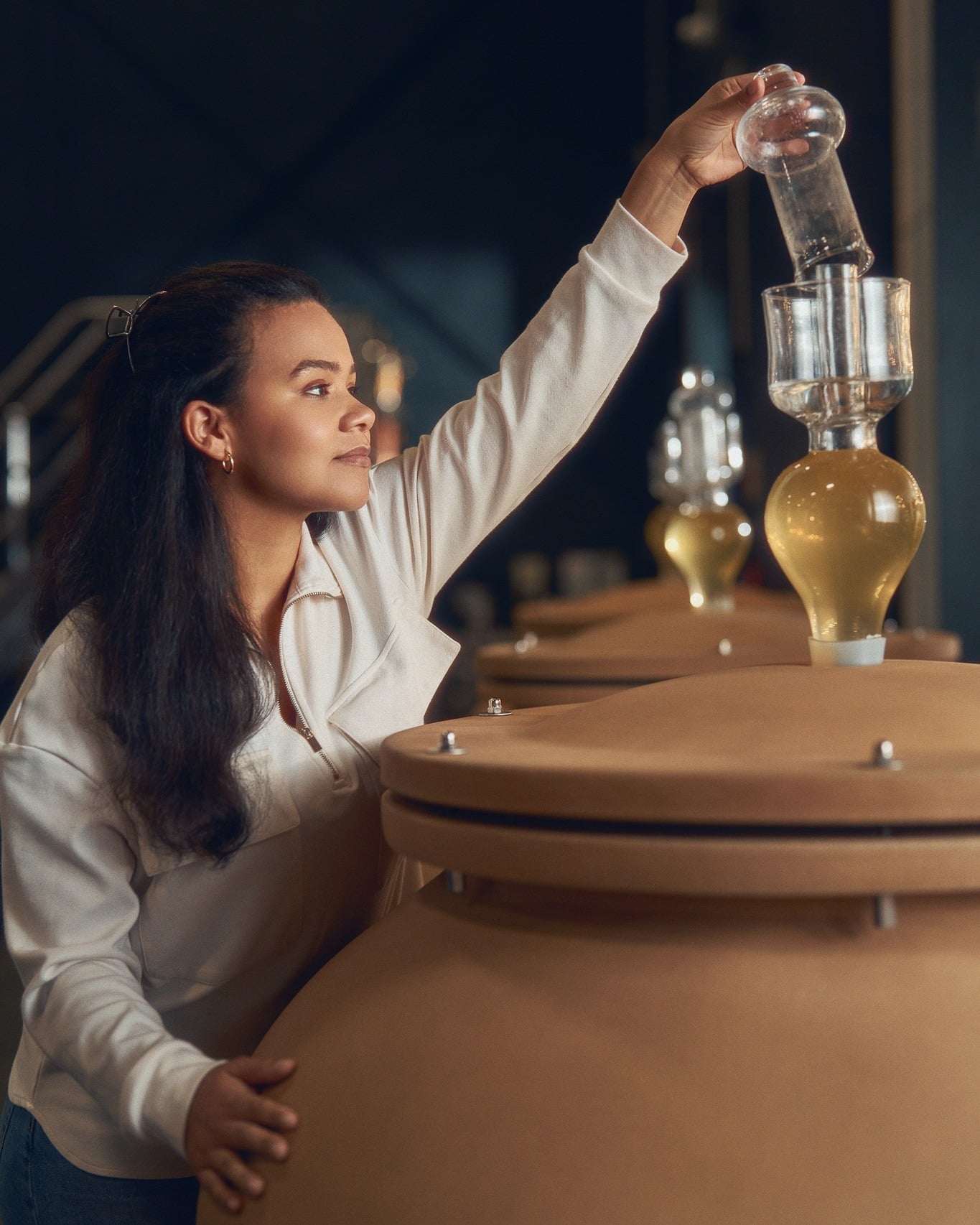
Hazendal’s Kiara Scott Farmer.
Hazendal, with a history spanning over three centuries back to its founding in 1699, nevertheless represents a unique paradox: it is an ancient Cape landmark that has undergone vast structural, cultural, and viticultural modernisations. The latest, and arguably most profound chapter of this ongoing rebirth, began with the recent appointment of award-winning cellarmaster, Kiara Scott Farmer.
Stepping into the cellarmaster role after a successful and fruitful few years at Englishman Tim Rudd’s scenic Paarl-based Brookdale, Scott Farmer brings with her a trailblazing legacy cultivated early days at Savage Wines, an ethos of minimal intervention, and a vision that bridges the gap between historical heritage and contemporary environmental stewardship with a firm focus always on quality winemaking.
Her arrival marks a definitive turning point for the Hazendal, transitioning from a scenic lifestyle estate into a vanguard of premium, terroir-driven winemaking in the prime terroir of Stellenbosch’s Bottelary Hills.
From Mitchells Plain to making wine
To understand the magnitude of Scott Farmer’s impact on Hazendal, one must first look at her impressive personal journey. Raised in Mitchells Plain on the Cape Flats, she entered the wine industry from an unconventional path, driven by a profound fascination with both the science and the artistry of oenology.
Breaking through enduring historical and socio-economic barriers of the time, she excelled at Elsenburg wine college before being selected for the prestigious Cape Winemakers Guild (CWG) Protégé Programme. Under the guidance of industry icons like David Nieuwoudt of Cederberg, Charles Hopkins of De Grendel, and Carl van de Merwe, formerly of DeMorgenzon, alongside international harvests in the Rhône Valley, Sancerre, and Sonoma, Kiara quickly proved her formidable and unquestionable winemaking talent.
Her status as an industry hotshot was finally cemented during her tenure at Brookdale, where she was appointed sole winemaker in 2019 at just 26 years old, making her the youngest female head winemaker in South Africa at the time. Her critically acclaimed Old Vine Chenin Blancs turned heads in the industry, culminating in her winning the prestigious Diners Club Winemaker of the Year Award.
As the first woman of colour to win this title, she did not just arrive at the Hazendal as a new employee, she arrived as a leading female transformative force with a distinct philosophical approach.
The terroir of the Bottelary Hills
The core of Scott Farmer’s winemaking outlook is encapsulated in her mantra: “Winemaking is an artistic endeavour; creating something that reflects a sense of place and culture.” At Hazendal, that “sense of place” is defined by the unique microclimate and geology of the Bottelary Hills ward in Stellenbosch.
The estate’s vineyards are influenced by their proximity to False Bay. Cool maritime breezes sweep across the slopes, moderating afternoon temperatures and allowing for a slow, extended ripening period. The soils here, primarily deep decomposed granite with some shale, impart a distinct, laser-like focused minerality and structural tension to the wines.
Historically, the Hazendal was known for a more broad, traditional portfolio of wines. However, Kiara’s approach has been fundamentally about shifting the property’s focus towards the soil and available terroir. By identifying specific parcels where distinct microclimates allow individual varietals to flourish, she is recalibrating the estate’s viticultural footprint to highlight purity of fruit over heavy-handed cellar manipulation.
While Duncan Savage played a key role as winemaking consultant alongside Jaco Engelbrecht in the replanting programme of the Brookdale Estate, long before Kiara picked up the winemaking reins, she nevertheless learnt and assimilated all the lessons of innovation, experimentation and of course, the art of the field blend.
The agricultural rebirth
The true rebirth of the Hazendal under Kiara begins in the soil, long before grapes ever reach the press. Recognizing the escalating challenges brought on by global climate change, she has spearheaded a comprehensive agricultural restructuring of the estate including ‘site-specific cultivar selection.’
With Hazendal moving away from a more rigid commitment to conventional Stellenbosch varieties in favour of planting ‘the right vines on the correct sites’, this has included introducing drought-resistant varieties and cultivars better suited to the shifting weather patterns of the Western Cape, such as Chenin Blanc, Marsanne, Roussanne and Carignan.
Another major pillar of the estate’s ‘new era’ is the conversion from conventional chemical farming to future-focused organic and ecological viticulture. By fostering biodiversity in the cover crops, eliminating harsh synthetic inputs, and restoring natural soil microbes, Hazendal is nurturing vines that are hopefully more inherently resilient for future climate challenges.
Under Kiara’s stewardship, harvesting has become an exercise in extreme precision, something she undoubtedly fine-tuned working with Duncan Savage. Grapes are meticulously hand-harvested based on flavour and acid maturity rather than purely sugar levels, ensuring that the intrinsic freshness and structural integrity of the Bottelary Hills granitic terroir is preserved and transferred to bottle.
In the cellar, Kiara employs a gentle, restrained hand. Her objective is simple: to make winemaking easier by doing the hard work in the vineyard first. This approach strips away the heavy cosmetic additions often used in commercial operations, such as commercial yeasts, enzymes, and excessive new oak, allowing the natural voice of the vineyard terroir and vintage to speak clearly in the final wines.
A prime example of this philosophy is her sensitive oak regime. By utilizing larger 500-litre French oak barrels and older seasoned wood, she ensures that the oak acts as a supportive frame rather than a dominant flavour component. This allows the delicate nuances of wet stone minerality, wild fynbos, and bright fruit expressions to take centre stage in her latest vinous creations.
The Hazendal Estate Collection
The tangible proof of this Estate rebirth is found in the release of what is called the ‘Hazendal Estate Collection’. This more tightly curated lineup serves as a directional reflection of Kiara’s broader long-term vision, abandoning corporate uniformity in favour of more characterful, elegant, distinct personality creations.
The critical reception of these releases has been immediate and enthusiastic. The White Blend quickly secured a 94/100-point ranking among the top wines in the Winemag Prescient Minority Report, while the Carignan captured a 93/100-point distinction. In addition, Kiara placed Top 10 in this year’s iTOO Next Generation Awards with the Syrah 2025. These accolades certainly go a long way in validating the idea of Hazendal’s rebirth – that a historic property can reinvent itself as a dynamic contender on the fine wine stage when guided by precise, skilled, terroir-driven winemaking.
A harmonious new future
The transformation of the Hazendal under Kiara Scott Farmer represents far more than a routine change in personnel, it is a profound reinterpretation and synthesis of history, culture, and forward-looking agriculture. Kiara has taken a centuries-old estate and injected it with the vitality of the new South African wine revolution, much in the same way she did at Brookdale before.
By marrying sustainable, organic vineyard practices with a minimal-intervention cellar philosophy, Kiara is successfully unearthing the true, unmasked voice of the Bottelary Hills terroir. As her newly released Estate Collection proves, the future of Hazendal is no longer just about preserving its colourful storied past, but more about creating new, courageous, climate-resilient benchmarks for a successful future Stellenbosch.
- Greg Sherwood was born in Pretoria, South Africa, and as the son of a career diplomat, spent his first 21 years traveling the globe with his parents. With a Business Management and Marketing degree from Webster University, St. Louis, Missouri, USA, Sherwood began his working career as a commodity trader. In 2000, he decided to make more of a long-held interest in wine taking a position at Handford Wines in South Kensington, London, working his way up to the position of Senior Wine Buyer over 22 years. Sherwood currently consults to a number of top fine wine merchants in London while always keeping one eye firmly on the South African wine industry. He qualified as the 303rd Master of Wine in 2007.
-
Share:

Related articles
Opinion & Analysis
Greg Sherwood MW: Could dry white save Bordeaux?
20 May 2026
For centuries, the word "Bordeaux" has conjured a distinct visual of deep inky rivers of Cabernet Sauvignon, Merlot and Cabernet Franc, historic chateaux flanked by manicured vineyards on gravelly soils,...

2
Opinion & Analysis
Greg Sherwood MW: Does the wine market need recalibrating?
7 May 2026
The fine wine market currently resembles a fractured landscape. A lopsided hourglass where the neck is tightening and the sand refuses to flow. On one side, you have the “trophy”...
6
Opinion & Analysis
Greg Sherwood MW: Why knowing less wins in the age of AI
23 April 2026
The modern world is experiencing a profound erosion of the "expert gatekeeper," a key topic Winemag columnist Michael Fridjhon touched on recently in his insightful article entitled "When the media...
Comments
0 comment(s)
Please read our Comments Policy here.