
Tim James: A visit to Callie Louw’s Sonkop
By Tim James, 28 September 2026
-
Share:





4
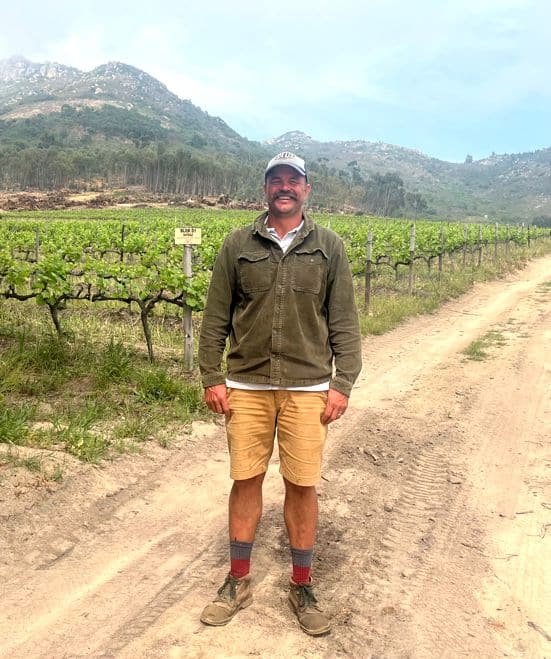
Fans of Callie Louw – there are many, and I think “fan” is the right word – will be pleased to know that all is going well at his new venture. Very well indeed, I’d say after my visit to his farm and nascent winery last week, on a misty spring morning.
It’s just more than a year since Callie and family arrived here, having left Porseleinberg. There he’d made fifteen vintages of syrah off those vines, and overseen and planted vineyards on this and two other large Swartland properties, all owned by Boekenhoutskloof. It seemed right, as he approached 50, to take the brave and difficult step of working for himself. As he told me at the time: “I’ve always loved farming and owning my own land has been a dream… the fire has grown bigger.”
This new farm – it was called Uitvlucht and has been renamed Sonkop for its highest peak – is in a part of the Swartland that’s remarkably different from Porseleinberg. Rolling hills too, but this is in the Joubertskloof in the low foothills of the Paardeberg, on the other side of that magical mountain from the famous establishments of Sadie, Badenhorst, Lammershoek, David & Nadia et al. With the highest vineyards at about 400 metres, it’s actually more elevated than Porseleinberg. When we drove up to those dizzy heights, Callie assured me that were it not for the mist we’d be able to see right across to Table Mountain.
This is perhaps the prettiest part of the southern Swartland, though lacking the grand vistas of wheatfields and huge open skies with mountains on the horizons. Anyone who knew the Fynbos Estate, home to Johan Simons’s eccentric and occasionally fascinating Dragonridge range of wines, will know this tucked-away area – Sonkop is its neighbouring farm. (A large Rainbow Chickens property is on another side, mostly undeveloped land as far as I could see).
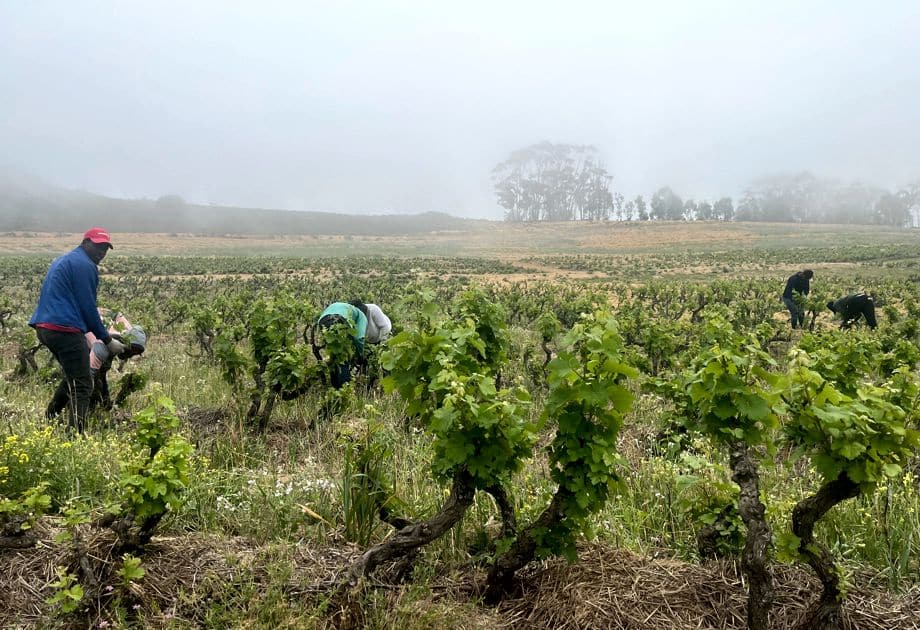
It’s easy to understand what drew Callie here, even apart from the appealing setting and the attractive buildings, including a good house, amongst large trees. There were already some vineyards planted on the mostly east- but also south-facing slopes, the orientation keeping them a little cooler, less exposed to the afternoon sun. Many vines were virused and needed to be removed (some were grafted to other varieties), but there’s some really good chenin, going back to the 1980s. The farm has a well-sized dam, fed by run-off from the slopes – a significant advantage over the farms of the Aprilskloof and Siebritskloof. Rather too much run-off on rare occasions, in fact – the mighty rains of May this year did fill the dam but also caused some havoc among the bare soils of newly-planted vines.
So. Having lost his viticulturist heart, Callie found a financial partner – always a tricky business, and I gather it took two shots, to find the KwaZulu-Natal wine lover, with some relevant experience in agricutural investment, who is now involved (but keeping his head low for the present it seems). Callie seems very pleased with the arrangements.
Investment in Sonkop is substantial. It’s altogether a much larger proposition than I’d guessed it to be. And larger than Callie had originally thought, in fact. A neighbouring wine-grape farm (devoted to mass production) had come up for sale and Sonkop has shared the land with the recently new owners of the Fynbos estate (things are clearly moving in this sliver of Swartland). These are an Italian-Swiss couple, who are, I gather, more interested in expanding and developing Fynbos’s olive plantations – though they’re not abandoning the vineyards there and, with Callie Louw as a friendly neighbour, can they avoid dabbling in wine too?
Sonkop has, then, a total of some 130 hectares. About 20 hectares of vineyards are now in production – including that old chenin as well as some chardonnay and cabernet sauvignon. Callie has already planted 15 more (shiraz, grenache and more cab), and another 15 will go in next year. White-wine grapes will account for just 12 of the final 50 hectares. Another venture on the farm sees Callie’s wife Marie, a professional photographer, moving to develop a commercial flower garden. Meanwhile, a production cellar is under construction and might just be usable to vinify the grapes that are now mere potential in the vigorous vineyards around it – Callie seems more concerned about getting the paperwork involved in registering it as a wine-production site done in time than the construction logistics.
As to the wines, Callie’s determination is to have just two, expressive of Sonkop and its plantings, and named for it: a red blend – seemingly with a basis in shiraz, and including that surprising cabernet (unorthodox for the modern Swartland) for structural support; and a white blend based on farm’s old chenin. This is a brave ambition; no other significant Swartland producer has managed to achieve this degree of focus – and it’s not the best time in the history of wine to be introducing a new brand, from a fair-sized large farm, with just two wines.
The first Sonkops will be vintage 2026. Callie made them in the cellars of Vondeling, where he is also helping with the wines and vineyards (he doesn’t like the word “consultant”). There they are resting and maturing – sadly I didn’t get a glance or a taste on this visit. Vintage 2027 will, hopefully, be accomplished in the new cellar. The labels for the two Sonkops are being designed now: they will reflect the view of the mountain and vineyards, and the image will, as I understand it, develop in detail and completeness over the next decade as the new vineyards come into maturity.
Callie has been working hard here, and effectively, and there is much more to come – he has, says his friend and former employer Marc Kent, “a work ethic second to none”. When he was showing me the vineyards he’d planted, his pleasure and anticipation was almost palpable as he welcomed the new spring growth of his emerging vines.
- Tim James is one of South Africa’s leading wine commentators, contributing to various local and international wine publications. His book Wines of the New South Africa – Tradition and Revolution appeared in 2013.
-
Share:

Related articles
Opinion & Analysis
Tim James: Who really wins at wine auctions?
12 October 2026
The Strauss & Co wine auctions began in 2019, in good time to benefit, as is clear in retrospect, from the pandemic that was soon to hit us. The stated...
6
Opinion & Analysis
Tim James: Why do we drink? And why do I?
5 October 2026
We all drink alcohol, it’s surely fair to say (unless there are some teetotal voyeurs – liseurs? – readingthis; “we” being the readers, extended to “people generally”). But why? That’s...
Opinion & Analysis
Tim James: America has discovered Chenin. Again.
21 September 2026
Something like “The Great Chenin Blanc Renaissance” has been a common article title here for a few decades now. But the one published recently on Wine-searcher was primarily about America. There,...
Keith Prothero | 28 September 2026
Brilliant. I look forward to tasting the wine and wish Callie all the success he deserves
Heike Laufer | 28 September 2026
Awesome Callie…can’t wait. Just had your Porcelaanberg 2019 New Year 2026, what an exemplary wine. Could not drink anything else after that.
Kenneth J Mechalske Jr | 28 September 2026
I enjoyed reading this article we are visiting here right now until October 12th. Hopefully we get to visit your establishment. Best of luck Kenny Mechalske
Kobus van Rensburg | 29 September 2026
Good luck Callie and Marie. Pitty that you are not going to produce a Shiraz stand alone wine.