
Tim James: Capaia – the wine dream that went bust
By Tim James, 9 September 2026
-
Share:





4
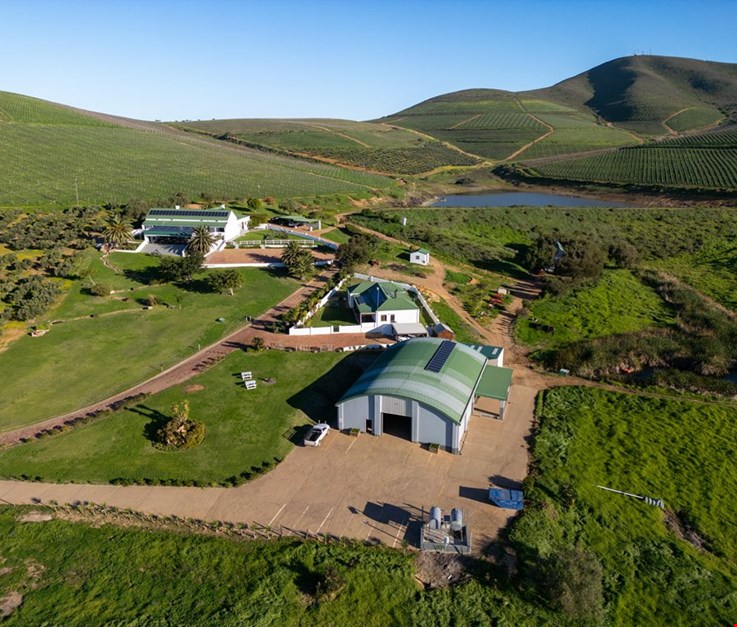
There’s a good chance that younger readers of this website will not even have heard (vaguely, perhaps?) of Capaia, a fairly large wine estate in the Philadelphia ward (even heard of that more than vaguely?) not far from Cape Town. But Capaia was gleaming on the horizon hopefully and brightly two decades back, having been founded in 1997, with an auspicious first bottling of a Bordeaux-style blend in 2003. The 2006 Grape poll to find the Cape’s top producers also asked voters about promising newcomers, and Capaia was the best-performing red wine in that category.
But the days of glory were short-lived. It’s an interesting and significant story, and on Thursday this week Capaia is going on auction (for details see here, if you’re a potentially interested party, or just want more details about the property and some eyebrow-raising claims about its eminence).
Established with panache on the rolling hills of a former wheat-farm on the edge of the Swartland, Capaia was back then a major German investment in the Cape. Although I dare say a lot of money was saved by buying land here rather than an established property in Stellenbosch, no expense was spared in vineyards or winery – for example, one of the world’s largest arrays of wooden fermenters was built onsite by Taransaud.
It was all the creation of Baron Alexander von Essen (pretty significant as an aristocrat, it seems, also a wine merchant back home) and his architect baroness, Ingrid – she came from the immensely rich family that owned the Miele domestic appliances company. So Europe’s feudal nobility and European capital ruled, and there seemed from the start to be not all that much faith in South Africa to provide more than the soil, and labour. The Herr Baron had great contacts back home, of course, and immediately brought in the eminent Hungarian winemaker Tibor Gál, most famous for building the reputation of the super-Tuscan Ornellaia. Czech-born New Zealand winegrown Daniel Schuster came in to oversee the vineyard planting (with imported virus-free material), as presumably the locals couldn’t be trusted. From another great aristocratic family came Italian Ludovico Antinori – advising in some capacity, I guess, or at least lending a suitable, classy glow.
Jan Coetzee was some sort of local advisor, and Tertius Naudé was appointed “winemaker-in-residence”, as Platter’s put it at the time. (I think it was more than rumour that the local winemaking hack was obliged to call his employers Sir and Madam). But the grand foreign contingent was what it was all about.
Tragically, Tibor Gál died in a car accident on Helshoogte in February 2005. He’d made two excellent vintages of Capaia, the flagship red. In 2011 I noted that the Capaia 2004 “fulfilled my hopes of half a decade ago” (tasting it for Platter 2006). The same year I also wrote about the “rather handsome, burly 2003 … still very much alive, with good fruit, well balanced and with some complexity and not too much sweetness, showing the potential of these Philadelphia vineyards.” The wines were big and bold, certainly, in the Parkerist fashion of the time. I later lamented about the 2009 Capaia that it was spoilt by over-ripeness (I was mostly referring to this character of many Michel Rolland-influenced wines here). Too often, I suggested, winemakers from classic regions came to the New World and forgot all about claims of elegance and, usually pretty disastrously, pursued the extreme ripeness that didn’t come naturally in most of Europe.
The death of Tibor Gál led to another European aristocrat – but this one also also a leading Bordelais winemaker, Baron/Comte/Graf/Earl Stephan von Neipperg (I’ve seen all those titles used) – being taken on as consultant. He seems to have been also a friend, and stayed as a permanent presence, eventually taking an ownership share in 2015, after the breakup of the Von Essen marriage and the Baroness’s sole proprietorship. It didn’t, frankly, seem to lead to great things in terms of wine. Nor had the consultancy of a famous Austrian winemaker, Manfred Tement, designed to raise the profile of the white wines.
The most serious consequence of Gál’s death was a period of instability in the winemaking at Capaia, from which the estate seems to never really have recovered. There was a rapid turnover for a while of local winemakers – basically as assistants to the famous European consultants. Were they ever respected? Ever allowed to make decisions as and when they were needed?
A time of stability did emerge with the arrival of Bernabé Strydom as cellarmaster – the first local to have that title recorded in Platter’s. But the reputation of the wines never really recovered. As far as I know, the always-important connections established with the German market became increasingly significant for sales. But a good part of the farm’s annual grape-harvest must have been sold off.
Capaia was perhaps generally unlucky. A local accountant, for example, defrauded them of R17 million before being found out. In 2021 Ingrid von Essen died, and the von Essen couple’s daughter Mariella took ownership, along with the faithful Comte Stephan von Neipperg.
But, at last, they clearly want out. And so to this auction. The starting price is set at just under R50 million. Is that a lot or a little? It doesn’t seem much, but I’m not in a position to know. Something must depend on the state of the 50-odd hecares of vines and a few more of olives (and many more unfarmed). Platter’s 2026 says that the winery was last year “slated for a major revamp” – did this happen or is it still needed? As to the value of the brand, it is surely pretty negligible – the 2022 flagship red Capaia is available (if you look hard, or on the website) for under R200, and Germany seems to constitute the international market. R50 million is not a vast amount in European money, but, also, Philadelphia remains not as desirable an address for investors as Constantia or Stellenbosch.
It’s all rather sad, in fact. So much aristocratic and metropolitan arrogance, its money spent and probably largely wasted on this adventure. It was a time when Cape wine and a new breed of local winemakers and viticulturists were on the threshold of proving themselves internationally – but this movement was apparently untrusted by at least these newcomers. Germans have been great contributors to winemaking here from the beginning (see here and here), but the Capaia intervention just didn’t work out, and looks like it’s coming to an end – soon, if this auction works.
- Tim James is one of South Africa’s leading wine commentators, contributing to various local and international wine publications. His book Wines of the New South Africa – Tradition and Revolution appeared in 2013.
-
Share:

Related articles
Opinion & Analysis
Tim James: Who really wins at wine auctions?
12 October 2026
The Strauss & Co wine auctions began in 2019, in good time to benefit, as is clear in retrospect, from the pandemic that was soon to hit us. The stated...
6
Opinion & Analysis
Tim James: Why do we drink? And why do I?
5 October 2026
We all drink alcohol, it’s surely fair to say (unless there are some teetotal voyeurs – liseurs? – readingthis; “we” being the readers, extended to “people generally”). But why? That’s...
Opinion & Analysis
Tim James: A visit to Callie Louw’s Sonkop
28 September 2026
Fans of Callie Louw – there are many, and I think “fan” is the right word – will be pleased to know that all is going well at his new...
GillesP | 9 September 2026
Let’s hope Capaia Estate will carry on.
From my personal experience, Capaia One is one of the very good Bordeaux Blend the Cape Winelands offers and for my everyday drinking Red, the Capaia Mariella at around R110 to R125 at Get Wine has been my go to for quite some time. I seriously find it difficult to beat the price ratio for quality in this wine category , plus they always have “matured vintage” of at least 5 to 6 years of age which very seldom other wine estates have in thos price range and for me this plays a huge part in my go to choice for everyday drinking wines which i am not buying to age or collect but to drink tomorrow. Happy to hear about other alternatives in this category.
Alan Snow | 10 September 2026
I agree… Capaia One has long been one of my favourite Bordeaux blends, and Lunch on the terrace at Mariella’s has a special relaxing ambiance. Is the restaurant included in the auction?
Tim James | 10 September 2026
Good to hear that the wine has given pleasure. I haven’t tried it for ages, but clearly I should. BTW, Alan, the “ONE” name was only used for the 2009 to 2019 vintages of the top wine. 2020 reverted to just using the estate name. And yes, the restaurant (in fact everything) is included in the sale.
Richard Hill | 11 September 2026
I had a fantastic tasting experience with Bernabe Strydom of the Capaia ’06 and ’08 vintages. World class Bordeaux Blends from those particular vintages. Mr. Strydom was a pleasure to engage with. All the very best to all going forward.