
Tim James: Getting out more – two Paarl wineries revisited
By Tim James, 25 August 2026
-
Share:





1
We wine writers don’t get out enough (as I’ve said before and will no doubt say again). Most of us rely too much on what easily comes our way – and too often it’s the same labels again and again. So I was pleased this past month to be prompted to visit a couple of Paarl producers – both of which I’d been to before, but not for a good few years. Oddly, perhaps, they have a few significant things in common quite beyond being in Paarl (in fact they’re at opposite sides of that now somewhat diminished appellation, with Franschhoek and Wellington both having gained “independence”). And beyond making two really good chenins. Both winemakers are also the owners, both are from other countries, and both are self-taught. There’s probably more, but that’s enough.
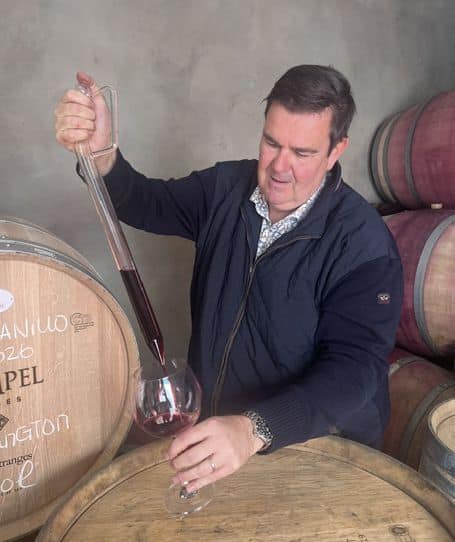
Tom Heeremans, who owns Tempel Wines along with his Latvian wife Tatjana Holkina, is one of a handsome contingent of Belgian vignerons in the Cape – I noted well over a dozen at the little Belgian Barrels Trade Festival last year. He has been making the wines himself since 2022 (confidently, but “still learning” and calling on advice when needed). All the wines are pleasingly restrained, and eminently drinkable at well below 14% alcohol.
The small farm is in perhaps the prettiest part of Paarl and provides only some (but a growing proportion) of the grapes for the wines. These are made with a keen eye on the international trade that accounts for some 85% of business – so the rather nice Sorgvry cinsault is being discontinued, as it doesn’t sell well. What does sell, accounting for half of Tempel’s production, is chenin and, less expectedly, tempranillo. Coming off a heritage Wellington vineyard, planted in 1985, the always good chenin, Kattemaai (all the wines have charming Afrikaans-Dutch names), can send different signals, however. Snap up the current 2023 for a rather delicately charming and fresh version, and the upcoming 2025 for a rather richer and riper one with a touch of pineapple.
Most of the wines bar the attractive, easy-going shiraz-based blend Blydskap sell for R325 off the farm or via the website. Oogwink 2022 is a tasty, pure-fruited and succulently dry Paardeberg shiraz, but the most interesting of the reds to me is the 2023 Tydsaam Tempranillo, the flagship wine at R395. From home-grown and brought-in Wellington fruit – with a touch of Paarl carignan for soft florality, says Tom – it’s destemmed and has some new oak in its 15 months in barrel. Rather fragrant, with a varietal tomato-leaf note, it has some complexity and elegance, the tannins supple. A decent buy, and something pleasingly unusual.
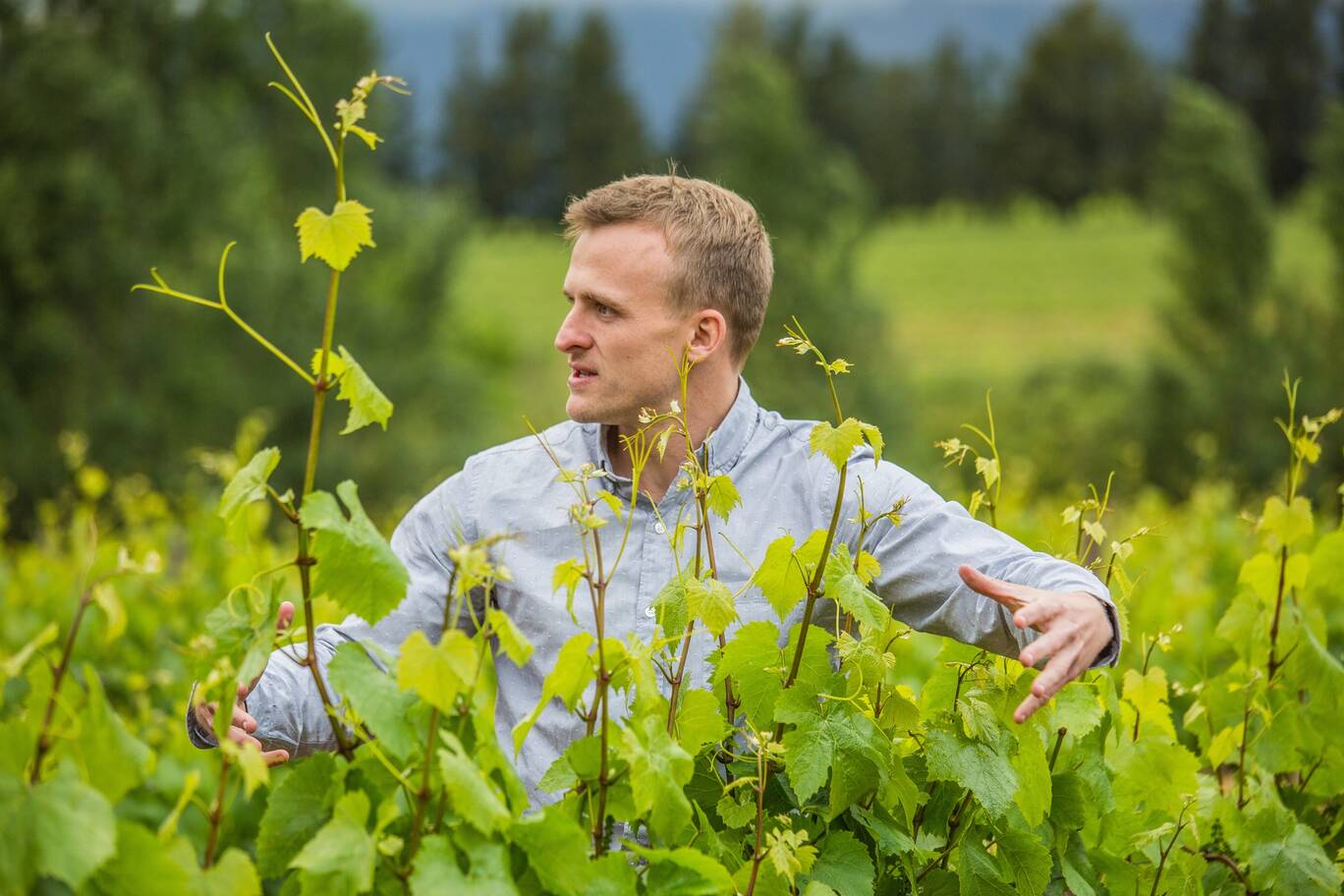
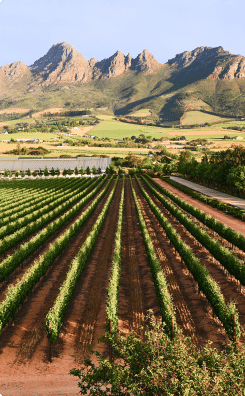
Across the appellation, on the Paarl slopes of the Simonsberg, Kristopher Tillery has been gradually assuming full control of winery and vineyards since his parents (Americans well established in Nigerian agriculture) acquired the farm in 2006. They subsequently enlarged and developed it, while relying on expert consultants. Kristopher, Harvard-trained in economics and sustanable development and now in his early 40s, gradually acquired something more than competence and started to move things in the directions he wanted: towards organic farming in the vineyards and a lighter, fresher and more elegant style in the winery.
Speaking of the radical changes, which lost a few customers who enjoyed the bigger, riper, more flamboyant approach, while gaining new ones, Kristopher says: “I can do it because I want to do it. If I had shareholders it would be different.” The vineyards now have wildlife corridors, making them interspersed with renosterveld, blurring, as Kristopher says, the boundary between “wildness and agriculture”. The farm and winery acquired full organic certification in 2023 and is now a member of the burgeoning Organic Wines South Africa. And the only real struggle he has found is all the paperwork. There are three distinct organic jurisdictions – USA, Europe, and Japan – and they have differing requirements that must be met by imported wines claiming to be organic, meaning that a local organic producer like Noble Hill must meet the most stringent of the demands in all respects.
The results, especially since he took on the winemaking himself a dozen years ago, are impressive. This was very evident in the vertical tasting he put on for me last week showing what has been done over the years on the estate with syrah (which occupies the largest area of the farm’s vineyards). We began with Shiraz 2005, the name changing to Syrah in 2009. The earliest vintages showed ripe power and sweetness, with even the 2005 still drinking well. The years after the arrival of Bernard le Roux in 2010 from Vilafonté show perhaps a great technical mastery, with a little more freshness and succulent balance, while continuing the ripely rich approach. They are all really nice wines for drinking now (but no hurry).
Kristopher’s first vintage in charge of the winemaking was 2014 – he was also by then fully involved in the vineyards, gaining confidence. 2015 is something of a standout in this period, the light-feeling elegance reflecting both earlier picking and a gentler approach in the winery. Then, in 2018, it mutated into Field Atlas (now at last in a more traditional burgundy bottle). Tasting it for Platter Guide a few years later I called it “a winningly bright, perfumed blend of syrah with 7% mourvèdre and 2% viognier. Quite lightly but deftly structured; fresh, flavourful & lively…. Half matured in oak (10% new), half in concrete.”
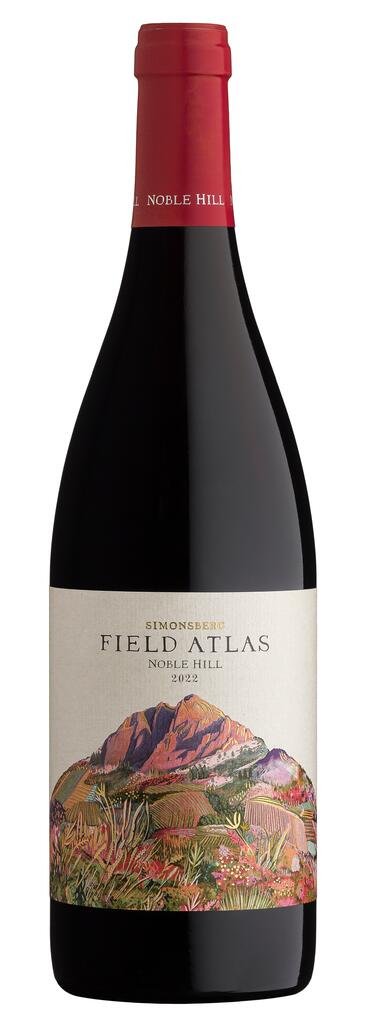 The 2021 went experimentally a bit too far in the direction of lightness – it’s a touch insubstantial. But things pulled themselves together for the very pleasing 2022, from syrah, mourvèdre, viognier and grenache, that I welcomed a few months back as giving remarkable value at R150 (R149, in fact, on the Noble Hill website). As I said then, it’s handsome, well structured, dry, lipsmacking and with some depth of flavour.
All the Noble Hill wines are well worth exploring and are all good value. But I must just mention again the fine single vineyard chenin – called Simonskop (the priciest wine in the range at R360), bearing the same beautiful painting of that mighty peak as on the Field Atlas label (the other wines’ labels show various old keys). And the Estate Reserve bordeaux-style blend (five varieties, five keys on the label), which I have greatly admired and enjoyed for its modest elegance – the current 2022 shows that character and is another remarkable bargain at R220.
If you need another inducement to visit Noble Hill, if you can, note that the restaurant has been recast from its former focus on Californian-Mexican to a more traditional wine-friendly bistro approach. Though the delicious Chicken Marbella I had (following a possibly even more delicious whipped feta with fresh herbs from the estate garden) is evidence, perhaps, of a continued American touch in the kitchen as well as of very sound cooking. The rebuilding of the restaurant will be finished soon – and other good news is that the end is in sight for the lengthy and deeply troublesome roadworks on what will now be a fine highway between Klapmuts and Simondium.
So all is well at Noble Hill, and Kristopher admits, with great justification I think, looking back at the directed commitment of his work over the past two decades, that “I’m getting to a place where I’m happy”.
- Tim James is one of South Africa’s leading wine commentators, contributing to various local and international wine publications. His book Wines of the New South Africa – Tradition and Revolution appeared in 2013.
-
Share:

Related articles
Opinion & Analysis
Tim James: Who really wins at wine auctions?
12 October 2026
The Strauss & Co wine auctions began in 2019, in good time to benefit, as is clear in retrospect, from the pandemic that was soon to hit us. The stated...
6
Opinion & Analysis
Tim James: Why do we drink? And why do I?
5 October 2026
We all drink alcohol, it’s surely fair to say (unless there are some teetotal voyeurs – liseurs? – readingthis; “we” being the readers, extended to “people generally”). But why? That’s...
Opinion & Analysis
Tim James: A visit to Callie Louw’s Sonkop
28 September 2026
Fans of Callie Louw – there are many, and I think “fan” is the right word – will be pleased to know that all is going well at his new...
Johan Smuts | 26 August 2026
The accommodation at Tempel Wines is also top notch. Well done Tom and Team.