
Tim James: Why do we drink? And why do I?
By Tim James, 5 October 2026
-
Share:




We all drink alcohol, it’s surely fair to say (unless there are some teetotal voyeurs – liseurs? – reading
this; “we” being the readers, extended to “people generally”). But why? That’s my first question, and
it’s easier to answer, strangely enough, in the first person plural: why do we (human beings) drink
alcohol, than it is in the first person singular: why do I (this particular human being) drink alcohol?
The harder, messier bit I shall return to later. As to why people drink alcohol (to the despair of many,
including the World Health Organisation, which says it’s an unsafe practice at any level of
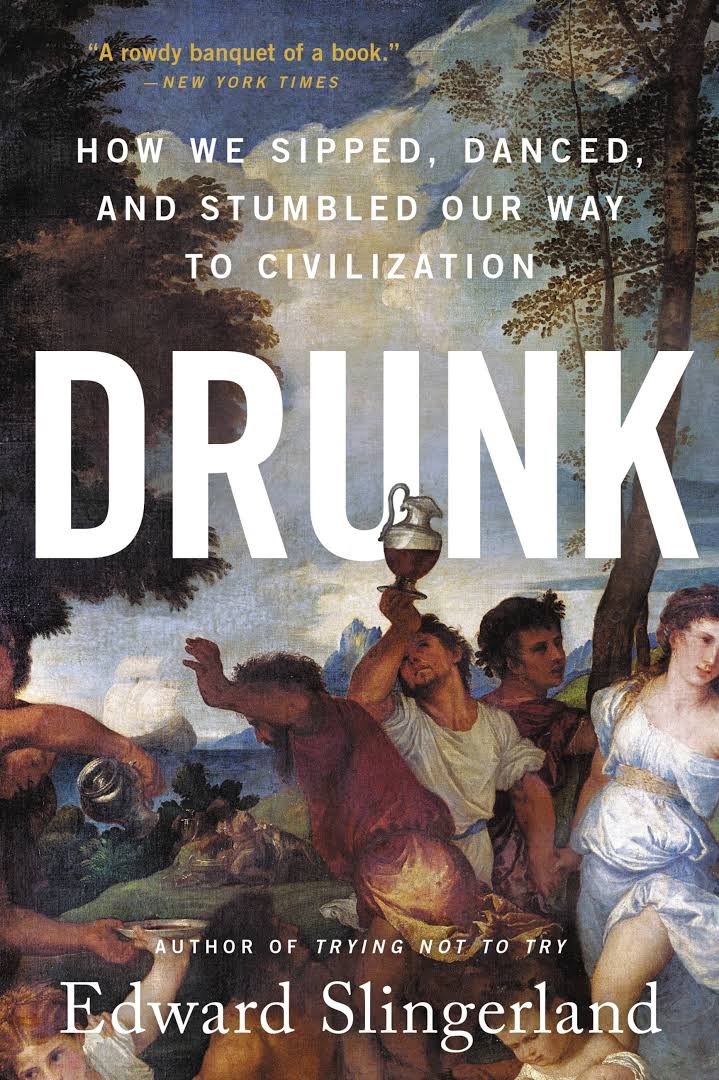
consumption) – well, I’m convinced by the answers summarised and articulated by Canadian
philosopher Edward Slingerland in his 2021 book called Drunk (subtitled How we sipped, danced, and
stumbled our way to civilization).
I’ve just re-read the book, which I reviewed mostly favourably back in 2023 – have a look there if you
didn’t see it and would like to know more of Slingerland’s arguments and marshalling of the evidence.
Basically, he confronts two facts: first, the overwhelmingly widespread use of alcohol (ahead of a
range of other intoxicants) throughout human history; and, second, the often appalling effects of
alcohol abuse in at least modern society, abuse that’s both social and individual. Given the latter, why
did human evolution allow for and even encourage the former? Why have many governmental
attempts to prohibit its usage seemed doomed to fail?
Because, Slingerland argues (with recourse to everything from pre-history to the structure of the brain
– the need to “dial down the prefrontal cortex”), intoxicants have been crucial to the development of
humans as creative, cultural and communal animals – as well as providing us with comfort and
pleasure.
That’s a very brief summary of his conclusions. As I wrote in my original review, I was convinced by
this argument, and also accepted his uncompromising description of the “dark side of Dionysis” that
seems to have emerged comparatively recently in human history.
Given this evolutionary usefulness, why are there a few societies that don’t have recourse to alcohol,
cannabis, peyote buttons and other hallucinogens and psychedelics? (It seems to have been only
North America where there was historically no use of nature’s escapist and bonding bounty.) This
needs local investigation, which usually reveals other social equivalents – religious ecstasy and
bonding and the like (Trump’s MAGA rallies, perhaps, it occurs to me, in puritanical America).
Fair enough, and that leaves only the question about individual participation or avoidance in drinking.
We here probably know more imbibers than total abstainers, but I’m sure we know some of those.
And we know in some cases that they they are there because they have been badly damaged by
over-indulgence (another recent re-read of mine has been A A Gill’s splendid autobiographical book
Pour Me, which rather entertainingly details the hell of his addiction before he went straight). And we
know in some cases of the substitutes people have. Many people don’t even seem to manage to be
miserable bastards without the occasional drink.
In fact, one of the most excoriated categories of alcohol consumer these days is the solitary drinker –
unaffected, as Slingerland argues, by the subtle social controls generally exercised by communal
consumption, on a large level as still lingers on in cultures like those of the European Mediteranean
countries, or the dining table or pub everywhere. Google the category and you find any number of
warnings, and the images show a lot of the truly miserable, lonely bastards (mostly men) huddled
over their glass or bottle.
I myself do a significant proportion of my wine-drinking solo, almost inevitably around my evening
meal. Worse, these days it usually includes a bit of brandy – and the advent of distillation, giving
unprecedentedly alcohol drinks, is something Slingerland (and no doubt many others) gives some
blame to regarding modern society’s alcohol problems. So perhaps the obvious answer to the
question of why I drink is simply that I’m an old drunk (in the company of the larger part of the wine
industry, in my experience – where usually it’s communal rather than solitary wine-drinking that
obtains, sometimes to the point of leaving me aghast – and comparatively sober).
It doesn’t feel like being simply an old drunk from the inside, and I haven’t had to deal with many
accusations. I seldom get obviously drunk, I’d say, either with others or alone, but admittedly
sometimes there’s more of a buzz than at others, and I certainly enjoy a degree of the buzz. I have
also frequently found that I’m more creative when the buzz is on. I tend to then write a bit more
loosely and uninhibitedly and thoughts flow more interestingly, to the writing’s benefit – though I have
learnt that it’s wise to check my spelling and syntax the next morning. But that’s not a reason, more an
occasional side-benefit. Good wine is pretty delicious and interesting once you’ve got the taste for it,
of course, and that is obviously part of the reason. But probably not all that much more seriously so
than the great world of tea, for example, though more extensive and various.
In the old days of my comparative youth, when I heard of someone’s disease of whatever kind
demanding the total cessation of alcohol consumption I would shudder with horror at the very idea.
Strangely, perhaps, now I think I could cope without alcohol – though I would most certainly not do so
willingly. It seems such an important part of my mealtime, whether a simple or more complex wine
and/or meal. Could I imagine doing as – still, apparently – many American adults and children do, and
have milk or “soda” with my meal? I think not. Or just water? (The aforementioned AA Gill managed,
after all, to be a serious restaurant critic after renouncing alcohol.) Beer, though, can be great,
including my beloved no-alc version Devils Peak Hero. Which reminds me, no also to no-alc wine until
it improves a whole lot (see Jamie Goode’s current piece). Wine, proper wine, retains its supreme
place, even – or arguably especially – for the solitary diner.
- Tim James is one of South Africa’s leading wine commentators, contributing to various local and international wine publications. His book Wines of the New South Africa – Tradition and Revolution appeared in 2013.
-
Share:

Related articles
Opinion & Analysis
Tim James: A visit to Callie Louw’s Sonkop
28 September 2026
Fans of Callie Louw – there are many, and I think “fan” is the right word – will be pleased to know that all is going well at his new...

4
Opinion & Analysis
Tim James: America has discovered Chenin. Again.
21 September 2026
Something like “The Great Chenin Blanc Renaissance” has been a common article title here for a few decades now. But the one published recently on Wine-searcher was primarily about America. There,...
Opinion & Analysis
Tim James: The impossible task of picking SA’s Top 10 Chenins
14 September 2026
Have we hacks all written enough, not to say ad nauseum, about the glories of the Cape’s chenin blancs? I can’t think I have much more to say about it,...
Comments
0 comment(s)
Please read our Comments Policy here.